We compared required GSM, finished GSM, after-wash GSM, shrinkage and spirality for every sample and development batch a working knit dye house finished recently. The fibre in the yarn predicts a lot more than most mills plan for.
At a glance
14,262Batches finished
16,329Fabric parts measured
10Fibre families compared
1 millRecent production records
Every dyeing manager knows that lyocell is “difficult” and that CVC is “easy”. Very few can say how difficult, or where the difficulty shows up. This study puts numbers on it, using one mill’s finishing records: what GSM was required, what GSM came off the compactor, what happened when light fabric was washed, and how much the fabric shrank.
Key findings
- Half of all parts leave finishing more than 5% below required GSM (50%). The standard remedy is a wash, which fixes 66% of them. It works best on 100% cotton (75%) and least on CVC and PC, where 35% stay light.
- Regenerated cellulose is the hardest group. Only 17% of lyocell-blend parts finish within ±5% of required GSM, and only 23% of viscose parts keep length shrinkage within 5%.
- Polyester content stabilises the fabric. CVC and PC blends hit GSM 67% of the time, against 47% for 100% cotton, and 82% keep length shrinkage within 5%.
- Elastane makes GSM harder to hit. Adding elastane to cotton drops GSM accuracy from 47% to 29%. Cotton-elastane single jersey is the worst common fabric: 18%.
- Construction matters as much as fibre. 100% cotton waffle finishes a median -15% light. Pique shrinks 10% in length against 5% for single jersey.
- Some things we expected to matter did not. Organic and conventional cotton behaved the same. So did recycled-cotton blends. Results were steady from month to month.
Finding 1: half of all parts come off the compactor light, and a wash is the usual fix
Buyers accept finished GSM within ±5% of the required GSM. Across all 14,262 batches, 50% of fabric parts left normal finishing more than 5% below that, and only 4% were more than 5% heavy. Light fabric is by far the most common GSM problem on a knit finishing floor.
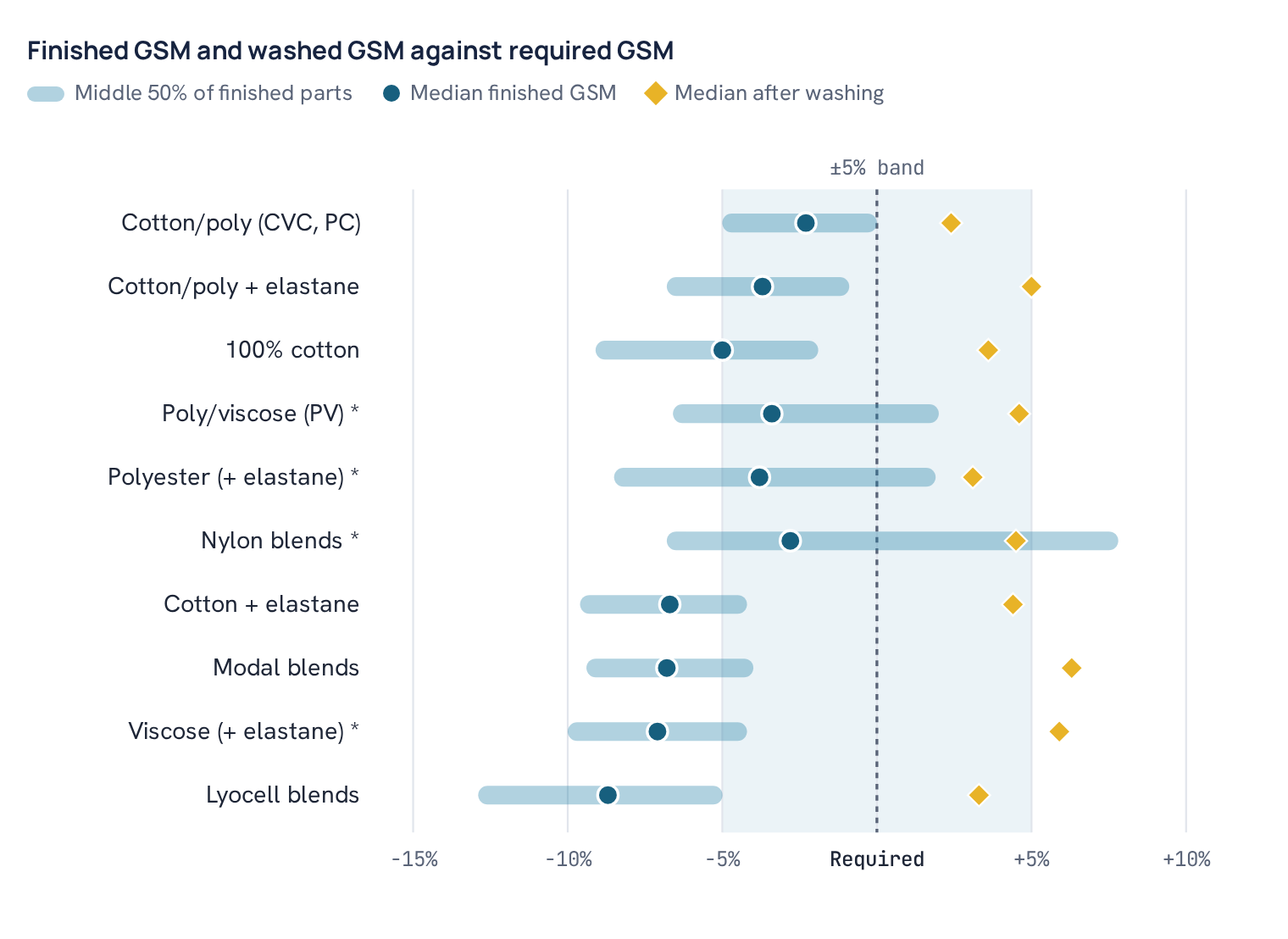
When a batch comes out light, the floor’s remedy is to wash it. Washing relaxes the fabric, it shrinks, the loops close up, and GSM rises. If the washed fabric is within tolerance, the batch is released with an instruction that it must be washed to reach the required GSM.
How often the wash fixes a light batch
Of the 7,903 parts that finished more than 5% light, washing brought 66% back within tolerance. 21% overshot and became more than 5% heavy, and 12% were still light. The median washed part gained 11.6% in GSM.
| Light parts by fibre family | Light parts | Median GSM gain from wash | Fixed (within ±5%) | Overshot (>5% heavy) | Still light |
|---|---|---|---|---|---|
| 100% cotton | 4,236 | +11.4% | 75% | 15% | 10% |
| Poly/viscose (PV) * | 62 | +10.0% | 60% | 24% | 16% |
| Cotton + elastane | 1,762 | +13.1% | 59% | 33% | 9% |
| Lyocell blends | 277 | +13.7% | 56% | 29% | 15% |
| Polyester (+ elastane) * | 72 | +7.9% | 56% | 11% | 33% |
| Cotton/poly (CVC, PC) | 683 | +8.0% | 54% | 12% | 35% |
| Cotton/poly + elastane | 168 | +11.1% | 52% | 24% | 24% |
| Modal blends | 286 | +14.6% | 45% | 47% | 8% |
| Viscose (+ elastane) * | 127 | +17.5% | 44% | 46% | 9% |
The wash works because the fibre shrinks, so how well it works depends on how much the fibre can shrink:
- 100% cotton gains about 11% and is fixed 75% of the time. This is where the remedy works best.
- CVC and PC gain only 8%, because the polyester does not shrink. 35% are still light after washing, so a light CVC batch needs a different fix.
- Viscose and modal gain 18% and 15%. Almost half overshoot and end up too heavy. Loose regenerated-fibre fabrics swing too far for the wash to be fine-tuned.
Polyester has no shrink property. In a CVC or PC fabric the polyester holds the structure, so the fabric cannot shrink, and washing changes the GSM very little. GSM only goes up when the fabric shrinks and the dia comes down. That is why a light CVC batch stays light after washing. The wash is not the fix for it.
Cotton-lyocell is the opposite. The fabric is very loose and shrinks a lot, so it goes heavy as soon as it is washed. You cannot really control that in finishing. What helps is heat setting the fabric before dyeing starts. That brings it under some control. If you wait until finishing, it is too late.
The real remedies are in development, before the fabric reaches the dye house: change the yarn count, or change the stitch length and knit the fabric a little tighter.
Finding 2: lyocell, viscose and modal are the hardest to control
The three regenerated cellulosic families sit at the bottom of every ranking. They finish lightest, they gain the most GSM when washed, and they shrink most in length.
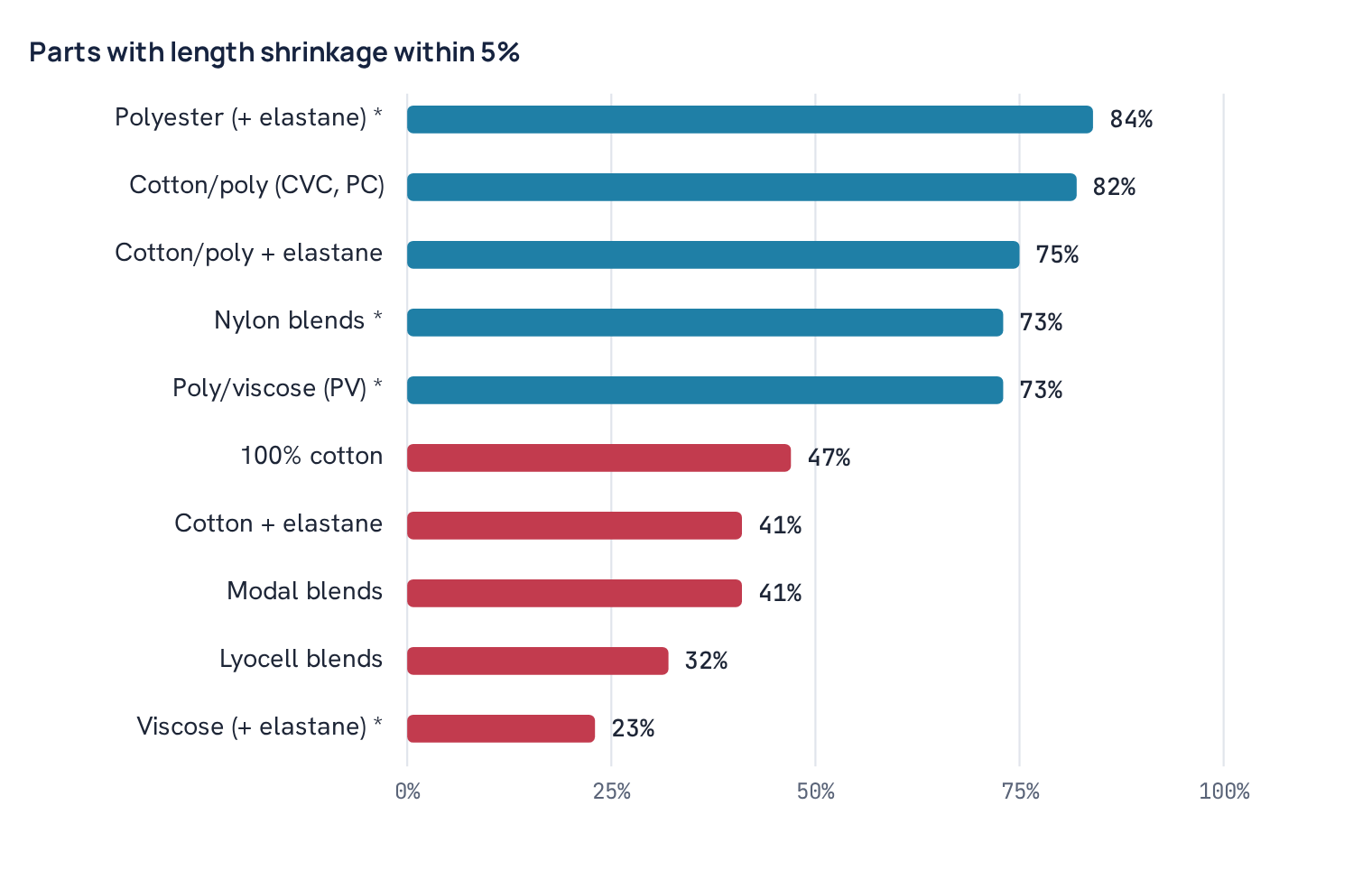
Viscose is the extreme case. Its median length shrinkage is 9%, and the worst tenth of parts shrink 14% or more. Lyocell blends have a median of 7% and a worst tenth of 12%. Wet regenerated fibres swell and lose strength, so they stretch in the wet process and then relax back when washed.
We do nothing special for lyocell or viscose. They are dyed and finished the normal way. After the stenter we check the parameters. If the length has grown or the width has come down, or the fabric needs some other correction, we set the compactor to adjust for it and then run the fabric. That is all.
Finding 3: polyester content makes fabric predictable
Add polyester to cotton and the fabric becomes much easier to finish on target. CVC and PC blends lead the GSM ranking with 67% of parts within ±5%, and only 25% more than 5% light. Median length shrinkage falls from 6% for 100% cotton to 4%. Polyester does not swell in water, so it holds the loop structure while the cotton relaxes.
The effect is strongest in heavy fabrics. CVC fleece and terry hit GSM 74% of the time, the best result of any fabric type in the study.
In solid shades, both fibres are dyed: the polyester with disperse dyes and the cotton with reactive dyes. For a melange effect, only one part is dyed, either the polyester or the cotton, and the other is left undyed.
Solid and melange CVC behave the same for GSM and shrinkage. Whether you dye both parts for a solid shade or only one part for a melange effect has nothing to do with shrinkage. Polyester shrinkage is usually good. It is almost never the problem.
Finding 4: elastane costs GSM accuracy
Almost every elastane fabric in the study was heat set (97% of cotton-elastane parts). Even so, adding elastane to cotton cuts GSM accuracy from 47% to 29%, and the GSM gain from washing grows from +3.6% to +4.4%. Single jersey is hit hardest: only 18% of cotton-elastane single jersey parts finish within ±5%, with a median of -7.2%.
For cotton-elastane fabric the normal heat-setting temperature is 180 to 190 °C. We heat set Lycra fabric to control its stretch, which is normally very high. Machine speed depends on the fabric. At a higher temperature the speed can be higher; at a lower temperature the speed has to be lower.
Speed sets the dwell time. Higher speed means less time in the heat and a weaker heat-setting effect. Lower speed means more time and a stronger effect.
High stretch is where light GSM comes from. When the fabric is stretched on the stenter, the width grows, the length can grow and the loops open out. The weight stays the same, but it is spread over a larger area. 100 g of fabric on 0.50 m² is 200 GSM. Stretch it to 0.60 m² and it reads 167 GSM. Stretching does not remove weight; it spreads it. If you set the fabric over-width during heat setting, it comes out light and too wide. How much it recovers when it relaxes depends on how well it was heat set.
Finding 5: construction matters as much as fibre
Within 100% cotton, the fabric structure changes the result a lot:
| 100% cotton fabric type | Batches | Median finished GSM vs required | Within ±5% | Median length shrinkage | Median width shrinkage |
|---|---|---|---|---|---|
| Single jersey | 4,906 | -5.0% | 46% | -5% | -2% |
| Rib / interlock | 939 | -4.4% | 50% | -7% | -4% |
| Fleece / terry | 885 | -4.5% | 50% | -8% | -2% |
| Pique | 439 | -5.8% | 39% | -10% | -2% |
| Waffle | 111 | -15.1% | 23% | -8% | -10% |
Waffle is the outlier: a median of -15% light and 10% width shrinkage. The raised cells of a waffle open out when the fabric is pinned to width on the stenter. Pique shrinks most in length (10%) because its tuck loops relax after washing.
To finish waffle, do not pull the dia at all, neither plus nor minus. Do not give any overfeed or underfeed in length. Run it through a relax dryer. Only then do you see the fabric’s real shrinkage and GSM.
If that GSM is off, fix it in knitting by changing the stitch length or the count. Do not play games with it in finishing. If you try to correct waffle in finishing, the shrinkage will not come right.
Finding 6: what did not matter
- Organic vs conventional cotton. 2,776 organic batches and 4,653 conventional batches finished with the same median GSM (-5.0%) and the same length shrinkage.
- Recycled-cotton blends. 326 batches, median GSM -4.4%, in line with the whole data set.
- Month of production. The share of parts within ±5% of required GSM stayed within a few points from month to month.
- Spirality. The median was 2% for every fibre family, and almost every part stayed within 4%.
Full results by fibre family
| Fibre family | Batches | Median finished GSM vs required | Finished within ±5% | Median washed GSM vs required | Median length shrinkage | Worst 10% length | Median width shrinkage | Median spirality | Heat set |
|---|---|---|---|---|---|---|---|---|---|
| Cotton/poly (CVC, PC) | 2,514 | -2.3% | 67% | +2.4% | -4% | -7% | -2% | 2% | 29% |
| Cotton/poly + elastane | 345 | -3.7% | 49% | +5.0% | -4% | -7% | -2% | 2% | 89% |
| 100% cotton | 7,429 | -5.0% | 47% | +3.6% | -6% | -10% | -2% | 2% | 34% |
| Poly/viscose (PV) * | 135 | -3.4% | 41% | +4.6% | -4% | -10% | -2% | 2% | 75% |
| Polyester (+ elastane) * | 166 | -3.8% | 38% | +3.1% | -3% | -7% | -2% | 2% | 79% |
| Nylon blends * | 40 | -2.8% | 36% | +4.5% | -4% | -8% | -2% | 2% | 78% |
| Cotton + elastane | 2,355 | -6.7% | 29% | +4.4% | -6% | -10% | -2% | 2% | 97% |
| Modal blends | 374 | -6.8% | 27% | +6.3% | -6% | -10% | -4% | 2% | 89% |
| Viscose (+ elastane) * | 164 | -7.1% | 25% | +5.9% | -9% | -14% | -2% | 3% | 76% |
| Lyocell blends | 300 | -8.7% | 17% | +3.3% | -7% | -12% | -3% | 3% | 77% |
Shrinkage is shown as negative when the fabric got shorter or narrower. * fewer than 200 batches, so read with care. Nylon blends have only 40 batches.
What this means on the floor
- Fix GSM in knitting, not in finishing. If a fabric keeps finishing light or heavy, change the yarn count or the stitch length. Forcing GSM in finishing costs you shrinkage.
- Do not count on a wash to rescue light CVC or PC. Polyester does not shrink, so washing adds very little GSM. Get the construction right before bulk.
- Heat set loose and stretch fabrics before dyeing. Cotton-lyocell and elastane fabrics are brought under control by heat setting at the start. By finishing it is too late.
- Never over-width on the stenter. Stretching spreads the same weight over more area, so the fabric reads light and too wide, and it may not come back.
- Relax-dry waffle with no dia pull and no overfeed. Measure its real GSM and shrinkage first, then correct it in knitting.
Methodology
- Source. Finishing and shrinkage records from one knit dyeing and finishing unit, recent production. 16,329 fabric parts from 14,262 batches. A batch with body fabric and rib counts as two parts.
- Batch type. The records cover sample, pre-production and development batches, not bulk production.
- Fibre family. Assigned from the yarn description on each record (for example “24/1 CVC 60/40” or “30/1 CB + 20D Ly”). 13,820 batches could be placed in a family; the rest had unclear or unusual yarn descriptions and are left out of the family results.
- Measurements. Required GSM and finished GSM as recorded by the finishing section. Washed GSM, length and width shrinkage and spirality from the mill’s wash test.
- Cleaning. GSM readings outside 60–800 g/m², shrinkage beyond ±40% and spirality beyond ±20% were treated as entry errors and excluded.
- Privacy. No buyer, style, order or batch number is published. Results are shown only as totals and medians.
- Limits. One mill, one recent period, one set of machines. Other mills will see different numbers, but we expect the ranking between fibre families to hold.

Textile engineer with 14+ years in dyeing and fabric development. He writes every guide on Dyeing Solution from real production work. Full profile