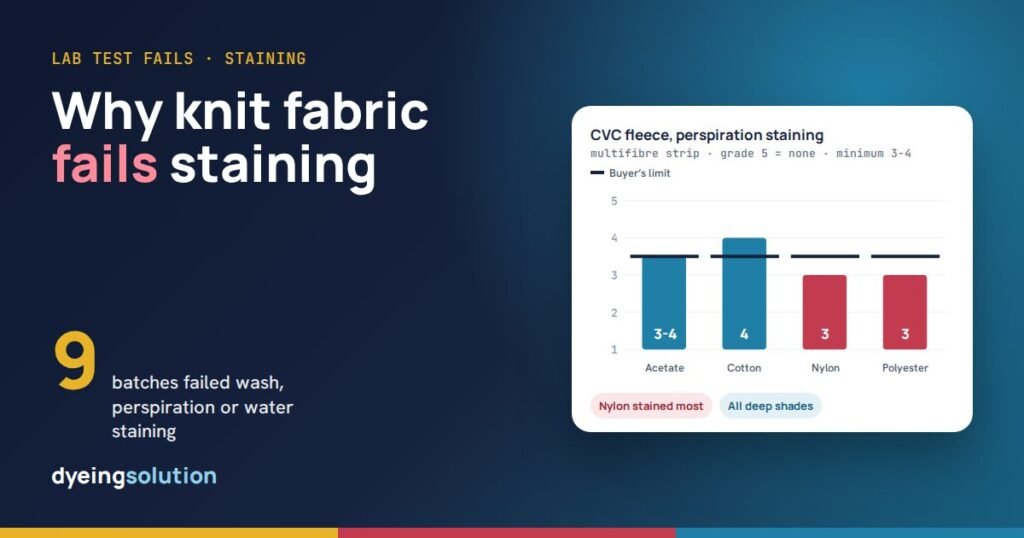
Over 95 new fabric developments, each one tested in the lab, staining failed 5 times in perspiration, 4 times in washing and 2 times in water fastness, on 9 batches, all deep shades. Here they are case by case: how each was knitted, dyed and finished, which fibre took the stain, and the cause and remedy.
About this series. These findings come from 95 development batches: new and uncommon knit fabrics such as CVC waffle, three-thread fleece, ottoman rib and Lycra interlock. Each batch was knitted, dyed and finished as a development sample, then tested by an accredited lab to the buyer’s standard. When a test failed, we found the actual cause on the floor and changed the next batch until it passed.
At a glance
9Batches failed staining
8 of 9Contained polyester
NylonMost stained fibre
3-4Most common minimum
How the lab tests staining
A colour fastness test checks two things: how much the fabric’s own colour changes, and how much colour it gives off onto other fabrics. For the second, the specimen is sewn to a multifibre strip, a woven strip with bands of acetate, cotton, nylon, polyester, acrylic and wool, and put through the test. Each band is then graded against the grey scale for staining, from 5 (no staining) to 1 (heavy staining).
- Washing (ISO 105-C06): washed for 30 minutes at 40°C in a reference detergent with steel balls for mechanical action.
- Perspiration (ISO 105-E04): soaked in artificial acid and alkaline sweat, pressed between plates and kept at 37°C for 4 hours.
- Water (ISO 105-E01): the same as perspiration, but with plain water.
Most buyers ask for staining 3-4; some ask for 4.
What stains, and why
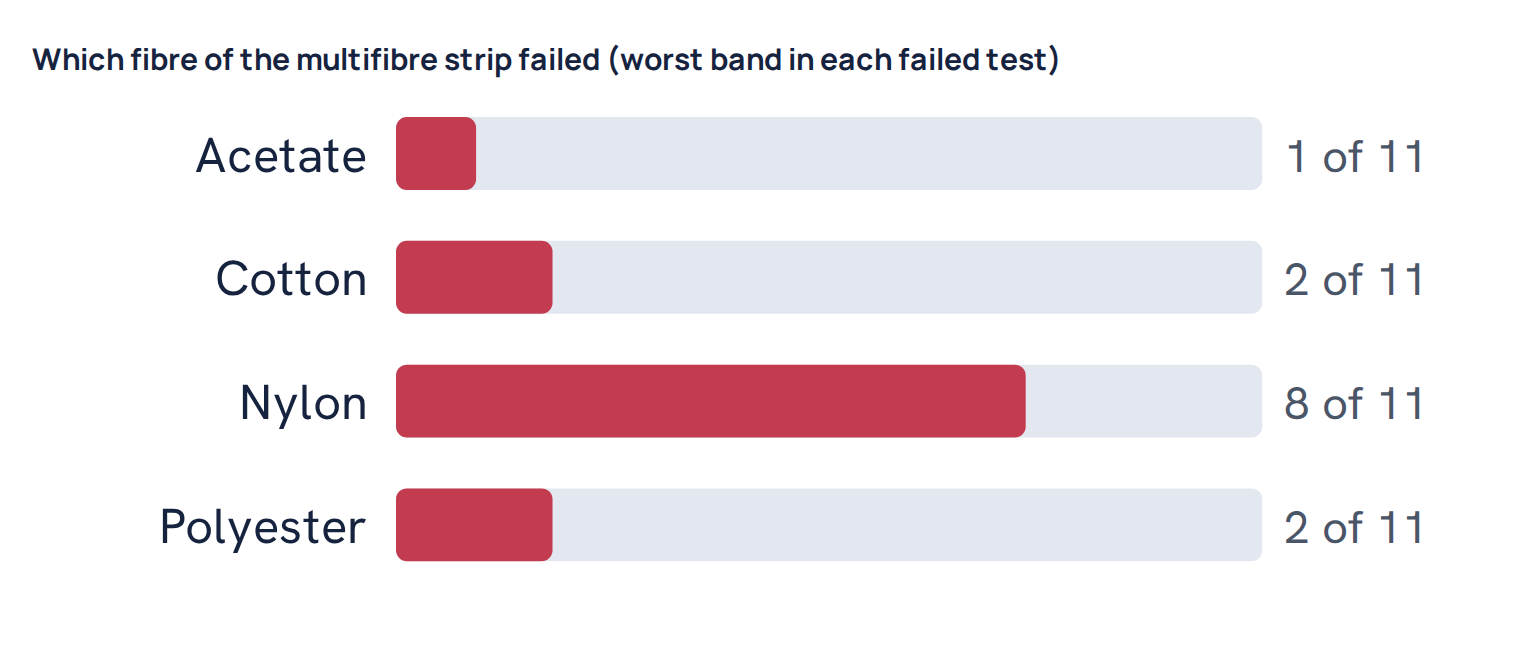
Nylon failed most often. In a cotton-polyester fabric, nylon, polyester and acetate pick up the disperse dye that comes off the polyester part; in a cotton fabric, nylon and cotton pick up loose reactive dye. Every failed batch was a deep shade: black, near black, dark brown or royal blue.
| Fabric | Failed a staining test |
|---|---|
| With polyester | 8 of 28 |
| Without polyester | 1 of 39 |
The cure is in the wash-off, the reduction clearing and the finishing temperature. The same process that gets wet rubbing to grade 3 also passes these tests.
How to read each case
Each case shows the fabric as it was knitted, the route it took through dyeing and finishing, the staining on each band of the multifibre strip against the buyer’s minimum, and the cause and remedy. Where more than one test failed, each has its own chart.
Rib: 1 case
Rib is a stable double knit. It is heat set only when heavy, tight, Lycra body rib or a design rib that needs its width fixed.
Case 1: Double ottoman rib, 350 GSM, wash staining
- Yarn: 26/1 CVC 60/40
- Fibre (declared): 60% Cotton 40% Polyester
- Stitch length: 37+35.5+21+18.5
- Machine: 34″ × 18G
- Required: 160 cm, 350 GSM
- Finished: 162 cm, 371 GSM
Lab test: Washing (ISO 105-C06)
Route: Greige → Slitting → Heat setting → Back sewing → Dyeing → Stenter → Compacting
Results
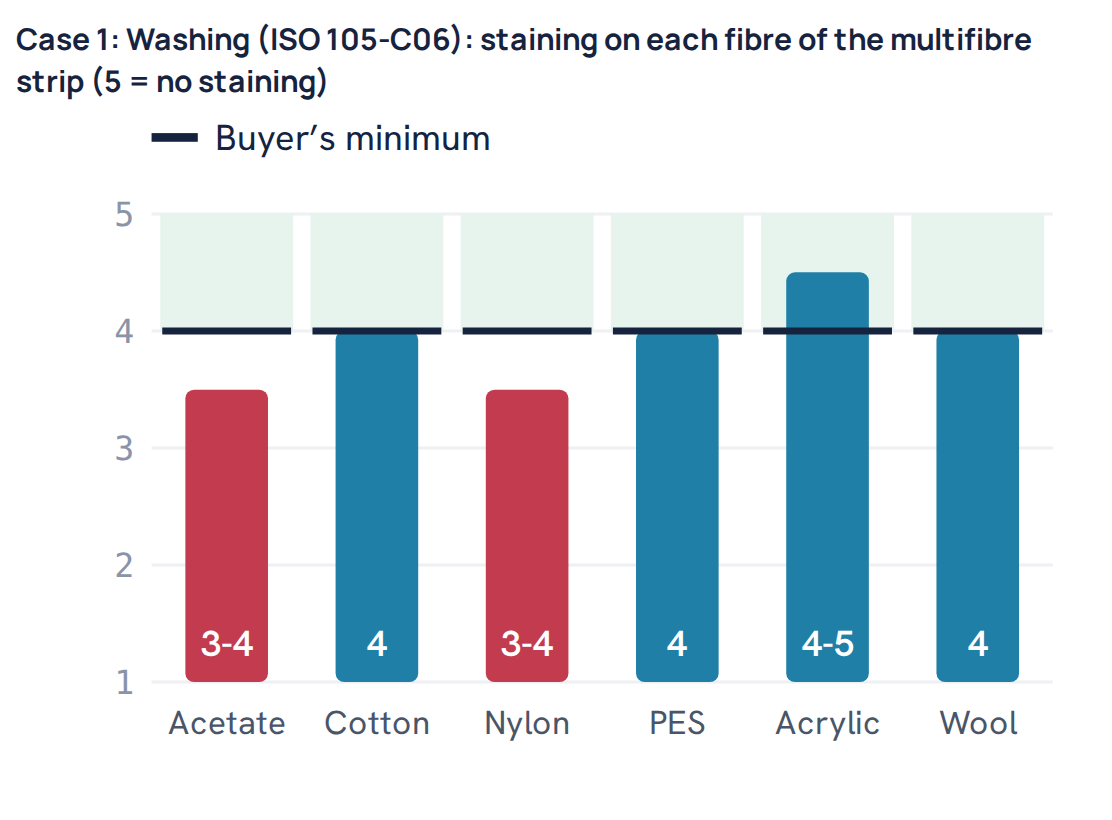
- Wash: worst staining: 3-4
- Wash: minimum: 4
- Colour change: 4
Other tests that failed in the same lab report: GSM.
Cause and remedy
Cause: The stain went mostly onto acetate, nylon in the multifibre strip. Those fibres take disperse dye, so the colour that came off was disperse dye from the polyester part, left on the fibre surface after dyeing.
Cause: It is a deep shade, and deep shades carry the most loose dye.
Remedy: Reduction clear the polyester part twice after disperse dyeing, then wash clear, before the cotton part is dyed.
Remedy: Dry and finish at 100–110°C on the stenter and compactor. Hotter than that, disperse dye moves back to the fibre surface and bleeds in the test, however well it was cleared.
Remedy: Use the longer wash-off for deep shades: two soapings at 80°C, hot washes at 70°C and 60°C, a bleed check on a sample against white fabric, then fixing and a final wash clear.
Interlock: 1 case
Interlock is a stable double knit; Lycra interlock is always heat set to fix the stretch and width.
Case 2: Lycra interlock, 280 GSM, perspiration and water staining
- Yarn: 40/1 cotton + 20D Lycra dyeable
- Fibre (declared): 95% Cotton 5% Elastane
- Stitch length: 29.5
- Machine: 38″ × 24G
- Required: 190 cm, 280 GSM
- Finished: 169 cm, 265 GSM
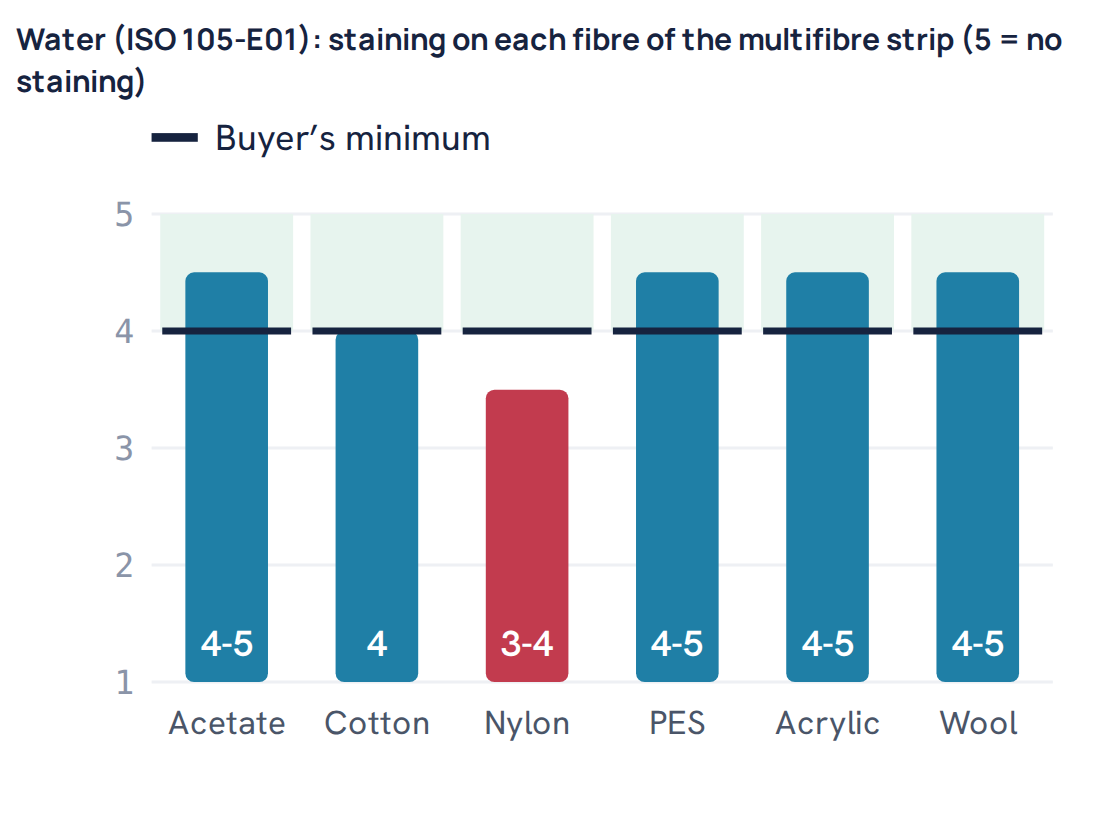
Lab test: Perspiration (ISO 105-E04); Water (ISO 105-E01)
Route: Greige → Slitting → Heat setting → Back sewing → Dyeing → Stenter → Compacting
Results
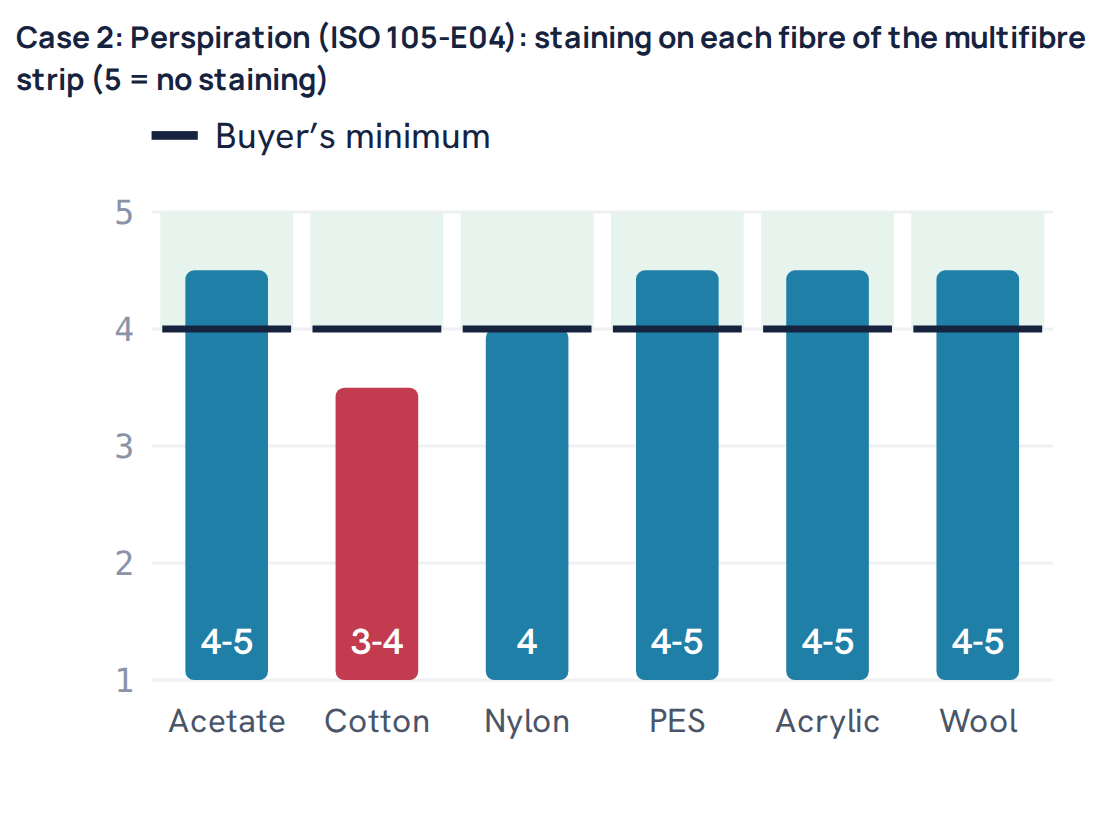
- Perspiration: worst staining: 3-4
- Perspiration: minimum: 4
- Water: worst staining: 3-4
- Water: minimum: 4
- Colour change: 4
Other tests that failed in the same lab report: Shrinkage, Rubbing fastness, Water fastness.
Cause and remedy
Cause: The stain went onto nylon. Nylon picks up loose reactive and direct dye easily in a wet test, so it is often the first fibre to fail on a deep cotton shade.
Cause: Cotton in the strip was stained, which means unfixed reactive dye was still in the fabric and came off in the wet test.
Cause: It is a deep shade (black, 9% shade), and deep shades carry the most loose dye.
Remedy: Use the longer wash-off for deep shades: two soapings at 80°C, hot washes at 70°C and 60°C, a bleed check on a sample against white fabric, then fixing and a final wash clear.
Waffle: 3 cases
Waffle is a loose texture knit: no enzyme, singed when a clean face is needed, and its GSM must be checked after washing.
Case 3: Tuck waffle, 290 GSM, wash staining
- Yarn: 30/2 ply CVC 60/40
- Fibre (declared): 60% Cotton 40% Polyester
- Stitch length: 40+31
- Machine: 42″ × 14G
- Required: 125 cm, 290 GSM
- Finished: 132 cm, 290 GSM
Lab test: Washing (ISO 105-C06)
Route: Greige → Slitting → Heat setting → Back sewing → Dyeing → Stenter → Compacting
Results
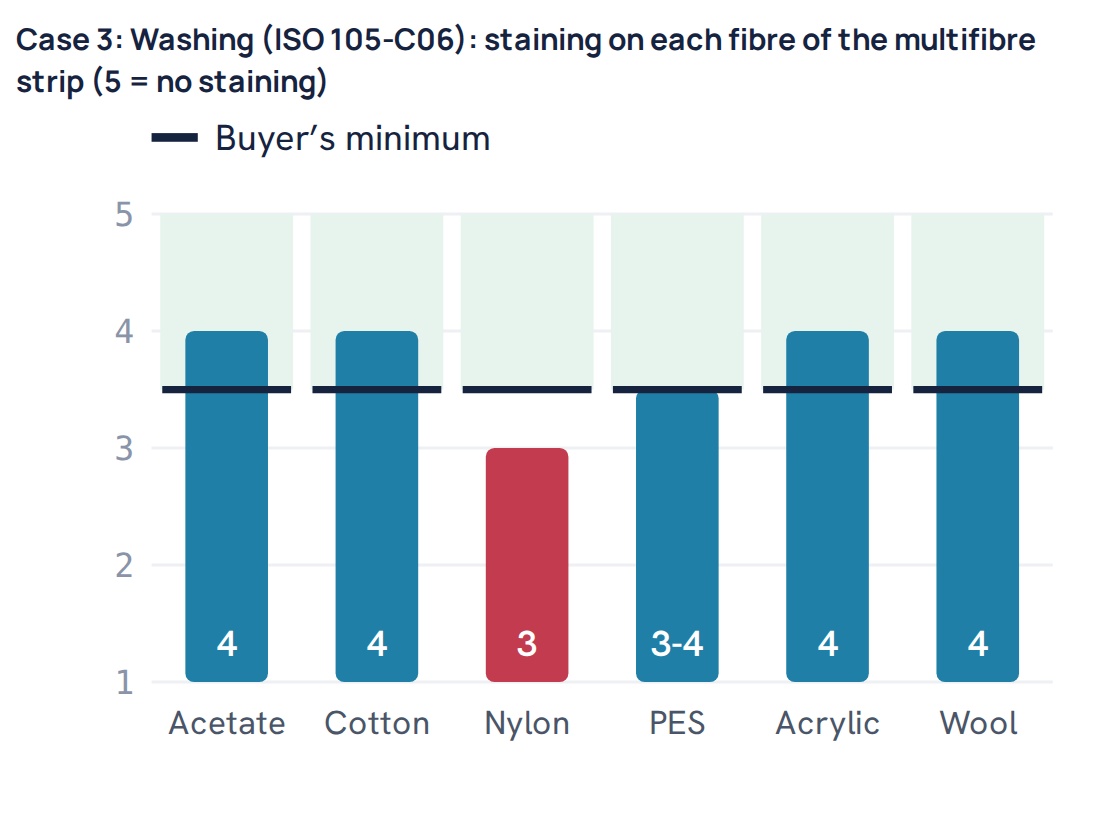
- Wash: worst staining: 3
- Wash: minimum: 3-4
- Colour change: 4
Other tests that failed in the same lab report: none.
Cause and remedy
Cause: The stain went mostly onto nylon in the multifibre strip. Those fibres take disperse dye, so the colour that came off was disperse dye from the polyester part, left on the fibre surface after dyeing.
Cause: It is a deep shade, and deep shades carry the most loose dye.
Remedy: Reduction clear the polyester part twice after disperse dyeing, then wash clear, before the cotton part is dyed.
Remedy: Dry and finish at 100–110°C on the stenter and compactor. Hotter than that, disperse dye moves back to the fibre surface and bleeds in the test, however well it was cleared.
Remedy: Use the longer wash-off for deep shades: two soapings at 80°C, hot washes at 70°C and 60°C, a bleed check on a sample against white fabric, then fixing and a final wash clear.
Case 4: Waffle, 220 GSM, perspiration and wash staining
- Yarn: 34/1 CVC 60/40
- Fibre (declared): 60% Cotton 40% Polyester
- Stitch length: 28.5+18.0
- Machine: 38″ × 18G
- Required: 145 cm, 220 GSM
- Finished: 148 cm, 210 GSM
Lab test: Perspiration (ISO 105-E04); Washing (ISO 105-C06)
Route: Greige → Slitting → Heat setting → Back sewing → Dyeing → Stenter → Compacting
Results
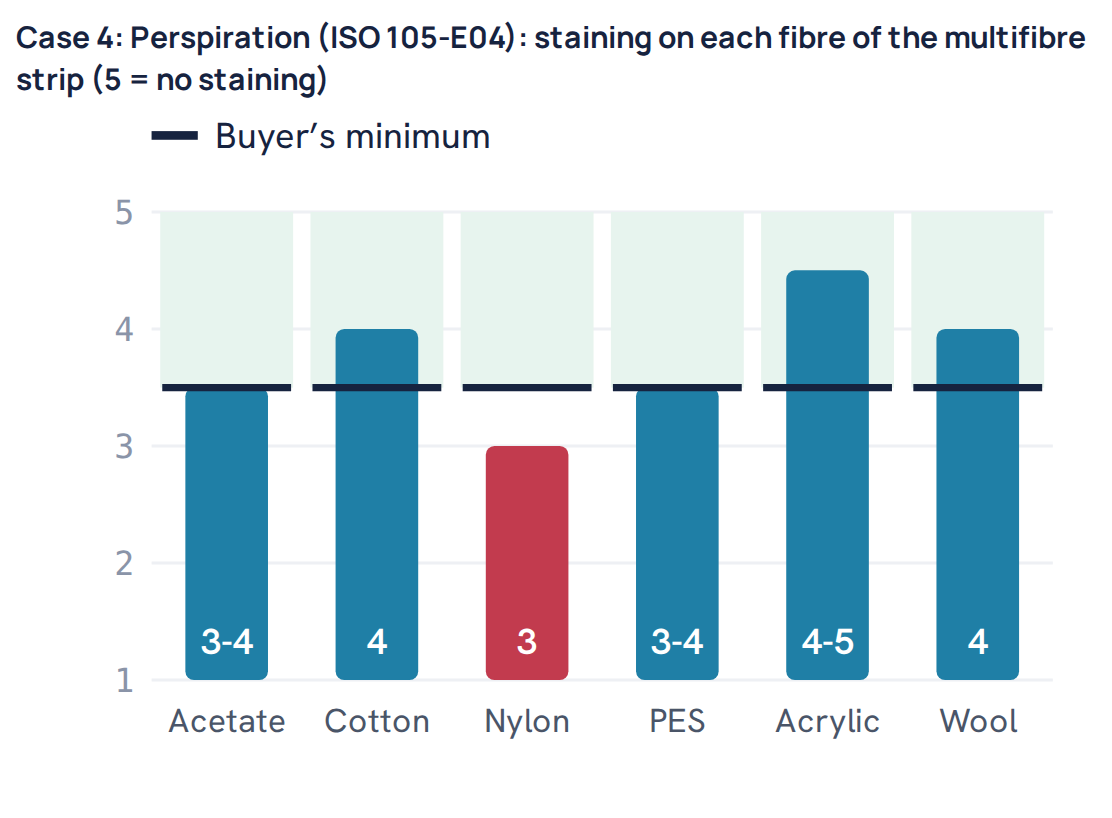
- Perspiration: worst staining: 3
- Perspiration: minimum: 3-4
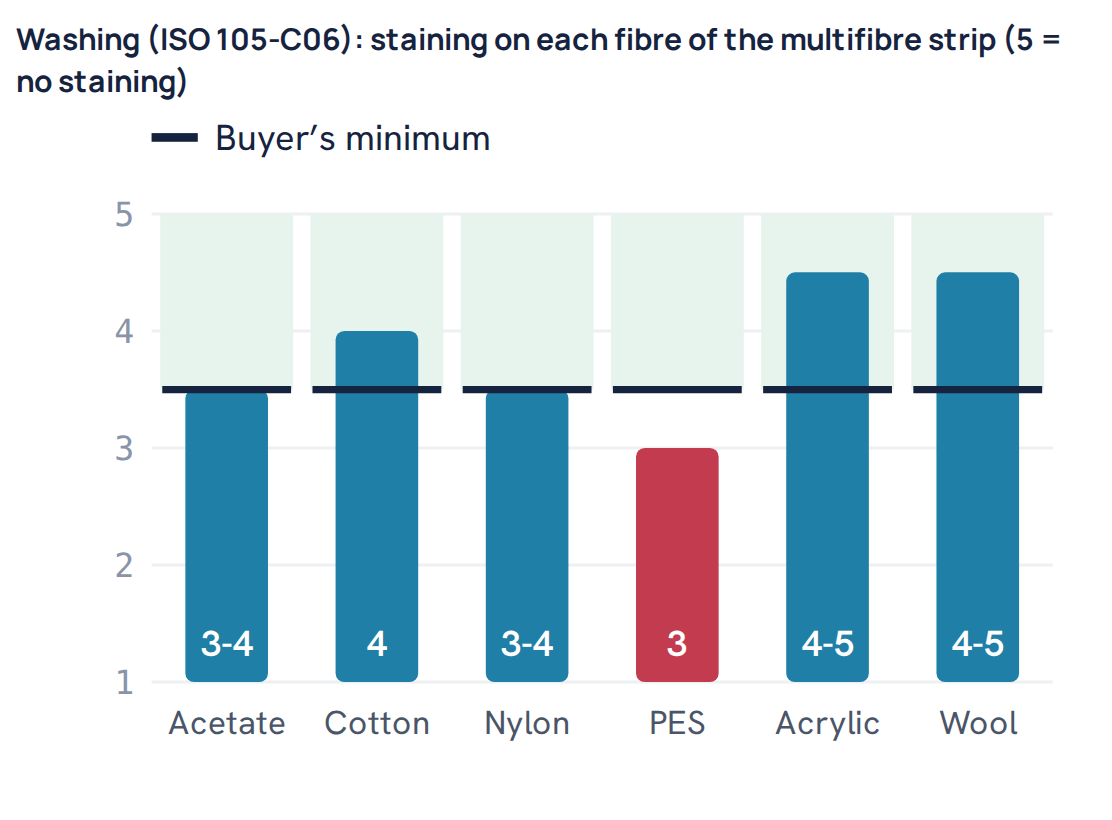
- Wash: worst staining: 3
- Wash: minimum: 3-4
- Colour change: 4
Other tests that failed in the same lab report: Wash fastness, Fibre analysis.
Cause and remedy
Cause: The stain went mostly onto nylon, polyester in the multifibre strip. Those fibres take disperse dye, so the colour that came off was disperse dye from the polyester part, left on the fibre surface after dyeing.
Cause: It is a deep shade, and deep shades carry the most loose dye.
Remedy: Reduction clear the polyester part twice after disperse dyeing, then wash clear, before the cotton part is dyed.
Remedy: Dry and finish at 100–110°C on the stenter and compactor. Hotter than that, disperse dye moves back to the fibre surface and bleeds in the test, however well it was cleared.
Remedy: Use the longer wash-off for deep shades: two soapings at 80°C, hot washes at 70°C and 60°C, a bleed check on a sample against white fabric, then fixing and a final wash clear.
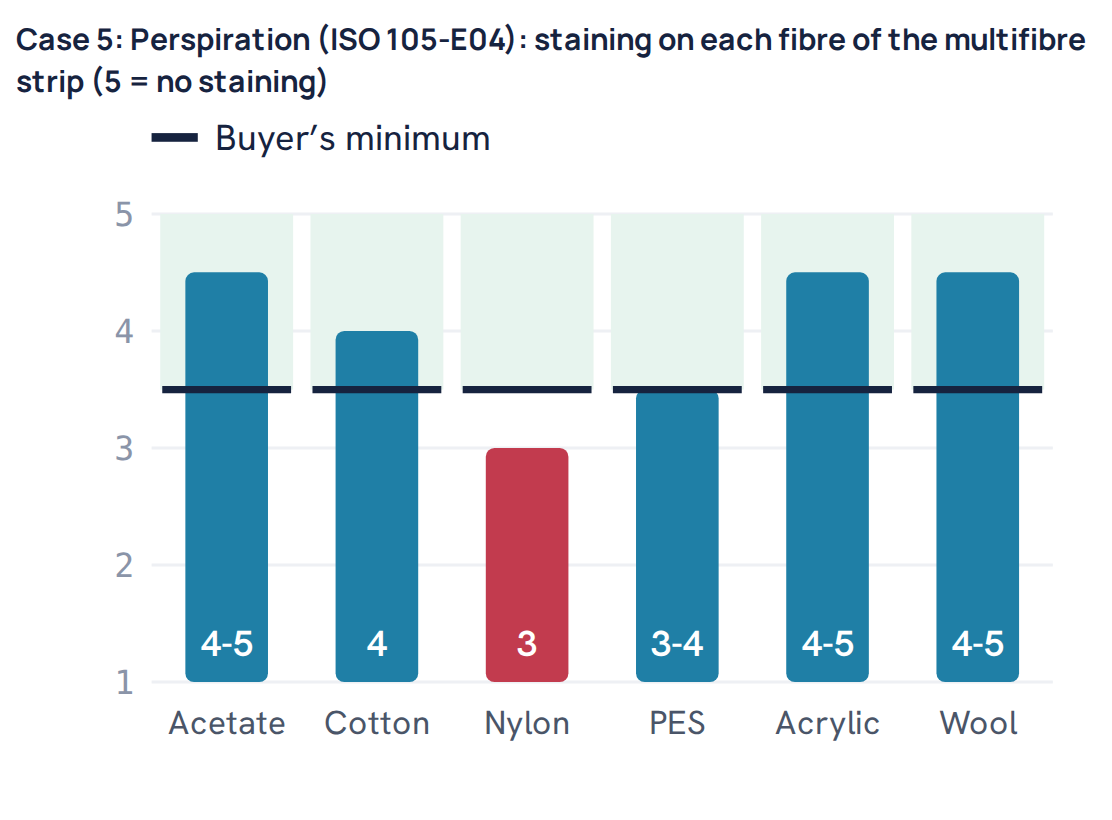
Case 5: Waffle, 270 GSM, perspiration staining
- Yarn: 20/1 CVC 60/40
- Fibre (declared): 60% Cotton 40% Polyester
- Stitch length: 29+19.0
- Machine: 44″ × 18G
- Required: 190 cm, 270 GSM
- Finished: 187 cm, 234 GSM
Lab test: Perspiration (ISO 105-E04)
Route: Greige → Dyeing → Stenter → Compacting
Results
- Perspiration: worst staining: 3
- Perspiration: minimum: 3-4
- Colour change: 4
Other tests that failed in the same lab report: GSM.
Cause and remedy
Cause: The stain went mostly onto nylon in the multifibre strip. Those fibres take disperse dye, so the colour that came off was disperse dye from the polyester part, left on the fibre surface after dyeing.
Cause: It is a deep shade, and deep shades carry the most loose dye.
Remedy: Reduction clear the polyester part twice after disperse dyeing, then wash clear, before the cotton part is dyed.
Remedy: Dry and finish at 100–110°C on the stenter and compactor. Hotter than that, disperse dye moves back to the fibre surface and bleeds in the test, however well it was cleared.
Remedy: Use the longer wash-off for deep shades: two soapings at 80°C, hot washes at 70°C and 60°C, a bleed check on a sample against white fabric, then fixing and a final wash clear.
Fleece: 4 cases
Fleece is dyed loop side inside; fleece of 350 GSM and up is heat set before dyeing.
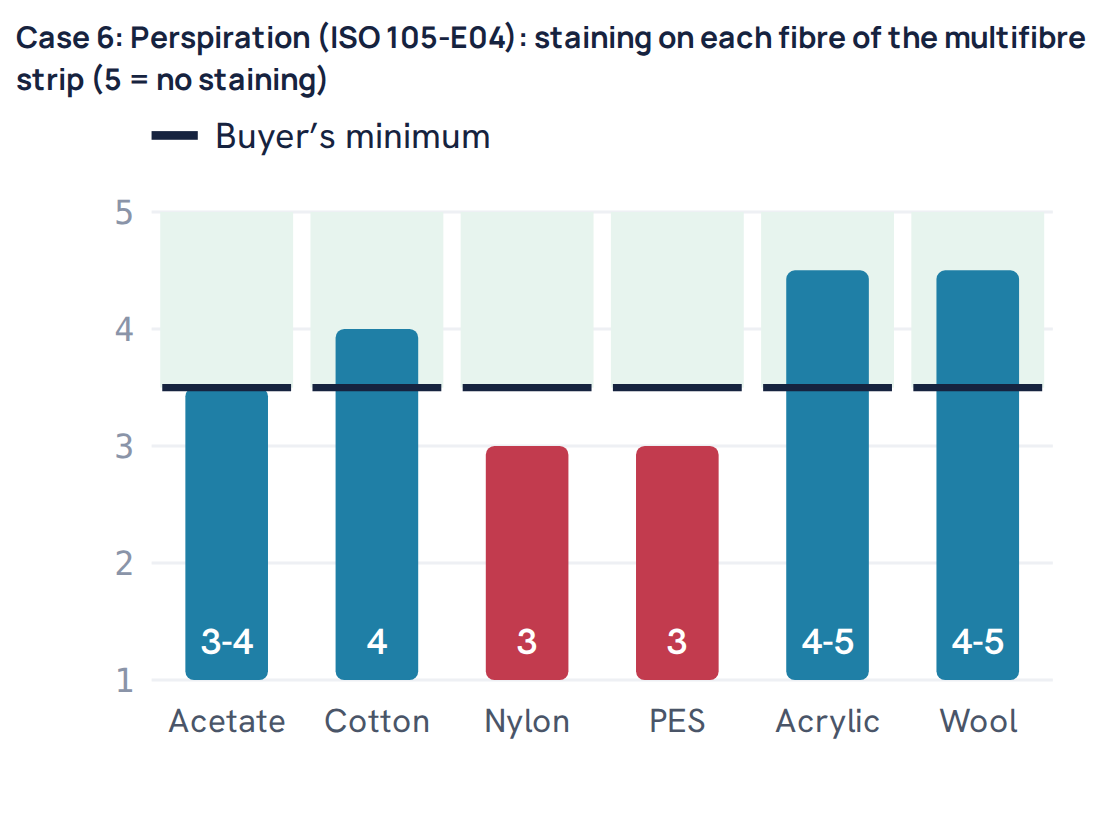
Case 6: Fleece, 290 GSM, perspiration staining
- Yarn: 30/1 CVC 60/40 + 75D polyester + 12/1 CVC 75/25
- Fibre (declared): 60% Cotton 40% Polyester
- Stitch length: 45+30+15.5
- Machine: 36″ × 20G
- Required: 180 cm, 290 GSM
- Finished: 180 cm, 300 GSM
Lab test: Perspiration (ISO 105-E04)
Route: Greige → Dyeing → Stenter → Compacting
Results
- Perspiration: worst staining: 3
- Perspiration: minimum: 3-4
- Colour change: 4
Other tests that failed in the same lab report: none.
Cause and remedy
Cause: The stain went mostly onto nylon, polyester in the multifibre strip. Those fibres take disperse dye, so the colour that came off was disperse dye from the polyester part, left on the fibre surface after dyeing.
Cause: It is a deep shade, and deep shades carry the most loose dye.
Remedy: Reduction clear the polyester part twice after disperse dyeing, then wash clear, before the cotton part is dyed.
Remedy: Dry and finish at 100–110°C on the stenter and compactor. Hotter than that, disperse dye moves back to the fibre surface and bleeds in the test, however well it was cleared.
Remedy: Use the longer wash-off for deep shades: two soapings at 80°C, hot washes at 70°C and 60°C, a bleed check on a sample against white fabric, then fixing and a final wash clear.
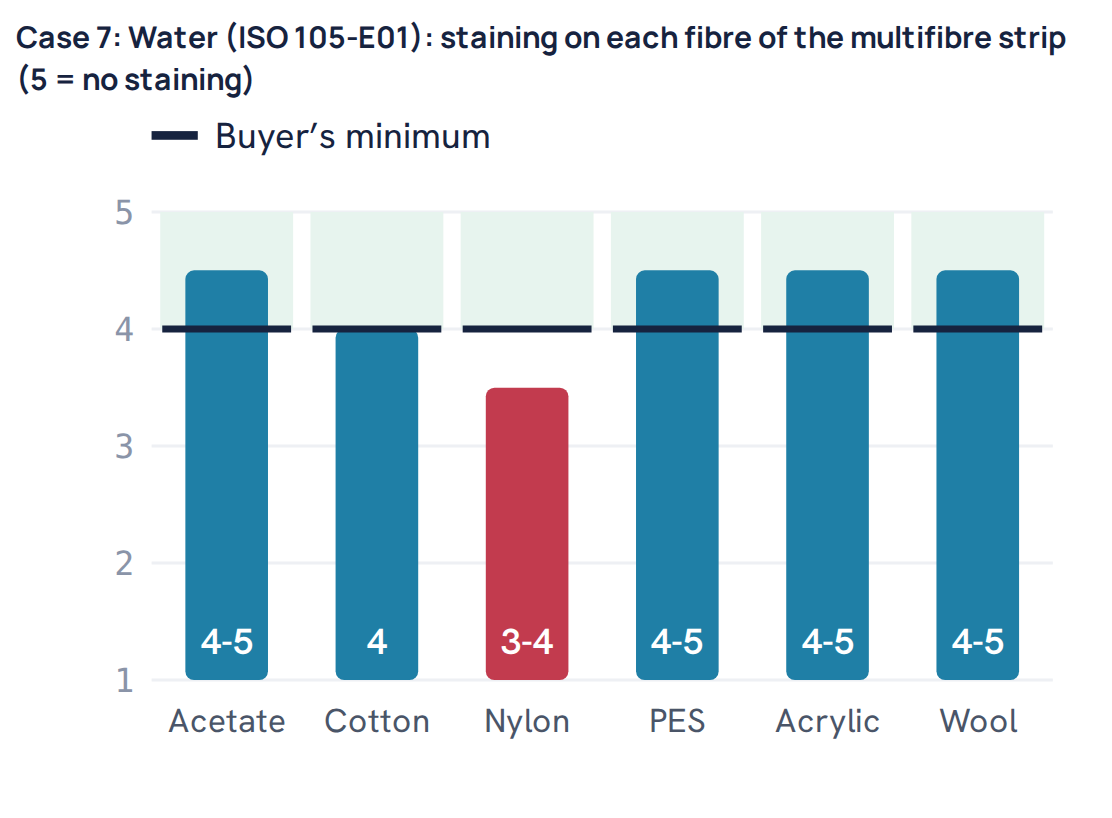
Case 7: (diagonal) fleece, 320 GSM, water staining
- Yarn: 34/1 combed + 26/1 combed
- Fibre (declared): 85% Cotton 15% Polyester
- Stitch length: 46.5+38.5+20
- Machine: 30″ × 16G
- Required: 160 cm, 320 GSM
- Finished: 153 cm, 310 GSM
Lab test: Water (ISO 105-E01)
Route: Greige → Dyeing → Stenter → Compacting
Results
- Water: worst staining: 3-4
- Water: minimum: 4
- Colour change: 4
Other tests that failed in the same lab report: Shrinkage, Rubbing fastness.
Cause and remedy
Cause: The stain went mostly onto nylon in the multifibre strip. Those fibres take disperse dye, so the colour that came off was disperse dye from the polyester part, left on the fibre surface after dyeing.
Cause: It is a deep shade (royal blue, 7% shade), and deep shades carry the most loose dye.
Remedy: Reduction clear the polyester part twice after disperse dyeing, then wash clear, before the cotton part is dyed.
Remedy: Dry and finish at 100–110°C on the stenter and compactor. Hotter than that, disperse dye moves back to the fibre surface and bleeds in the test, however well it was cleared.
Remedy: Use the longer wash-off for deep shades: two soapings at 80°C, hot washes at 70°C and 60°C, a bleed check on a sample against white fabric, then fixing and a final wash clear.
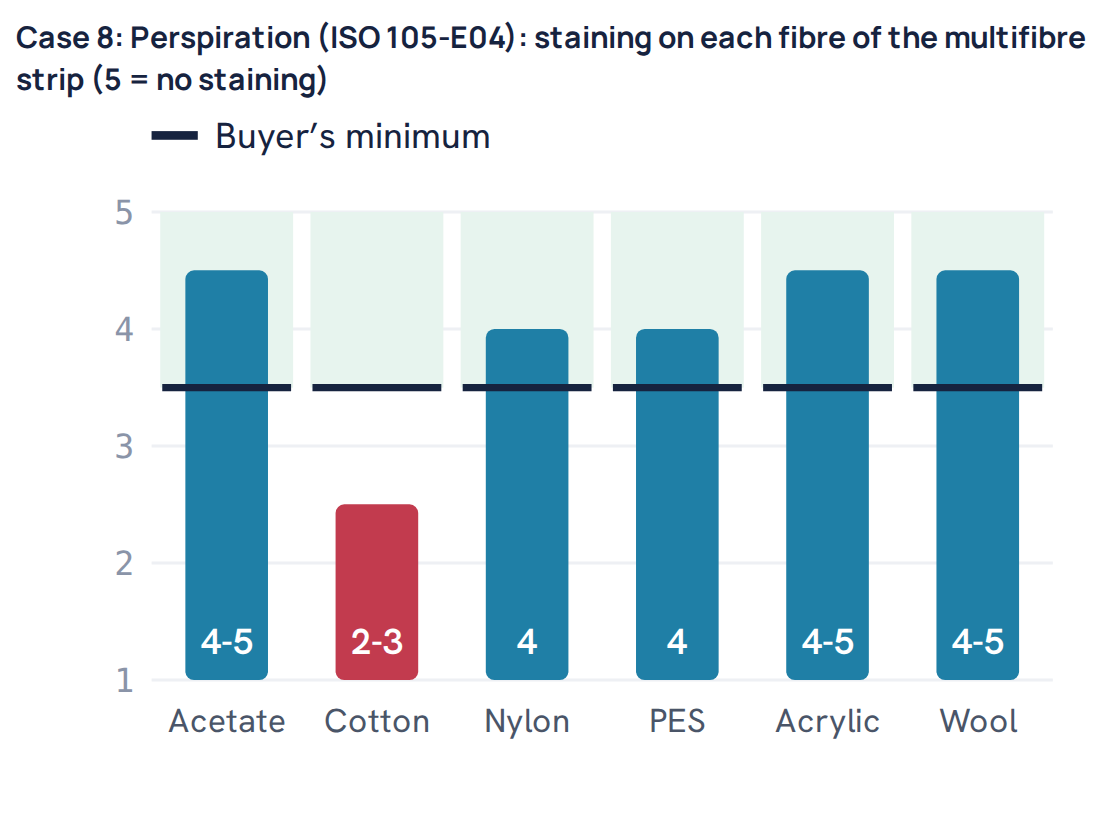
Case 8: Fleece, 400 GSM, perspiration staining
- Yarn: 22/1 cotton + 10/1 PC 50/50
- Fibre (declared): 86% Cotton 14% Polyester
- Stitch length: 30+36+42
- Machine: 16″ × 14G
- Required: 140 cm, 400 GSM
- Finished: 160 cm, 359 GSM
Lab test: Perspiration (ISO 105-E04)
Route: Greige → Dyeing → Stenter → Compacting
Results
- Perspiration: worst staining: 2-3
- Perspiration: minimum: 3-4
- Colour change: 4
Other tests that failed in the same lab report: none.
Cause and remedy
Cause: Cotton in the strip was stained, which means unfixed reactive dye was still in the fabric and came off in the wet test.
Cause: It is a deep shade, and deep shades carry the most loose dye.
Remedy: Use the longer wash-off for deep shades: two soapings at 80°C, hot washes at 70°C and 60°C, a bleed check on a sample against white fabric, then fixing and a final wash clear.
Case 9: Fleece, 330 GSM, wash staining
- Yarn: 30/1 combed + 26/1 CVC 60/40 + 8/1 carded
- Fibre (declared): 80% Cotton 20% Polyester
- Stitch length: 47.5+39.5+20
- Machine: 30″ × 16G
- Required: 165 cm, 330 GSM
- Finished: 170 cm, 332 GSM
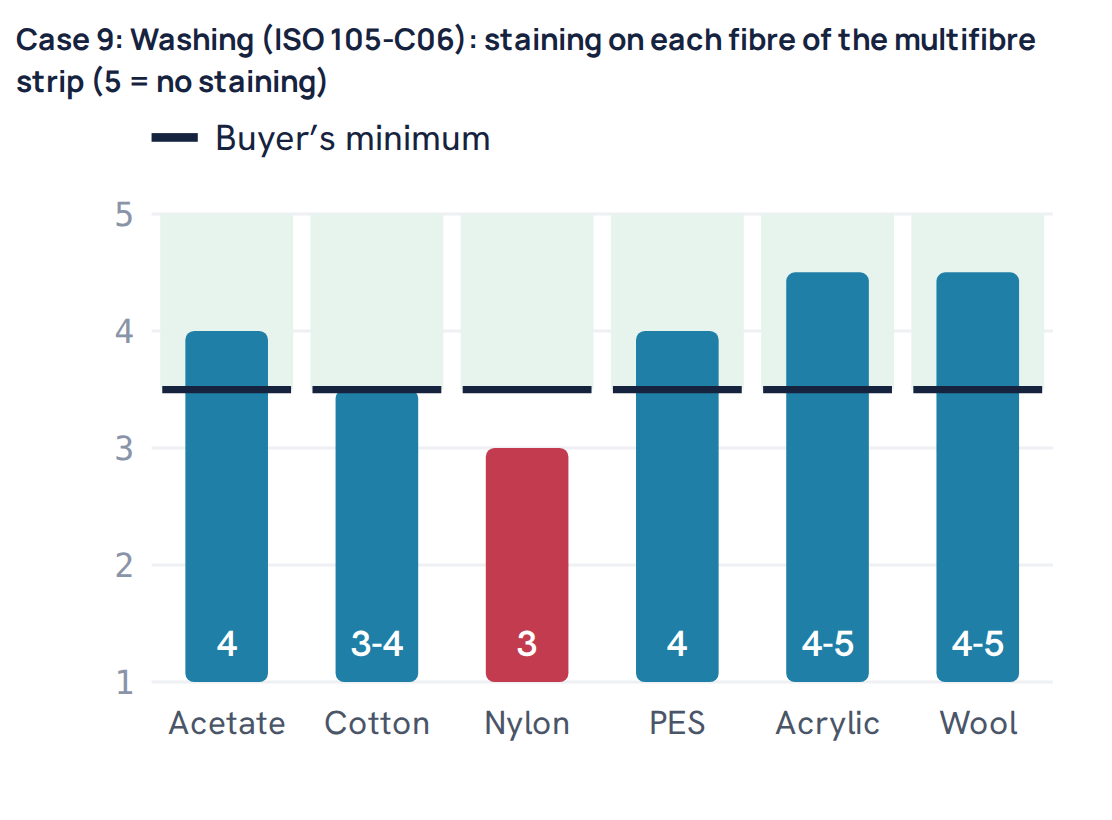
Lab test: Washing (ISO 105-C06)
Route: Greige → Dyeing → Stenter → Compacting
Results
- Wash: worst staining: 3
- Wash: minimum: 3-4
- Colour change: 4
Other tests that failed in the same lab report: Rubbing fastness, Pilling, GSM.
Cause and remedy
Cause: The stain went mostly onto nylon in the multifibre strip. Those fibres take disperse dye, so the colour that came off was disperse dye from the polyester part, left on the fibre surface after dyeing.
Cause: It is a deep shade, and deep shades carry the most loose dye.
Remedy: Reduction clear the polyester part twice after disperse dyeing, then wash clear, before the cotton part is dyed.
Remedy: Dry and finish at 100–110°C on the stenter and compactor. Hotter than that, disperse dye moves back to the fibre surface and bleeds in the test, however well it was cleared.
Remedy: Use the longer wash-off for deep shades: two soapings at 80°C, hot washes at 70°C and 60°C, a bleed check on a sample against white fabric, then fixing and a final wash clear.
From the floor: what I learned from these 9 cases
- Staining fails come on our deep shades, black, royal blue and dark brown, and mostly on fabric with polyester in it.
- For cotton, soap twice at 80°C, give hot washes at 70°C and 60°C, check a sample against white fabric, then fix and wash clear. For polyester, reduction clear twice, and never finish above 100–110°C.
- Polyester fastness also depends on using high-fastness disperse dyes, and on drying at 100–110°C instead of the 140–150°C used for cotton. At development stage this is hard to control: small 10–20 kg batches come to the stenter between hot cotton rolls, and the temperature has to come down and go back up for each one.
- On a contrast garment, where a dark panel sits beside a white or light one, sometimes the colour still stains after this process. Then we give the light colour a water-repellent finish, so even if the dark colour bleeds, it does not take on the light part.
Questions
Why does nylon get stained in a colour fastness test?
Nylon takes both disperse dye from polyester and loose reactive dye from cotton, so it shows the stain first.
How do you stop a CVC fabric staining in the wash test?
Reduction clear the polyester twice after disperse dyeing, give the cotton the longer wash-off, and finish at no more than 100–110°C.
What is a multifibre strip?
A test fabric with bands of acetate, cotton, nylon, polyester, acrylic and wool, sewn to the specimen to show which fibres pick up colour.

Textile engineer with 14+ years in dyeing and fabric development. He writes every guide on Dyeing Solution from real production work. Full profile