Nylon-elastane is dyed like 100% nylon, with acid dye and a sliding pH, after heat setting to fix the elastane. Here is the process from our floor, step by step.
At a glance
180°CHeat set, always
AcidDye class
98°CTop dyeing temperature
No enzyme
Nylon-elastane knits, mostly Lycra single jersey for lingerie, swimwear and sportswear, are dyed like 100% nylon: acid dye, a low start and a pH that slides down as the bath heats. The elastane adds heat setting before dyeing.
The route for nylon-elastane
Process flow: nylon-elastane knit dyeing
- Heat setting of the greige fabric at 180°C, always.
- Scour only, without bleaching.
- Acid dyeing following the 100% nylon process.
- After-treatment: soaping, fixing for medium and dark shades, softener.
- Finishing on the stenter.
- Nylon-elastane gets a scour only, as on our other fabrics without cellulose to bleach.
- No enzyme on nylon-elastane.
- Nylon-elastane is always heat set, at 180°C.
- The nylon part is dyed with the same process as 100% nylon.
Heat setting fixes the elastane at the width and stretch the buyer needs before the fabric goes into hot water. Nylon-elastane is heat set at 180°C.
The dyeing curve
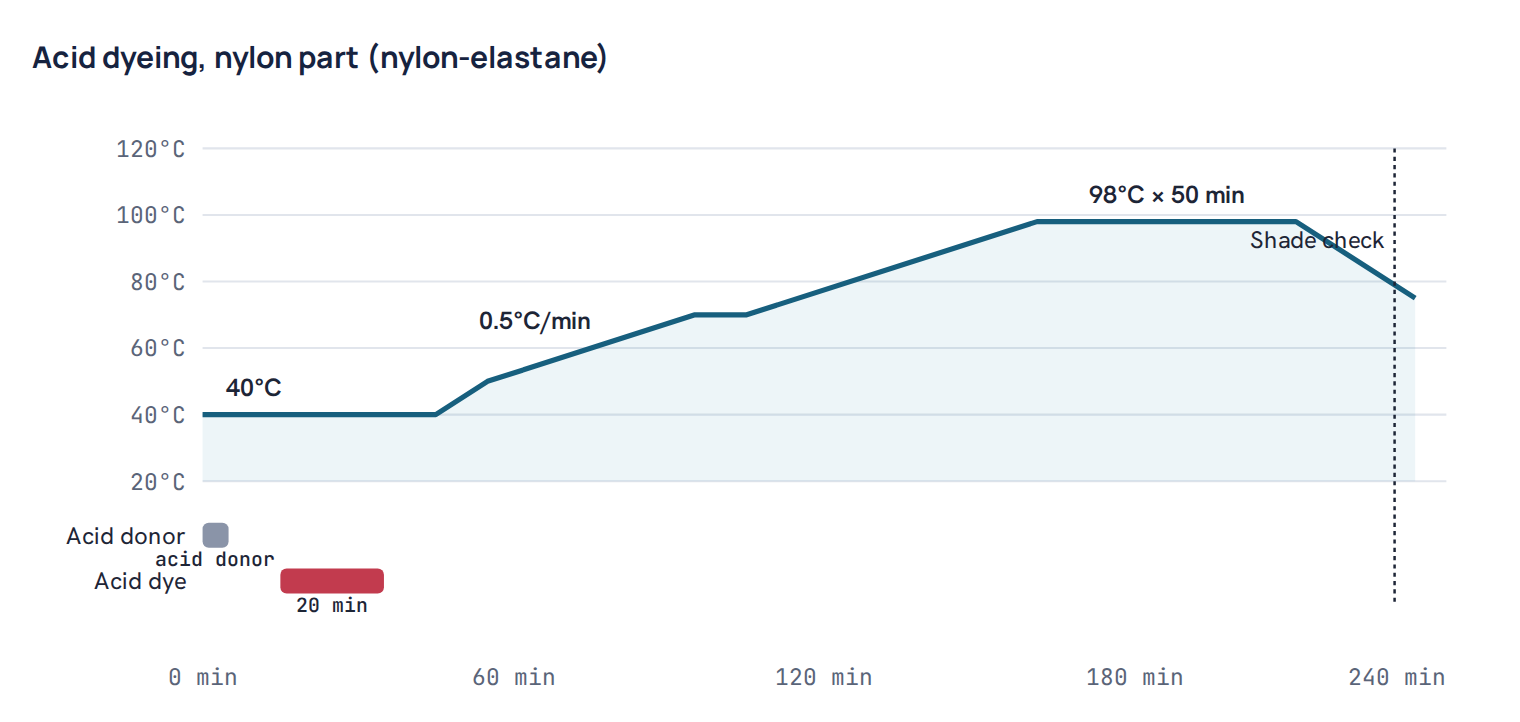
The acid donor starts the bath close to neutral and releases acid as the temperature rises, so the pH falls just when the nylon is most ready to take dye. The slow 0.5°C per minute rise between 50°C and 98°C is where the shade is made level.
Common fault: heating too fast between 50°C and 98°C. Nylon takes up acid dye quickly in this range, and a fast rise gives an uneven, streaky shade that no after-treatment can fix.
After-treatment
Soaping at 80°C for 10 minutes (up to 15 for dark shades), fixing for medium and dark shades at pH 5–5.5, and softener in the last bath.
What nylon blends look like at delivery
Our finishing records hold about 40 nylon-blend batches, mostly nylon-elastane. That is a small sample, so read it as a direction:
| Measure | Nylon blends | Polyester |
|---|---|---|
| Batches in our records | 40 | 166 |
| Median finished GSM vs required | -2.8% | -3.8% |
| Parts within ±5% of required GSM | 36% | 38% |
| Parts more than 5% light | 34% | 43% |
| Median length shrinkage | -4% | -3% |
| Parts within 5% length shrinkage | 73% | 84% |
| Heat set | 78% | 79% |

Textile engineer with 14+ years in dyeing and fabric development. He writes every guide on Dyeing Solution from real production work. Full profile