How nylon knits are prepared, acid dyed with a sliding pH and finished on a working dye house floor, with the dosing for light, medium and deep shades.
At a glance
AcidDye class
98°CTop dyeing temperature
pH 8 → 4Slides down as the bath heats
110°CStenter finishing
Nylon takes up acid dye very fast once the bath gets warm. That speed is the whole challenge: if the dye rushes onto the fibre, the shade comes out uneven and it cannot be levelled afterwards. Every step in the nylon process is about slowing that uptake down, with a low start temperature, a slow heating rate in the critical zone and a pH that falls gradually instead of starting low.
The route for 100% nylon
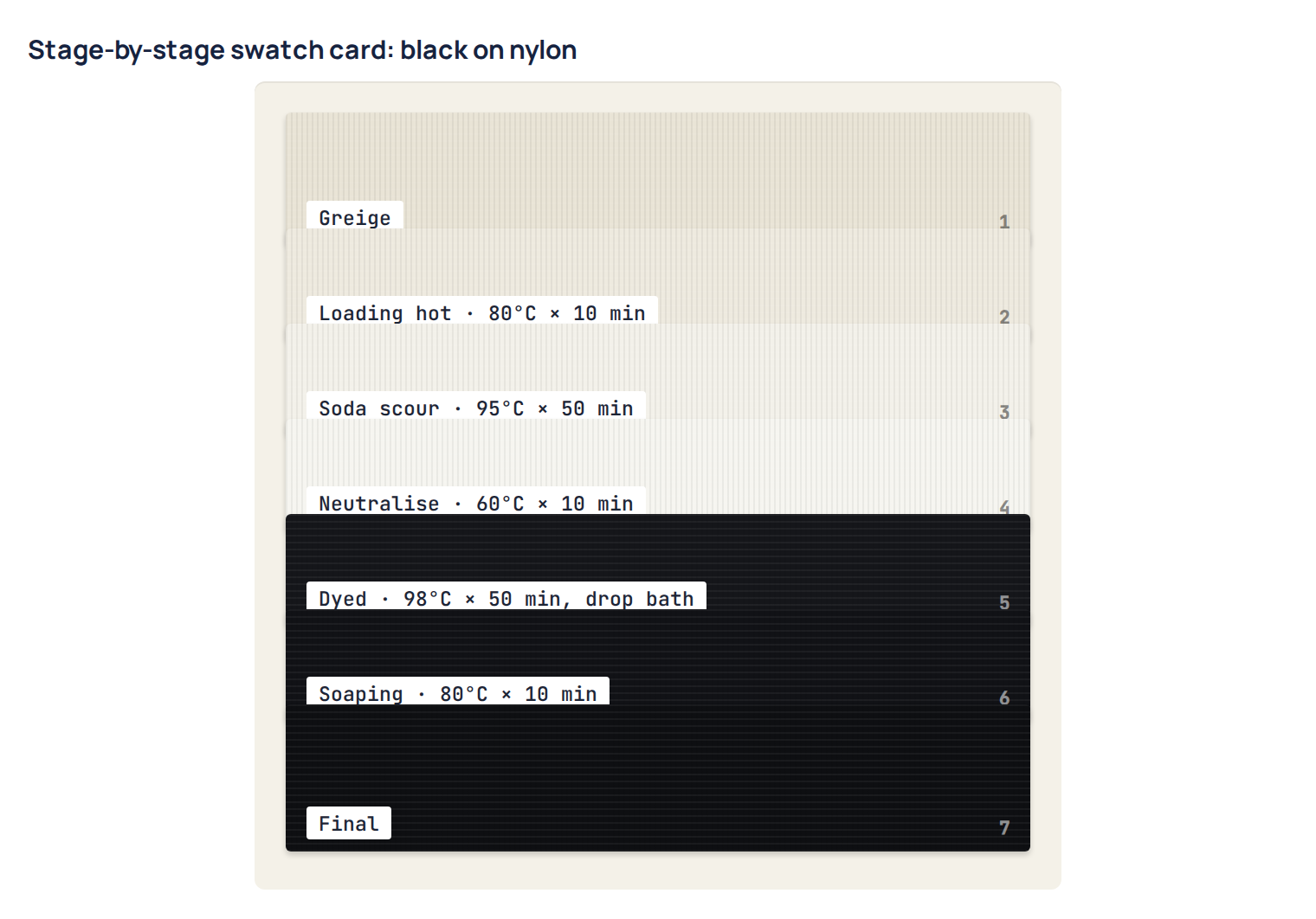
- Loading hot: 80°C for 10 minutes to open the fabric
- Soda scouring: 95°C for 50 minutes to remove knitting oil
- Neutralisation: acid rinse back to pH 7
- Acid dyeing: 40°C start, slow rise to 98°C with a sliding pH
- Wash-off: hot wash and soaping
- Fixing and softening: at pH 5–5.5
- Finishing: stenter at 110°C
Scouring
Nylon has no natural wax like cotton, but it carries spinning and knitting oil that must come off before dyeing. The fabric is loaded hot at 80°C for 10 minutes, then soda scoured at 95°C for 50 minutes with a detergent and soda ash. After draining, a hot wash and an acid rinse bring the bath back to pH 7, ready for the dyeing bath.
There is no enzyme step. Enzymes work on cellulose, and nylon has none.
The scouring bath also carries hydrogen peroxide (2.5 g/L). Nylon itself does not need peroxide, but we use it because many nylon orders are bright shades, and the peroxide pulls up the brightness of the base.
The dyeing curve
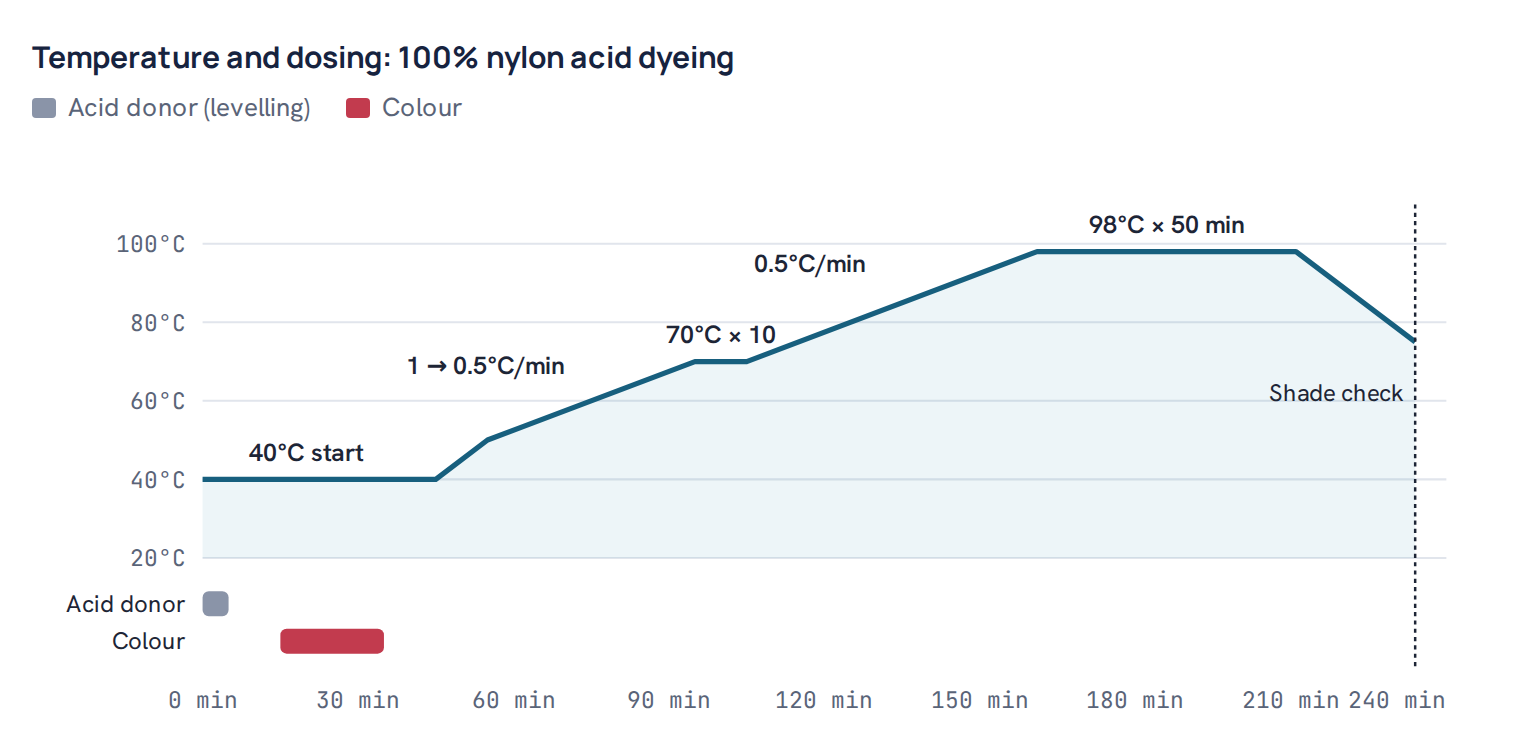
We dye nylon with acid dyes and a pH-sliding agent (an acid donor). The bath starts close to neutral and releases acid slowly as the temperature rises, so the pH falls exactly when the fibre is most ready to take up dye. This gives a far more level shade than starting at a low pH.
Step by step
- Check the pH and bring the bath to 40°C.
- Dose the levelling agent and acid donor over 5 minutes, then run 10 minutes.
- Dose the colour over 20 minutes, then run 10 minutes.
- Heat from 40°C to 50°C at 1°C per minute.
- Heat from 50°C to 70°C at 0.5°C per minute, then hold 10 minutes at 70°C.
- Heat from 70°C to 98°C at 0.5°C per minute.
- Run 50 minutes at 98°C.
- Cool from 98°C to 75°C at 1°C per minute and check the shade.
If the shade needs an addition, the colour is mixed in the side tank with water at 90°C for 15 minutes before dosing, so it goes in fully dissolved.
Acid donor by shade depth
| Shade | Acid donor | pH at start → end |
|---|---|---|
| Light | 0.25 g/L | 8.0 → 5.0 |
| Medium | 0.5 g/L | 7.5 → 4.5 |
| Deep | 1.0 g/L | 7.0 → 4.1 |
Deeper shades need more dye to go onto the fibre, so they get more acid donor and finish at a lower pH.
Common fault: heating too fast between 50°C and 98°C. Nylon takes up acid dye quickly in this range, and a fast rise gives an uneven, streaky shade that no after-treatment can fix.
Wash-off, fixing and softening
After the shade check the bath is dropped and the fabric gets a cold rinse. Soaping follows with a soaping agent (2 g/L) at 80°C for 10 minutes as standard, longer (up to 15 minutes) for dark shades, then a cold wash. Medium and dark shades get a fixing agent (2 g/L) at pH 5–5.5 to improve wash fastness. Light shades do not need it. A softener (1 g/L at pH 5–5.5) goes in the last bath.
Tip: check the shade again after soaping. Soaping removes the loose dye on the surface, and the shade can move slightly.
Finishing
Nylon is finished on the stenter at 110°C. Most nylon knits are nylon-elastane single jersey, and in our records almost all of them are heat set to control the elastane stretch.
What nylon-elastane looks like at delivery
Our finishing records hold about 20 nylon-elastane batches, mostly Lycra single jersey. That is too few for firm figures, but the pattern is clear:
- Finished GSM: a median of −4.0% against required. 37% of parts are within ±5%, and 44% are more than 5% light.
- After washing: GSM rises about 3% above required.
- Shrinkage: median length shrinkage 3% and width 2%, with the worst tenth of parts near 7% in length. That is much more stable than cotton.
- Heat setting: used on 93% of parts.
See the full GSM and shrinkage study for all fibres.
Limitations of 100% nylon and how to handle them
- Uneven and running shades. This is the biggest nylon problem. Unevenness, running shade and part-to-part shade variation are common. Control the dye uptake with the acid donor, a 40°C start and 0.5°C per minute heating.
- Spots. Nylon fabric often shows spots after dyeing. Mix every addition in the side tank at 90°C for 15 minutes before dosing, so no undissolved dye reaches the fabric.
- Wet fastness in deep shades. Medium and dark shades need the fixing agent after soaping.
- Heat damage. Dried at too high a temperature, nylon turns stiff like paper. Finish on the stenter at 110°C.
- Heat setting nylon-elastane. Above 180°C, at 190–200°C, nylon-elastane fabric is destroyed. Keep heat setting at or below 180°C.
- Light GSM on Lycra jersey. Like cotton-elastane, most nylon-elastane jersey finishes light. The lasting fix is in knitting.
The biggest problem with nylon is evenness. We get uneven dyeing on nylon fabric in large amounts, with running shade and part-to-part shade problems. Spots on nylon fabric are also common. If nylon is dried at too high a temperature, it goes stiff like paper. And Lycra nylon, the nylon-elastane fabrics, are destroyed if they are heat set above 180°C, at 190 or 200°C.

Textile engineer with 14+ years in dyeing and fabric development. He writes every guide on Dyeing Solution from real production work. Full profile