Viscose dyes easily but shrinks more than any other fibre we finish. Here is the process we run on a working winch floor, step by step, and what viscose looks like when it reaches the cutting table.
At a glance
70–80°CScour, never hotter
60°CWhole dyeing curve
No enzymeIt weakens viscose
−10%Median length shrinkage
Viscose is a regenerated cellulose fibre like lyocell, and it takes the same reactive dyes as cotton. It is softer and weaker when wet than either of them, and it swells a lot in water. That makes the dyeing itself straightforward, but the fabric is easy to damage in pretreatment and very hard to hold to size in finishing.
The route for 100% viscose
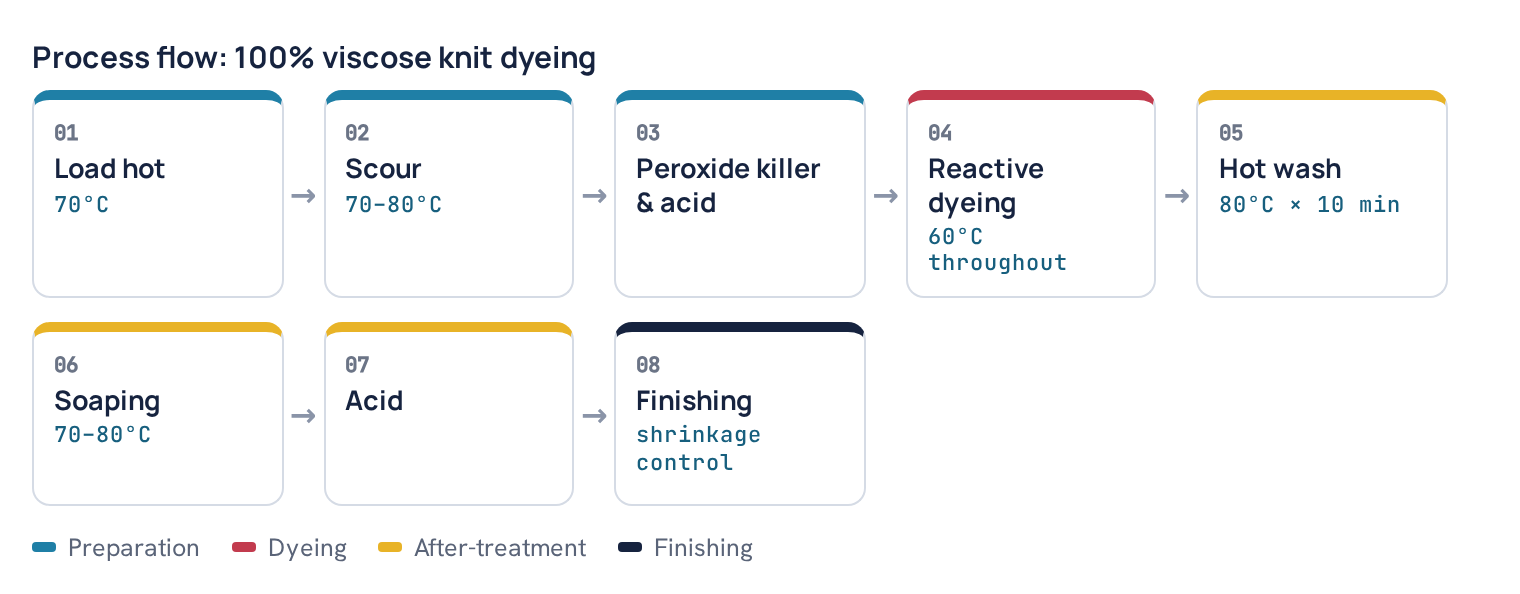
- Loading hot: 70°C, then soda ash at 80°C for 15 minutes
- Scouring: 70–80°C for 30 minutes, usually with a multifunctional scouring agent
- Peroxide killer and acid
- Reactive dyeing: 60°C throughout, salt in three portions
- Wash-off: hot wash, acid, soaping
- Finishing: stenter and compactor, with extra care on shrinkage
Pretreatment: a mild 70–80°C scour
The first auxiliaries go into the machine and the fabric is loaded at 70°C. Soda ash (2 g/L) is dosed and the bath runs at 80°C for 15 minutes, then drains. The scouring chemicals are dosed next, and the bath runs at 80°C for 30 minutes. After draining and washing, the fabric gets a peroxide killer (0.15 g/L) and acid (0.7 g/L).
A plain soda scour works, but it can sometimes leave the fabric uneven. So on our floor the scour is usually done with a multifunctional scouring agent, still at 70–80°C. It is a single product that already contains a small amount of peroxide, a wetting agent and a detergent, so it does all these jobs on its own. That is why it is called multifunctional.
- 70–80°C is the standard scour for viscose, and it is enough.
- A soda scour without bleach can sometimes come out uneven.
- So we normally use a multifunctional scouring agent. It is one product with a little peroxide, a wetting agent and a detergent already inside it, so it does every job on its own. The result is better.
- A plain soda scour at 80°C also works if needed.
Common fault: scouring viscose at cotton temperatures. At 98°C with strong alkali the fibre swells and weakens, and the fabric comes out with crease marks and lower strength.
The dyeing curve
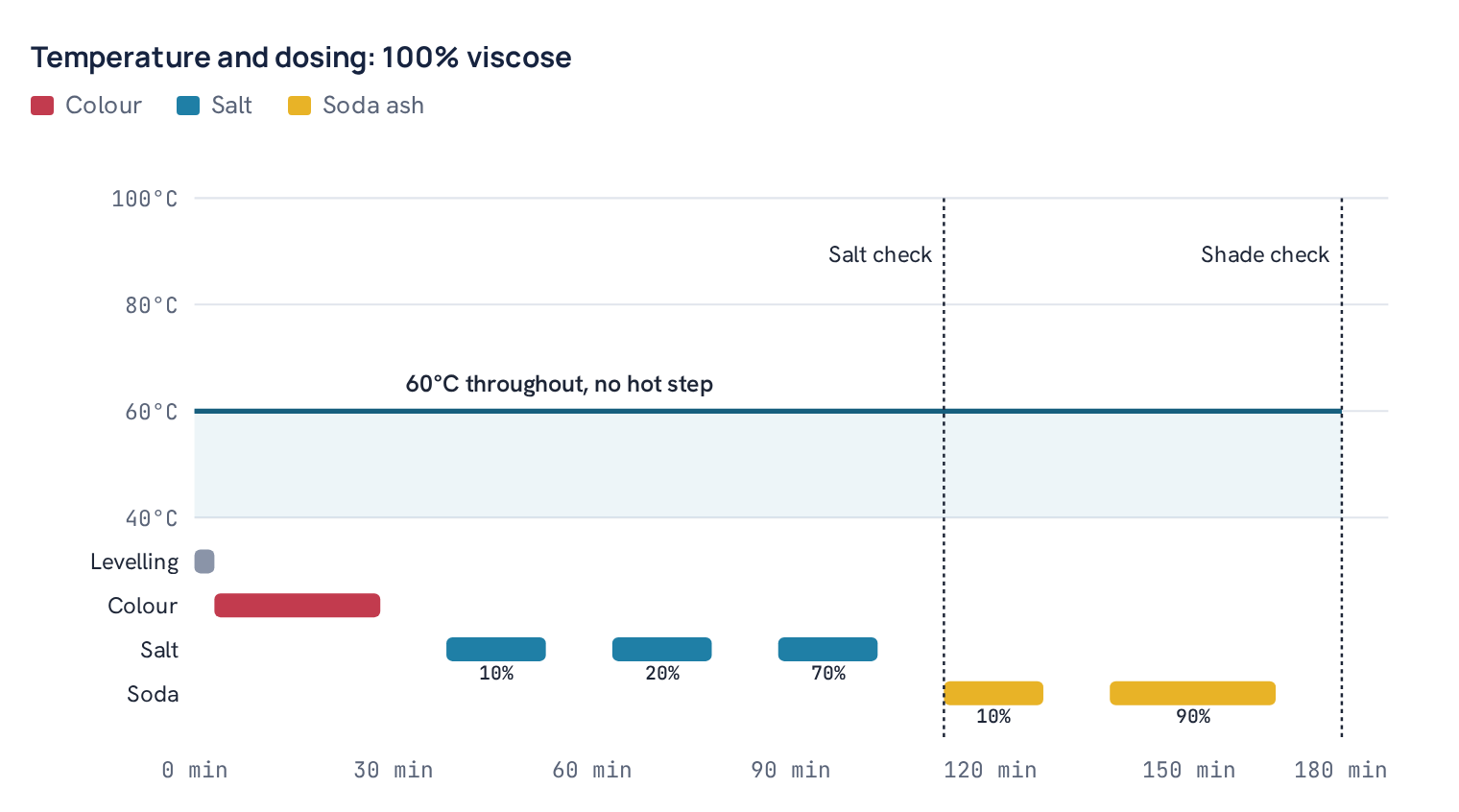
The whole curve runs at 60°C. There is no hot step, unlike lyocell’s 80°C × 15 minutes. What slows the dyeing down is the dosing: the salt goes in three portions of 10%, 20% and 70%, each over 15 minutes, and the soda goes in two portions of 10% and 90%.
Step by step
- Check the levelling pH (6.2). At 60°C, dose the levelling agent over 3 minutes.
- Dose the colour over 25 minutes and run 10 minutes.
- Dose the salt in three portions of 10%, 20% and 70%, each over 15 minutes with 10 minutes of run time after it.
- Check a salt sample.
- Dose 10% of the soda ash over 15 minutes and run 10 minutes.
- Dose the other 90% over 25 minutes and run 10 minutes.
- Check the shade.
Tip: always take the salt sample before the soda. Viscose takes up dye fast, and after the soda there is little room to correct the shade.
For turquoise and Reactive Blue 19 shades, viscose follows the same special curves as cotton, with their own temperatures and pH.
Wash-off
Viscose is washed off like cotton, with one limit: the hot wash never goes above 80°C.
- Drop the bath and wash.
- Hot wash at 80°C for 10 minutes.
- Soaping at 70–80°C, depending on the shade. Deep shades go to the higher end.
- Acid.
There is no enzyme step on viscose.
- Hot wash at 80°C for 10 minutes, never more than 80°C.
- Soaping is done like cotton, at 70–80°C depending on the shade.
- Then acid.
- No enzyme on viscose. It damages the strength.
What viscose looks like at delivery
Viscose shrinks more than any other fibre in our finishing records. In our GSM and shrinkage study, only 23% of viscose parts kept length shrinkage within 5%, the lowest of any fibre family.
| Fabric | Batches | Median finished GSM vs required | Within ±5% | More than 5% light | Median length shrinkage | Worst 10% length | Washed GSM vs required | Light parts fixed by washing | Light parts that overshoot after washing |
|---|---|---|---|---|---|---|---|---|---|
| 100% viscose | 10 | −3.3% | 50% | 43% | 16% | 20% | +9.0% | 33% | 50% |
| Viscose + elastane | 113 | −8.3% | 17% | 76% | 10% | 13% | +6.0% | 40% | 48% |
Plain viscose held GSM better than viscose-elastane, but its length shrinkage was extreme: a median of 16%, and 20% in the worst tenth. Viscose-elastane is heat set in almost every case, which brings length shrinkage down to about 10%, but three out of four parts still finish light.
Washing is a risky fix on viscose. A light viscose part gains about 17% in GSM when washed, so almost half of them overshoot and end up too heavy.
10 plain viscose batches is a very small sample; read the first row with care.
Limitations of 100% viscose and how to handle them
- Low strength. The first buyer complaint. Keep the scour and hot wash at 80°C or below, and skip the enzyme.
- Very high length shrinkage. Plan compaction and overfeed for it from the start, and set the target with a wash test.
- Shade variation. Take the salt sample before the soda, because there is little room to correct after fixation.
- Hairy surface. With no enzyme to clean the face, viscose can finish hairy.
- Light GSM on viscose-elastane. Fix it in knitting with the yarn count or stitch length. Do not rely on washing, which overshoots.
Buyer complaints on viscose, in order:
- Strength
- Shrinkage
- Shade variation
- Hairy fabric

Textile engineer with 14+ years in dyeing and fabric development. He writes every guide on Dyeing Solution from real production work. Full profile