Modal is a regenerated cellulose fibre made from beech wood: softer than viscose and stronger when wet. Here is the reactive dyeing curve we use for modal, and what modal and modal blends look like at delivery from over 300 batches.
At a glance
EnzymeFull treatment (viscose: none)
80°CSalt in three thirds
3-step soda0.5 g/L, 1 g/L, rest
100%Modal-elastane heat set
Modal sits between viscose and lyocell. Like viscose it is regenerated cellulose, but it is made to a higher wet strength, so it handles the dyeing machine better and keeps a very soft, smooth handle that buyers want for underwear, loungewear and T-shirts. It takes the same reactive dyes as cotton. In knits it is almost always blended with elastane, cotton or both.
The route for 100% modal
- Load the fabric.
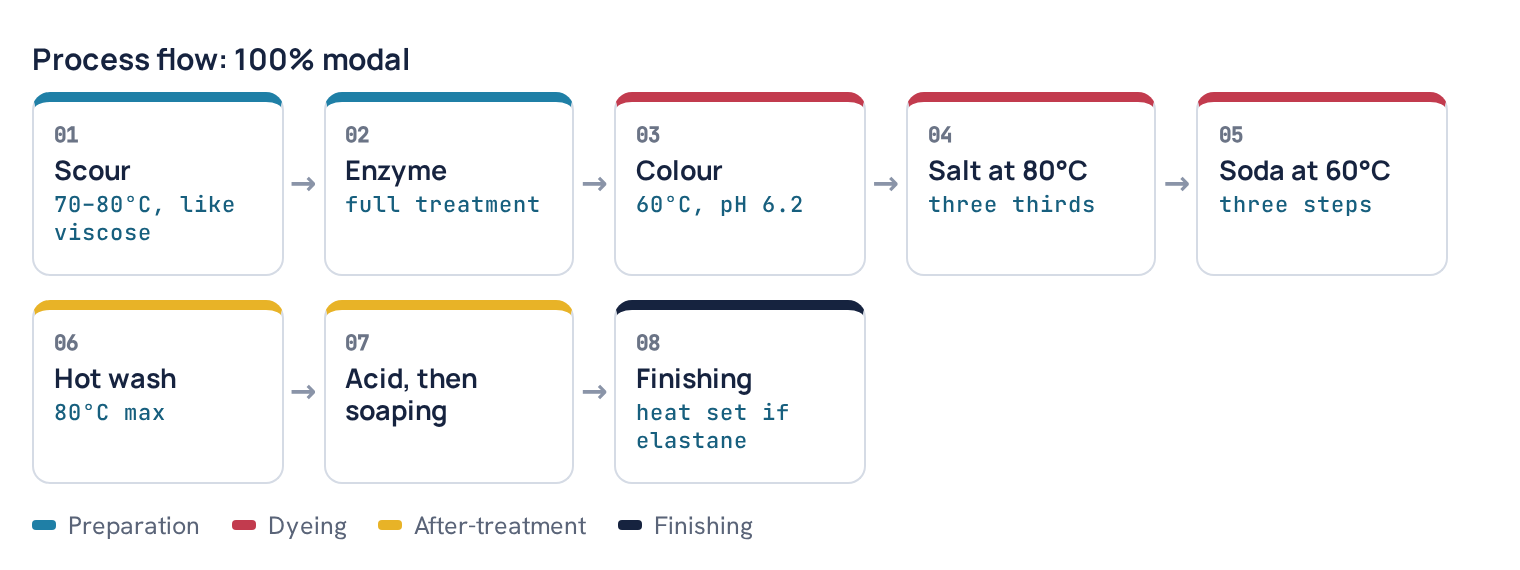
- Scour the same way as viscose: 70–80°C with the multifunctional scouring agent.
- Enzyme: a full enzyme treatment, slightly stronger than usual.
- Reactive dyeing at 60°C, with the salt added at 80°C.
- Wash-off: normal hot at 80°C maximum, acid to neutralise, then soaping.
- Finishing with heat setting for modal-elastane.
- Modal is scoured the same way as viscose. A lyocell-type scour also works without problems.
- The difference is the enzyme. Viscose gets no enzyme, and lyocell gets it at the very end. Modal gets a good enzyme treatment, a bit more than usual.
The dyeing curve
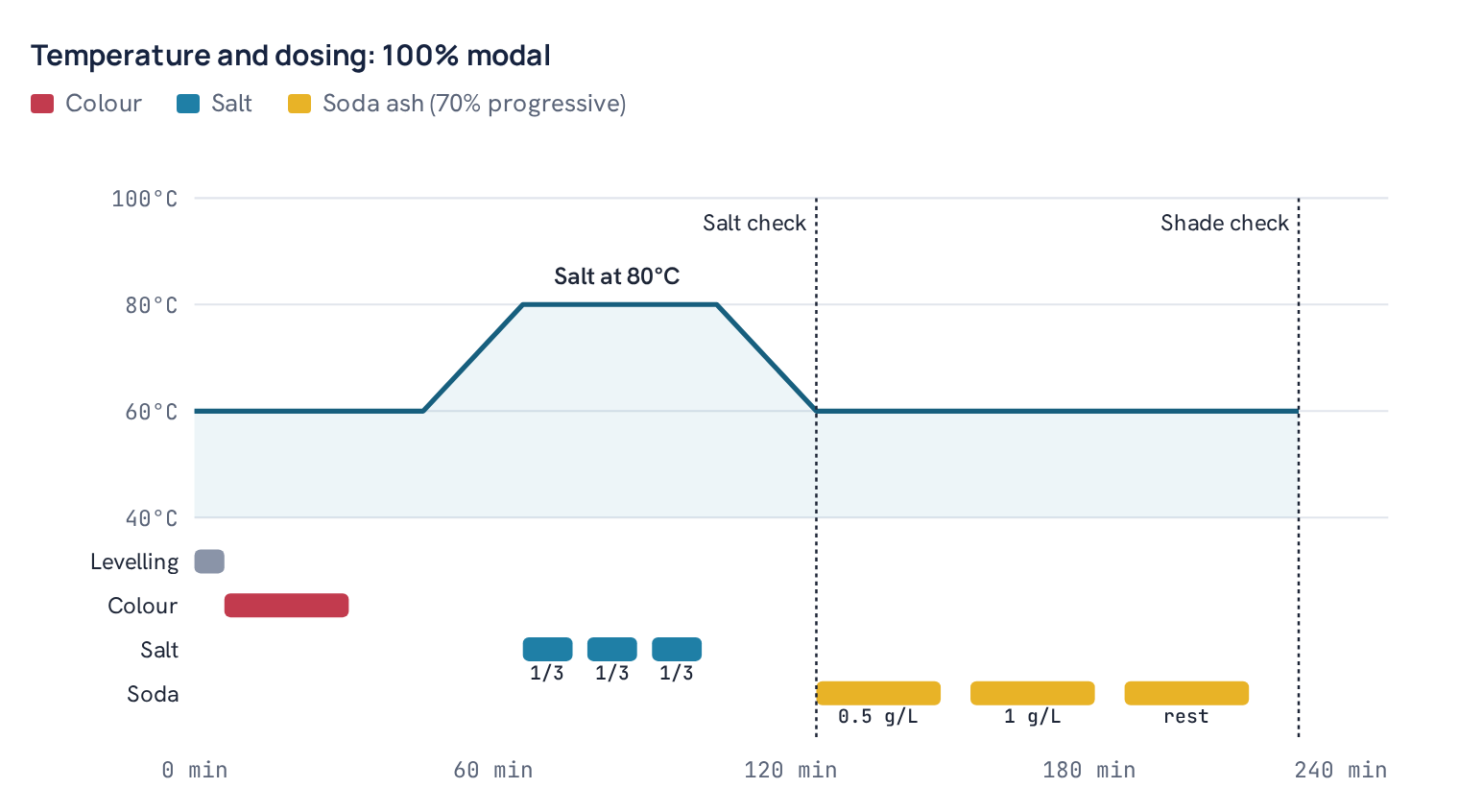
Modal shares its curve with lyocell, viscose and cotton-modal on our process sheets. The colour goes in at 60°C, the bath is heated to 80°C, the salt goes in three equal thirds, and the bath cools back to 60°C before the soda goes in three slow steps.
Step by step
- At 60°C, check the levelling pH (6.2) and add the levelling agent. Run 6 minutes.
- Dose the colour over 25 minutes and run 15 minutes.
- Heat to 80°C at 1°C per minute.
- Dose the salt in three equal thirds, each over 10 minutes with 3 minutes of run time.
- Cool to 60°C at 1°C per minute and check a salt sample.
- Dose the soda in three steps, each over 25 minutes at 70% progressive: 0.5 g/L (run 6), 1 g/L (run 6), then the rest (run 10).
- Check the shade.
Turquoise and bright blue shades on modal follow their own hotter curves, the same as on cotton. See the 100% cotton dyeing process.
Tip: the first soda step is only 0.5 g/L. Modal takes up reactive dye faster than cotton, and a small first step keeps the fixation level.
Wash-off
- Normal hot wash at 80°C, never higher, like viscose.
- Acid to neutralise.
- Soaping.
- The hot wash maximum is 80°C, the same as viscose, for the standard time.
- On modal the acid comes before the soaping: normal hot, acid to neutralise, then soaping.
What modal looks like at delivery
Our records hold only three plain modal batches, but they hold over 300 modal-blend batches (see the full GSM and shrinkage study):
| Fabric | Batches | Median finished GSM vs required | Within ±5% | More than 5% light | Median length shrinkage | Worst 10% length | Washed GSM vs required | Light parts fixed by washing | Light parts that overshoot |
|---|---|---|---|---|---|---|---|---|---|
| Modal + elastane | 49 | −6.4% | 38% | 58% | 6% | 12% | +7.1% | 42% | 50% |
| Cotton-modal + elastane | 249 | −7.5% | 18% | 79% | 6% | 10% | +6.5% | 45% | 49% |
| Cotton-modal | 25 | −6.0% | 44% | 52% | 7% | 10% | +6.5% | 43% | 36% |
Modal-elastane is heat set in every case, and it still finishes light more often than not. Washing does not help: half of the light parts end up too heavy after washing, because modal shrinks a lot once it is wet. Cotton-modal rib with elastane is the hardest: only 18% of parts within GSM tolerance.
Limitations of modal
- Hairiness. Modal fabric tends to come out hairy, which is why it gets a good enzyme treatment.
- Strength. Lower than cotton.
- Light GSM. Fix the construction in knitting; washing overshoots.
- Length shrinkage. About 6% median, 10–12% in the worst tenth. Plan compaction for it.
- The main buyer complaint on modal is hairiness: the fabric stays hairy.
- Modal has a bulky feel and is even softer than viscose, which makes it perfect for ladies’ wear.
- Its strength is not as good as cotton.

Textile engineer with 14+ years in dyeing and fabric development. He writes every guide on Dyeing Solution from real production work. Full profile