Heat setting fixes polyester, nylon and elastane fabric at a chosen width at about 180–200°C. Typical settings, pre-setting versus post-setting, which knits need it according to our records, and the faults it causes.
At a glance
180–200°Ctypical setting range
97%cotton-elastane parts set
5–15%typical overfeed
28% vs 29%shrinkage fails, set vs not
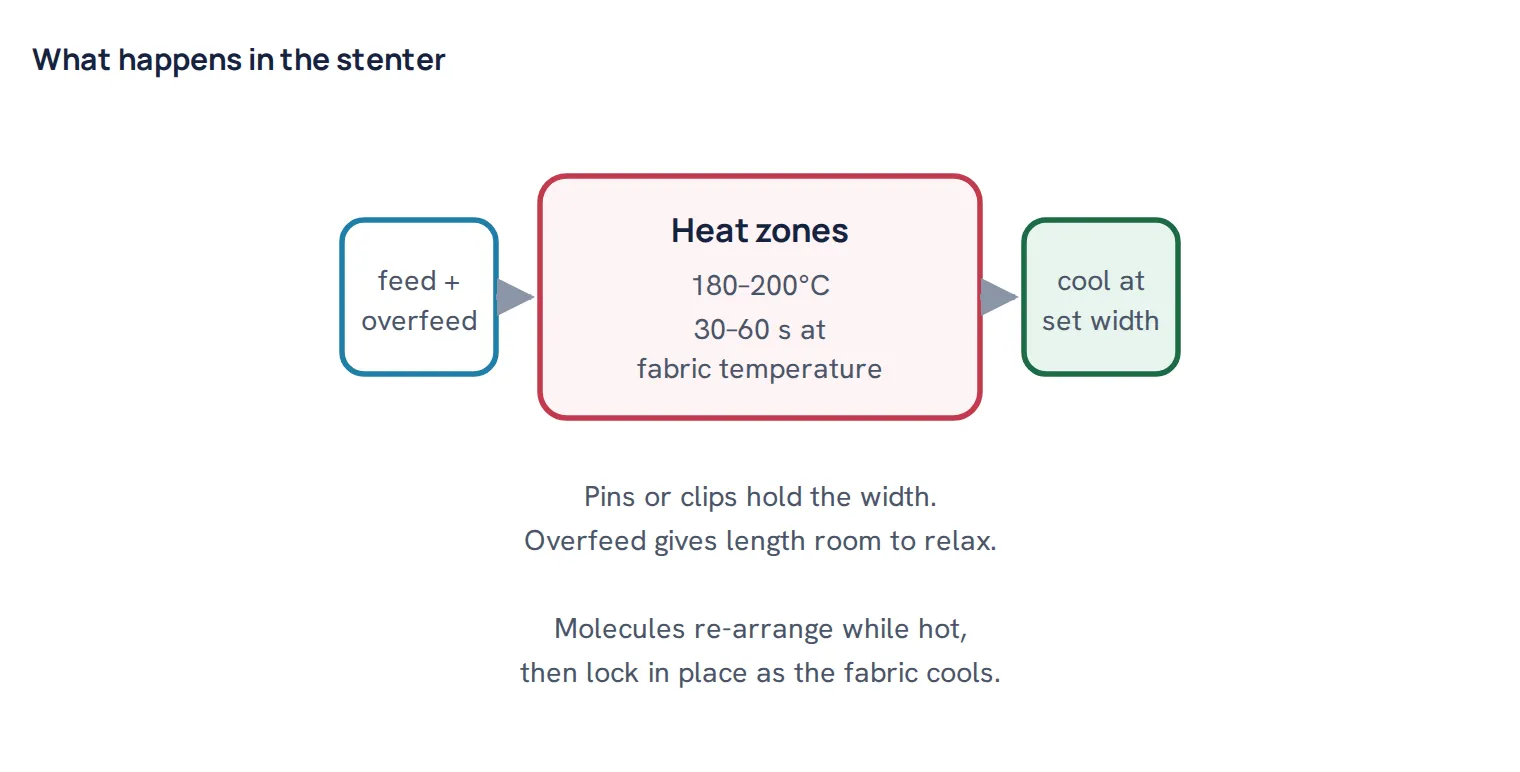
Heat setting is a short, high-temperature treatment on a stenter that fixes a fabric containing polyester, nylon or elastane at a chosen width and length. At around 180–200°C the synthetic fibre’s molecules can move and re-arrange; when the fabric cools, they lock into the new shape. After that, the fabric “remembers” its set dimensions and resists shrinking, curling and creasing in later wet processes and in the customer’s wash.
This guide explains how heat setting of polyester fabric works, when it is done before or after dyeing, the typical settings, which knit fabrics need it, and the faults that come from getting it wrong, with figures from our own finishing records.
How heat setting works
Polyester, nylon and elastane are thermoplastic: they soften above their glass transition temperature and harden again when cooled. When yarn is spun and knitted, the fibres carry internal stresses. In hot water or a dryer those stresses relax, and the fabric shrinks or distorts. Heat setting releases those stresses on purpose, under control, while the fabric is held at the width and length you want. The molecules settle into a new, relaxed arrangement at that size. As long as the fabric is not later heated above the setting temperature, it keeps it.
Typical settings
Settings depend on the fibre, the fabric weight and the machine, so each mill fixes its own. Typical ranges for knit fabric:
| Fabric | Temperature | Notes |
|---|---|---|
| Polyester, polyester-elastane | About 180–200°C | Lower end with elastane to protect it |
| Cotton-elastane, CVC-elastane | About 180–190°C | Watch for cotton yellowing |
| Nylon, nylon-elastane | About 175–190°C | Nylon yellows if too hot |
| Viscose-elastane, modal-elastane | About 180–190°C | Sets the elastane only |
The time that matters is the time the fabric itself spends at temperature, usually 20–60 seconds, not the time in the machine. Heavier fabric needs longer for the heat to reach the middle. Overfeed of about 5–15% lets the fabric relax in length while it is set, and the set width is chosen so the fabric reaches its finished width and GSM after dyeing.
Before dyeing or after?
Pre-setting (on greige fabric, before dyeing) is the norm for knits with elastane and for many polyester knits. It stops the fabric curling, creasing and shrinking uncontrollably in the hot dye bath, which is especially important in jet machines. Its drawbacks: oils and dirt on greige fabric can be baked in, and heat-set polyester takes up disperse dye slightly differently, so all lots must be set the same way.
Post-setting (after dyeing, at final finishing) gives the most exact final dimensions and avoids baking in dirt, but the fabric goes through dyeing unset, so creasing risk is higher, and the dyed fabric must withstand the setting heat without the dye moving (thermomigration) or the shade changing.
Many mills do both: a pre-set before dyeing for stability, and a final stenter pass at a lower temperature to adjust width and GSM.
Which knit fabrics are heat set: our records
In our finishing records of more than 14,000 batches, the share of parts that were heat set depended mainly on the synthetic content:
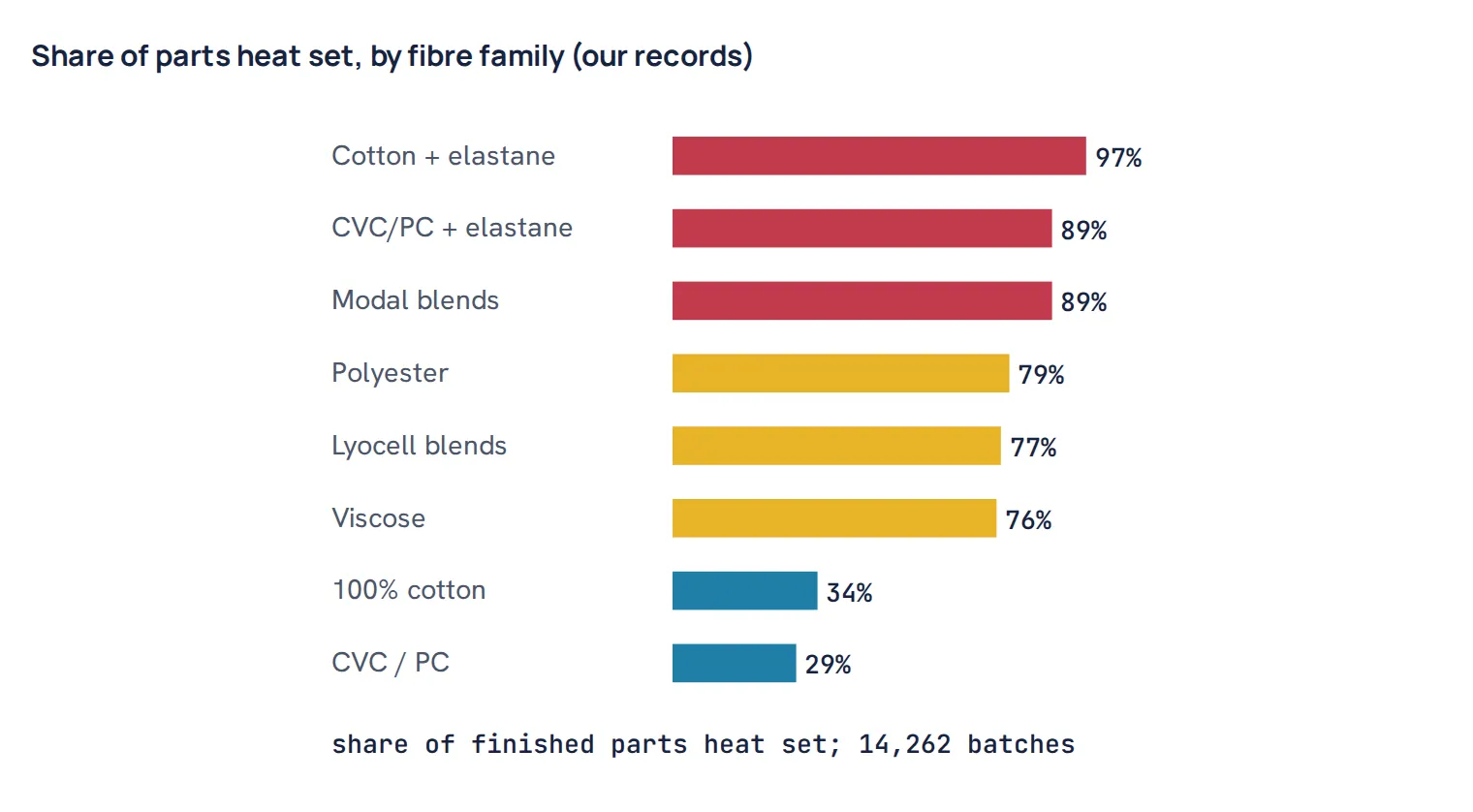
Almost every elastane fabric is heat set, because without it the elastane pulls the fabric in unpredictably. Plain cotton and CVC are set only in particular cases: heavy fleece and terry from about 350 GSM, tight or design structures and fabrics prone to crease marks in the jet. Setting a 100% cotton fabric does not set the cotton itself, which is not thermoplastic; it mainly flattens and stabilises the structure before dyeing.
Heat setting is not a shrinkage cure on its own
A common belief is that heat setting guarantees low shrinkage. Our lab data says otherwise. In the lab reports where we knew the pre-treatment, heat-set batches failed the shrinkage test about as often as batches with no pre-treatment (28% against 29%). Shrinkage is decided at the end, by the finished width, the overfeed and the compaction; heat setting only gives a stable starting point. See why knit fabric fails the shrinkage test.
Common mistake: setting the fabric wider than the finished width “to gain GSM later”. The set width becomes the fabric’s memory; if it is too wide, the fabric comes out light, and the extra width pulled in finishing comes back as width shrinkage in the wash.
Faults from heat setting
- Yellowing or scorching of cotton, nylon or white fabric from too high a temperature or too long a time.
- Weak or broken elastane above about 195°C, giving poor recovery and “grin-through”.
- Barré or shade differences when different lots are set at different temperatures, because polyester’s dye uptake depends on its heat history.
- Width or GSM off target from the wrong set width or overfeed.
- Baked-in stains from knitting oil on greige fabric that was not cleaned before pre-setting.
Worked example. A cotton-elastane single jersey must finish at 160 cm and 200 GSM. The mill pre-sets it at about 185°C at a width a little above 160 cm with some overfeed, so after dyeing, which pulls it in, and final finishing it lands at 160 cm. If the pre-set width is too wide, the fabric finishes light and grows narrower in the wash; too narrow, and it finishes heavy and tight.
Summary
- Heat setting fixes thermoplastic fibres at a chosen size by heating to about 180–200°C and cooling while held.
- It prevents curling, creasing and uncontrolled shrinkage in dyeing and washing.
- Elastane fabrics are almost always heat set; plain cotton and CVC only in special cases.
- It does not guarantee low shrinkage; finishing width, overfeed and compaction still decide it.
Process routes that include heat setting are in the polyester-elastane dyeing process and the cotton-elastane dyeing process.
Questions
What is heat setting in textiles?
It is a short treatment at about 180–200°C on a stenter that fixes fabric containing polyester, nylon or elastane at a chosen width and length, so it resists shrinking and creasing later.
Why is polyester heat set?
To release stresses from spinning and knitting under control, giving stable dimensions, less curling and creasing in dyeing, and lower shrinkage in washing.
What temperature is used for heat setting polyester?
Typically about 180–200°C fabric temperature for 20–60 seconds, lower with elastane to avoid damaging it.
Is heat setting done before or after dyeing?
Both are used. Pre-setting before dyeing is normal for elastane and many polyester knits; post-setting after dyeing gives exact final dimensions. Many mills do both.
Does heat setting stop shrinkage?
Not on its own. In our lab reports heat-set batches failed shrinkage about as often as unset ones; final width, overfeed and compaction decide the shrinkage.

Textile engineer with 14+ years in dyeing and fabric development. He writes every guide on Dyeing Solution from real production work. Full profile