Polyester-elastane is dyed like polyester, with disperse dye under pressure, but the elastane sets limits: a slower rise to 130°C, a lower temperature when the elastane is weak, and a cooler finish. Here is the process from our floor, step by step, and what these fabrics look like at delivery from recent data.
At a glance
180–190°CHeat set before dyeing
130°CDyeing (120°C for weak elastane)
0.5°C/minHeating rate
85%Parts within 5% length shrinkage
Polyester-elastane knits are filament or spun polyester plated with 20D to 40D elastane: rib, single jersey, interlock and bonded interlock for sportswear, leggings and fitted tops. Only the polyester takes the disperse dye. The elastane stays lighter, but it takes some disperse dye on its surface, and that loose dye is where most fastness problems start. The elastane also limits how hot and how long the fabric can be treated.
The route for polyester-elastane
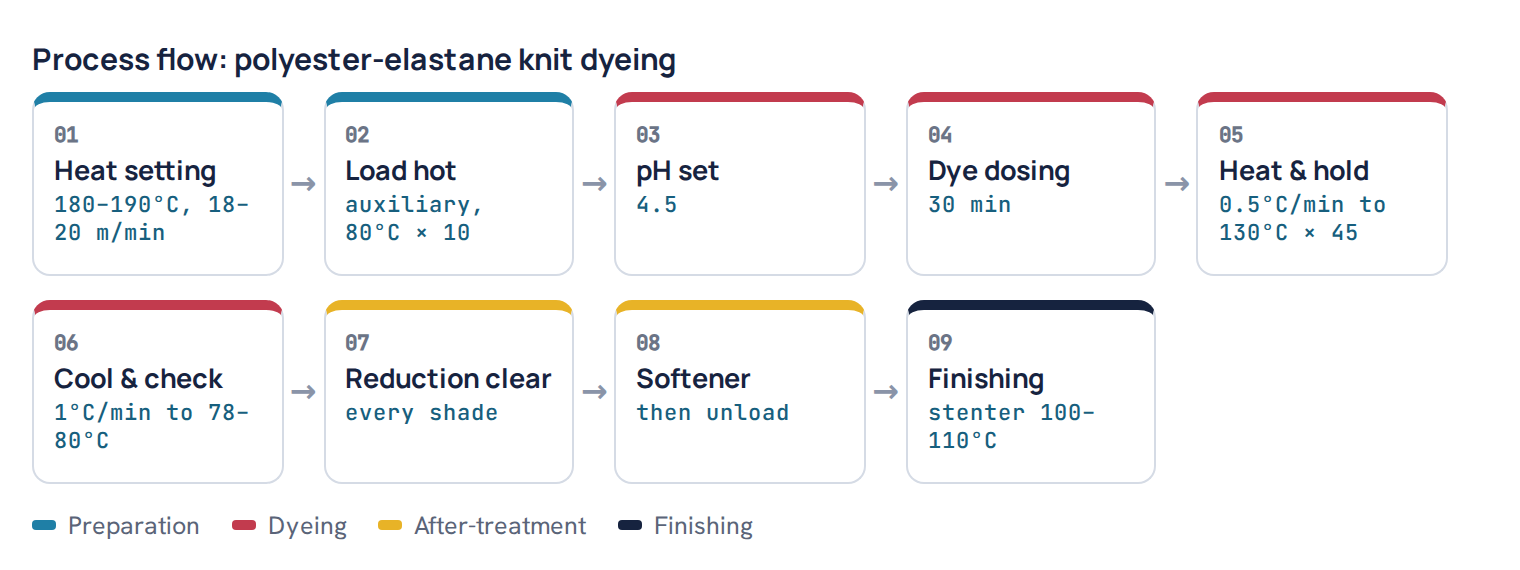
- Heat setting of the greige fabric before dyeing at 180–190°C, to fix the width and stretch.
- Load and give a loading hot with an auxiliary at 80°C for 10 minutes, then drain. No scour.
- Set the pH of the dyebath to 4.5 and dose the disperse dye over 30 minutes.
- Heat from 40°C to 130°C at 0.5°C per minute and hold 45 minutes. Only when the elastane is weak, dye at 120°C instead.
- Cool at 1°C per minute to 78–80°C and check the shade.
- Reduction clearing on every shade, then softener, and unload.
- Finishing on the stenter at 100–110°C; 100°C is best.
- There is no scouring on polyester-elastane. Like 100% polyester, we give an auxiliary, do the loading hot at 80°C for 10 minutes, then go to dyeing at pH 4.5.
Heat setting
92% of polyester-elastane parts in our records are heat set, against 70% for 100% polyester. Heat setting fixes the elastane at the width and length you want, so the fabric does not pull in or grow in dyeing and finishing. It runs at 180–190°C, at 18–20 metres per minute, before dyeing.
- Polyester-elastane is heat set before dyeing, at 180–190°C.
- Speed is 18–20 metres per minute. At 190°C we can run at 20.
- It is heat set like cotton-elastane. Too much heat means strength loss.
- If the fabric stops or gets stuck inside the heat-set machine, that part goes hard, like plastic.
Common fault: a stop inside the heat-setting machine. The part that sits in the heat turns hard and plastic-like and cannot be recovered.
The dyeing curve
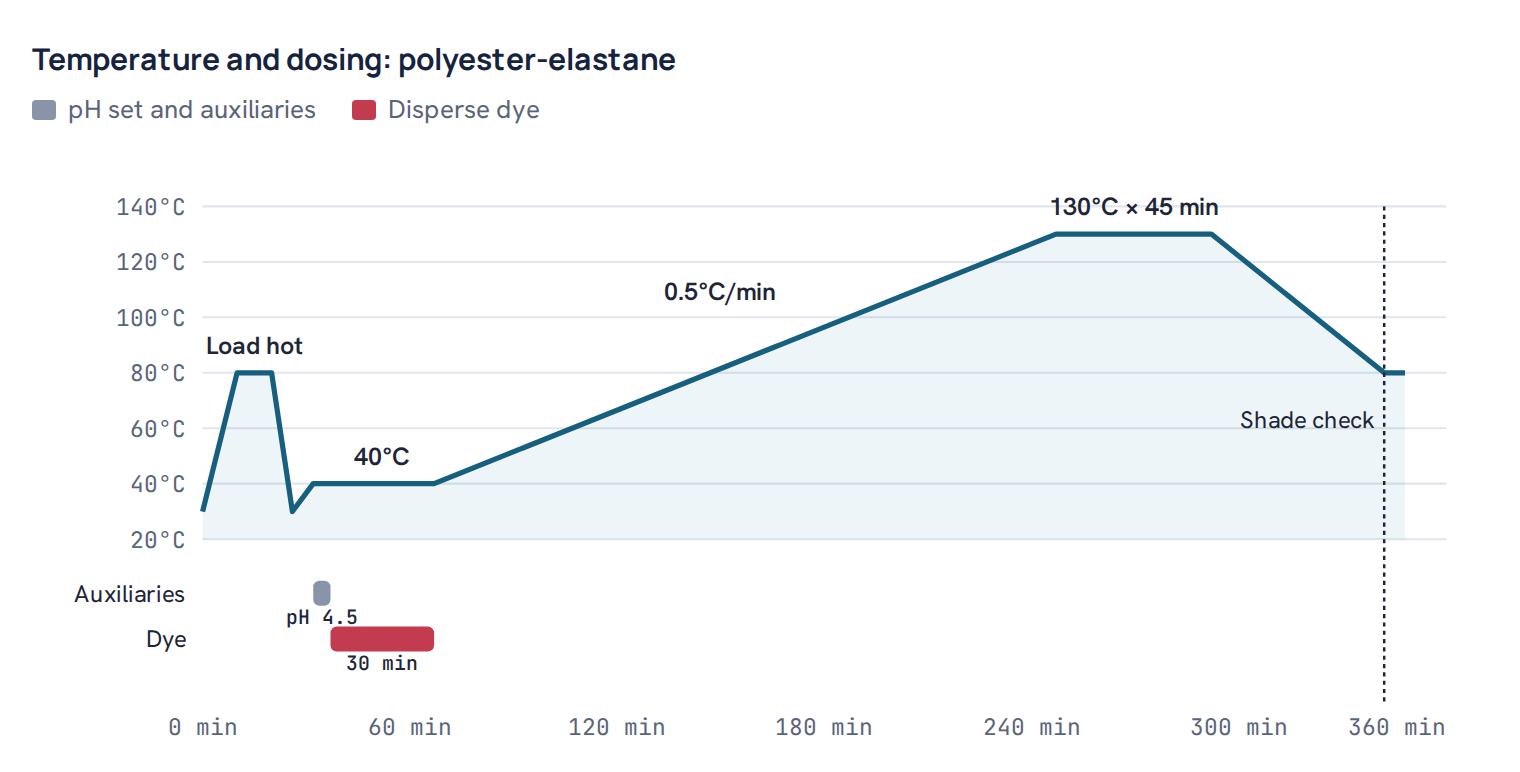
In the normal case, polyester-elastane is dyed at the same 130°C as 100% polyester. The difference is the heating rate: a slower 0.5°C per minute rise, with cooling at 1°C per minute. When the elastane in a fabric is weak, 130°C is close enough to its limit to damage it and take away its strength, so that fabric is dyed at a lower 120°C instead.
- The dyeing temperature is 130°C in the normal case.
- Only when the elastane strength is not good, in that real case, we reduce the temperature and dye at 120°C. At 130°C weak elastane can get destroyed and lose its strength.
- Dyebath pH is 4.5.
- Heating is normally 0.5°C per minute. Cooling is 1°C per minute.
Normal or dyeable elastane
Normal elastane stays white when the polyester is dyed. Some fabrics use a dyeable elastane, which takes up the disperse dye along with the polyester, so the colour is fixed on both fibres.
Common fault: heating too fast through the middle of the curve. Polyester takes up disperse dye quickly from about 90–100°C, and a fast rise gives an uneven shade.
Reduction clearing
After the dyeing bath is drained, the loose disperse dye on the fibre surface, and on the elastane, is removed with a reducing agent and alkali. On polyester-elastane it is a must on every shade: dark, medium and light.
- Reduction clearing is a must.
- Dark and medium shades need it, and we do it on light colours too. Every colour gets a reduction clear.
What polyester-elastane looks like at delivery
From recent finishing data on about 46 polyester-elastane batches (see the full GSM and shrinkage study), compared with 100% polyester and cotton-elastane:
| Measure | Polyester-elastane | 100% polyester | Cotton-elastane |
|---|---|---|---|
| Median finished GSM vs required | −0.9% | −4.0% | −6.7% |
| Parts within ±5% of required GSM | 38% | 36% | 29% |
| Parts more than 5% light | 34% | 47% | 68% |
| Parts more than 5% heavy | 28% | 18% | 2% |
| Median length shrinkage | 3% | 3% | 6% |
| Parts within 5% length shrinkage | 85% | 87% | 41% |
| Heat set | 92% | 70% | 97% |
By fabric type
| Fabric type | Batches | Median finished GSM vs required | Within ±5% | More than 5% light | More than 5% heavy | Median length shrinkage |
|---|---|---|---|---|---|---|
| Rib | 22 | 0.0% | 33% | 29% | 38% | 3% |
| Single jersey | 11 | −1.6% | 33% | 42% | 25% | 4% |
| Interlock | 6 | 0.0% | 71% | 14% | 14% | 2% |
Polyester-elastane holds its length almost as well as 100% polyester: 85% of parts stay within 5% length shrinkage, against 41% for cotton-elastane. GSM is the problem, and it goes both ways. A third finish light and more than a quarter finish heavy, often from the elastane pulling the fabric in. Interlock holds GSM best.
These are small samples, especially by fabric type. Read them as a direction, not a rule.
Limitations of polyester-elastane
- GSM out on both sides. Control width and overfeed at heat setting and in finishing; fix the construction in knitting.
- Elasticity and recovery fall. The first buyer complaint. Keep the heat setting within 180–190°C, and drop the dyeing to 120°C when the elastane is weak.
- Elastane damage and grin-through. Damaged elastane breaks out of the knit and shows on the face as a hairy look.
- Shade difference between elastane and polyester. On a navy, the elastane can come out darker, close to black.
- Fastness after finishing. Disperse dye migrates out of polyester at high stenter temperatures. Finish at 100–110°C, best at 100°C.
Finishing temperature
Finishing temperature is an important issue on polyester-elastane. We normally finish polyester-elastane, like regular nylon and polyester, at 100–110°C, and 100°C is best. At higher temperatures the disperse dye migrates out of the polyester to the surface, and the colour fastness falls.
- Buyer complaints: elasticity falls and recovery goes down.
- The elastane gets damaged and comes out of the fabric, standing out like hair.
- Shade difference: we dye a navy, and on the elastane it looks black, darker than the polyester.
- We normally finish at 100–110°C, for nylon and polyester as well. 100°C is best, and there the colour fastness stays fine.
- Above it, the polyester dye migrates out and the fastness goes bad.

Textile engineer with 14+ years in dyeing and fabric development. He writes every guide on Dyeing Solution from real production work. Full profile