Hemp is a cellulose fibre, so a cotton-hemp knit takes the same reactive dyes as cotton. On our floor it gets a 98°C soda-ash scour, the 80°C migration step, and no enzyme. Here is the process from a real batch, stage by stage.
At a glance
98°CScour-bleach, 60 min
60°CReactive dyeing
80°C × 20Migration step
No enzymeIt weakens hemp
Hemp is a bast fibre: it comes from the stem of the plant, like linen, not from a seed like cotton. It is cellulose, so it takes reactive dye in the same way, but its fibres are coarser, stiffer and less uniform, and the greige yarn carries more natural colour. In knits it is almost always blended with cotton; the cotton-hemp fabrics in our records are single jerseys from yarns such as 75/25 and 90/10 cotton/hemp.
The route for cotton-hemp
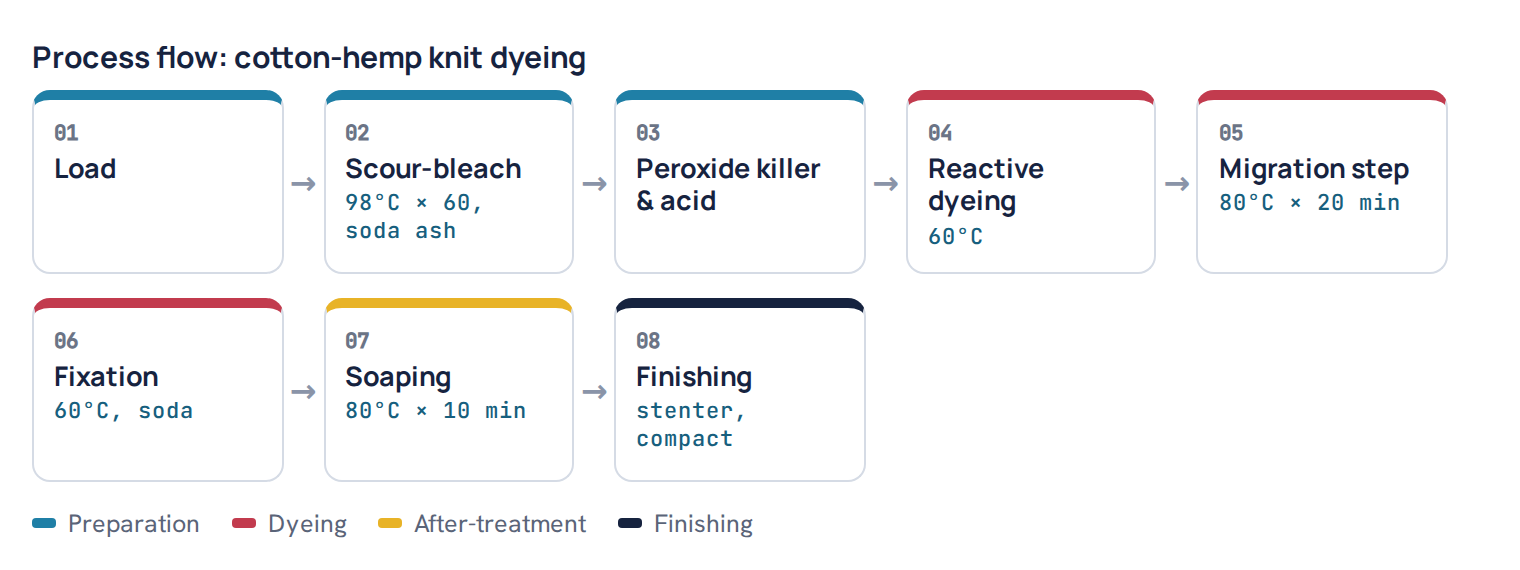
- Scour-bleach at 98°C for 60 minutes with soda ash instead of caustic.
- Peroxide killer and acid.
- Reactive dyeing at 60°C, with the 80°C × 20 min migration step after the salt.
- Soaping at 80°C for 10 minutes with a soaping agent (1 g/L).
- Unload and finish. No enzyme.
Pretreatment
Cotton-hemp is scoured at the same 98°C for 60 minutes as 100% cotton, but with a milder alkali: soda ash (4 g/L) instead of caustic, with hydrogen peroxide (2.5 g/L) as usual. A peroxide killer and acid follow. Hemp is weaker than cotton, so it gets the gentler alkali, not a stronger scour.
- 98°C × 60 min scouring is right for cotton-hemp.
- On 100% cotton we use caustic 2 g/L and peroxide 2.5 g/L. On cotton-hemp we use no caustic: only soda ash 4 g/L, with peroxide 2.5 g/L as usual.
- It is not stronger for hemp. Hemp has lower strength than cotton.
The dyeing curve
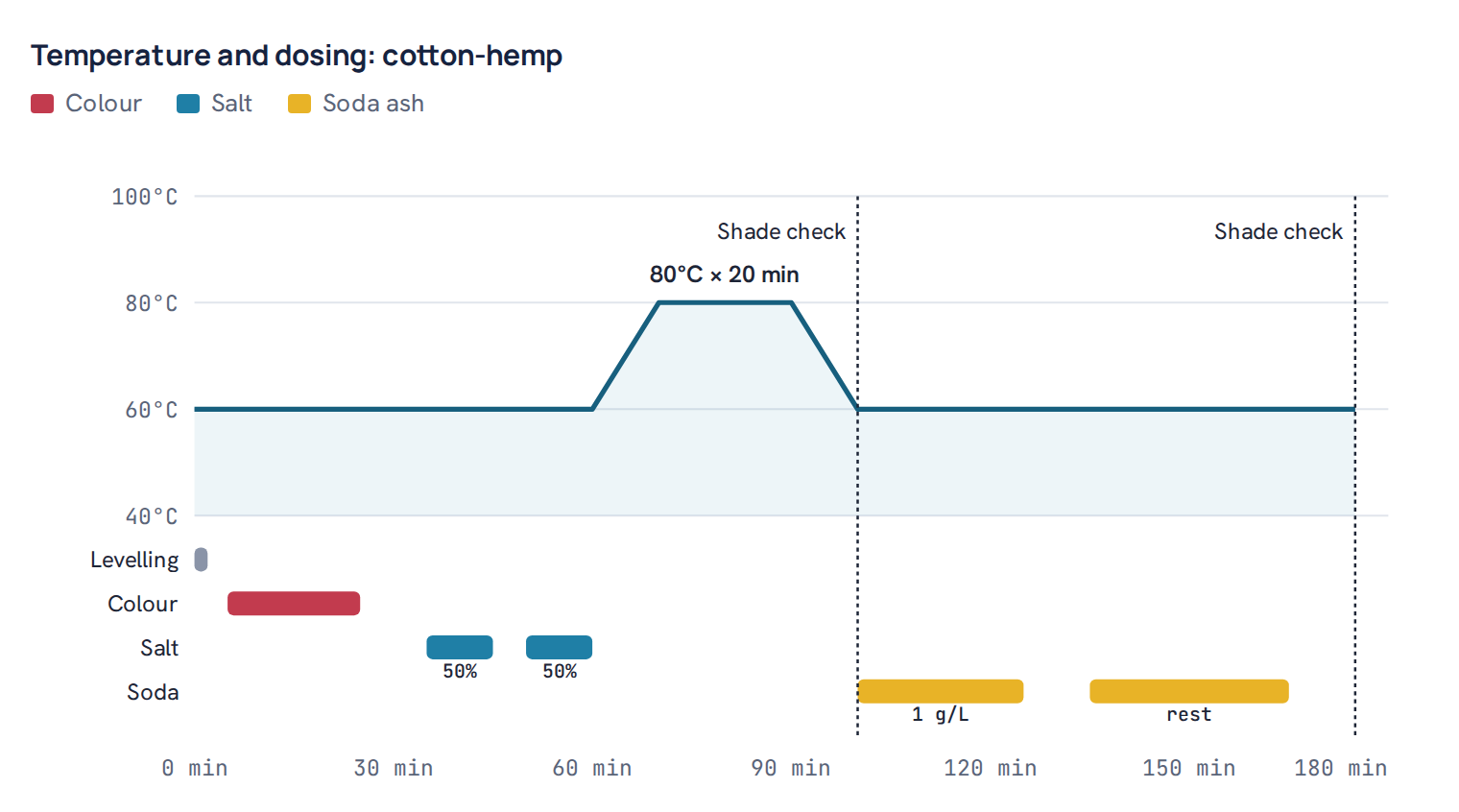
This batch was dyed on the migration-step curve. The colour goes in at 60°C over 20 minutes, the salt in two halves, and then the bath is heated to 80°C for 20 minutes before it cools back to 60°C for the soda. The 80°C step lets the dye migrate and even out before it is fixed.
Step by step
- Levelling at 60°C, run 5 minutes.
- Dose the colour at 60°C over 20 minutes, run 10 minutes.
- Dose 50% of the salt over 10 minutes, run 5 minutes; then the other 50% over 10 minutes, run 5 minutes.
- Heat to 80°C and run 20 minutes, then cool to 60°C and check the shade.
- Dose 1 g/L soda ash over 25 minutes (linear), run 10 minutes.
- Dose the rest of the soda over 30 minutes (70% progressive), run 10 minutes, and check the shade.
On this light-medium tan, a 1:20 liquor ratio, the dyebath held 30 g/L salt and 8 g/L soda ash.
- The migration step is essential for cotton-hemp.
- Hemp is a critical fibre and a special type of fibre, so we always give it the migration.
Wash-off
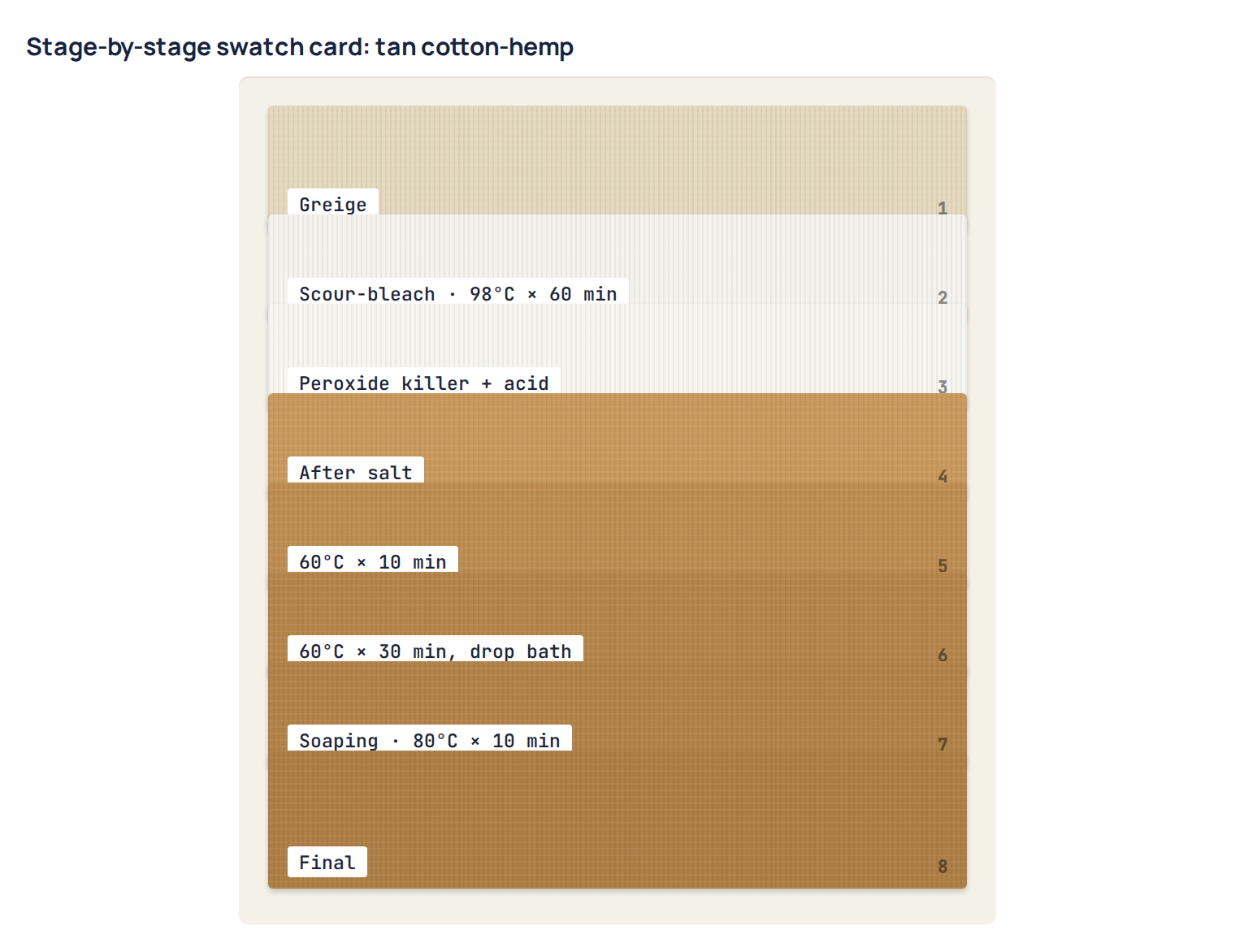
After the shade check the bath is dropped. Soaping follows at 80°C for 10 minutes with a soaping agent (1 g/L) and an auxiliary (0.2 g/L), and the fabric is unloaded.
There is no enzyme on cotton-hemp.
- No enzyme on cotton-hemp. The enzyme destroys the hemp fibres.
- It also loosens the bond between the hemp and the cotton in the yarn and the knit, and the strength falls.
Limitations of cotton-hemp
- Levelness. Hemp is a critical fibre; the migration step is essential.
- Lower strength. Use soda ash, not caustic, in the scour, and skip the enzyme.
- Stiffer handle. Hemp is coarser and stiffer than cotton.
Our finishing records hold only two cotton-hemp batches, too few for GSM and shrinkage figures. We will add them when there is enough data.
- Hemp is a rare fibre. It is not yet at mass production level.
- In most factories it is still at the development stage, with only small production runs, so there are no common buyer complaints yet.
- With the 98°C soda scour, the migration step and no enzyme, it runs without problems.

Textile engineer with 14+ years in dyeing and fabric development. He writes every guide on Dyeing Solution from real production work. Full profile