Cotton and modal are both cellulose, so a cotton-modal knit is dyed in one reactive bath. The modal sets the pace: it takes dye faster and shrinks more. Here is the curve we use and what 274 cotton-modal batches look like at delivery.
At a glance
1 bathReactive for both fibres
80°CSalt in three thirds
60/40Most common blend in our records
18%Lycra-blend parts within GSM
Cotton-modal is one of the most common premium knit blends: cotton for body and strength, modal for softness and drape. In our records most cotton-modal is spun as a 60/40 cotton/modal yarn, often plated with 20D or 30D elastane in rib and single jersey for underwear, T-shirts and ladies’ tops. Unlike CVC, both fibres take the same reactive dyes, so there is only one dyeing bath.
The route for cotton-modal
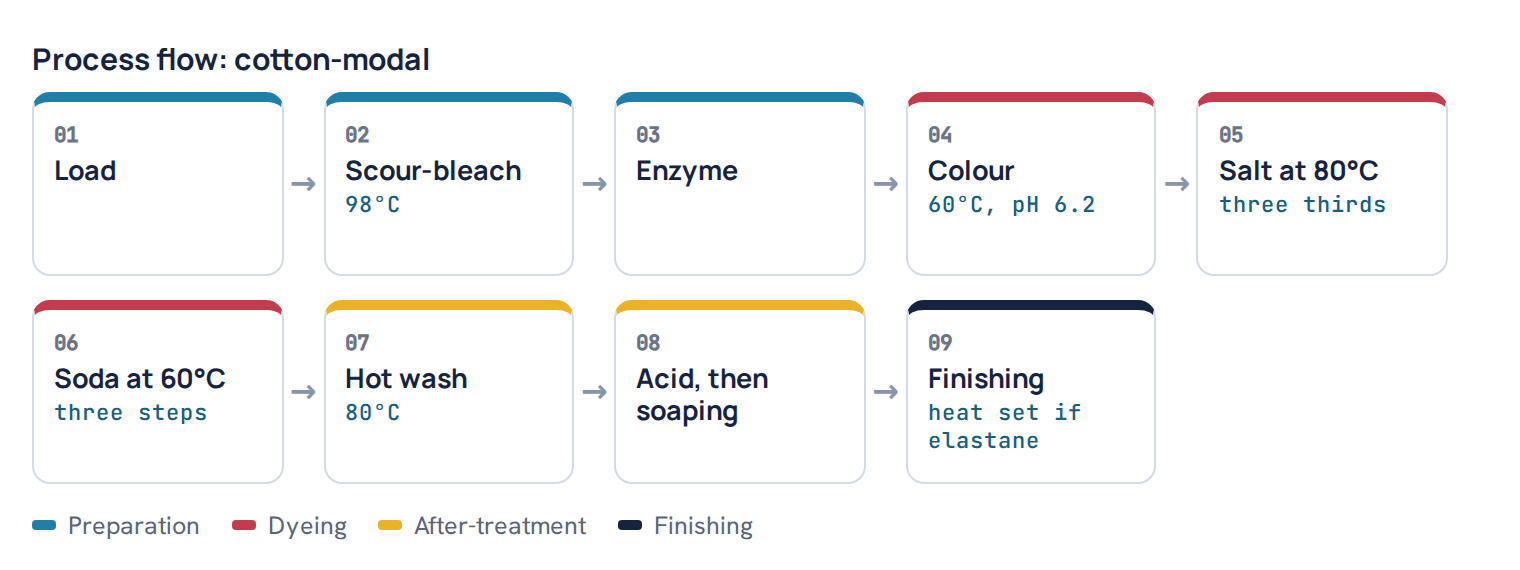
- Load the fabric.
- Scour-bleach at 98°C, the normal cotton scour.
- Enzyme.
- Reactive dyeing at 60°C, with the salt added at 80°C.
- Wash-off: hot wash at 80°C (standard; no need to go higher), acid, soaping.
- Finishing, with heat setting for elastane fabrics.
- Cotton-modal normally needs the 98°C scour.
- The hot wash has no special limit, but 80°C is the standard and there is no need to go above it.
The dyeing curve
Cotton-modal is dyed on the same curve as 100% modal, lyocell and viscose on our process sheets, not the cotton curve. The modal takes up dye faster than the cotton, so the curve slows down the salt and the soda to let both fibres reach the same shade.
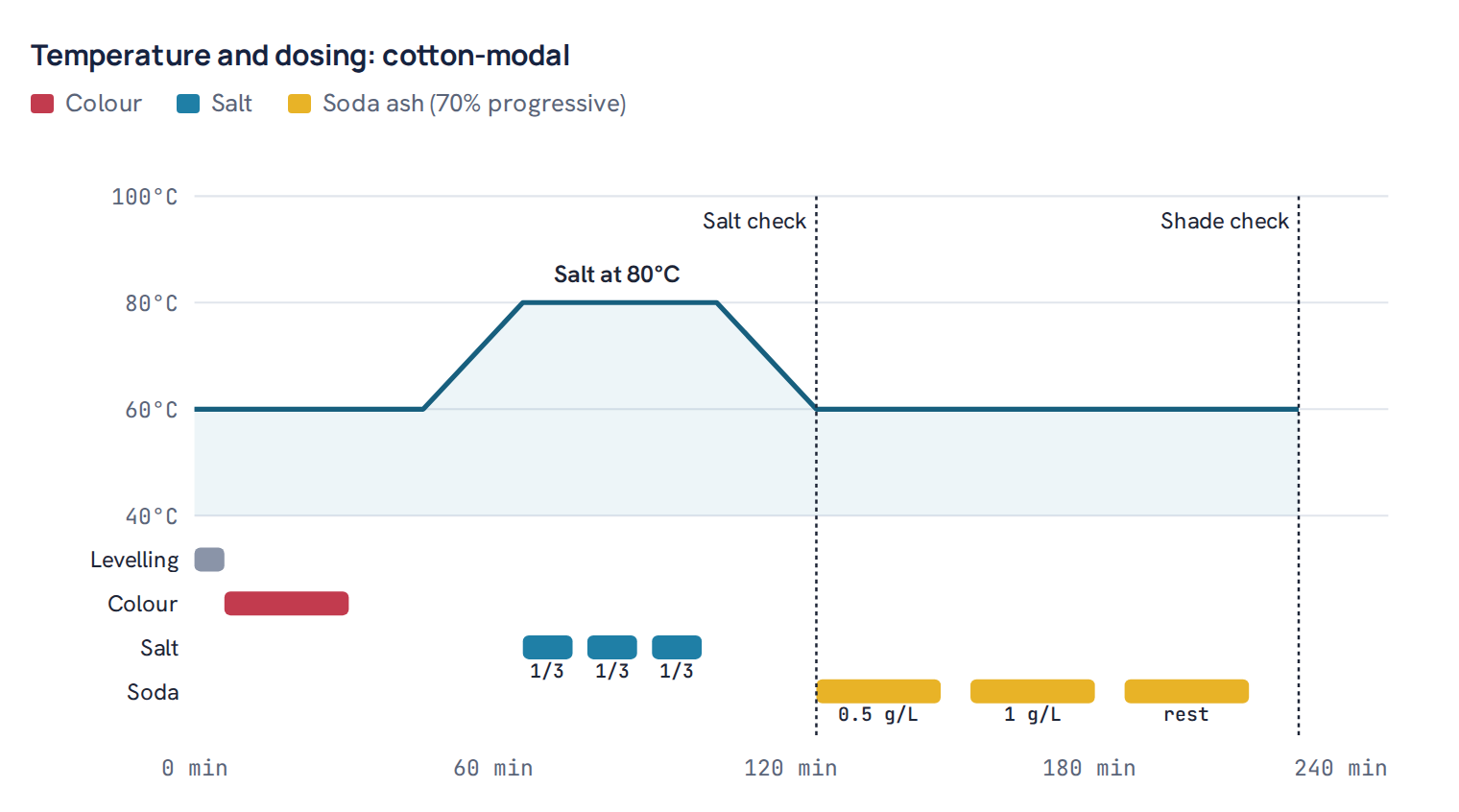
- At 60°C, check the levelling pH (6.2) and add the levelling agent. Run 6 minutes.
- Dose the colour over 25 minutes and run 15 minutes.
- Heat to 80°C at 1°C per minute and dose the salt in three equal thirds, each over 10 minutes with 3 minutes of run time.
- Cool to 60°C at 1°C per minute and check a salt sample.
- Dose the soda in three steps, each over 25 minutes at 70% progressive: 0.5 g/L, 1 g/L, then the rest.
- Check the shade.
Turquoise and bright blue shades on cotton-modal follow their own curves. See the 100% modal and 100% cotton processes.
What cotton-modal looks like at delivery
From our finishing records (see the full GSM and shrinkage study):
| Measure | Cotton-modal + elastane | Cotton-modal | Modal + elastane |
|---|---|---|---|
| Batches | 249 | 25 | 49 |
| Median finished GSM vs required | −7.5% | −6.0% | −6.4% |
| Within ±5% of required GSM | 18% | 44% | 38% |
| More than 5% light | 79% | 52% | 58% |
| Median length shrinkage | 6% | 7% | 6% |
| Median width shrinkage | 4% | 5% | 2% |
| Light parts that overshoot after washing | 49% | 36% | 50% |
| Heat set | 98% | 11% | 100% |
Cotton-modal-elastane by fabric type
| Fabric type | Batches | Median finished GSM vs required | Within ±5% | Median length shrinkage | Median width shrinkage |
|---|---|---|---|---|---|
| Lycra rib (1×1, 2×2, 5×2) | 207 | −7.5% | 19% | 6% | 5% |
| Lycra single jersey | 39 | −6.3% | 14% | 7% | 2.5% |
Cotton-modal with elastane is one of the hardest fabrics in our records to hold to GSM: four out of five parts finish more than 5% light, even though almost all are heat set. Lycra rib also shrinks 5% in width. Half of the light parts overshoot when washed, so washing is not the fix.
Limitations of cotton-modal
- Light GSM on Lycra rib and jersey. Fix the construction in knitting; do not stretch to width and do not rely on washing.
- Width shrinkage on rib. Plan for about 5% in width as well as 6% in length.
- Two fibres, one shade. Modal takes up dye faster than cotton; the slow salt and soda keep them together.
- Fuzzy look. The fabric can look slightly fuzzy, with a pilling-type surface.
- 100% modal fabric is expensive, so cotton and modal are usually mixed.
- There are normally no complaints on cotton-modal.
- It can have a slightly fuzzy look, a pilling-type problem.

Textile engineer with 14+ years in dyeing and fabric development. He writes every guide on Dyeing Solution from real production work. Full profile