Scuba fabric is a thick, smooth, stretchy polyester-elastane double knit that looks like neoprene but is a textile. What it is made of, how it is knitted, scuba vs neoprene and ponte, uses, and how it is dyed and cared for.
At a glance
Double knittwo faces
Polyester+ elastane
Not rubberunlike neoprene
Heat setbefore dyeing
Scuba fabric is a thick, smooth, stretchy double-knit fabric, usually polyester with elastane (spandex). It gets its name from its look and feel, which resemble the neoprene of diving wetsuits, but it is a knitted fabric, not rubber. Scuba holds its shape, does not crease, has a slight sheen and a spongy body, which makes it popular for structured dresses, skirts, tops, leggings, bodycon styles and face masks.
This guide explains what scuba fabric is made of, how it is knitted, scuba vs neoprene and ponte, what it is used for, and how it is processed and cared for, from the dyeing and development side.
What is scuba fabric made of?
Most scuba fabric is around 90–95% polyester and 5–10% elastane. The polyester is usually a fine continuous filament yarn, which gives the smooth, slightly shiny surface; the elastane gives stretch and recovery. Because both fibres are synthetic, scuba does not absorb much water, dries fast and keeps its colour well, but it is not very breathable.
How scuba is knitted
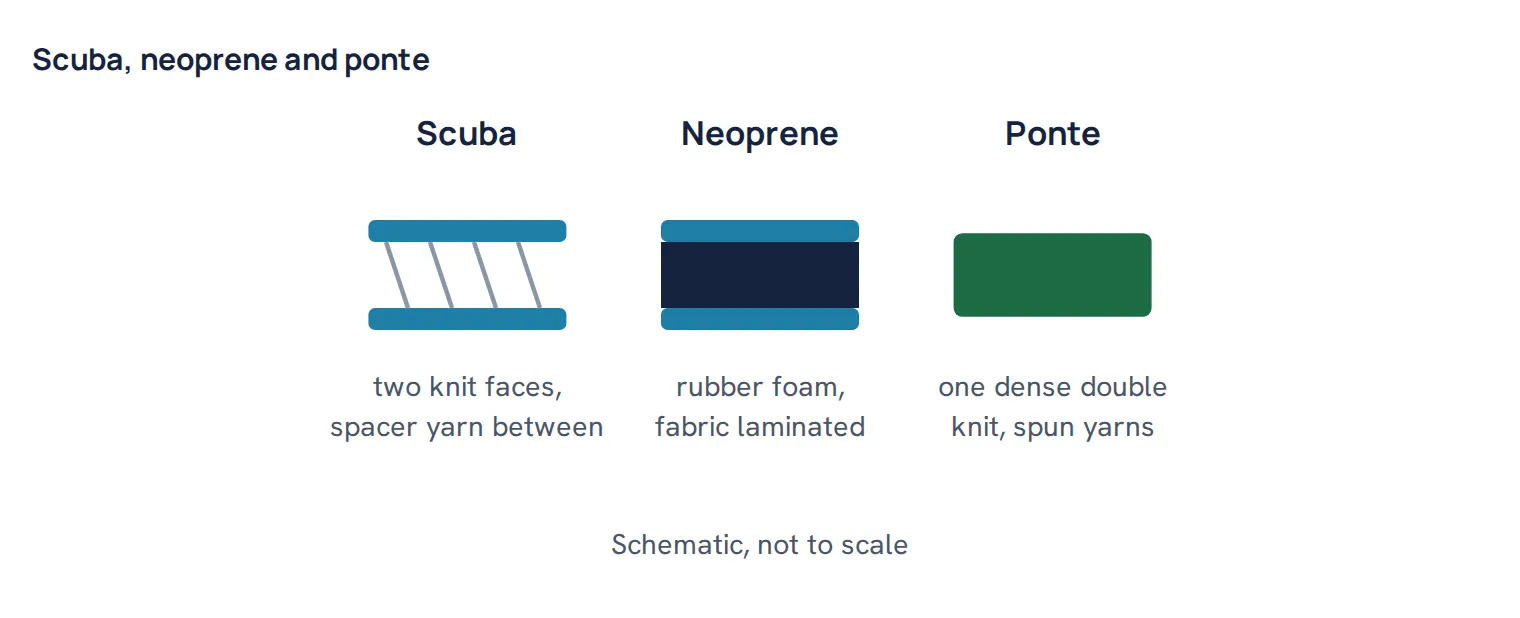
Scuba is a double knit: it is made on a circular machine with two needle beds, so both faces are smooth knit surfaces, joined in the middle. In the most common construction a spacer or tuck yarn holds the two faces slightly apart, which gives scuba its thickness and spongy, cushioned feel. That is also why some scuba is sold as “air layer” or “spacer” fabric. For the related double knits, see interlock and ponte.
Scuba vs neoprene
Real neoprene is a synthetic rubber foam, usually with fabric laminated to both sides; it insulates in water and is used for wetsuits. Scuba fabric only looks similar. It is a knitted textile, lighter, more breathable and easier to sew, and it gives no warmth in water. Clothing labelled “neoprene” for fashion is very often scuba knit.
Scuba vs ponte
Both are thick, stable double knits used for structured clothes. The differences, from our ponte development records:
- Yarn: scuba is usually a fine polyester filament with elastane, smooth and slightly shiny; ponte is usually spun polyester/viscose with elastane, more matte and fabric-like.
- Feel: scuba is spongy and springy; ponte is denser and drapes more.
- Breathability: ponte, with viscose, breathes better; scuba is warmer and less breathable.
- Pilling: ponte made from spun polyester tends to pill; filament scuba pills less.
See the Ponte Roma development guide for how ponte is knitted.
How scuba is processed in the dye house
Scuba is processed like other polyester-elastane knits. It is heat set first to fix its width and stretch, then dyed with disperse dyes at high temperature, kept at the lower end of the range because of the elastane, then cleared to remove loose dye. Polyester-elastane dyeing needs care: too fast a heating rate gives uneven, streaky shades, and every extra high-temperature cycle weakens the elastane. See the polyester-elastane dyeing process. Scuba is also a favourite base for sublimation printing, because it is white polyester with a smooth surface.
What is scuba fabric used for?
- Structured dresses, pencil and skater skirts
- Fitted tops, crop tops and bodycon styles
- Leggings and athleisure
- Face masks, bags and costumes
- Printed fashion, especially sublimation prints
Common mistake: ironing scuba on a high heat setting. The polyester and elastane can glaze, shine or shrink, and the iron can leave a permanent mark. Use low heat with a pressing cloth, or steam lightly from a distance.
How to care for scuba fabric
- Wash at 30°C on a gentle cycle, inside out.
- Do not use bleach; avoid hot tumble drying.
- Hang to dry; it dries quickly and rarely needs ironing.
- If needed, iron on low heat with a pressing cloth.
Summary
- Scuba is a thick, smooth polyester-elastane double knit, not rubber.
- It looks like neoprene but is lighter, easier to sew and gives no warmth in water.
- Compared with ponte it is springier and shinier, and less breathable.
- It is heat set and dyed with disperse dyes, and is popular for sublimation prints.
- Wash cool, avoid high heat and use a pressing cloth when ironing.
Questions
What is scuba fabric?
A thick, smooth, stretchy double-knit fabric, usually polyester with elastane, that looks like neoprene but is a knitted textile.
What is scuba fabric made of?
Usually about 90–95% polyester and 5–10% elastane (spandex), with a fine polyester filament giving the smooth face.
Is scuba fabric the same as neoprene?
No. Neoprene is rubber foam used for wetsuits; scuba is a knitted fabric that only looks similar. It is lighter and easier to sew.
What is the difference between scuba and ponte?
Both are thick double knits. Scuba is usually filament polyester-elastane, springy and slightly shiny; ponte is usually spun polyester-viscose-elastane, denser and more matte.
Is scuba fabric breathable?
Not very. Polyester absorbs little moisture and the double structure is thick, so scuba is warm and best for cooler weather or short wear.

Textile engineer with 14+ years in dyeing and fabric development. He writes every guide on Dyeing Solution from real production work. Full profile