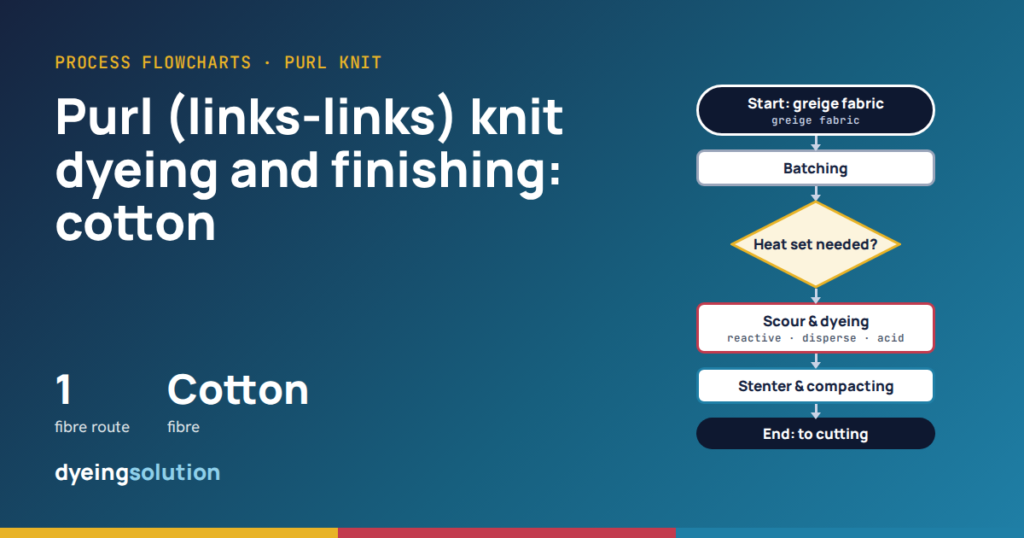
Purl looks the same on both sides and stretches a lot in length, so length shrinkage is the thing to watch. Here is the cotton route from greige fabric to the cutting table.
At a glance
100% cottonFibre in our records
Not heat setIn our records
LengthStretches most
Purl (links-links) knit alternates face and back loops course by course, so both sides look like the back of single jersey. It stretches far more in length than other knits and does not curl at the edges. It is used for sweater-style tops and baby wear.
This is a rare fabric in our records, so this article gives the route and the rules rather than statistics.
How it is dyed
Cotton purl follows the 100% cotton route. Because it stretches so much in length, it must not be pulled long in finishing: relaxed drying, overfeed and compacting control its length shrinkage.
Purl has a reversible, textured structure and is sensitive to relaxation. Length shrinkage is controlled through proper relaxation, dryer overfeed, width control and compaction, without excessive tension.
The sequence before the dyeing machine
Every chart below follows the same sequence before dyeing. Steps a fabric does not need simply drop out; they are drawn dashed.
- Greige inspection, then batching. A fabric that stays a tube is turned inside out here.
- If it needs heat setting, singeing or mercerising: slitting first. None of these is ever done on a tube.
- If it needs heat setting: heat setting in open width.
- If it needs singeing: singeing in open width, after checking the flame cannot damage the fabric.
- If it is mercerised: mercerising, then drying.
- If the fabric was opened: back sewing, to make it a tube again with the face side inside (the loop side, for terry).
- Loading into the dyeing machine, then scouring, bleaching and dyeing, single part or double part as the fibre needs.
Flowchart
100% cotton purl knit
Full fibre process: 100% cotton dyeing process.
Dyeing and finishing: 100% cotton purl knit
Common faults and buyer complaints
High length shrinkage. Improve relaxation, overfeed and compaction.
GSM and width variation. Control stitch length and finishing.
Spirality or skewness. Balance knitting and finishing tension.
Crease marks. Reduce rope tension.
Uneven appearance. Control knitting and dyeing.

Textile engineer with 14+ years in dyeing and fabric development. He writes every guide on Dyeing Solution from real production work. Full profile