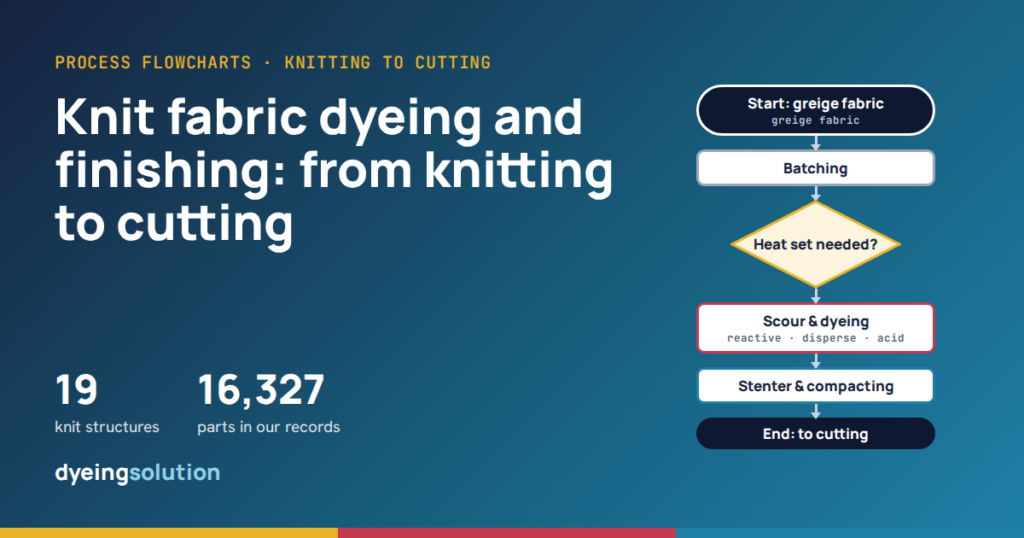
One master sequence that every knit fabric follows, the rules that decide which steps a fabric needs, and a flowchart article for each of 19 knit structures, built on 16,326 parts from our finishing records.
At a glance
19Knit structures
16,326Parts in our records
15Fibre processes
Greige knit fabric leaves the knitting floor as a tube. Before it reaches the cutting table it is inspected, prepared, dyed and finished, and every step changes its width, GSM and shrinkage. The order of those steps is the same for every knit. What changes from fabric to fabric is which optional steps it needs, and how each step is set.
This page sets out that master sequence and the rules behind it. Each fabric then has its own article with a flowchart for every fibre it is made in.
The master flowchart
Knit dyeing and finishing: the master sequence
The rules that decide each step
Heat setting
Heat setting is done open width at 180–190°C, after slitting. It is mainly for dimensional stability, not only to prevent crease marks. Six things decide it:
- Fibre content. Polyester and nylon fabrics are heat set.
- Elastane. Fabric with Lycra is heat set to fix the stretch.
- GSM. Single jersey from 180 GSM, lacoste from 250 GSM, fleece and terry from 350 GSM.
- Construction. A tight knit is heat set.
- Width and stability. When the buyer’s width or stability needs it.
- Design fabrics. Jacquard, pointelle and other 3D or loose designs are heat set to fix the width at which the design shows correctly.
Rib and interlock are stable double knits and are heat set only when they are heavy, tight or Lycra body rib. Collar and cuff rib is not heat set, even with Lycra.
Turning and back sewing
Every fabric is dyed with the face inside, so nozzle friction and any spots fall on the back. A fabric that stays a tube is turned inside out at batching. A fabric opened for heat setting, singeing or mercerising is back sewn into a tube with the face inside (terry: loop side inside) before it is loaded.
Singeing
Singeing is used when the fabric cannot take the enzyme and the buyer needs a clean face. It is always done in open width, never on a tube: the fabric is slit after batching and singed, after heat setting when it is heat set. Check first that the flame cannot damage the fabric: polyester cannot be singed because it hardens, and CVC or fleece is singed only when the face is cotton yarn.
Mercerising
Mercerising is done on buyer requirement, followed by drying, before back sewing and loading. Mercerised knit has its own process article.
Single or double part dyeing
A fabric of one fibre is dyed in one part. A blend whose fibres need different dye classes, such as CVC, PC or polyester-viscose, is dyed in two parts: the polyester part first with disperse dye at 130°C and reduction clearing, then the cotton or viscose part with reactive dye.
Finishing
Most knit fabric today is finished open width: slitting, stenter and compacting. The stenter runs at about 150°C for cotton, but at 100–110°C once a polyester part has been dyed, to protect fastness. Tubular finishing (squeezer, relax dryer, turning machine, tube compacting) is still used for some fabric; turn the tube before compacting, or dust trapped inside is pressed into a white mark that never comes out.
Before cutting
After compacting, the fabric is given time to relax before cutting, typically 12 to 24 hours. The cutting floor asks for shrinkage, spirality or skewness, and a shade band with 4-point inspection.
Bursting strength
Bursting is not a step in the flowchart. It is tested in the lab on finished fabric against the buyer’s kPa requirement. Loose fabrics such as fleece and waffle lose bursting strength to too much enzyme, which is why some of them are singed instead.
Steps only some fabrics need
| Fabric | Extra or changed step |
|---|---|
| Fleece | Slitting, stenter, peach if needed, brushing, stenter, shearing, compacting |
| French terry | Never brushed; peach between two stenter passes when needed; loop side inside for dyeing |
| Pique | Relax dryer after the stenter to take out length shrinkage |
| Waffle | Singeing instead of enzyme on cotton; GSM checked after washing |
| Jacquard | Width and overfeed set to the buyer’s swatch at heat setting |
| Mesh | Polyester mesh always heat set; cotton mesh GSM checked after washing |
Flowcharts by fabric
Every fabric in our finishing records, by share of parts. Each link opens the flowcharts for every fibre that fabric is made in.
| Fabric | Parts | Share |
|---|---|---|
| Single jersey | 8,277 | 50.7% |
| Rib | 2,120 | 13.0% |
| Fleece | 1,823 | 11.2% |
| French terry | 1,096 | 6.7% |
| Interlock | 1,049 | 6.4% |
| Pique and lacoste | 824 | 5.0% |
| Double-face and bonded interlock | 330 | 2.0% |
| Waffle and thermal | 275 | 1.7% |
| Jacquard | 185 | 1.1% |
| Pointelle | 110 | 0.7% |
| Mesh | 76 | 0.5% |
| Drop needle rib | 72 | 0.4% |
| Ponte roma | 36 | 0.2% |
| Ottoman rib | 34 | 0.2% |
| Scuba | 12 | 0.1% |
| Denim-look knit | 3 | 0.0% |
| Popcorn | 2 | 0.0% |
| Seersucker knit | 1 | 0.0% |
| Purl (links-links) | 1 | 0.0% |
Dyeing process by fibre
The flowcharts show the order of steps. The full recipe-level process for each fibre is in these articles:
- 100% cotton dyeing process
- Cotton-elastane (Lycra) dyeing process
- CVC and PC dyeing process
- 100% polyester dyeing process
- Polyester-elastane dyeing process
- Viscose dyeing process
- Modal dyeing process
- Lyocell dyeing process
- Cotton-modal dyeing process
- Nylon dyeing process
- Cotton-acrylic dyeing process
- Cotton-hemp dyeing process
- Linen blends dyeing process
- Cotton-Sorona type dyeing process
- Mercerised knit dyeing process
Related: crease marks in knit dyeing and stripping reactive-dyed cotton.
Questions
What is the dyeing process of knit fabric?
Greige inspection, batching, slitting and heat setting if needed, then loading in the dyeing machine, scouring and bleaching, enzyme if the fibre allows, dyeing, wash-off and softening, then stenter, compacting, final inspection and relaxation before cutting. The flowchart above shows each step and when it is needed.

Textile engineer with 14+ years in dyeing and fabric development. He writes every guide on Dyeing Solution from real production work. Full profile