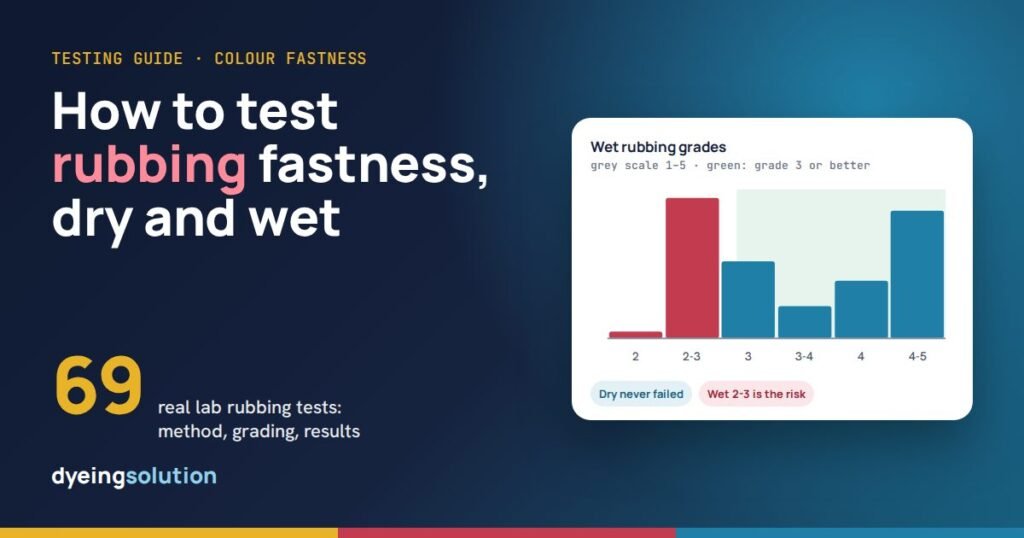
How the lab tests colour fastness to rubbing dry and wet (ISO 105-X12), step by step, how the grey scale grading works, and what 69 real lab tests on knit developments showed.
About this guide. The method below is written from the public ISO and AATCC standards in plain words. The data comes from our own lab reports on 95 new knit developments, each tested by an accredited lab to the buyer’s standard, so you can see what real results look like.
At a glance
69Rubbing tests in our data
85%Passed
0Dry rubbing fails
Dry 4 / wet 3Usual minimum
What the test measures
Rubbing (crocking) fastness is how much colour a fabric gives off when it is rubbed against another surface: a light shirt under a dark jacket, a sofa under black jeans. It is tested dry and wet, because water helps loose dye move, so wet rubbing is always the harder test.
Equipment
- A crockmeter: a rounded rubbing finger 16 mm across that presses down with a force of 9 N and moves back and forth over a 104 mm track.
- White cotton rubbing cloth, cut into 50 × 50 mm squares.
- Distilled water and a way to wet the cloth to a set pick-up (a balance and a squeeze roller or blotting paper).
- The grey scale for assessing staining, and a viewing cabinet with daylight (D65) light.
How the test is done, step by step (ISO 105-X12)
- Condition the fabric and the rubbing cloth in the standard atmosphere.
- Cut specimens at least 50 × 140 mm: one set along the length and one across the width, for dry and for wet.
- Fix the specimen flat on the base of the crockmeter, with the length of the specimen along the track.
- Dry rubbing: fix a dry square of rubbing cloth over the finger, lower it onto the fabric and run 10 strokes back and forth in 10 seconds.
- Wet rubbing: wet a new square of cloth with water so it carries 95–100% of its own weight in water, then repeat the 10 strokes.
- Dry the wet cloth at room temperature.
- Assess each rubbing cloth against the grey scale for staining, in the viewing cabinet.
Grading the result
The grey scale for staining runs from 5 (no staining) to 1 (heavy staining), in half grades. The cloth is laid beside an unused piece of the same cloth, and the contrast between them is matched to the nearest pair on the scale. The lowest grade from the length and width specimens is reported. AATCC 8 works on the same principle.
Example. Dry cloth slightly tinted, matched to grade 4-5. Wet cloth clearly stained, matched to grade 2-3. Reported: dry 4-5, wet 2-3. Against a minimum of dry 4 and wet 3, it fails on wet.
What real results look like
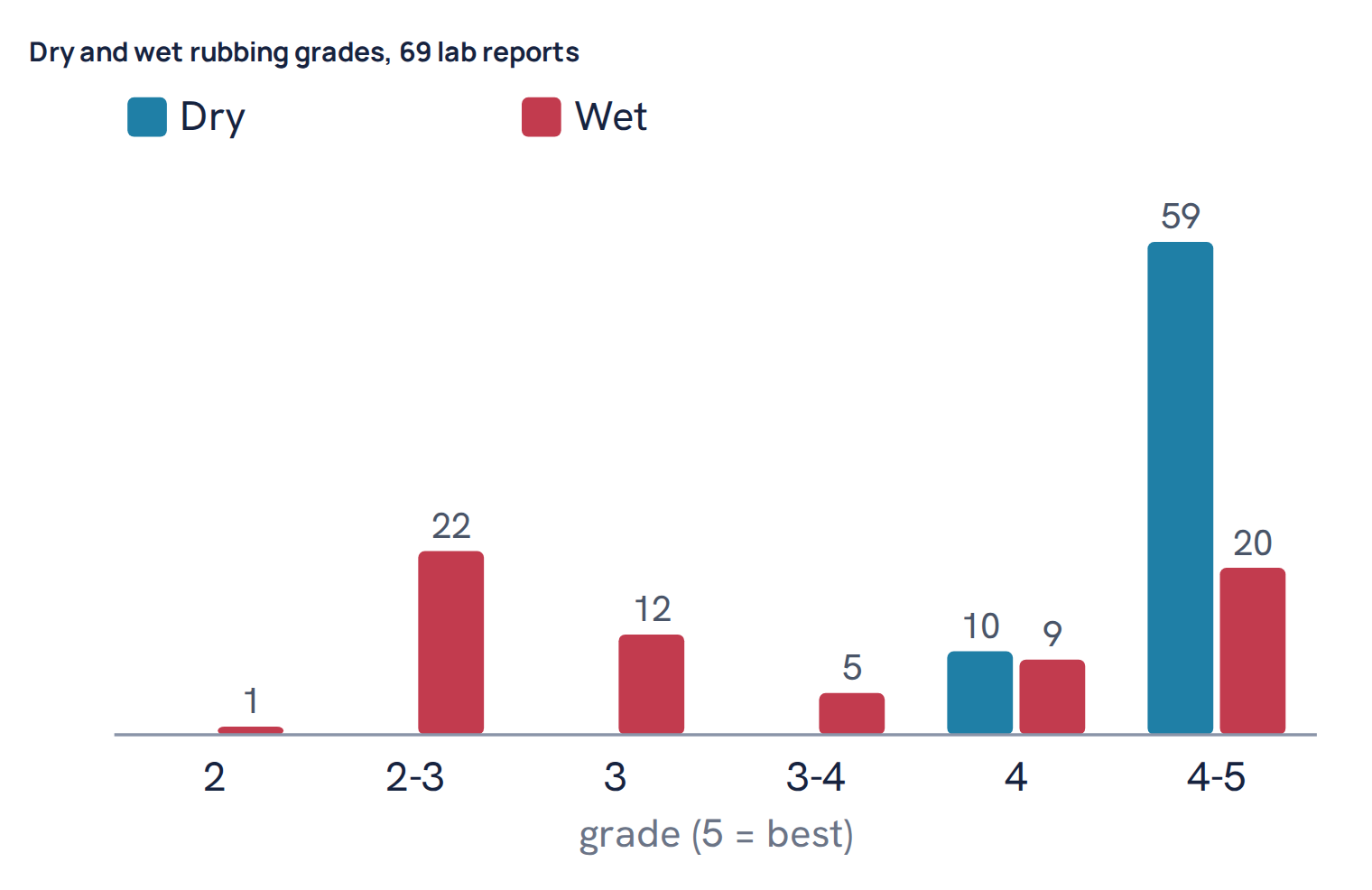
59 of 69 batches passed. Dry rubbing never failed. Every fail was on wet rubbing, and almost all on deep shades.
Checking rubbing in the factory before the lab
A wet rub check on a dyed swatch, with a white cotton cloth wetted the same way, takes a few minutes and tells you before unloading whether the wash-off was enough. On a deep shade, also wash a small sample in a pot and see whether the water takes colour.
Common mistakes that change the result
- Too much or too little water in the wet cloth; a wetter cloth stains more.
- Rubbing cloth that is not the standard white cotton.
- Assessing under shop lighting instead of daylight in a viewing cabinet.
- Testing only along the length; across the width can grade lower.
- Testing fabric straight from the stenter, before it has cooled and conditioned.
If a batch fails, see why knit fabric fails wet rubbing: 10 real cases and the fix.
From the floor
- Wet rubbing fails on our deep shades: black, red, royal blue and turquoise. Wet 2-3 is normal with standard soaping and wash clear; wet 3 is tough.
- For wet 3 on cotton we soap twice at 80°C, give hot washes at 70°C and 60°C, check a sample for bleeding against white fabric, then fix, wash clear and give a wet rubbing improver before unloading. Many times it comes 3-4.
- With polyester in the fabric, reduction clear twice for wet 3, and never finish above 100–110°C.
Questions
What is the difference between dry and wet rubbing?
Dry rubbing uses a dry cloth; wet rubbing uses a cloth wetted to 95–100% pick-up. Water helps loose dye move, so wet rubbing grades lower.
What does grade 2-3 mean in rubbing fastness?
Noticeable staining on the white cloth, halfway between grade 2 (considerable staining) and grade 3 (moderate staining).
Which standard is used for rubbing fastness?
ISO 105-X12 in most of our reports; AATCC 8 and GB/T 3920 work on the same principle.
Related: dye recipe calculator.

Textile engineer with 14+ years in dyeing and fabric development. He writes every guide on Dyeing Solution from real production work. Full profile