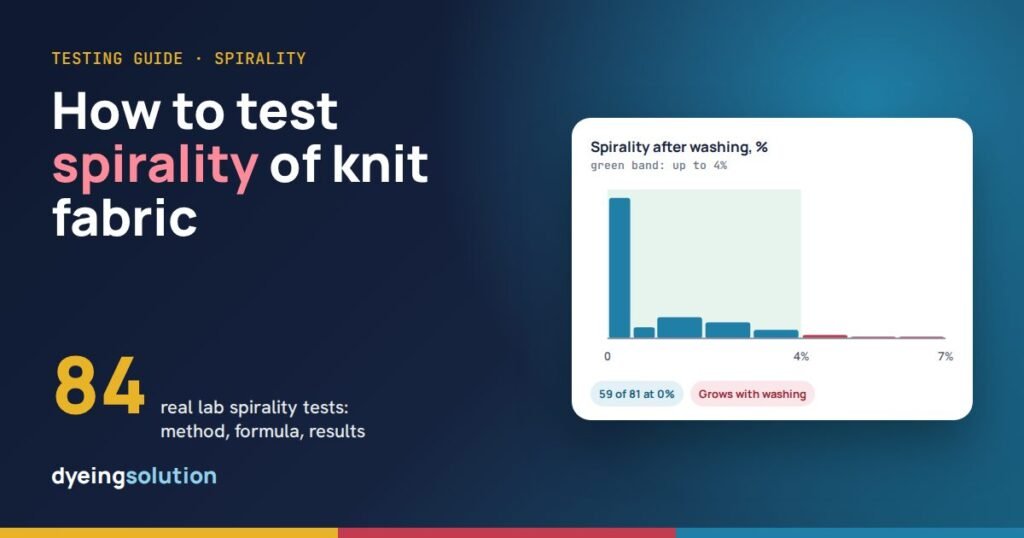
How the lab measures spirality (twist) in knit fabric after washing, step by step, with the formula, a worked example, and what 84 real lab tests showed.
About this guide. The method below is written from the public ISO and AATCC standards in plain words. The data comes from our own lab reports on 95 new knit developments, each tested by an accredited lab to the buyer’s standard, so you can see what real results look like.
At a glance
84Spirality tests in our data
96%Passed
59 of 81Measured 0% after one wash
4%Common maximum
What the test measures
Spirality is when the wales of a knit fabric stop running straight down and lean to one side after washing. In a garment it shows as side seams that twist round the body and hems that drop at an angle. The lab measures how far the wale line moves from its original position after washing, as a percentage of the length measured.
Equipment
- The same washing machine, detergent and drying equipment as the shrinkage test.
- A right-angle ruler or set square, a steel rule and an indelible marker.
- A conditioning room at 20 ± 2°C and 65 ± 4% RH.
How the test is done, step by step
- Cut and condition the specimen, as for the shrinkage test (often the same specimen is used for both).
- Mark a reference. Draw a straight line along one wale, and a line at right angles across the course at one end, so you have an upside-down T of known length.
- Wash and dry as the buyer specifies (ISO 6330 programme and drying method), once or five times.
- Condition again and lay the specimen flat without pulling it straight.
- Measure the displacement: how far the end of the wale line has moved sideways from a line drawn at right angles to the course line.
- Calculate the spirality.
Calculating the result
Spirality % = sideways displacement ÷ marked length × 100 (ISO 16322-2 describes the marking options).
Worked example. A 40 cm wale line has moved 1.6 cm sideways after washing. Spirality = 1.6 ÷ 40 × 100 = 4.0%. Against a maximum of 4% it is just at the limit; another wash would probably take it over.
On garments, some buyers use AATCC 179 (skewness change), which measures the same lean on a made-up garment.
What real results look like
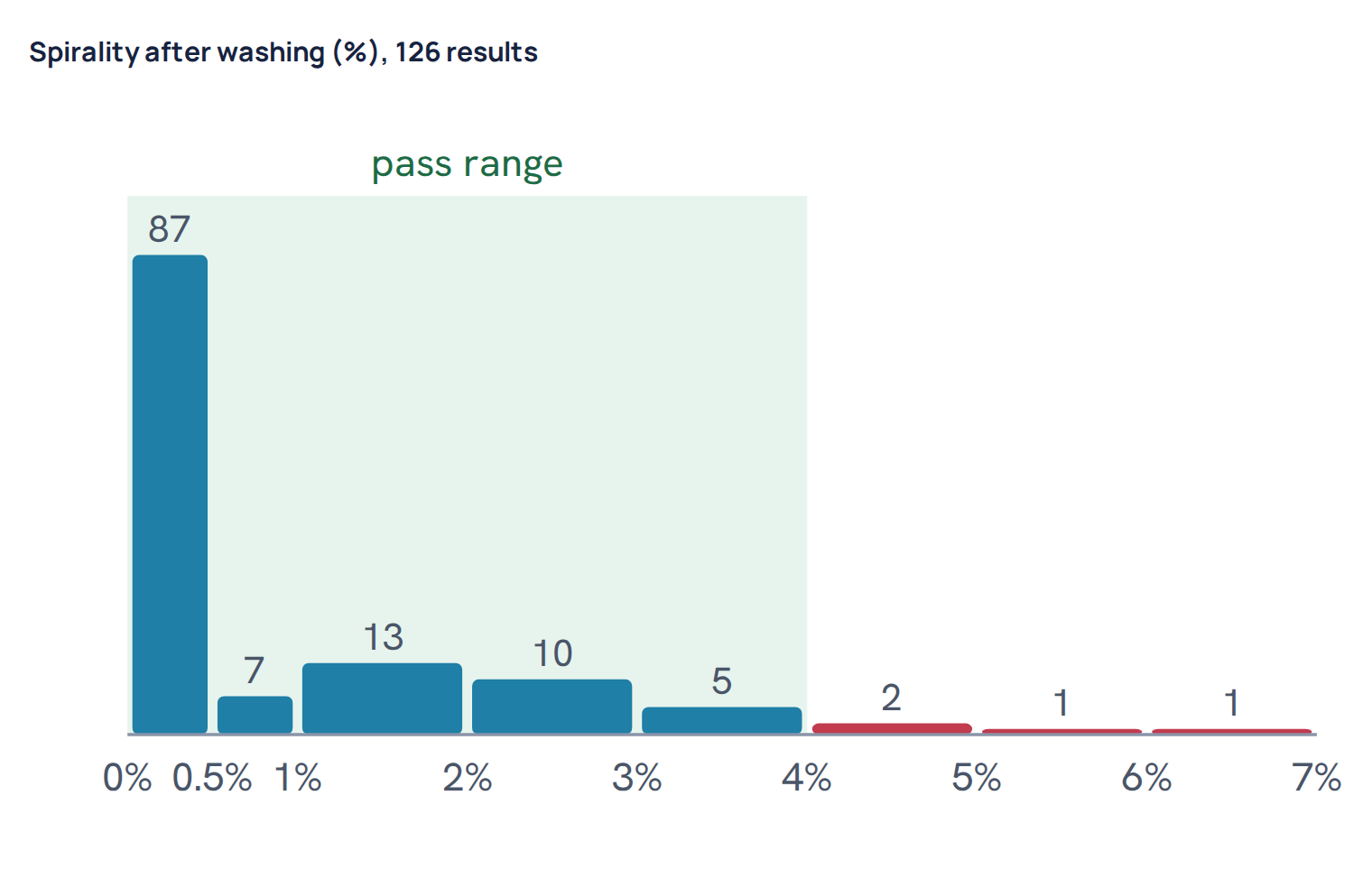
59 of 81 one-wash results were 0%. Rib, interlock, waffle and fleece are balanced structures and do not twist; spirality belongs to single jersey and to rib knitted from twist-lively single yarn. 81 of 84 batches passed.
| Fabric group | Tested | Passed |
|---|---|---|
| Single jersey | 14 | 13 (92%) |
| Rib | 22 | 20 (90%) |
| Interlock | 8 | 8 (100%) |
| Terry | 11 | 11 (100%) |
| Waffle | 10 | 10 (100%) |
| Fleece | 17 | 17 (100%) |
| Pique and lacoste | 2 | 2 (100%) |
Common mistakes that change the result
- Smoothing the specimen straight before measuring, which pulls the wales back into line.
- Drawing the reference line along a course instead of a wale, or not at a true right angle.
- Testing after one wash when the buyer asks for five; spirality grows with every wash.
- Drying by a different method: tumble drying shows more spirality than line drying.
If a batch fails, see why knit fabric fails the spirality test.
From the floor
- Spirality comes from the yarn twist: the twist creates torque, and the torque gives spirality.
- Improper finishing makes it worse, when the width is taken up and down.
- Use alternate S- and Z-twist yarn on the knitting machine, and finish open width on the stenter with the wale line properly controlled. Then there is no problem.
Questions
How is spirality calculated?
Sideways displacement of the wale line ÷ marked length × 100. A 1.6 cm shift over 40 cm is 4%.
What is the spirality limit for knit fabric?
Most buyers allow up to 4% after washing; some ask for 3% or less.
Which fabrics show spirality?
Mainly single jersey and fabrics knitted from twist-lively single yarn. Double-knit fabrics such as rib and interlock rarely do.
Related: shrinkage and GSM after wash calculator.

Textile engineer with 14+ years in dyeing and fabric development. He writes every guide on Dyeing Solution from real production work. Full profile