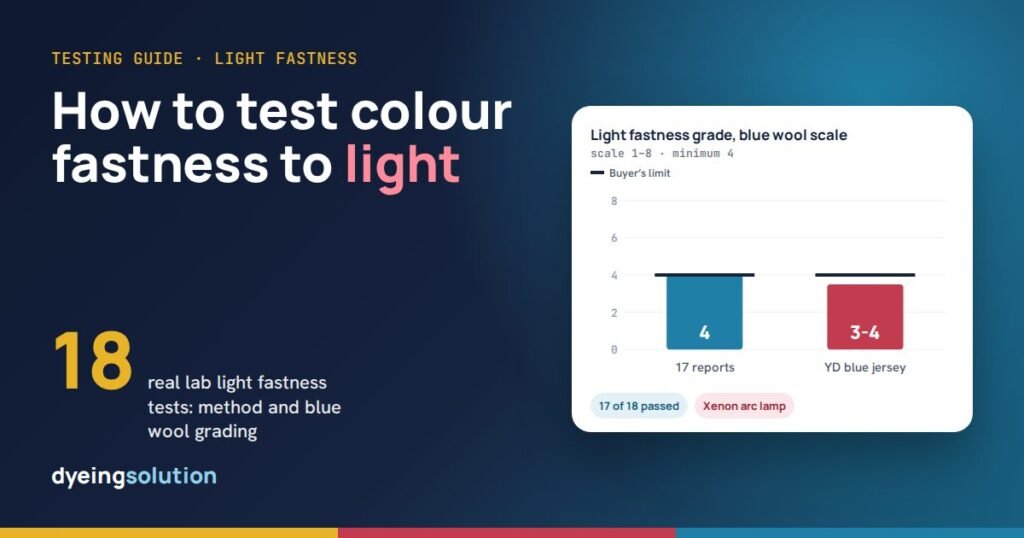
How the lab tests colour fastness to light with a xenon arc lamp and blue wool references (ISO 105-B02), how the 1 to 8 grading works, and what our lab reports showed.
About this guide. The method below is written from the public ISO and AATCC standards in plain words. The data comes from our own lab reports on 95 new knit developments, each tested by an accredited lab to the buyer’s standard, so you can see what real results look like.
At a glance
18Light fastness tests in our data
17 of 18Passed
1 to 8Blue wool scale
4Usual minimum
What the test measures
Colour fastness to light shows how much a colour fades in daylight. It matters most for outerwear, sportswear and anything sold in a shop window. Unlike the other fastness tests, it is graded on a scale of 1 to 8, not 1 to 5.
Equipment
- A xenon arc lamp tester, filtered to match daylight through window glass, with control of temperature and humidity (air-cooled in our reports).
- Blue wool references 1 to 8: eight standard blue wool fabrics, each fading at about twice the speed of the next one up.
- The grey scale for colour change, opaque covers for masking, and a viewing cabinet.
How the test is done (ISO 105-B02)
- Mount the specimen on a card beside the blue wool references.
- Cover part of each specimen and reference, so an unexposed area stays for comparison.
- Expose them together under the xenon lamp.
- Check the references: the exposure runs until the blue wool reference for the target grade (grade 4 in most of our reports) has faded by a set amount on the grey scale.
- Compare the fading of the specimen with the fading of the blue wool references. The grade is the number of the reference that faded about as much as the specimen.
Example. A navy specimen fades less than blue wool 4 but more than blue wool 5: grade 4. A blue that faded about halfway between references 3 and 4 is graded 3-4, and fails a minimum of 4.
What real results look like
17 of 18 lab reports passed. The one fail was a yarn-dyed blue single jersey at 3-4 against a minimum of 4. Reactive dyes on cotton generally reach grade 4 at medium and deep shades; pale shades and some bright blues and turquoises are the risk.
Common mistakes that change the result
- Running the test without the right blue wool references beside the specimen.
- Letting the temperature or humidity in the tester drift, which changes how fast colours fade.
- Assessing the faded area under the wrong light.
From the floor
- Light fastness depends totally on the dyes: on the dye supplier and the dye maker. If they do not give high light-fastness dyes, we cannot control it in any way on the floor.
- So to get light fastness right, use high light-fastness dyes. That’s all.
Questions
Why is light fastness graded 1 to 8?
It is compared with eight blue wool references, each fading about twice as slowly as the one below it.
What light fastness grade do buyers ask for?
Grade 4 in most of our reports; some accept 3 for pale shades.

Textile engineer with 14+ years in dyeing and fabric development. He writes every guide on Dyeing Solution from real production work. Full profile