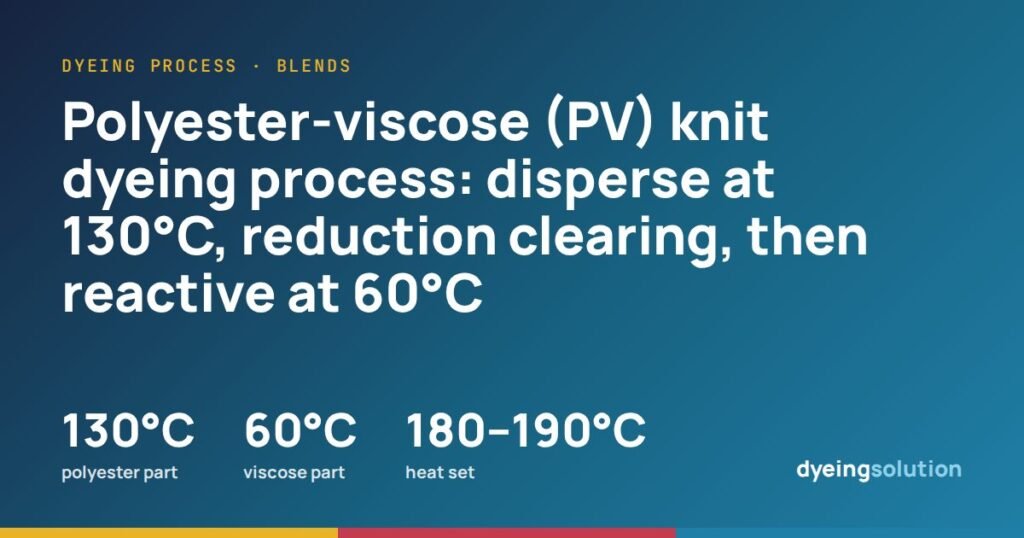
Polyester-viscose is dyed in two baths: the polyester part with disperse dye at 130°C, then the viscose part with reactive dye at 60°C. Here is the process from our floor, step by step, and what PV looks like at delivery.
At a glance
180–190°CHeat set before dyeing
130°CPolyester part, pH 4.5
60°CViscose part
No enzymeSingeing if a clean face is needed
Polyester-viscose (PV, also called TR) knit is dyed in two baths. The polyester part takes disperse dye under pressure; the viscose part takes reactive dye like any cellulose. Each part follows its own single-fibre process: polyester first, then viscose.
The route for polyester-viscose
Process flow: polyester-viscose (PV) knit dyeing
- Heat setting of the greige fabric at 180–190°C. Any fabric that needs polyester dyeing is heat set first.
- Load the fabric and give a loading hot at 80°C for 10 minutes.
- Polyester part: disperse dyeing at pH 4.5 and 130°C, following the 100% polyester process.
- Reduction clearing to remove the loose disperse dye from the surface.
- Viscose part: reactive dyeing at 60°C, following the 100% viscose process.
- After-treatment: hot wash (never above 80°C), soaping, fixing and softener.
- Finishing at 100–110°C.
- Polyester-viscose is dyed in two parts. First the polyester part is dyed, then reduction clearing, then the viscose part.
- The polyester part follows the polyester process and the viscose part follows the viscose process.
- No enzyme on polyester-viscose. If the buyer needs a clean surface, singeing can be done instead.
- There is no scouring on polyester-viscose. Only sometimes, for light colours, a scour is done.
There is normally no scour on polyester-viscose: the fabric goes straight from the loading hot into the polyester bath, as on 100% polyester. Only for some light colours is a scour given first.
Heat setting
Polyester-viscose is heat set before dyeing at 180–190°C. It fixes the width and the dimensions before the fabric goes into the hot polyester bath. In our records 75% of PV parts are heat set.
The dyeing curves
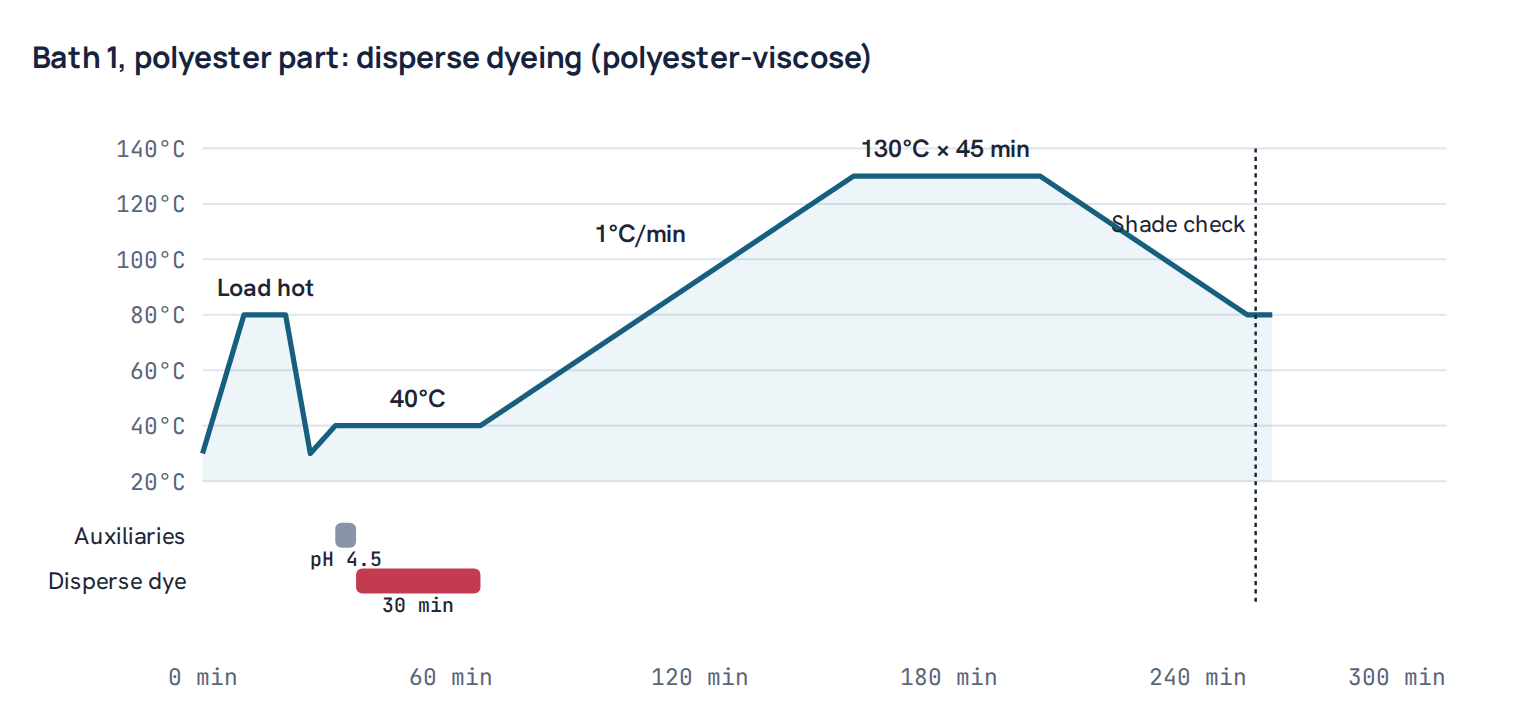
The polyester bath runs exactly as on 100% polyester: pH 4.5, the disperse dye dosed over 30 minutes, a steady rise to 130°C, 45 minutes at 130°C, and a slow cool before the shade is checked. After draining, the fabric is reduction cleared, so no loose disperse dye is carried into the reactive bath.
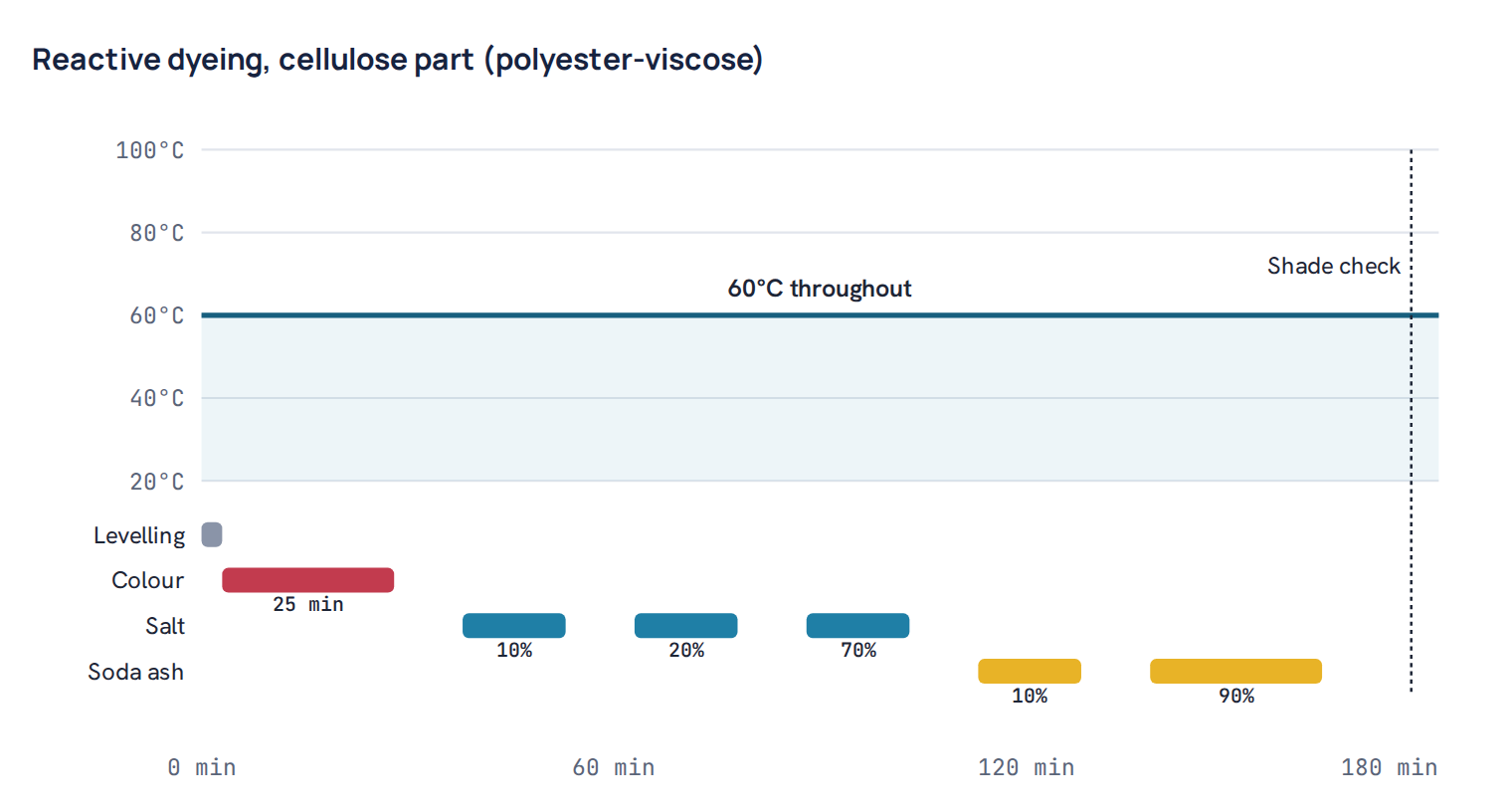
The viscose part is then dyed on the viscose curve: everything at 60°C, with the salt and soda dosed in portions so the fast-dyeing viscose goes on evenly.
Common fault: carrying loose disperse dye into the reactive bath. Without a proper reduction clear, the surface disperse dye stains and the final fastness fails, however good the reactive part is.
After-treatment
The viscose part is washed off like cotton, with one limit: the hot wash never goes above 80°C. Then soaping, fixing and softener.
Finishing
Fabric with polyester is finished at 100–110°C on the stenter and compactor, not at the 140–150°C used for cotton. Hotter than that, the disperse dye moves back to the fibre surface and the fastness fails.
What polyester-viscose looks like at delivery
From recent finishing data (see the full GSM and shrinkage study), compared with 100% polyester and viscose:
| Measure | PV | Polyester | Viscose |
|---|---|---|---|
| Batches in our records | 135 | 166 | 164 |
| Median finished GSM vs required | -3.4% | -3.8% | -7.1% |
| Parts within ±5% of required GSM | 41% | 38% | 25% |
| Parts more than 5% light | 39% | 43% | 68% |
| Median length shrinkage | -4% | -3% | -9% |
| Parts within 5% length shrinkage | 73% | 84% | 23% |
| Heat set | 75% | 79% | 76% |
PV sits between its two fibres: far more stable in length than viscose, but with GSM spread on both sides, 39% light and 20% heavy.
Limitations of polyester-viscose
- Strength. Viscose is weak, especially when wet. Blends with viscose can lose strength, and shade variation can come up between batches and between the two fibres.
- Fastness. Comes from the polyester part: a full reduction clear and a cool finish.

Textile engineer with 14+ years in dyeing and fabric development. He writes every guide on Dyeing Solution from real production work. Full profile