Polyester-nylon is dyed in two baths, polyester first with disperse dye, then nylon with acid dye. Here is the process from our floor, step by step.
At a glance
180°CHeat set, always
130°CPolyester bath
100–110°CFinishing
No enzyme
Polyester-nylon knits are dyed in two baths: the polyester part with disperse dye, the nylon part with acid dye, each following its own single-fibre process.
The route for polyester-nylon
Process flow: polyester-nylon knit dyeing
- Heat setting of the greige fabric at 180°C, always.
- Scour only, the same as nylon-elastane.
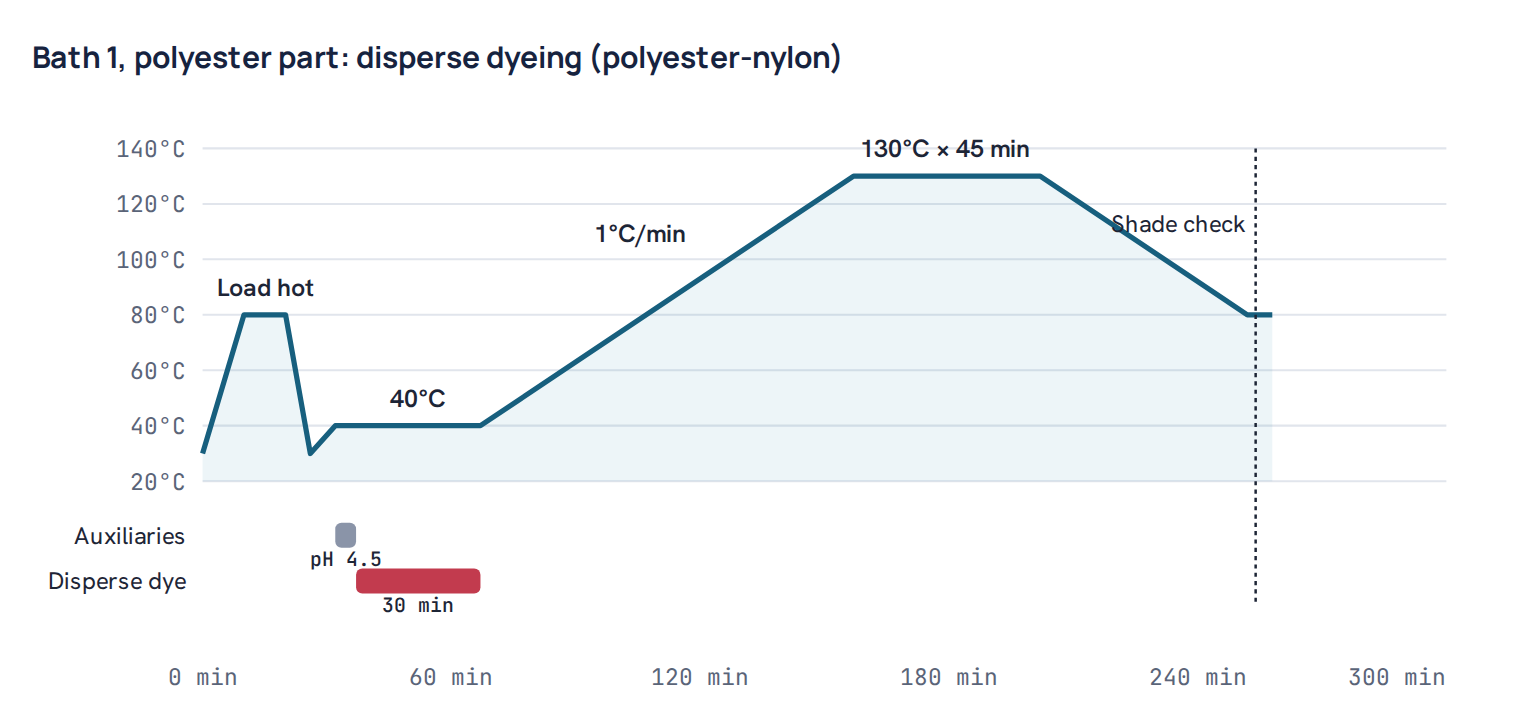
- Polyester part: disperse dyeing at pH 4.5, following the polyester process.
- Reduction clearing.
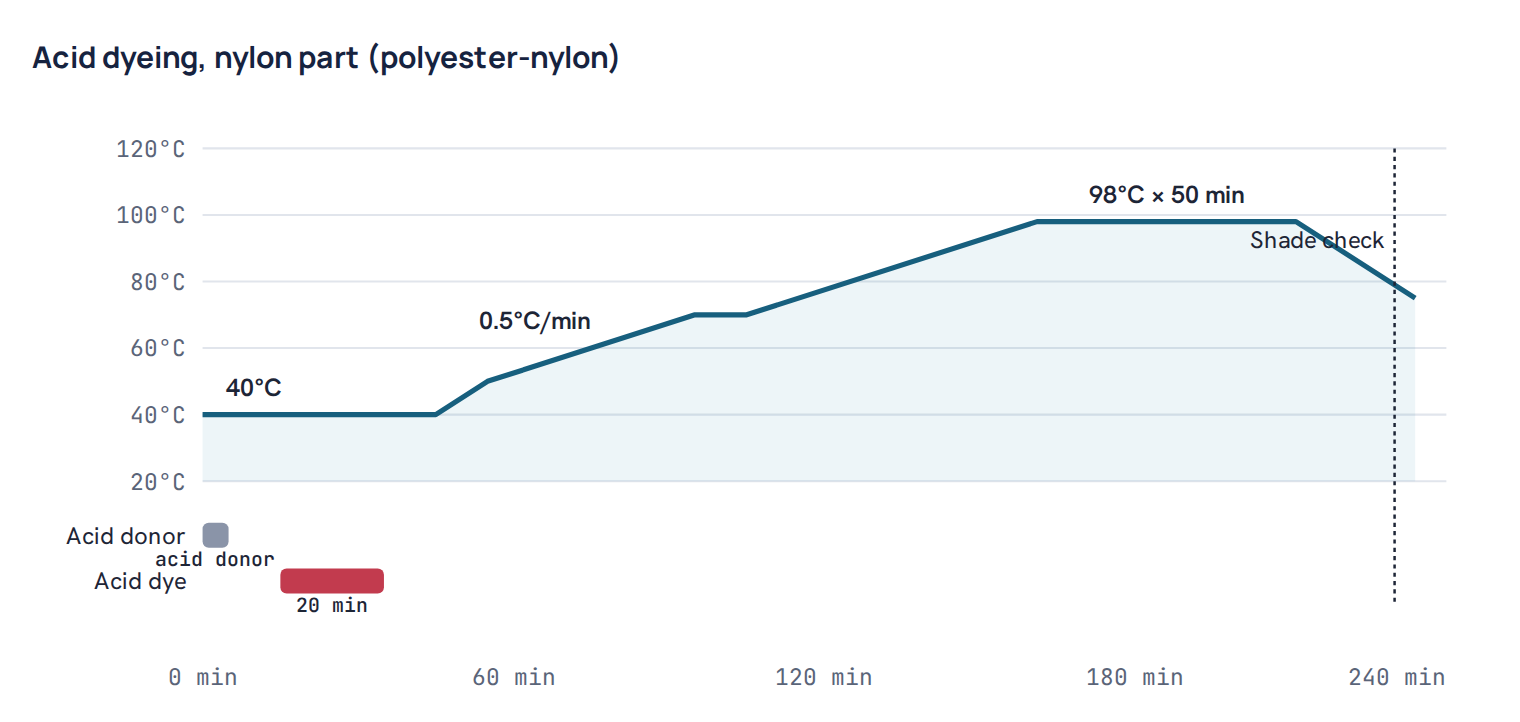
- Nylon part: acid dyeing following the 100% nylon process.
- Softener, and unload. With no cotton or viscose in the fabric, there is no reactive soaping or fixing step.
- Finishing at 100–110°C.
- Polyester-nylon gets the same scour and the same process as nylon-elastane. No enzyme.
- It is always heat set, at 180°C, the same as nylon-elastane.
- The polyester bath is 130°C. We do not lower it because of the nylon: where there is polyester, 130°C is needed.
- Where there is no cotton or viscose, the soaping and fixing are not needed: reduction clearing and a good softener.
The polyester bath runs at 130°C, the same as 100% polyester. It is not lowered because of the nylon: as long as there is polyester in the fabric, even a small share, it needs 130°C to take the disperse dye. Heat setting is at 180°C, the same as nylon-elastane.
The dyeing curves
Finishing
Fabric with polyester is finished at 100–110°C on the stenter and compactor, not at the 140–150°C used for cotton. Hotter than that, the disperse dye moves back to the fibre surface and the fastness fails.

Textile engineer with 14+ years in dyeing and fabric development. He writes every guide on Dyeing Solution from real production work. Full profile