Linen is a cellulose fibre like cotton, and it takes the same reactive dyes. The difference is in the preparation and in how the fabric holds its size. Here is a real 100% linen batch, stage by stage, and what linen blends look like at delivery.
At a glance
70°CScour-bleach, 40 min
60°CReactive dyeing
No enzymeIt can destroy linen
19%Linen-blend parts within GSM
Linen comes from the stem of the flax plant. It is a bast fibre like hemp: long, strong and stiff, with a natural slub and a cool, dry handle. In knits it appears as 100% linen jersey and, far more often, as cotton-linen and other linen blends. Because it is cellulose, the cotton reactive dyeing process applies; the preparation and finishing are where linen is different.
The route for 100% linen
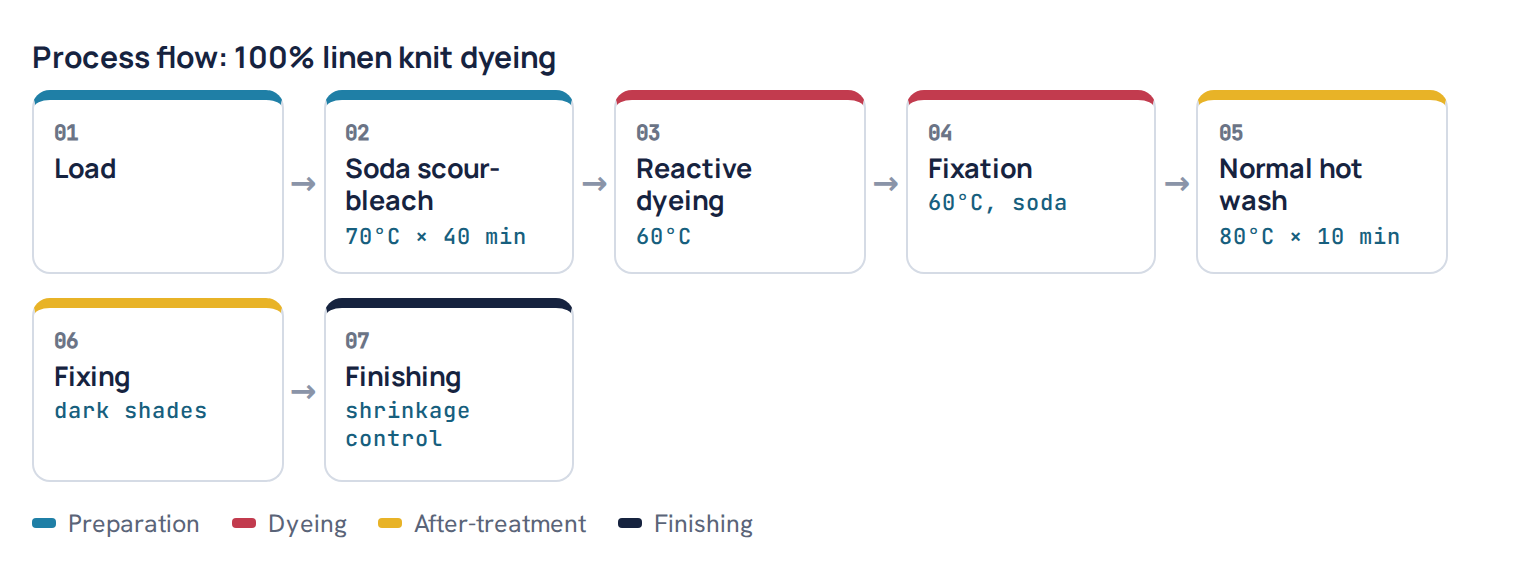
- Scour-bleach with soda ash at 70°C for 40 minutes. No high temperature, no strong alkali.
- Reactive dyeing at 60°C: salt, then soda, then drop the bath.
- Normal hot wash at 80°C for 10 minutes.
- Fixing for dark shades such as navy.
- Finishing with length shrinkage control.
There is no enzyme on linen. The enzyme can destroy the fabric, so it is left out.
The dyeing
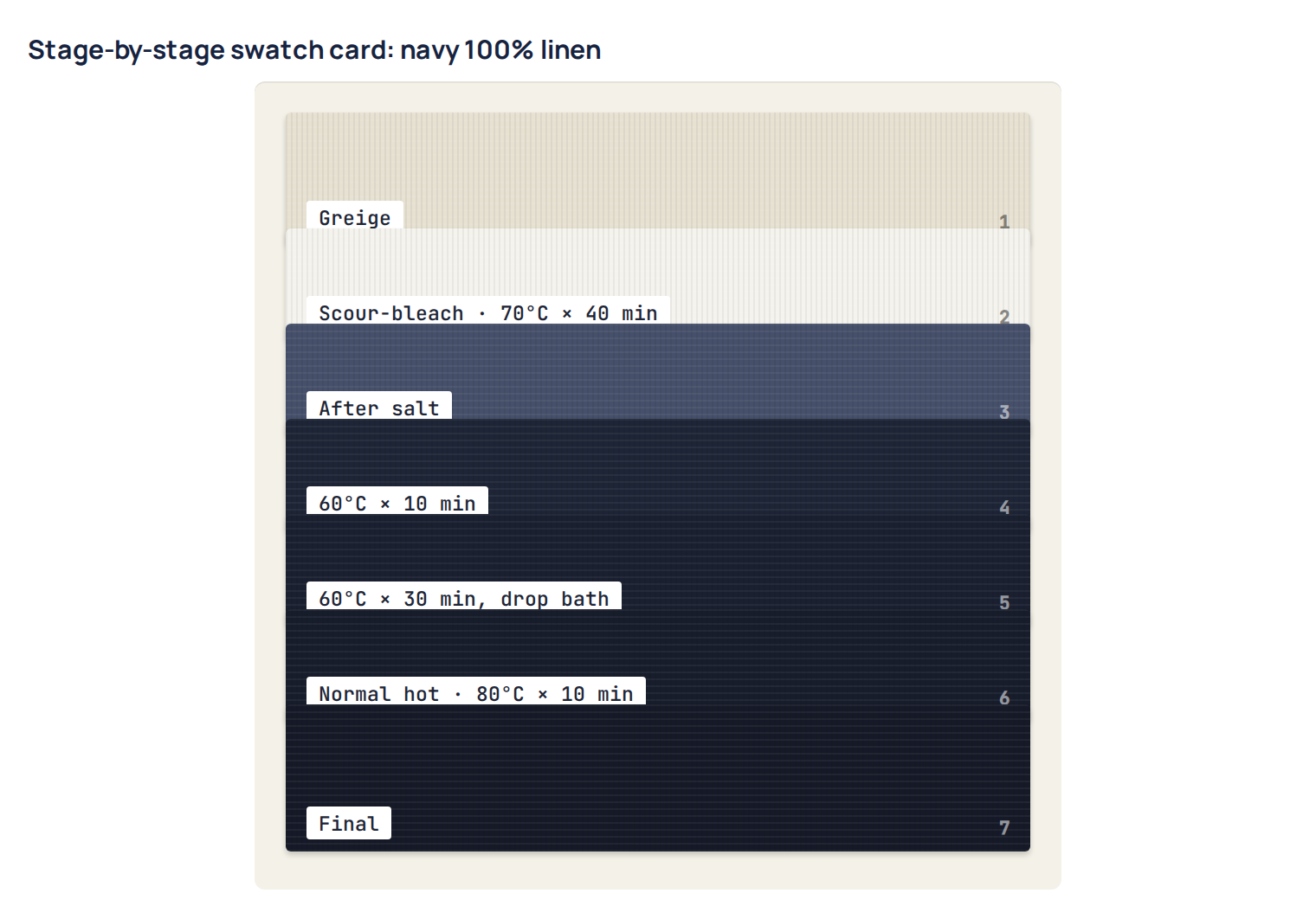
The linen is dyed with the same reactive curves as 100% cotton, at 60°C with salt and soda ash. On the navy batch below, the swatches after salt, after 10 minutes of soda and after 30 minutes show the shade building up before the bath is dropped. See the 100% cotton dyeing process for the curves step by step.
What linen blends look like at delivery
Our finishing records hold no 100% linen batches in the period we studied, but they hold 27 cotton-linen batches, mostly 70/30 cotton/linen single jersey. Compared with 100% cotton (see the full GSM and shrinkage study):
| Measure | Cotton-linen | 100% cotton |
|---|---|---|
| Batches | 27 | 7,429 |
| Median finished GSM vs required | −9.4% | −5.0% |
| Parts within ±5% of required GSM | 19% | 47% |
| Parts more than 5% light | 74% | 51% |
| Median length shrinkage | 8% | 6% |
| Worst 10% length shrinkage | 13% | 10% |
| Median width shrinkage | 3.5% | 2% |
Even 30% linen changes the fabric a lot. Three out of four cotton-linen parts finished more than 5% light, and length shrinkage was higher than for 100% cotton.
27 batches is a small sample; read the figures as a direction, not a rule.
Limitations of linen and how to handle them
- Light GSM. Linen-blend knits finish light far more often than cotton. Fix the construction in knitting.
- Length shrinkage. Plan compaction for 8% or more.
- Seed coat on the fabric. The main buyer complaint. Linen is scoured mildly with soda, not at 98°C with strong alkali, so the black seed-coat specks stay on the fabric.
- Stiff handle and slub. Linen’s natural stiffness and slub are part of its look.
- Linen carries a lot of seed coat: the small black specks, like the seed coat in cotton.
- Linen is not given a full scour at high temperature. It is not scoured at 98°C or with heavy alkali; it is normally scoured with soda.
- Because of that, the seed coat does not come out. It stays on the fabric.
- This is the main buyer complaint on linen.

Textile engineer with 14+ years in dyeing and fabric development. He writes every guide on Dyeing Solution from real production work. Full profile