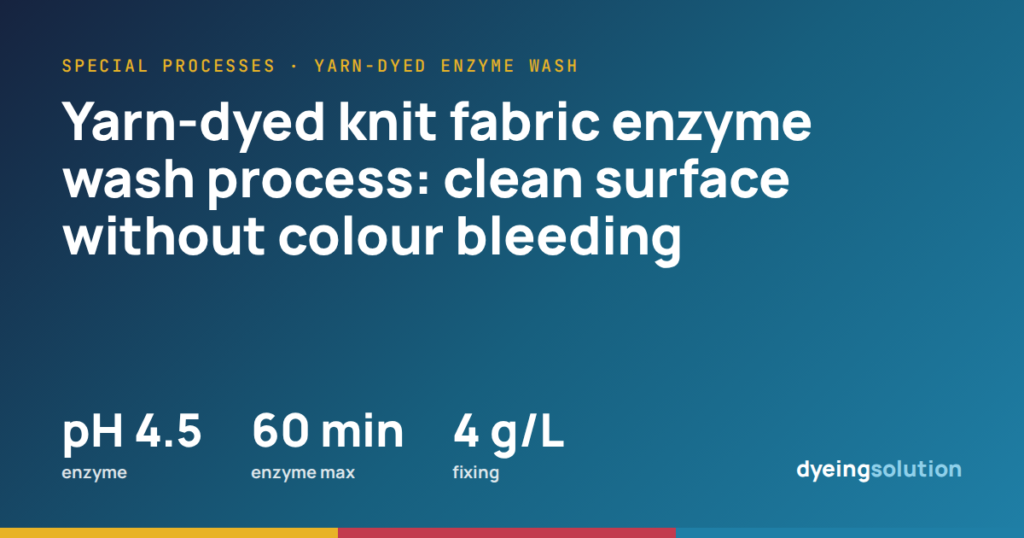
Yarn-dyed fabric is already coloured, so it is never dyed again: it is washed, enzyme treated, fixed and softened. Here is the wash we run, and why every chemical is there.
At a glance
No dyeingColour is in the yarn
pH 4.5Enzyme, 45–60 min
4 g/LFixing agent
Anti back-stainingIn every bath
Yarn-dyed knit fabric (stripes, checks, yarn-dyed jacquard and ponte) is knitted from yarn that is already dyed. In the dye house it only needs a wash: to clean it, to give a clean surface with the enzyme, and to soften it. The risk is the colour itself: loose dye from a dark stripe can bleed into a white or light stripe during the wash.
The recipe
| Chemical (by function) | Amount | Purpose |
|---|---|---|
| Dispersing / anti back-staining agent | 2.0 g/L | Holds loose dye in the bath so it does not stain light stripes |
| Wetting and scouring agent | 1.0 g/L | Cleans the fabric |
| Cellulase enzyme | 1.5% | Removes surface fibre for a clean face |
| Fixing agent | 4.0 g/L | Locks the yarn dye and stops bleeding |
| Dispersing agent (final bath) | 1.0 g/L | With the softener |
| Softener | 2.0 g/L | Hand feel |
The route
- Wash with the dispersing agent and the wetting agent.
- Enzyme treatment at pH 4.5 for 45 minutes to 1 hour, to remove the hairiness.
- Cut a sample and check the hairiness. When it is OK, drain.
- Wash clear.
- Fixing.
- Softener with dispersing agent, then unload and finish.
- We control the enzyme bath at pH 4.5 and run it 45 minutes or an hour to remove the hairiness.
- Then we cut a sample and check the hairiness. If it is OK, we drain, wash clear, and unload with softener.
Heat setting and bleaching
- Yarn-dyed fabric is heat set when it has Lycra, when it is heavy GSM, or when it is a design fabric.
- It is never scoured with caustic or bleached in fabric form, even with a white stripe. The white yarn is already prepared at the yarn stage, before knitting.
Why the fixing agent matters
- Sometimes the yarn was not fixed properly when it was dyed. Whatever fixing is needed then has to be done here, in the fabric wash.
Common faults and buyer complaints
- The common problems are poor fastness and staining. For example, a white stripe next to a red stripe: the red bleeds into the white.
Staining of white or light stripes. Dispersing agent in the wash baths to hold loose dye, and the fixing agent to lock the yarn dye.
Poor fastness. Fix in the fabric wash when the yarn was not fixed at the yarn stage, and check fastness before bulk.

Textile engineer with 14+ years in dyeing and fabric development. He writes every guide on Dyeing Solution from real production work. Full profile