Natural dyes come from plants and other natural sources, and they behave differently from reactive dyes. Here is the natural dyeing process we run on knit fabric, with its full curve.
At a glance
MordantBefore or after dyeing
30°CColour dosing
80°C × 45 minExhaustion
Light shadesBest fastness
Natural dyes are extracted from plants, roots, bark, insects or minerals. Buyers ask for them for eco and organic collections. They do not react with cotton the way reactive dyes do, so there is no soda step: the dye goes on cold, is exhausted onto the fibre by heat and salt, and is held by the mordant.
- Natural dyeing is usually done with mordant dyes, with the mordant used before or after the dye.
- The fabric is 100% cotton or organic cotton.
- There are many kinds of natural dye, mordant dyes and food dyes among them. All of them dye with natural colour.
- Deep natural shades have poor fastness: wash, rubbing and light are all weak. We use natural dyes because they are skin-friendly and eco-friendly.
The route
- Scour and enzyme as for cotton.
- Mordant before or after the dye.
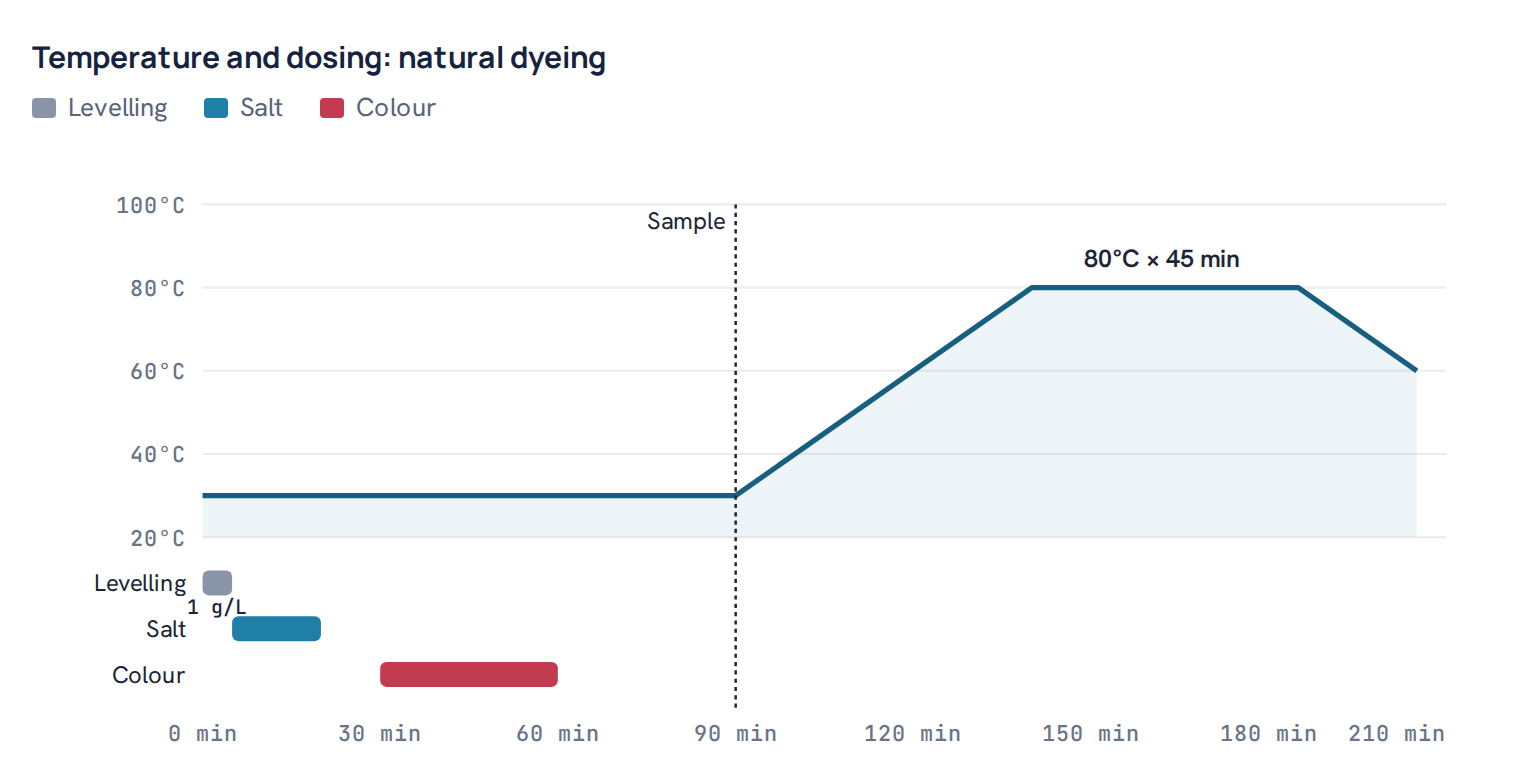
- Dyeing: salt first, colour at 30°C, then heat to 80°C and hold 45 minutes.
- Wash-off: rinse at 80°C, cold wash, hot wash at 70°C, rinse.
- Softener and unload.
The dyeing curve
Step by step
- Add the levelling agent, 1 g/L.
- Dose the salt over 15 minutes and run 10 minutes.
- At 30°C, dose the colour over 30 minutes and run 30 minutes; take a sample.
- Raise to 80°C at 1°C per minute and run 45 minutes.
- Cool and drain.
- Rinse at 80°C for 10 minutes, cold wash, hot wash at 70°C for 10 minutes, rinse.
- Softener, unload.
Common faults and buyer complaints
- The biggest problem is fastness. It is very poor and almost impossible to fix. Light colours are OK; deep colours give problems.
- The shade is not accurate, and shade variation is very large. These are the buyer complaints.
Poor fastness on deep shades. Agree light to medium shades with the buyer, and agree the fastness level before bulk.
Shade variation. Agree a shade tolerance with the buyer; natural dyes cannot match the repeatability of reactive dyes.

Textile engineer with 14+ years in dyeing and fabric development. He writes every guide on Dyeing Solution from real production work. Full profile