Cotton with elastane is dyed like cotton, but the elastane changes almost everything around the dyeing: heat setting, a cooler scour, and a GSM that is hard to hold. Here is the process from our floor, a real batch card, and data from 2,355 batches.
At a glance
180–190°CHeat setting
80°CScour-bleach (cotton: 98°C)
60°CReactive dyeing
29%Parts within GSM tolerance
Cotton-elastane knits (often called Lycra fabrics on the floor) carry a few percent of elastane plated with the cotton yarn: 20D, 30D or 40D filament in single jersey, rib, interlock and fleece. Only the cotton takes reactive dye. The elastane stays close to white, but it controls the stretch, the width and the GSM of the fabric, and it cannot take the heat and alkali that 100% cotton gets.
The route for cotton-elastane
Process flow: cotton-elastane knit dyeing
- Heat setting of the greige fabric at 180–190°C, before dyeing, to stabilise the elastane and control width and shrinkage.
- Loading hot at 80°C for 10 minutes.
- Scour-bleach at 80°C for 50 minutes: caustic 0.5 g/L and hydrogen peroxide 2.5 g/L.
- Peroxide killer (0.15 g/L) and acid (1 g/L).
- Reactive dyeing of the cotton at 60°C.
- Wash-off: normal hot and acid, then soaping at 80°C for 10 minutes.
- Fixing (1 g/L) for dark shades.
- Finishing with width and overfeed control.
The scour runs at 80°C instead of 98°C to protect the elastane: higher temperatures and long exposure can damage it and reduce its stretch and recovery. There is no enzyme step. A cellulase enzyme attacks cotton and can weaken the fabric, so it is left out when the surface is already clean enough without it.
Heat setting: why and how
Elastane has very high stretch. Heat setting fixes the elastane at the width and length you want, so the fabric does not pull in or grow later. Almost every cotton-elastane part in our records is heat set: 97%, against 34% for plain cotton.
- For cotton-elastane the normal heat-setting temperature is 180 to 190°C.
- We heat set Lycra fabric to control its stretch, which is normally very high.
- Machine speed depends on the fabric. At a higher temperature the speed can be higher; at a lower temperature it has to be lower.
- Speed sets the dwell time: higher speed means a weaker heat-setting effect, lower speed a stronger one.
How stretch makes the fabric light
When the fabric is stretched on the stenter, the width grows, the length can grow and the loops open out. The weight stays the same, but it is spread over a larger area. 100 g of fabric on 0.50 m² is 200 GSM. Stretch it to 0.60 m² and it reads 167 GSM. Stretching does not remove weight; it spreads it.
Common fault: setting cotton-elastane over-width to reach the required width. It comes out light and too wide, and how much it recovers depends on how well it was heat set.
Pretreatment and dyeing
The fabric is loaded hot at 80°C for 10 minutes with the wetting and anti-crease auxiliaries. The scour-bleach runs at 80°C for 50 minutes with only 0.5 g/L caustic and 2.5 g/L hydrogen peroxide, much milder than the 98°C × 60 min, 2 g/L caustic bath used on 100% cotton. A peroxide killer and acid follow.
The cotton part is then dyed with the same reactive curves as 100% cotton, at 60°C with salt and soda ash. On the batch below, a deep brown at a 1:8 liquor ratio, the dyebath held 60 g/L salt and 20 g/L soda ash. See the 100% cotton dyeing process for each curve step by step.
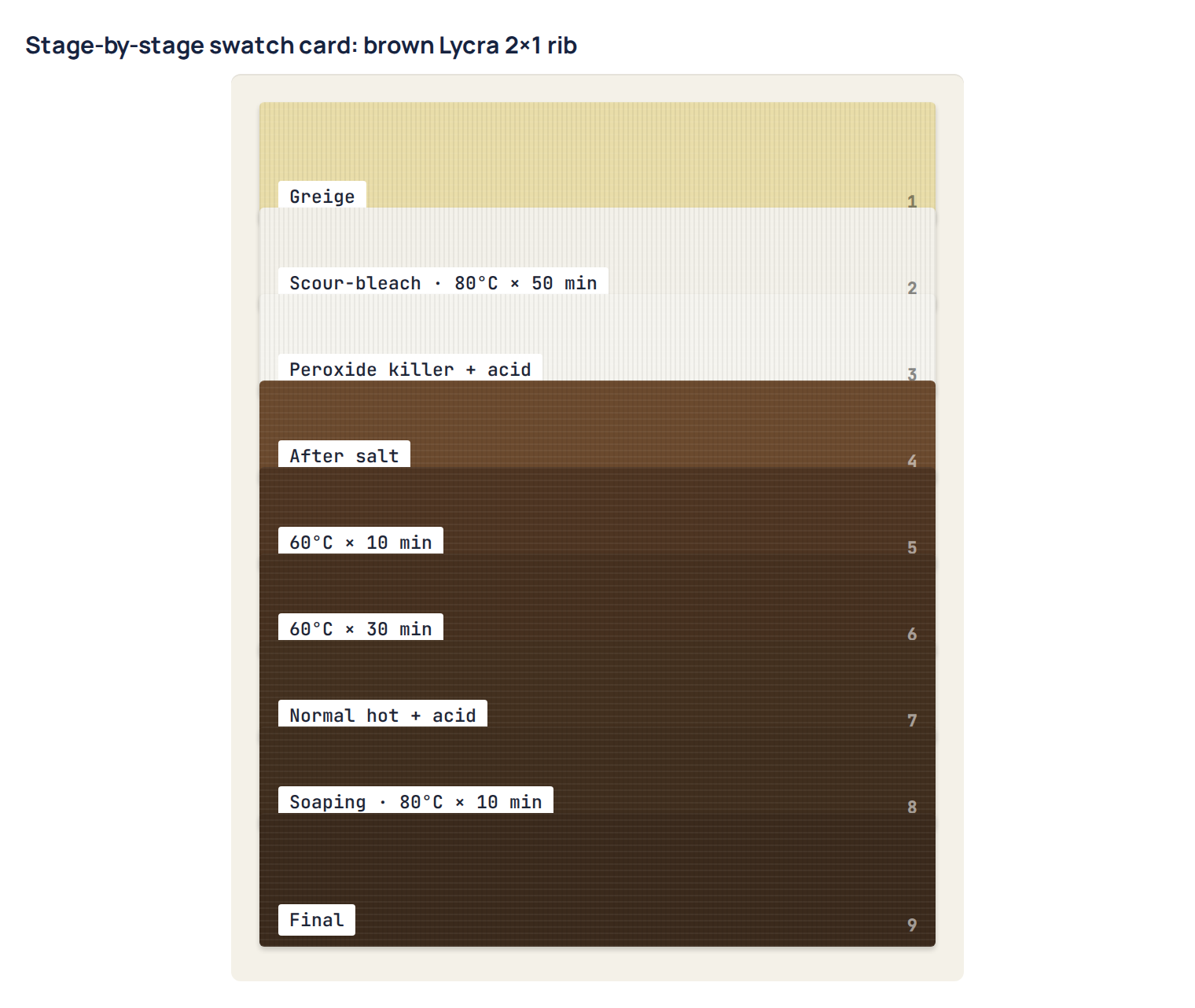
The margin of the same card shows how a second batch was corrected: yellow reduced by 20% and red by 5%, a normal shade correction between batches.
What cotton-elastane looks like at delivery
From our finishing records of 2,355 cotton-elastane batches (see the full GSM and shrinkage study), compared with 100% cotton:
| Measure | Cotton-elastane | 100% cotton |
|---|---|---|
| Median finished GSM vs required | −6.7% | −5.0% |
| Parts within ±5% of required GSM | 29% | 47% |
| Parts more than 5% light | 68% | 51% |
| Median length shrinkage | 6% | 6% |
| Light parts fixed by washing | 59% | 75% |
| Light parts that overshoot after washing | 33% | 15% |
| Heat set | 97% | 34% |
By fabric type
| Cotton-elastane fabric type | Batches | Median finished GSM vs required | Within ±5% | Median length shrinkage | Median width shrinkage |
|---|---|---|---|---|---|
| Single jersey | 1,188 | −7.2% | 18% | 7% | 2% |
| Rib / interlock | 871 | −5.4% | 40% | 5% | 5% |
| Fleece / terry | 166 | −4.6% | 47% | 8% | 2% |
| Pique | 80 | −5.6% | 38% | 10% | −2% (grows) |
Cotton-elastane single jersey is the hardest common fabric in the whole study: only 18% of parts finish within GSM tolerance, with a median of 7% light. Rib and interlock hold GSM better but shrink 5% in width as well as length.
Limitations of cotton-elastane and how to handle them
- Light GSM, especially single jersey. Two out of three parts finish light. Do not stretch over-width to reach the width; fix the construction in knitting with the yarn count or stitch length.
- Washing overshoots. A light part gains about 13% when washed, and a third end up too heavy.
- Growth and recovery. The most common buyer complaint: the elastane does not recover, the fabric grows, or its size is unstable, sometimes with spirality. First check the heat-setting conditions, the elastane percentage, the finishing overfeed and width, and the stenter temperature.
- Heat-setting control. Temperature and speed together set the result. Too little and the fabric grows and pulls; too much and the handle and elastane suffer.
- Width shrinkage on rib and interlock. Plan for about 5% in width as well as length.

Textile engineer with 14+ years in dyeing and fabric development. He writes every guide on Dyeing Solution from real production work. Full profile