Polyester is dyed with disperse dye at 130°C, under pressure. The process is short on steps but strict on pH and heating rate. Here is the curve we run, step by step, and what polyester looks like at delivery from 166 batches.
At a glance
130°C × 45Dyeing hold
pH 4.5Dyebath
1°C/minHeating and cooling
84%Parts within 5% length shrinkage
Polyester has no reactive sites for cotton dyes, and it takes up almost nothing below 100°C. Disperse dyes, fine particles that dissolve slowly into the fibre, go in only when the polyester is heated well above its glass transition, so the bath is taken to 130°C in a pressurised machine. Everything around that hold is about getting the dye on evenly and cleaning off what did not go in.
The route for 100% polyester
Process flow: 100% polyester
- Load the fabric and give it a loading hot wash at 80°C for 10 minutes, then drain.
- Set the pH of the dyebath to 4.5.
- Dose the disperse dye over 30 minutes.
- Heat from 40°C to 130°C at 1°C per minute.
- Run 45 minutes at 130°C.
- Cool at 1°C per minute to 78–80°C and check the shade.
- If the shade is right, drain.
- Reduction clearing, then softener, and unload.
- First the fabric is loaded and given a loading hot, then drained.
- The pH is controlled at 4.5, then the colour is dosed over 30 minutes.
- The temperature goes from 40°C to 130°C at 1°C per minute and runs 45 minutes.
- Cooling is also 1°C per minute, down to 78–80°C, then the shade is checked.
- If the shade is OK, drain, then reduction, then softener, then unload.
The dyeing curve
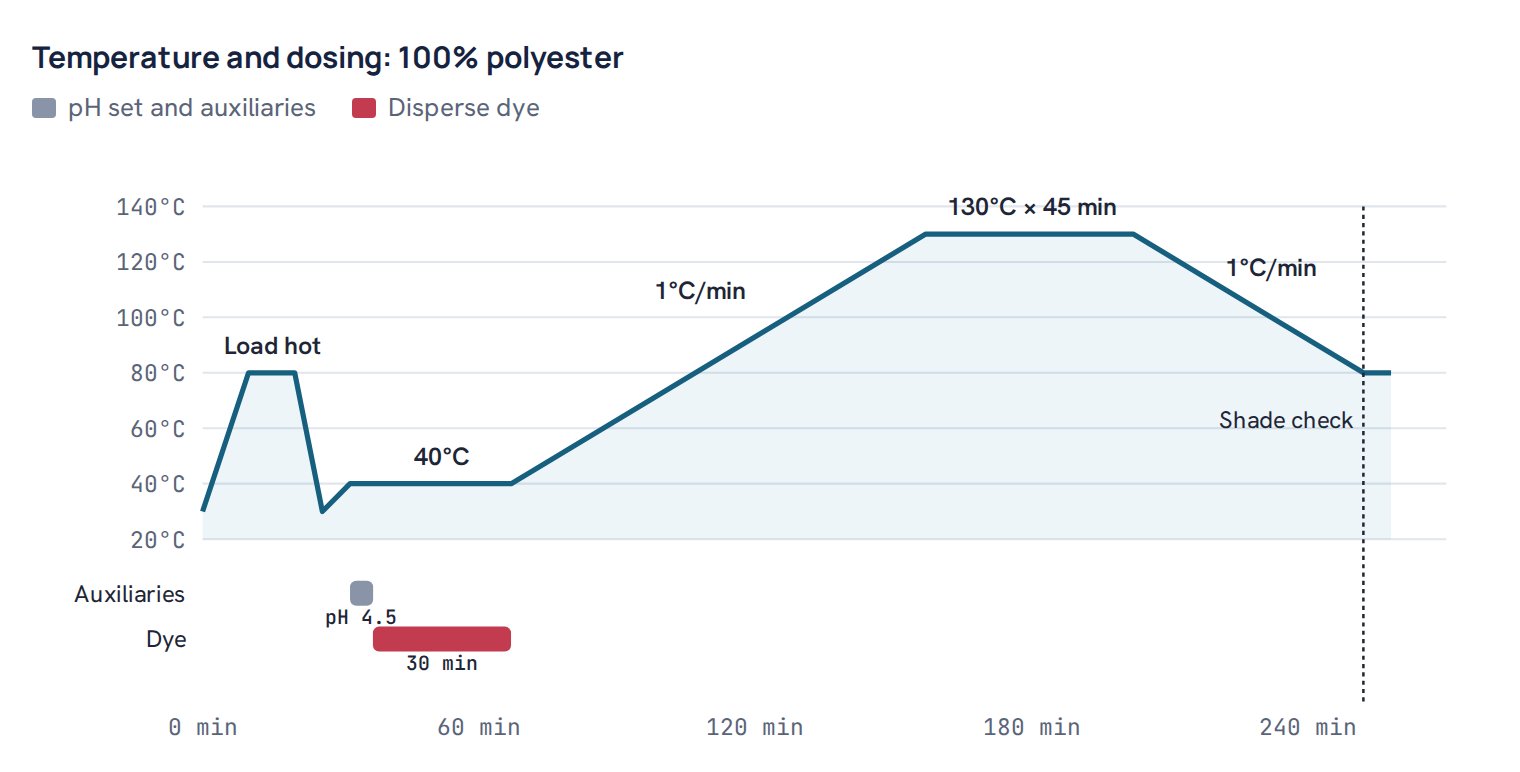
Common fault: heating too fast through the middle of the curve. Polyester takes up disperse dye quickly once it passes about 90–100°C, and a fast rise there gives an uneven, streaky shade.
Common fault: draining hot from 130°C. Cooling at 1°C per minute to about 80°C before draining avoids crease marks set into the hot polyester.
Reduction clearing
After the dyeing bath is drained, the loose disperse dye left on the fibre surface is removed with a reducing agent and alkali. Without it, deep shades rub off and stain other fabrics in washing. For light and medium shades, 80°C for 10 minutes is enough. Dark shades get a longer clear, 15–20 minutes at 70–80°C depending on the disperse dye system, to remove more surface dye and improve rubbing and wash fastness. A softener follows before unloading.
What polyester looks like at delivery
From our finishing records (see the full GSM and shrinkage study):
| Fabric | Batches | Median finished GSM vs required | Within ±5% | More than 5% light | Median length shrinkage | Worst 10% length | Parts within 5% length shrinkage | Heat set |
|---|---|---|---|---|---|---|---|---|
| 100% polyester | 102 | −4.0% | 36% | 47% | 3% | 6% | 87% | 70% |
| Polyester + elastane | 64 | −3.3% | 41% | 37% | 4% | 8% | 78% | 92% |
Polyester is the most stable fibre for shrinkage in our records: 87% of 100% polyester parts keep length shrinkage within 5%, against 47% for 100% cotton. GSM is harder: a third of light polyester parts are still light after washing, because polyester does not shrink to recover weight. Most 100% polyester fabrics in our records are mesh.
Limitations of 100% polyester
- Light GSM does not wash out. Like CVC, polyester cannot shrink back to weight. Fix the construction in knitting.
- Levelness. Depends on pH 4.5 and the 1°C per minute heating rate.
- Rubbing fastness and surface staining. The most common buyer complaint, mainly on dark shades. The first fix is the reduction clear: check its pH, the hydrosulphite and caustic dosage, the temperature and the time, before changing the dye recipe.

Textile engineer with 14+ years in dyeing and fabric development. He writes every guide on Dyeing Solution from real production work. Full profile