Mercerised cotton has already been through strong caustic, so it needs a gentler scour, no enzyme, and a slower dyeing curve than normal cotton. Here is the process from our floor, for yarn-mercerised and fabric-mercerised knits.
At a glance
No enzymeProtects the lustre
95°CScour-bleach (cotton: 98°C)
80°CSalt goes in hot
3-stepSalt and soda dosing
Mercerising treats cotton with strong caustic soda under tension. The fibres swell and round out, and the cotton gains lustre, strength and a much higher uptake of dye. It can be done on the yarn before knitting or on the fabric. Because the cotton has already been through strong alkali, a mercerised fabric needs a gentler scour than normal cotton, and it takes dye faster.
The route for mercerised fabric
Process flow: true mercerised fabric
Yarn-mercerised fabric
- Inject acid (1 g/L), a detergent (1 g/L) and the process auxiliary (2 g/L). Load the fabric.
- Run 70°C × 10 minutes, then drain.
- Inject the wetting agent (1 g/L) and the process auxiliary (2 g/L), dose soda ash (2 g/L) over 5 minutes, and run 80°C × 20 minutes.
- Check the absorbency, give a normal hot wash with acid, and go to dyeing. No enzyme.
Fabric-mercerised greige
- Acid wash at 70°C × 10 minutes: acid (1 g/L), detergent (1 g/L), process auxiliary (2 g/L).
- Scour-bleach at 95°C × 45 minutes: wetting agent (1 g/L), process auxiliary (2 g/L), detergent (1 g/L), soda ash (2 g/L), caustic (1 g/L), hydrogen peroxide (2.5 g/L).
- Normal hot at 70°C × 5 minutes with acid (1 g/L) and a peroxide killer (0.15 g/L). No enzyme.
The same process auxiliary goes into every bath, from the first acid wash to the dyeing. Its job is to keep the fabric evenly wetted, prevent creases and deposits, and keep the dyeing consistent from bath to bath.
This is the 95°C scour we use for mercerised fabric instead of cotton’s 98°C: the cotton has already been through strong alkali in mercerising, so it does not need the full scour. See the 100% cotton dyeing process for the normal route.
The dyeing curve for mercerised fabric
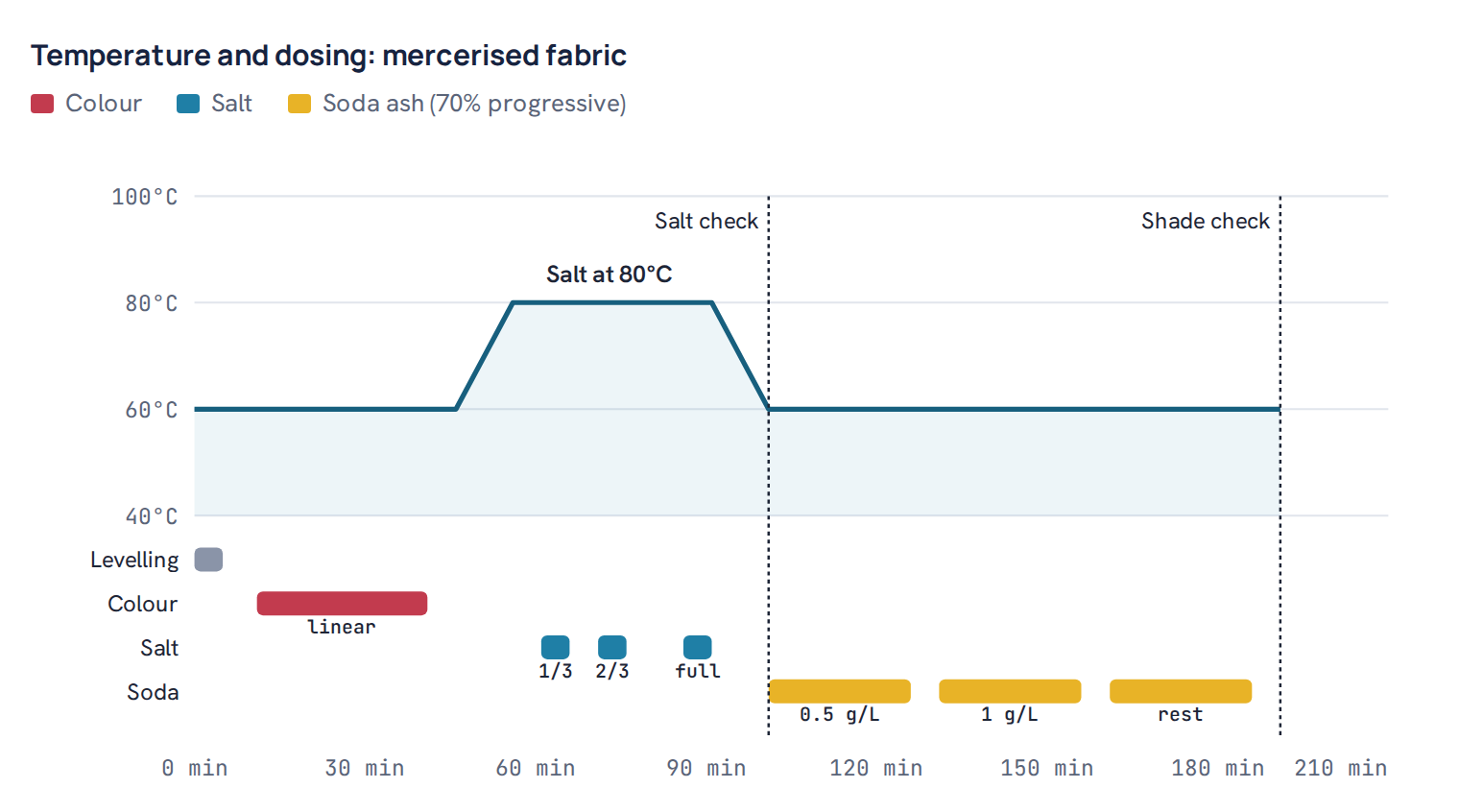
Mercerised cotton takes up reactive dye faster than normal cotton. The curve slows everything down: the colour goes in linear over 30 minutes, the bath is heated to 80°C before the salt, the salt goes in three steps, and the soda goes in three steps after cooling back to 60°C.
Step by step
- Check the levelling pH. Dose the levelling agent over 5 minutes and run 6 minutes.
- Dose the colour over 30 minutes (linear) and run 10 minutes.
- Heat to 80°C at 2°C per minute and run 5 minutes.
- Dose the salt in three steps: ⅓ over 5 minutes, run 5; ⅔ over 5 minutes, run 10; the full amount over 5 minutes, run 5.
- Cool to 60°C at 2°C per minute and check a salt sample.
- Dose the soda in three steps, each over 25 minutes at 70% progressive with 5 minutes of run time: 0.5 g/L, then 1 g/L, then the rest.
- Check the shade.
Tip: the soda goes in three slow steps starting at only 0.5 g/L. Mercerised cotton fixes fast, and a big first soda portion gives an unlevel shade.
Limitations of mercerised fabric
- Uneven shade or lustre. The most common buyer complaint. Mercerised cotton takes up dye fast, so any difference in the mercerising shows up as a shade or lustre difference.
- Dimensional stability. Mercerised fabric can be less stable in size after washing.
The first fix is to check how evenly the fabric or yarn was mercerised: the caustic concentration, the tension, the dwell time, and the washing and neutralisation afterwards. Check those before changing the dye recipe.

Textile engineer with 14+ years in dyeing and fabric development. He writes every guide on Dyeing Solution from real production work. Full profile