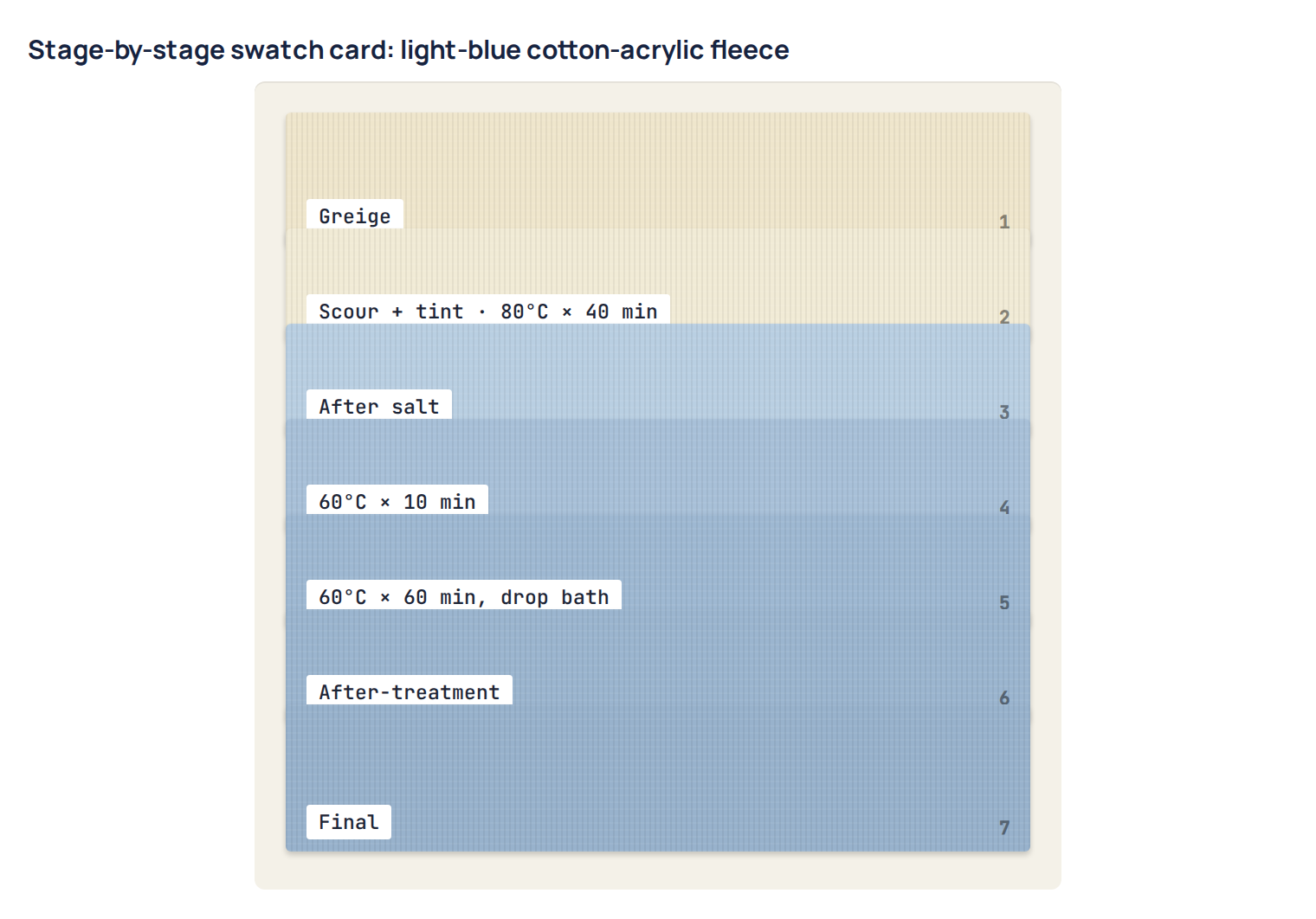
A cotton-acrylic fleece dyed to a light light blue, step by step: the scour with a tint, the 60°C reactive dyeing of the cotton, and the full after-treatment, redrawn from the process curves used on the floor.
At a glance
80°C × 40Scour with tint
60°CReactive dyeing
90°C × 10Soaping
40°CSoftener
Acrylic brings bulk, warmth and a soft, wool-like handle, which is why it turns up in fleece and sweatshirt fabrics blended with cotton. The two fibres need different dye classes: reactive dyes for the cotton, and basic (cationic) dyes if the acrylic is to be dyed. The batch in this article is a cotton-acrylic fleece dyed to a very light light blue with reactive dyes.
In a cotton-acrylic blend, the reactive dye colours only the cotton. The acrylic stays essentially undyed. For deeper shades the acrylic part needs its own cationic (basic) dye system; for a very light shade like this one, reactive dye on the cotton is enough.
The route for cotton-acrylic
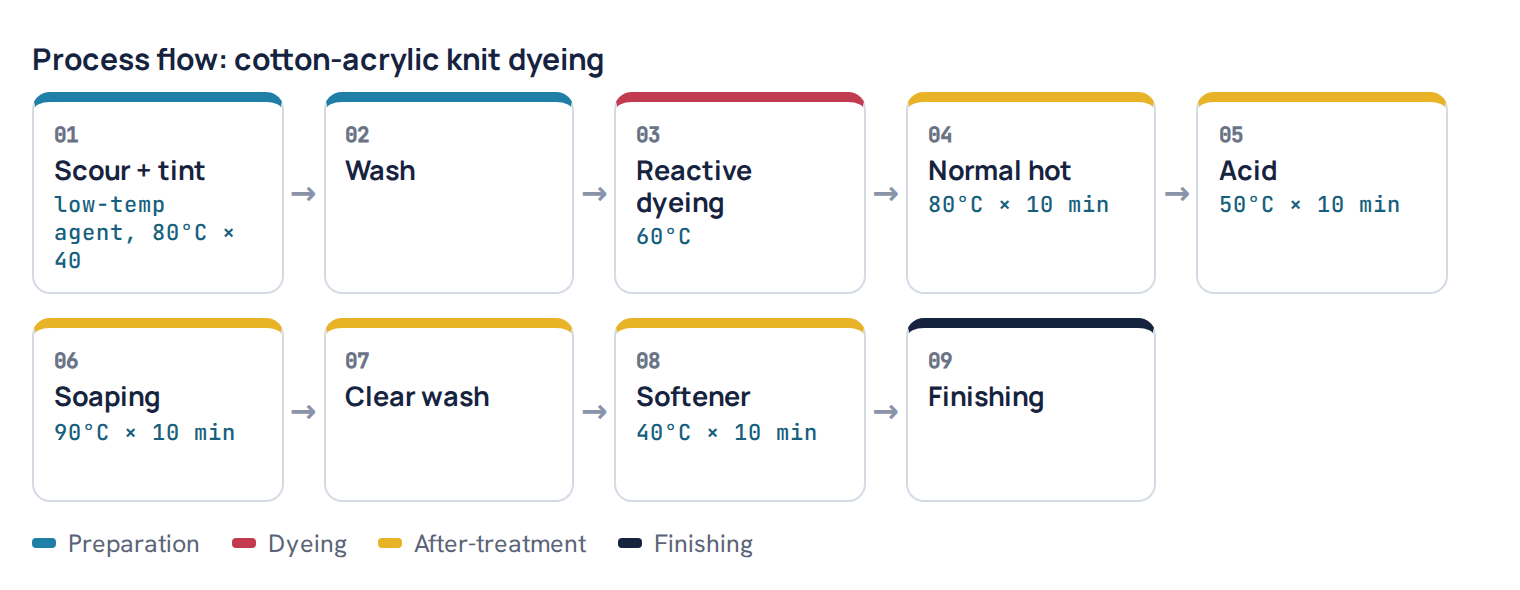
- Scour at 80°C for 40 minutes with a scouring agent, an auxiliary and a tint, then drain and wash.
- Reactive dyeing of the cotton at 60°C.
- Normal hot at 80°C for 10 minutes, then a wash.
- Acid at 50°C for 10 minutes, then a wash.
- Soaping at 90°C for 10 minutes, then a clear wash.
- Softener at 40°C for 10 minutes, then wash and unload.
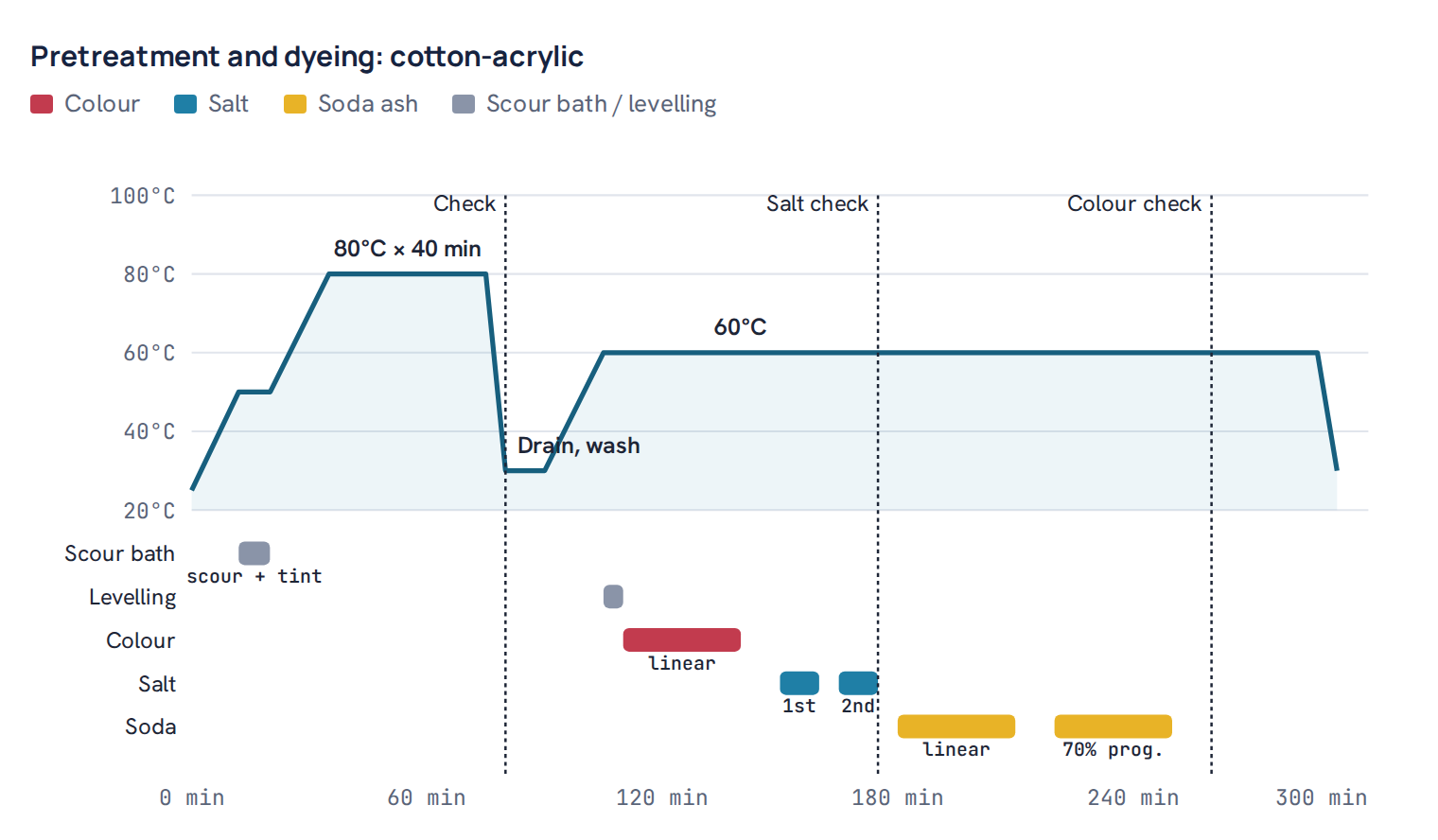
Pretreatment and dyeing curve
Step by step
- Fill and heat to 50°C. Inject the scouring agent, the auxiliary and the tint.
- Heat to 80°C and run 40 minutes. Check a sample.
- Drain, fill and give a normal wash.
- Heat to 60°C. Inject the levelling auxiliaries and run 5 minutes.
- Dose the colour over 30 minutes (linear) and run 10 minutes.
- Dose the salt in two portions, each over 10 minutes (linear) with 5 minutes of run time. Check a salt sample.
- Dose the first soda over 30 minutes (linear) and run 10 minutes.
- Dose the second soda over 30 minutes (70% progressive) and run 10 minutes. Check the colour, then drain and fill.
For this very light shade (under 0.2% dye in total) the bath held 20 g/L salt and 10 g/L soda ash.
The scour uses a special low-temperature scouring agent with a blueing tint. The tint neutralises the cream, yellowish undertone of the greige, so the base looks whiter before a light shade goes on.
- This is a special scouring agent that works at low temperature.
- It carries a blueing tint, so the base comes out whiter for light shades.
After-treatment curve
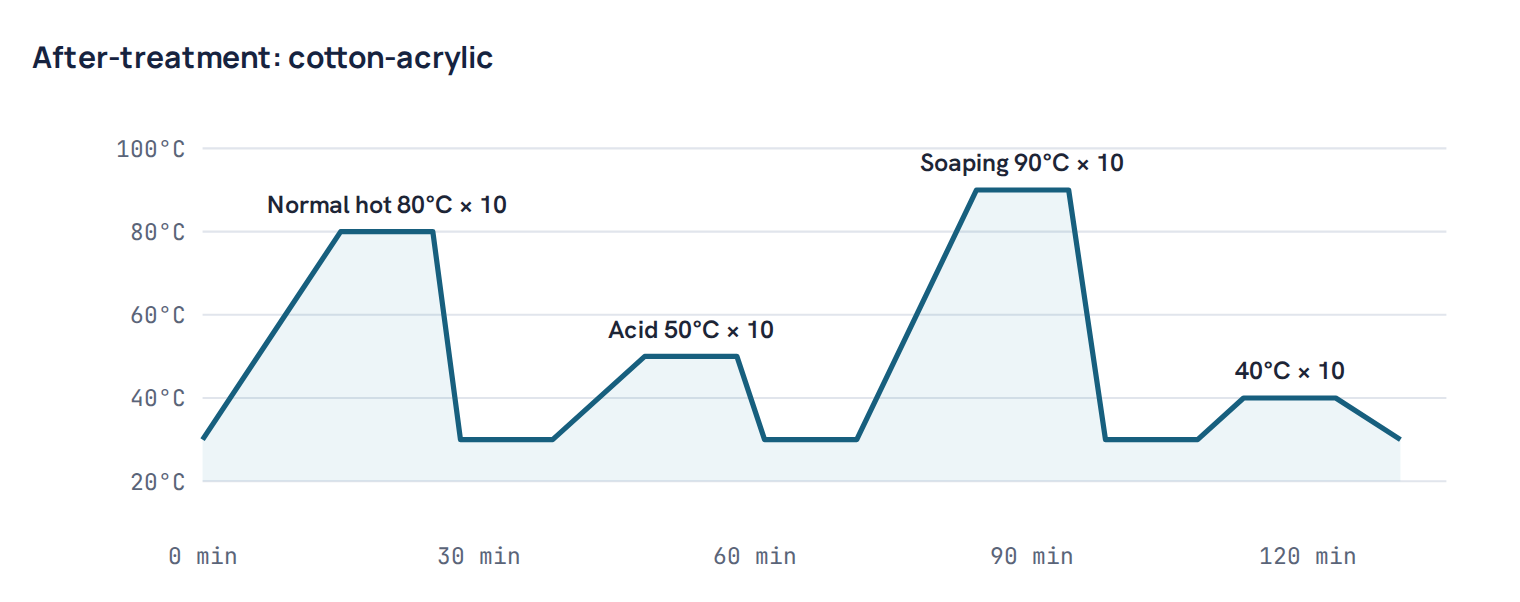
- Normal hot at 80°C for 10 minutes, drain.
- Wash 10 minutes, fill.
- Acid at 50°C for 10 minutes, drain, normal wash 10 minutes.
- Soaping at 90°C for 10 minutes with a soaping agent and auxiliary. Check a sample.
- Drain, normal wash, clear wash.
- Softener at 40°C for 10 minutes, then drain, wash and unload.
There is no enzyme on this fabric. It is left out when the required surface and handle are already there, and because an enzyme treatment could affect the blend or the shade.
Our finishing records hold only two acrylic-blend batches, both fleece, too few for GSM and shrinkage figures.
Limitations of cotton-acrylic and how to handle them
- Shade variation. Check that the blend is uniform and that the dyes suit both fibres.
- Pilling. Acrylic fleece pills more than cotton.
- Shade depth and fastness. With reactive dye only, the acrylic stays pale. Deeper shades need a cationic system for the acrylic part.
The first fix for any of these is to check the blend uniformity, the dye compatibility, the pH and temperature profile, and the exhaustion, then adjust the recipe or process.

Textile engineer with 14+ years in dyeing and fabric development. He writes every guide on Dyeing Solution from real production work. Full profile