A crease mark is a line that runs down the fabric and will not come out. It is made in the dyeing machine, mostly on heavy cotton knits, and almost always for a few known reasons. Here is what causes them, the machine settings and temperatures we use to stop them, and what to do when a batch comes out creased.
At a glance
80°CMaximum for heavy fabric
80%Maximum machine load
180 cmMaximum open width
3 minCycle time per round
What a crease mark is
In a winch, jet or soft-flow machine, knit fabric runs as a rope, folded on itself many times. If a fold stays in one place while the fabric is hot, swollen or rubbed, it sets. On the finished fabric it shows as a line along the length, mostly a lighter line, sometimes a darker one. Crease marks show most on dark shades. On light shades they are much less visible.
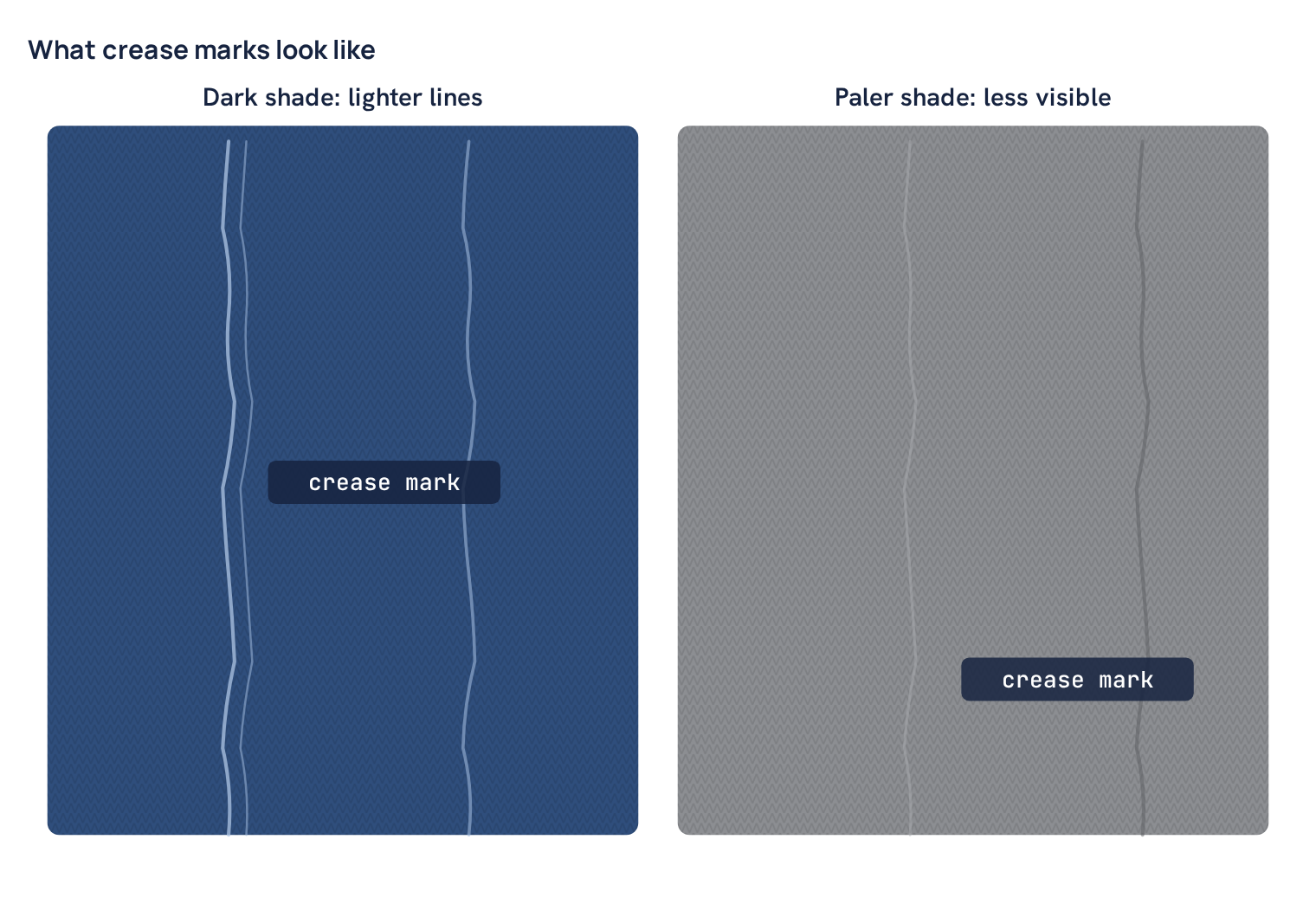
- Crease marks mainly come as lighter lines, and sometimes darker lines.
- They show most on dark shades. On light shades they are much less.
- The most common case is 100% cotton fabric. On polyester it is rare.
Why crease marks form
Three things together set a crease: the fabric is folded, the fold stays still, and the fibre is soft enough at that moment to take its shape. On our floor, crease marks normally come from these causes:
- Heavy GSM fabric that is not heat set. Heavy fabrics fold hard in the rope and hold the fold.
- Tightly knitted fabric.
- Fabric left in rope form for too long in store before dyeing.
- Twisted loading. Fabric that goes into the machine twisted keeps folding in the same place.
- Fabric too wide for the nozzle. Above 180 cm open width, the fabric crumples more in the nozzle.
- Overloading the machine.
- High temperature and ballooning. Above 80°C the fabric fills with air and balloons (see below).
- High-temperature dyeing, such as polyester at 130°C.
- No anti-crease agent in the bath.
- If fabric stays in rope form in store for a long time, crease marks can come. Two, four, seven or ten days is fine; 15 days is the most.
- Heavy GSM fabric and tightly knitted fabric.
- Fabrics that have to be dyed at high temperature.
- If the fabric load is more than the machine capacity.
- If we run a bigger-dia fabric than the machine is meant for.
Heavy GSM fabric: heat set before dyeing
Elastane and polyester fabrics are always heat set. 100% cotton normally does not need it, but a heavy cotton fabric is heat set before dyeing to give it dimensional stability, so it does not crease in the rope. It runs at the same 180–190°C used for elastane fabrics. These are the weights we treat as heavy:
| Fabric | Heat set before dyeing from |
|---|---|
| Single jersey | 180 GSM and above |
| Lacoste | 250 GSM and above |
| Fleece and terry | 350 GSM and above |
- Higher GSM fabric must be heat set before dyeing, otherwise there is a chance of crease marks.
- Single jersey 180 GSM and above, lacoste 250 GSM and above, fleece and terry 350 GSM and above.
- 100% cotton normally needs no heat set, but for the crease mark issue heavy GSM fabric must be heat set, for its dimensional stability.
- The temperature is the same 180–190°C as for Lycra fabric.
Loading the machine
- Inject the anti-crease agent into the machine first.
- Load the fabric straight, never twisted, spread out as evenly as possible.
- Keep the fabric’s open width at 180 cm or below. Wider fabric crumples more in the nozzle and creases.
- Load 80% of the machine capacity at most for heavy GSM fabric. Modern machines are rated for 90%.
- After heat setting, when the fabric comes to the machine, it must never be loaded twisted. Arrange it so the fabric goes in fairly straight.
- Fabric dia must be 180 cm open or below. Above that the fabric crumples more in the nozzle in rope form, and crease marks come.
- 180 cm is a standard limit for every machine. Nozzles are about the same on every machine.
- Modern machines are now made with much bigger nozzles, to clean up crease marks and to dye heavy GSM fabric. That is also a remedy.
Machine settings
| Setting | For crease-sensitive fabric |
|---|---|
| Fabric load | 80% of capacity at most (modern machines take 90%) |
| Open width | 180 cm or below |
| Nozzle | 100% open |
| Reel speed | As low as possible while keeping the cycle time |
| Cycle time | 2–3 minutes per round, 3 minutes ideal |
| Pump speed | The lowest that still moves the fabric |
| Temperature | 80°C or below in scouring, dyeing and soaping |
| Anti-crease agent | In scouring, dyeing and soaping, at the supplier’s dose |
| Liquor ratio | Standard; no direct link with crease marks |
- Keep the nozzle 100% open, so the fabric gets as little pressure as possible.
- Run the reel speed as low as possible while still reaching the cycle time. We keep a 3-minute cycle time and adjust the reel speed to it.
- Pump speed depends on how fast the water pushes the fabric. Try to run the lowest pump speed possible; the lower, the better for the fabric.
- Modern machines take 90% loading, but for heavy GSM fabric try not to load above 80%.
- Liquor ratio has no relation with crease marks. Keep it at the standard.
- The anti-crease dose depends on its concentration. The chemical supplier defines how many g/L to use.
Temperature: 80°C and the balloon
For heavy GSM fabric, scouring, dyeing and soaping are kept at 80°C or below. Above 80°C the fabric balloons: it fills with air and puffs up in the large space inside the machine. When the reel pulls that balloon up into the much smaller reel and nozzle, it rubs and folds, and the fold becomes a crease mark.
- Scouring: cotton is normally scoured at 98°C. For heavy fabric we use a low-temperature multifunctional scouring and bleaching agent at 70–80°C. It gives good whiteness, but fluorescent and very bright shades still need the full 98°C scour.
- Soaping: not above 80°C. Low-temperature soaping agents remove the loose dye at 60°C, so there is no need to go hotter.
- Anti-crease agent: in all three baths: scouring, dyeing and soaping.
- A hole after each roll joint: a batch is usually several rolls joined together. A small hole cut 1–2 inches after each joint lets the air out, so the fabric cannot balloon.
- For scouring, dyeing and soaping, try not to use a temperature above 80°C.
- Many low-temperature scouring agents are now on the market that work at 70–80°C. Heavy GSM fabric should be scoured with these.
- Above 80°C the fabric balloons inside the machine. When the reel pulls it up, the big balloon converts to the small reel dia, and there is friction and a fold. That fold can become a crease mark.
- So at each roll joint, just 1–2 inches after the joint, we make a small hole. Air gets out and the fabric cannot balloon.
Polyester: when 80°C is not possible
Polyester has to be dyed at 130°C, so the 80°C limit cannot apply. On polyester, crease marks are rare, and the protection comes from elsewhere: heat setting before dyeing, cooling at 1°C per minute to 78–80°C before draining, and a looser knitted construction for heavy 100% polyester.
- For polyester we have to dye at 130°C, so we cannot lower the temperature.
- For 100% polyester it is better to use a loose-knitted fabric.
Where crease marks start, fibre by fibre
| Fibre | Risk point | What we do |
|---|---|---|
| Cotton, heavy GSM | The most common case. Heavy and tight fabrics fold hard, and a 98°C scour makes them balloon. | Heat set before dyeing, low-temperature scour at 70–80°C, and no step above 80°C. |
| Polyester and polyester-elastane | Rare, but the 130°C dyeing cannot be lowered, and draining hot sets the folds. | Heat set, loose-knitted construction, and cool at 1°C per minute to 78–80°C before draining. |
| Lyocell | A hot, strong alkaline scour. The fibre swells and creases in the rope. | Mild soda scour at 60°C, and an anti-crease agent in every wet stage. |
| Viscose | A cotton-type scour at 98°C with strong alkali. | Scour at 70–80°C only, and keep the hot wash at 80°C or below. |
The crease-sensitive dyeing process
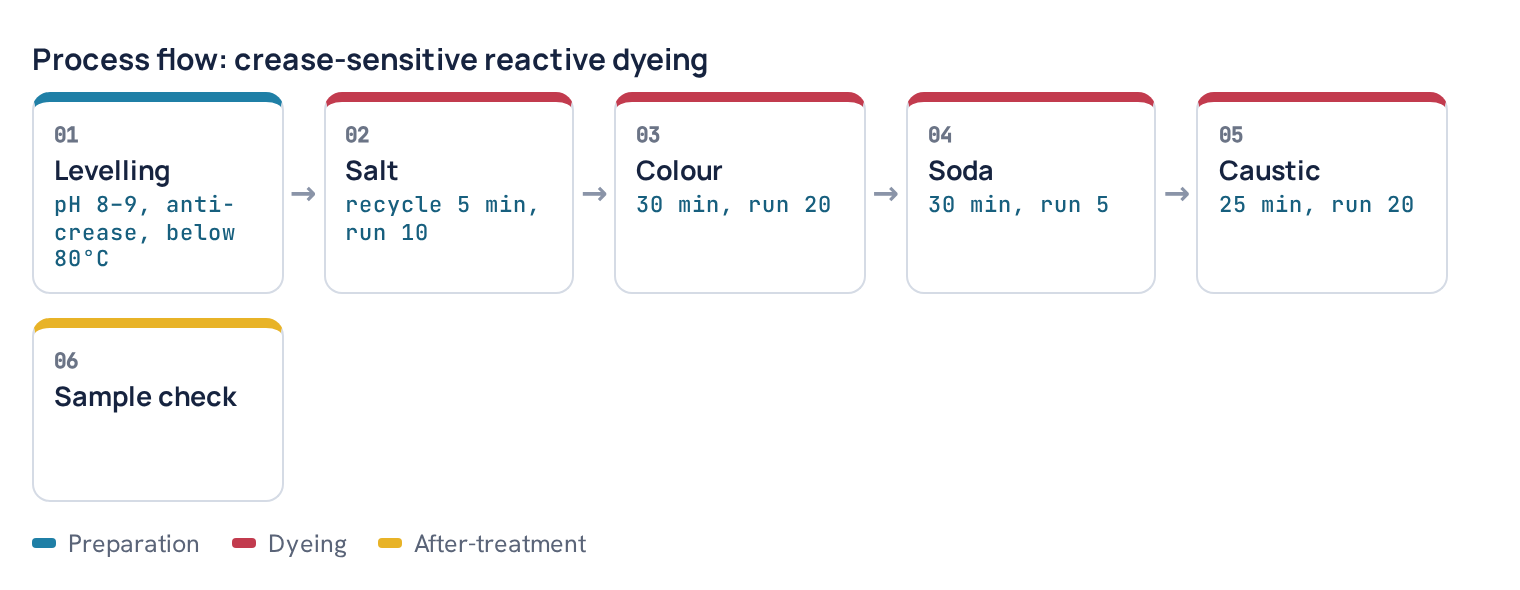
For fabrics that crease easily, we run a separate reactive dyeing process, below 80°C. An anti-crease agent goes in with the levelling agent from the very start, at pH 8–9, and the dye is fixed with soda followed by caustic.
- Levelling at pH 8–9, with the levelling agent and anti-crease agent injected.
- Salt in by recycle over 5 minutes, then run 10 minutes.
- Colour dosing over 30 minutes, then run 20 minutes.
- Soda dosing over 30 minutes, then run 5 minutes.
- Caustic dosing over 25 minutes, then run 20 minutes.
- Sample check.
The anti-crease agent is a lubricant. It reduces the friction between fabric and fabric, and between fabric and machine. Putting it in at the start, and keeping it in every step after, is what protects the fabric.
- The anti-crease agent is a type of lubricant. It reduces the friction of fabric to fabric and fabric to machine.
- So we give it at the start and use it in every step.
- Any good anti-creasing agent works. There is no need for one special product.
- For this process a temperature below 80°C is better.
How to prevent crease marks: checklist
- Heat set heavy fabric before dyeing: single jersey from 180 GSM, lacoste from 250 GSM, fleece and terry from 350 GSM.
- Do not keep fabric in rope form in store for more than 15 days.
- Inject the anti-crease agent first, then load the fabric straight, never twisted.
- Open width 180 cm or below; machine load 80% at most.
- Nozzle 100% open, the lowest reel and pump speed that keeps a 2–3 minute cycle.
- Scouring, dyeing and soaping at 80°C or below, with low-temperature scouring and soaping agents.
- Anti-crease agent in scouring, dyeing and soaping.
- A small air hole just after each roll joint, so the fabric cannot balloon.
- On polyester: heat set, cool to 78–80°C before draining, and use a looser knit for heavy fabric.
What to do when a batch comes out creased
A crease mark is much easier to prevent than to remove. When a batch does come out with crease marks, there are two steps that can help:
- Re-run it in the machine with an anti-crease agent.
- Re-heat set the dyed fabric.
- If crease marks come, we take the fabric back to the machine with an anti-creasing agent.
- Or we re-heat set the dyed fabric.

Textile engineer with 14+ years in dyeing and fabric development. He writes every guide on Dyeing Solution from real production work. Full profile