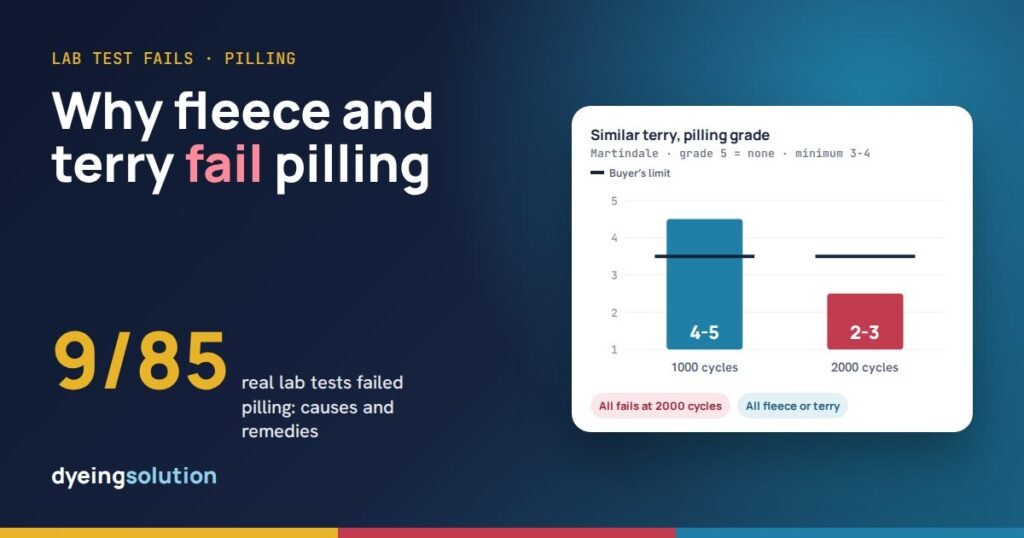
Over 95 new fabric developments, each one tested in the lab, pilling was tested 85 times and failed 9 times, on 7 different batches, all fleece or terry. Here they are case by case: how each was knitted, dyed and finished, what the lab found, and the cause and remedy.
About this series. These findings come from 95 development batches: new and uncommon knit fabrics such as three-thread fleece, diagonal terry, design rib and waffle. Each batch was knitted, dyed and finished as a development sample, then tested by an accredited lab to the buyer’s standard. When a test failed, we found the actual cause on the floor and changed the next batch until it passed.
At a glance
9 of 85Reports failed pilling
7Batches, all fleece or terry
2000Martindale cycles in every fail
3-4Most common minimum
How the lab tests pilling
Pilling is the small balls of tangled fibre that form on a fabric face when it is rubbed in wear. The lab rubs the fabric in a controlled way and then compares it with photographic standards, grading from 5 (no pilling) to 1 (very severe pilling), in half grades. Fuzzing (raised fibre that has not yet rolled into pills) is often graded beside it.
Two methods appear in our reports. In the pilling box (ISO 12945-1), specimens on rubber tubes tumble in a cork-lined box, usually for 10,800 revolutions (3 hours at 60 rpm). In the Martindale method (ISO 12945-2), a specimen is rubbed against the same fabric in a figure-of-eight path, at set stages up to 2000 cycles. The Martindale at 2000 cycles is the harder test.
Most buyers ask for 3-4; a few ask for 4.
Which fabrics fail
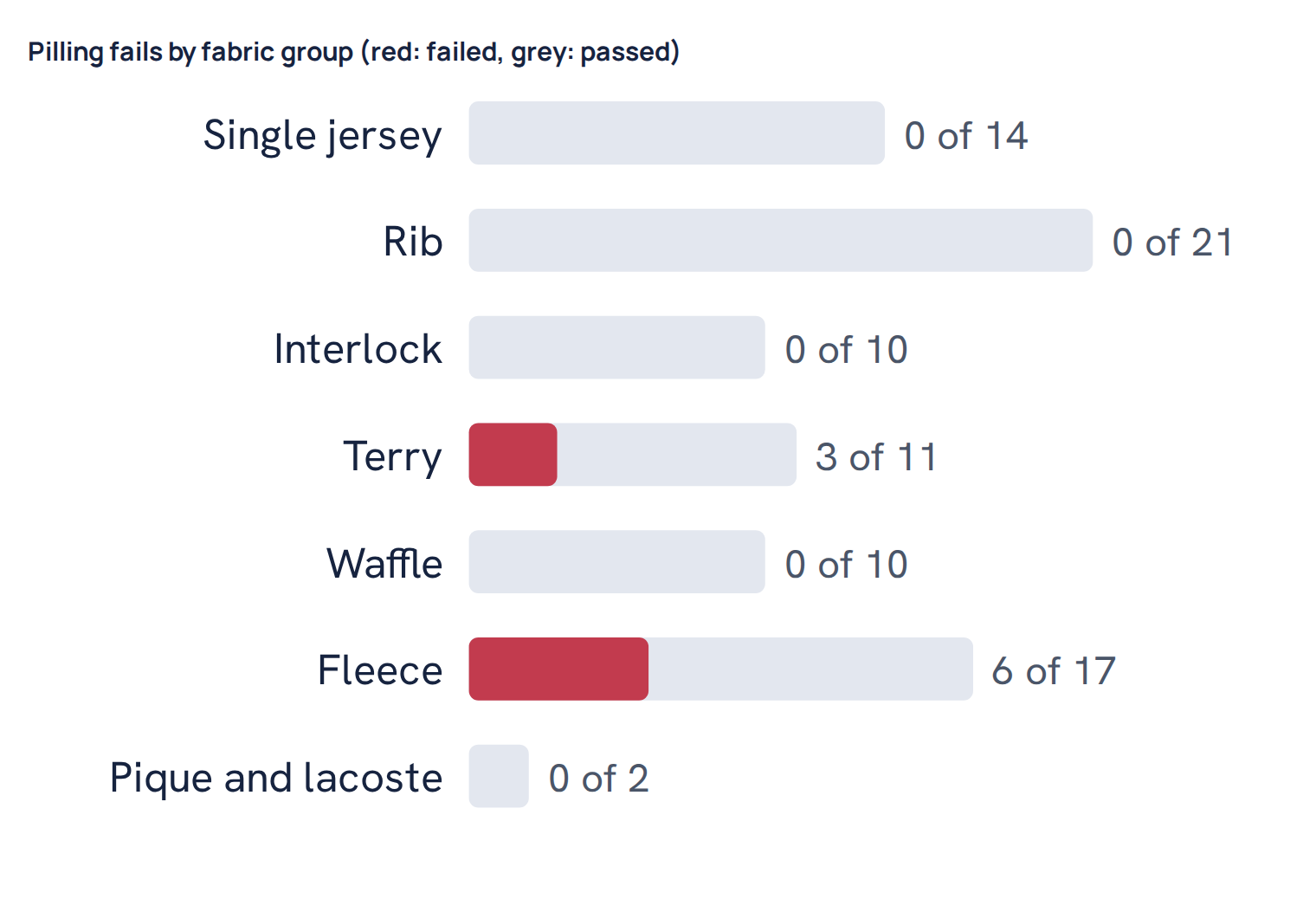
Every pilling fail in our records was a fleece or a terry, all around 330 GSM, all with a coarse loop yarn, and none singed or heat set. Single jersey, rib, interlock and waffle did not fail once.
The test setting decides the result
| Test | Failed |
|---|---|
| Pilling box, ISO 12945-1 | 0 of 54 |
| Martindale 2000 cycles, fleece and terry | 9 of 16 |
The same kind of fabric that passes with 4-5 at 1000 cycles can drop to 2-3 at 2000 cycles. So the first question when a fleece or terry is developed is which test and how many cycles the buyer uses.
How to read each case
Each case shows the fabric as it was knitted, the route it took through dyeing and finishing, the pilling and fuzzing grades against the buyer’s minimum, and the cause and remedy.
Terry: 3 cases
Terry is dyed loop side inside. Heavy terry (350 GSM and up) is heat set before dyeing.
Case 1: Terry, 330 GSM, pilling 2-3 against 3-4
- Yarn: 28/1 mélange 2% + 75D polyester + 10/1 CVC 75/25
- Fibre (declared): Cotton + Polyester + Viscose
- Stitch length: 29+16
- Machine: 30″ × 20G
- Required: 160 cm, 330 GSM
- Finished: 160 cm, 325 GSM
Lab test: ISO 12945-2 (Martindale), face, 2000 cycles
Route: Greige → Dyeing → Stenter → Compacting
Results
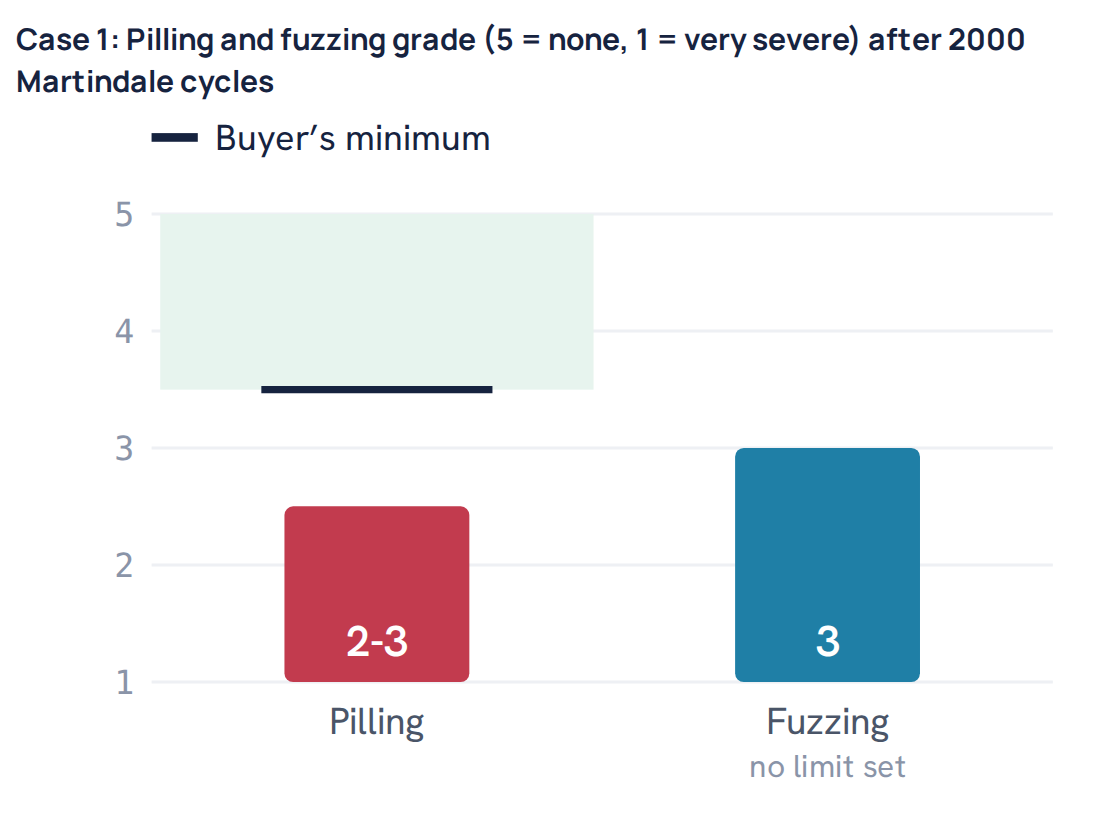
- Pilling grade: 2-3
- Fuzzing grade: 3
- Minimum: 3-4
- Martindale cycles: 2000
Other tests that failed in the same lab report: none.
Cause and remedy
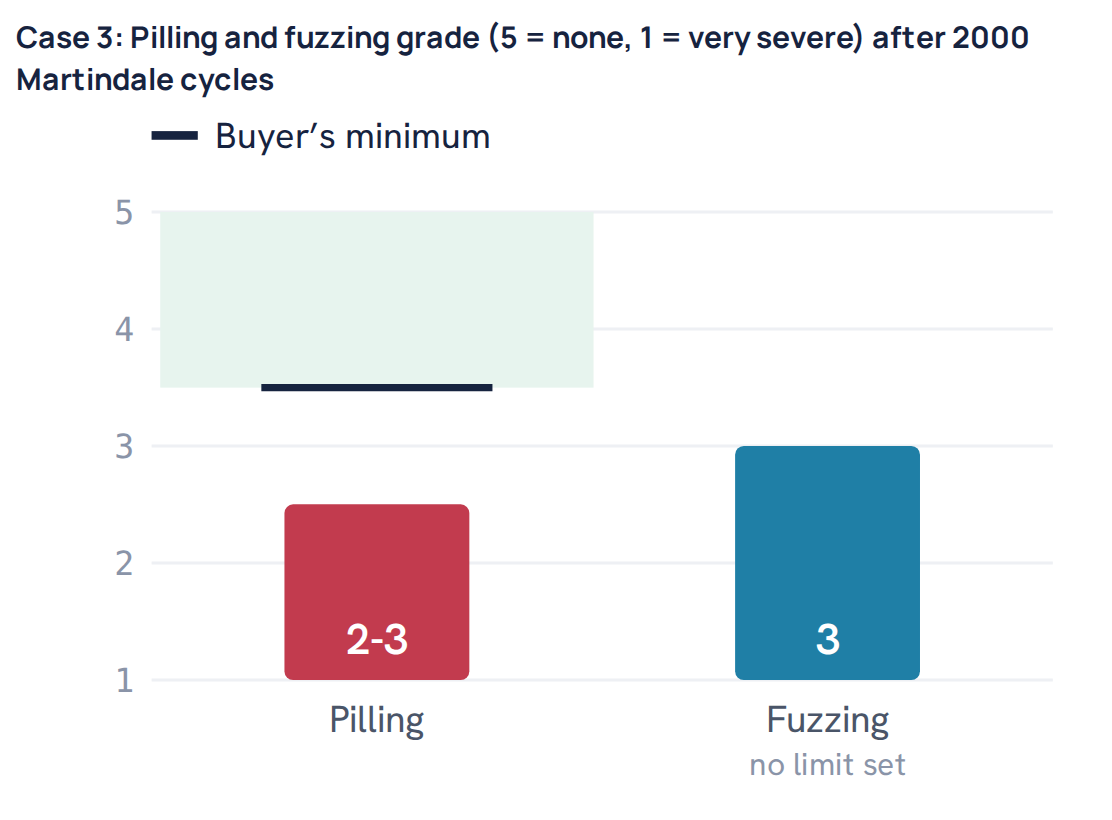
Cause: The lab rubbed the face on the Martindale for 2000 cycles, the hardest setting in our reports, and graded pilling 2-3 against a minimum of 3-4.
Cause: The loop yarn is a coarse cotton-polyester blend with many short fibre ends. When a blend pills, the polyester fibre is strong enough to hold the pill on the surface instead of letting it break off.
Cause: A heavy loop-back fabric has long, loose loops. The looser the knit, the easier fibres pull out and pill; a tight knit holds them in.
Cause: The face was neither singed nor given a proper enzyme treatment, so the hairy surface fibres were still there to start pills.
Remedy: Use a better-quality loop yarn spun from longer fibre (combed rather than carded): fewer fibre ends, fewer pills.
Remedy: Knit it tighter where the design allows. A tightly knitted fabric pills less than a loose one.
Remedy: Make the face smooth before testing: singe it (open width, after slitting) or give a proper enzyme treatment to remove the hairy surface fibre.
Remedy: Before sending, check pilling on the Martindale at the cycle count the buyer asks for. Our fleece and terry passed at 1000 cycles but failed at 2000.
Case 2: Terry, 330 GSM, pilling 2-3 against 3-4
- Yarn: 28/1 cotton + 75D polyester + 10/1 CVC 75/25
- Fibre (declared): 75% Cotton 25% Polyester
- Stitch length: 46+29+16
- Machine: 30″ × 20G
- Required: 160 cm, 330 GSM
- Finished: 173 cm, 325 GSM
Lab test: ISO 12945-2 (Martindale), face, 2000 cycles
Route: Greige → Dyeing → Stenter → Compacting
Results
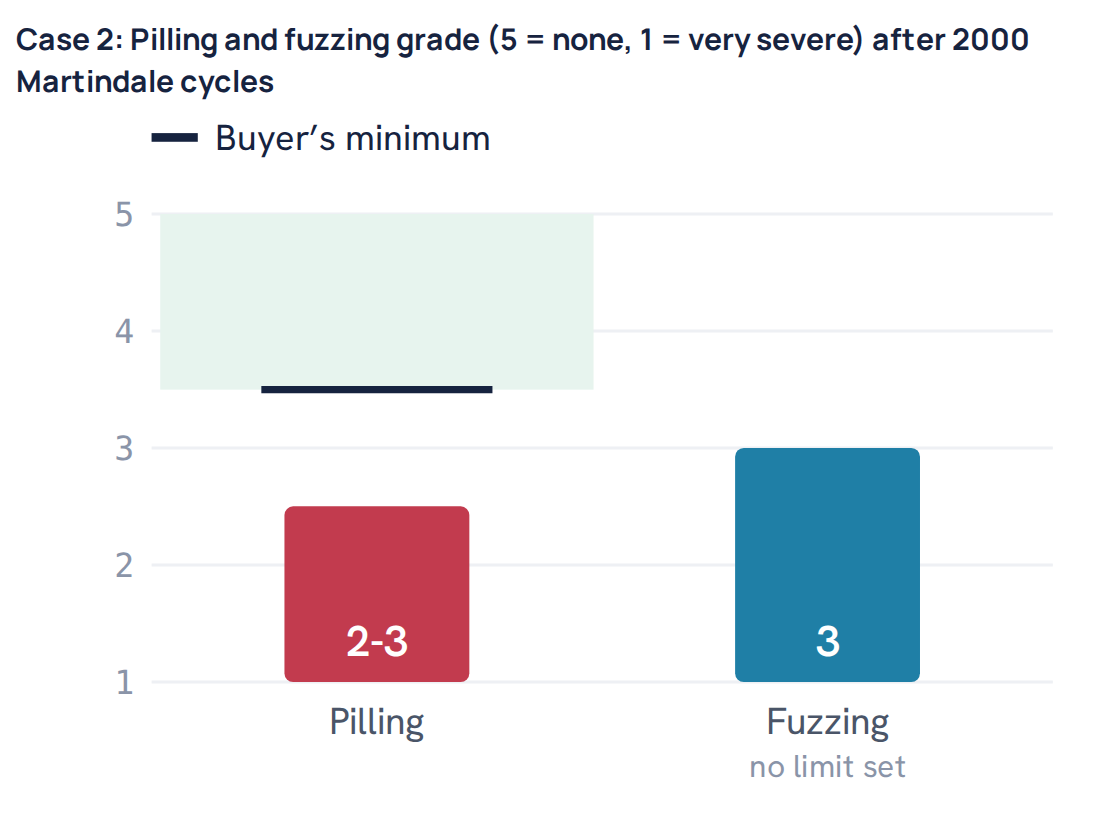
- Pilling grade: 2-3
- Fuzzing grade: 3
- Minimum: 3-4
- Martindale cycles: 2000
Other tests that failed in the same lab report: Fibre analysis.
Cause and remedy
Cause: The lab rubbed the face on the Martindale for 2000 cycles, the hardest setting in our reports, and graded pilling 2-3 against a minimum of 3-4.
Cause: The loop yarn is a coarse cotton-polyester blend with many short fibre ends. When a blend pills, the polyester fibre is strong enough to hold the pill on the surface instead of letting it break off.
Cause: A heavy loop-back fabric has long, loose loops. The looser the knit, the easier fibres pull out and pill; a tight knit holds them in.
Cause: The face was neither singed nor given a proper enzyme treatment, so the hairy surface fibres were still there to start pills.
Remedy: Use a better-quality loop yarn spun from longer fibre (combed rather than carded): fewer fibre ends, fewer pills.
Remedy: Knit it tighter where the design allows. A tightly knitted fabric pills less than a loose one.
Remedy: Make the face smooth before testing: singe it (open width, after slitting) or give a proper enzyme treatment to remove the hairy surface fibre.
Remedy: Before sending, check pilling on the Martindale at the cycle count the buyer asks for. Our fleece and terry passed at 1000 cycles but failed at 2000.
Case 3: Terry, 330 GSM, pilling 2-3 against 3-4
- Yarn: 30/1 combed + 75D polyester + 10/1 CVC 75/25
- Fibre (declared): 80% Cotton 20% Polyester
- Stitch length: 46+29+16
- Machine: 34″ × 20G
- Required: 180 cm, 330 GSM
- Finished: 200 cm, 322 GSM
Lab test: ISO 12945-2 (Martindale), face, 2000 cycles
Route: Greige → Dyeing → Stenter → Compacting
Results
- Pilling grade: 2-3
- Fuzzing grade: 3
- Minimum: 3-4
- Martindale cycles: 2000
Other tests that failed in the same lab report: none.
Cause and remedy
Cause: The lab rubbed the face on the Martindale for 2000 cycles, the hardest setting in our reports, and graded pilling 2-3 against a minimum of 3-4.
Cause: The loop yarn is a coarse cotton-polyester blend with many short fibre ends. When a blend pills, the polyester fibre is strong enough to hold the pill on the surface instead of letting it break off.
Cause: A heavy loop-back fabric has long, loose loops. The looser the knit, the easier fibres pull out and pill; a tight knit holds them in.
Cause: The face was neither singed nor given a proper enzyme treatment, so the hairy surface fibres were still there to start pills.
Remedy: Use a better-quality loop yarn spun from longer fibre (combed rather than carded): fewer fibre ends, fewer pills.
Remedy: Knit it tighter where the design allows. A tightly knitted fabric pills less than a loose one.
Remedy: Make the face smooth before testing: singe it (open width, after slitting) or give a proper enzyme treatment to remove the hairy surface fibre.
Remedy: Before sending, check pilling on the Martindale at the cycle count the buyer asks for. Our fleece and terry passed at 1000 cycles but failed at 2000.
Fleece: 4 cases
Fleece is dyed loop side inside; fleece of 350 GSM and up is heat set before dyeing.
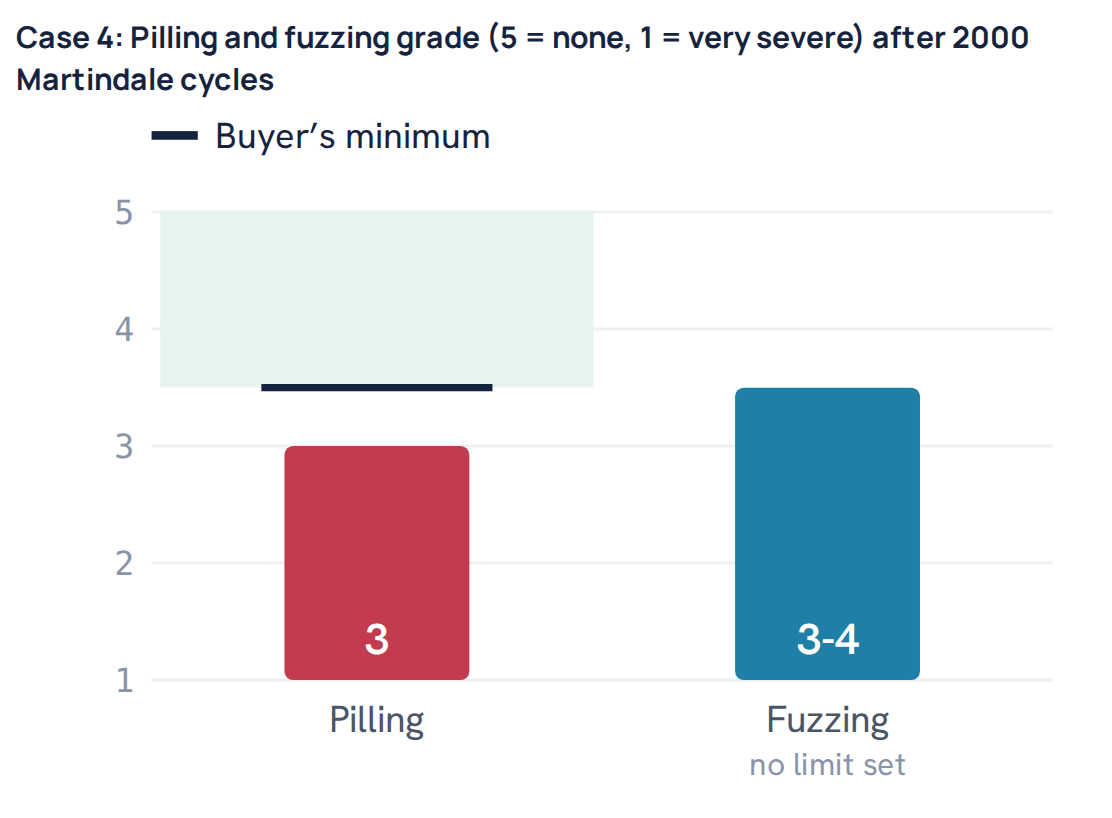
Case 4: Fleece, 330 GSM, pilling 3 against 3-4
- Yarn: 30/1 combed + 26/1 CVC 60/40 + 8/1 carded
- Fibre (declared): 88% Cotton 12% Polyester
- Stitch length: 47.5+39.5+20
- Machine: 36″ × 14G
- Required: 170 cm, 330 GSM
- Finished: — cm, — GSM
Lab test: ISO 12945-2 (Martindale), face, 2000 cycles
Route: Greige → Dyeing → Stenter → Compacting
Results
- Pilling grade: 3
- Fuzzing grade: 3-4
- Minimum: 3-4
- Martindale cycles: 2000
Other tests that failed in the same lab report: Shrinkage.
Cause and remedy
Cause: The lab rubbed the face on the Martindale for 2000 cycles, the hardest setting in our reports, and graded pilling 3 against a minimum of 3-4.
Cause: The loop yarn is a coarse 8/1 carded cotton. Carded yarn is spun from shorter fibre, and short fibre leaves many more fibre ends sticking out of the yarn. Those ends work to the surface and roll into pills; long fibre leaves fewer ends.
Cause: A heavy loop-back fabric has long, loose loops. The looser the knit, the easier fibres pull out and pill; a tight knit holds them in.
Cause: The face was neither singed nor given a proper enzyme treatment, so the hairy surface fibres were still there to start pills.
Remedy: Use a better-quality loop yarn spun from longer fibre (combed rather than carded): fewer fibre ends, fewer pills.
Remedy: Knit it tighter where the design allows. A tightly knitted fabric pills less than a loose one.
Remedy: Make the face smooth before testing: singe it (open width, after slitting) or give a proper enzyme treatment to remove the hairy surface fibre.
Remedy: Before sending, check pilling on the Martindale at the cycle count the buyer asks for. Our fleece and terry passed at 1000 cycles but failed at 2000.
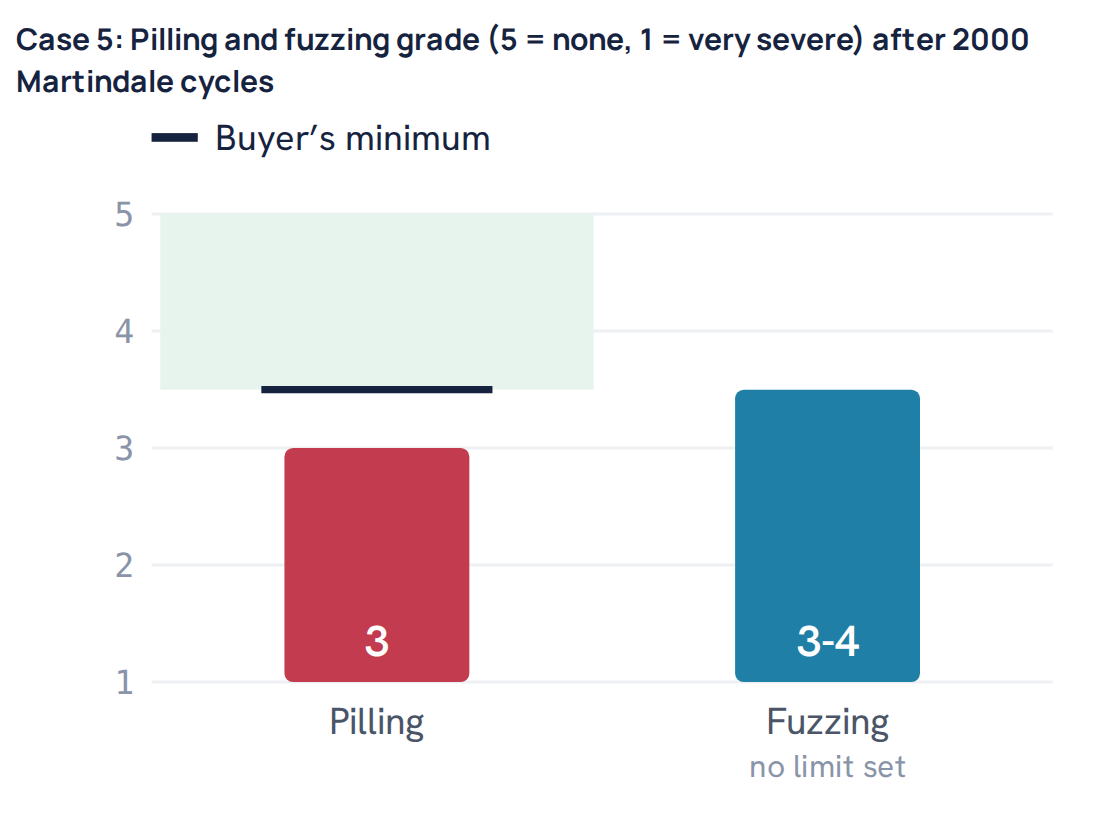
Case 5: Fleece, 330 GSM, pilling 3 against 3-4
- Yarn: 30/1 combed + 26/1 CVC 60/40 + 8/1 carded
- Fibre (declared): 88% Cotton 12% Polyester
- Stitch length: 47.5+39.5+20
- Machine: 36″ × 14G
- Required: 170 cm, 330 GSM
- Finished: 171 cm, 330 GSM
Lab test: ISO 12945-2 (Martindale), face, 2000 cycles
Route: Greige → Dyeing → Stenter → Compacting
Results
- Pilling grade: 3
- Fuzzing grade: 3-4
- Minimum: 3-4
- Martindale cycles: 2000
Other tests that failed in the same lab report: none.
Cause and remedy
Cause: The lab rubbed the face on the Martindale for 2000 cycles, the hardest setting in our reports, and graded pilling 3 against a minimum of 3-4.
Cause: The loop yarn is a coarse 8/1 carded cotton. Carded yarn is spun from shorter fibre, and short fibre leaves many more fibre ends sticking out of the yarn. Those ends work to the surface and roll into pills; long fibre leaves fewer ends.
Cause: A heavy loop-back fabric has long, loose loops. The looser the knit, the easier fibres pull out and pill; a tight knit holds them in.
Cause: The face was neither singed nor given a proper enzyme treatment, so the hairy surface fibres were still there to start pills.
Remedy: Use a better-quality loop yarn spun from longer fibre (combed rather than carded): fewer fibre ends, fewer pills.
Remedy: Knit it tighter where the design allows. A tightly knitted fabric pills less than a loose one.
Remedy: Make the face smooth before testing: singe it (open width, after slitting) or give a proper enzyme treatment to remove the hairy surface fibre.
Remedy: Before sending, check pilling on the Martindale at the cycle count the buyer asks for. Our fleece and terry passed at 1000 cycles but failed at 2000.
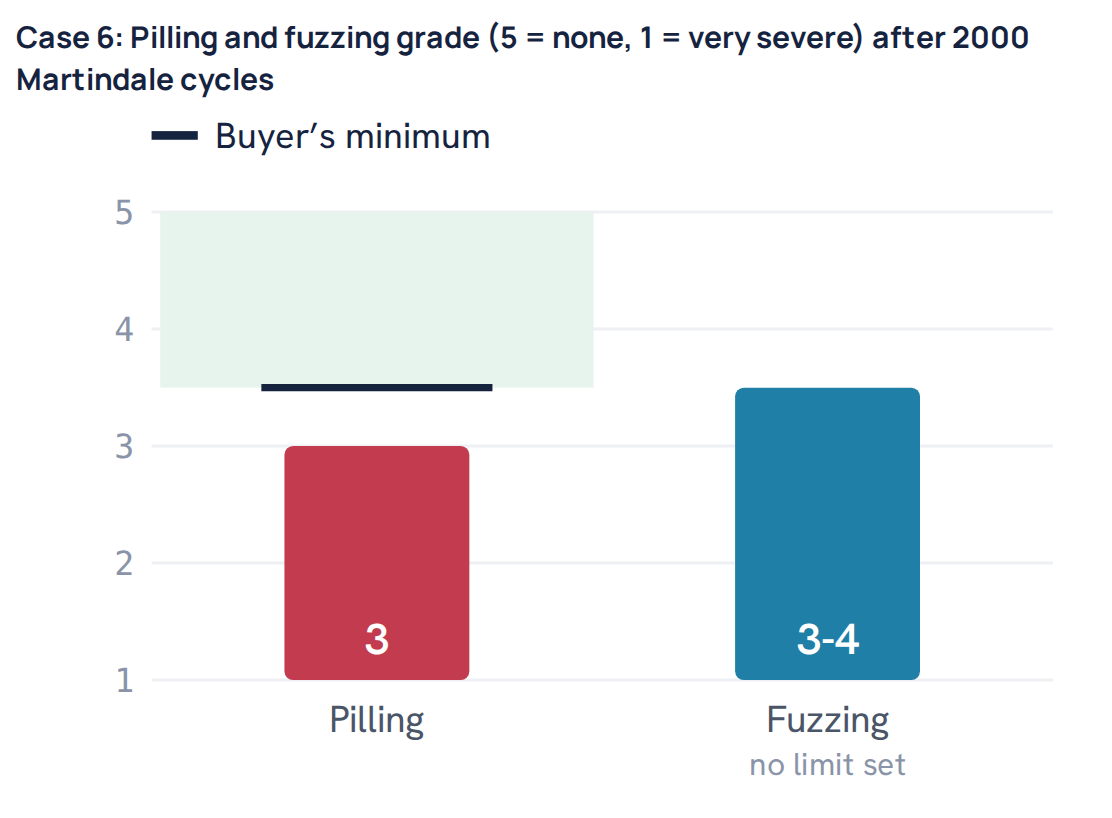
Case 6: Fleece, 330 GSM, pilling 3 against 3-4
- Yarn: K-30/1 combed + T-26/1 CVC 60/40 RING + L-8/1 carded
- Fibre (declared): 100% Cotton
- Stitch length: 47.5+39.5+20
- Machine: 36″ × 14G
- Required: 175 cm, 330 GSM
- Finished: 180 cm, 330 GSM
Lab test: ISO 12945-2 (Martindale), face, 2000 cycles
Route: Greige → Dyeing → Stenter → Compacting
Results
- Pilling grade: 3
- Fuzzing grade: 3-4
- Minimum: 3-4
- Martindale cycles: 2000
Other tests that failed in the same lab report: Fibre analysis.
Cause and remedy
Cause: The lab rubbed the face on the Martindale for 2000 cycles, the hardest setting in our reports, and graded pilling 3 against a minimum of 3-4.
Cause: The loop yarn is a coarse 8/1 carded cotton. Carded yarn is spun from shorter fibre, and short fibre leaves many more fibre ends sticking out of the yarn. Those ends work to the surface and roll into pills; long fibre leaves fewer ends.
Cause: A heavy loop-back fabric has long, loose loops. The looser the knit, the easier fibres pull out and pill; a tight knit holds them in.
Cause: The face was neither singed nor given a proper enzyme treatment, so the hairy surface fibres were still there to start pills.
Remedy: Use a better-quality loop yarn spun from longer fibre (combed rather than carded): fewer fibre ends, fewer pills.
Remedy: Knit it tighter where the design allows. A tightly knitted fabric pills less than a loose one.
Remedy: Make the face smooth before testing: singe it (open width, after slitting) or give a proper enzyme treatment to remove the hairy surface fibre.
Remedy: Before sending, check pilling on the Martindale at the cycle count the buyer asks for. Our fleece and terry passed at 1000 cycles but failed at 2000.
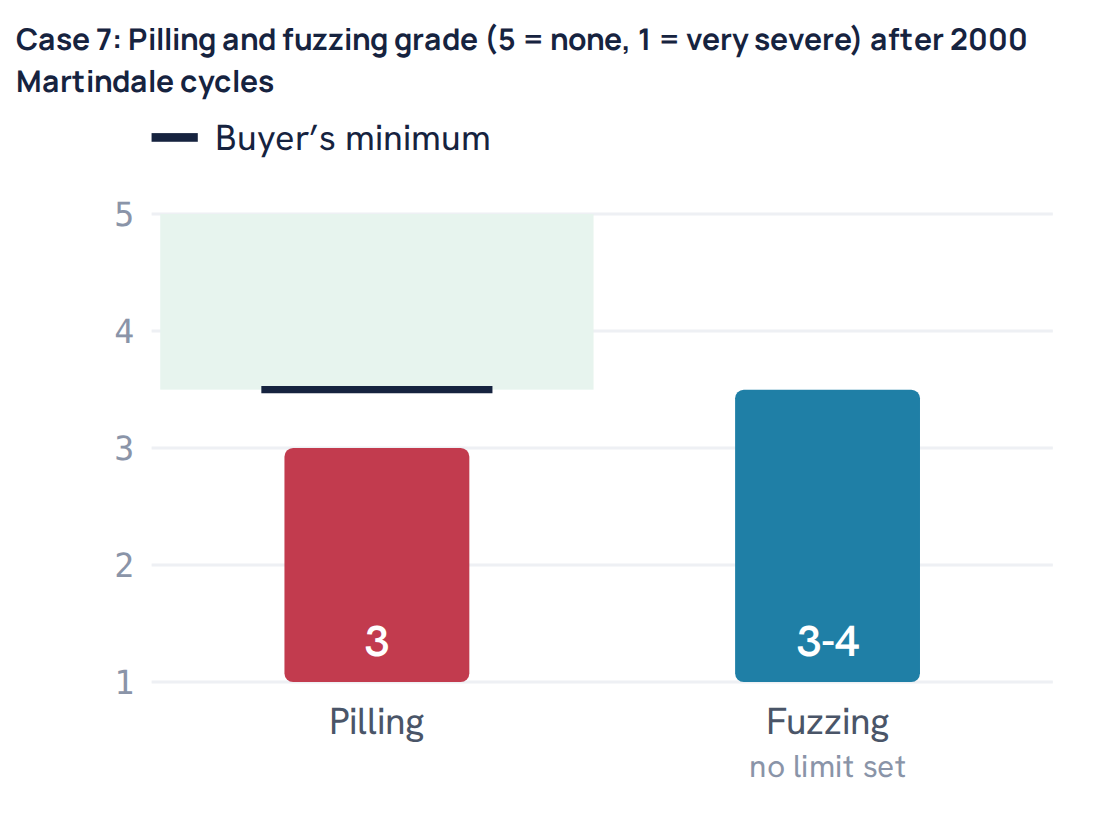
Case 7: Fleece, 330 GSM, pilling 3 against 3-4
- Yarn: 30/1 combed + 26/1 CVC 60/40 + 8/1 carded
- Fibre (declared): 80% Cotton 20% Polyester
- Stitch length: 47.5+39.5+20
- Machine: 30″ × 16G
- Required: 165 cm, 330 GSM
- Finished: 170 cm, 332 GSM
Lab test: ISO 12945-2 (Martindale), face, 2000 cycles
Route: Greige → Dyeing → Stenter → Compacting
Results
- Pilling grade: 3
- Fuzzing grade: 3-4
- Minimum: 3-4
- Martindale cycles: 2000
Other tests that failed in the same lab report: Wash fastness, Rubbing fastness, GSM.
Cause and remedy
Cause: The lab rubbed the face on the Martindale for 2000 cycles, the hardest setting in our reports, and graded pilling 3 against a minimum of 3-4.
Cause: The loop yarn is a coarse 8/1 carded cotton. Carded yarn is spun from shorter fibre, and short fibre leaves many more fibre ends sticking out of the yarn. Those ends work to the surface and roll into pills; long fibre leaves fewer ends.
Cause: A heavy loop-back fabric has long, loose loops. The looser the knit, the easier fibres pull out and pill; a tight knit holds them in.
Cause: The face was neither singed nor given a proper enzyme treatment, so the hairy surface fibres were still there to start pills.
Remedy: Use a better-quality loop yarn spun from longer fibre (combed rather than carded): fewer fibre ends, fewer pills.
Remedy: Knit it tighter where the design allows. A tightly knitted fabric pills less than a loose one.
Remedy: Make the face smooth before testing: singe it (open width, after slitting) or give a proper enzyme treatment to remove the hairy surface fibre.
Remedy: Before sending, check pilling on the Martindale at the cycle count the buyer asks for. Our fleece and terry passed at 1000 cycles but failed at 2000.
From the floor: what I learned from these 7 cases
- Pilling starts in spinning. With short fibre there are more fibre ends coming out of the yarn, and they pill; with long fibre there are fewer. So long fibre gives less pilling.
- Then knitting: a tightly knitted fabric pills less, a loosely knitted one more, and an unstable loop pills badly.
- Then dyeing: if the fabric does not get a proper enzyme treatment or singeing, the face stays hairy and pilling is poor.
- So the remedy is a better-quality loop yarn from longer fibre, a tighter knit, and a smooth face from singeing or a proper enzyme treatment.
Questions
What pilling grade is acceptable for fleece?
Most buyers ask for 3-4 after the test; a few ask for 4. Always check which method and how many cycles they use.
Why does fleece pill more than single jersey?
Its coarse loop yarn carries more short fibre, and in a blend the polyester holds pills on the surface instead of letting them wear off.
How do you reduce pilling on cotton fleece?
Use a loop yarn spun from longer fibre, knit it tighter, make the face smooth with singeing or a proper enzyme treatment, and test at the buyer’s cycle count before sending.

Textile engineer with 14+ years in dyeing and fabric development. He writes every guide on Dyeing Solution from real production work. Full profile