CVC and PC knits need two dye classes in two baths: disperse dye for the polyester at 130°C, then reactive dye for the cotton at 60°C. Here is the full route from our floor, with a real batch card and data from 2,514 batches.
At a glance
2 bathsPolyester first, cotton second
130°CDisperse dyeing, 45 min
60°CReactive dyeing
67%Parts within GSM tolerance
CVC means “chief value cotton”: a blend where cotton is the larger part, such as 60/40 or 80/20 cotton/polyester. PC is the reverse, with polyester the larger part, such as 65/35. Both are dyed the same way, and both are among the easiest fabrics to finish to size. They are also the fabrics where a mistake in one bath shows up only after the other bath is finished.
Why CVC needs two baths
Cotton and polyester take completely different dyes. Reactive dye bonds to cotton but has no affinity for polyester. Disperse dye goes into polyester at high temperature but only stains cotton. So each fibre is dyed in its own bath, with its own chemistry:
- Bath 1, polyester: disperse dye at 130°C for 45 minutes.
- Bath 2, cotton: reactive dye at 60°C with salt and soda ash.
The polyester is dyed first. The 130°C bath would damage reactive dye already fixed on the cotton, while the 60°C reactive bath does not disturb disperse dye already inside the polyester.
- In solid shades both fibres are dyed: the polyester with disperse dye and the cotton with reactive dye.
- For a melange effect only one part is dyed, either the polyester or the cotton, and the other is left undyed.
- Solid and melange CVC behave the same for GSM and shrinkage.
The route for CVC
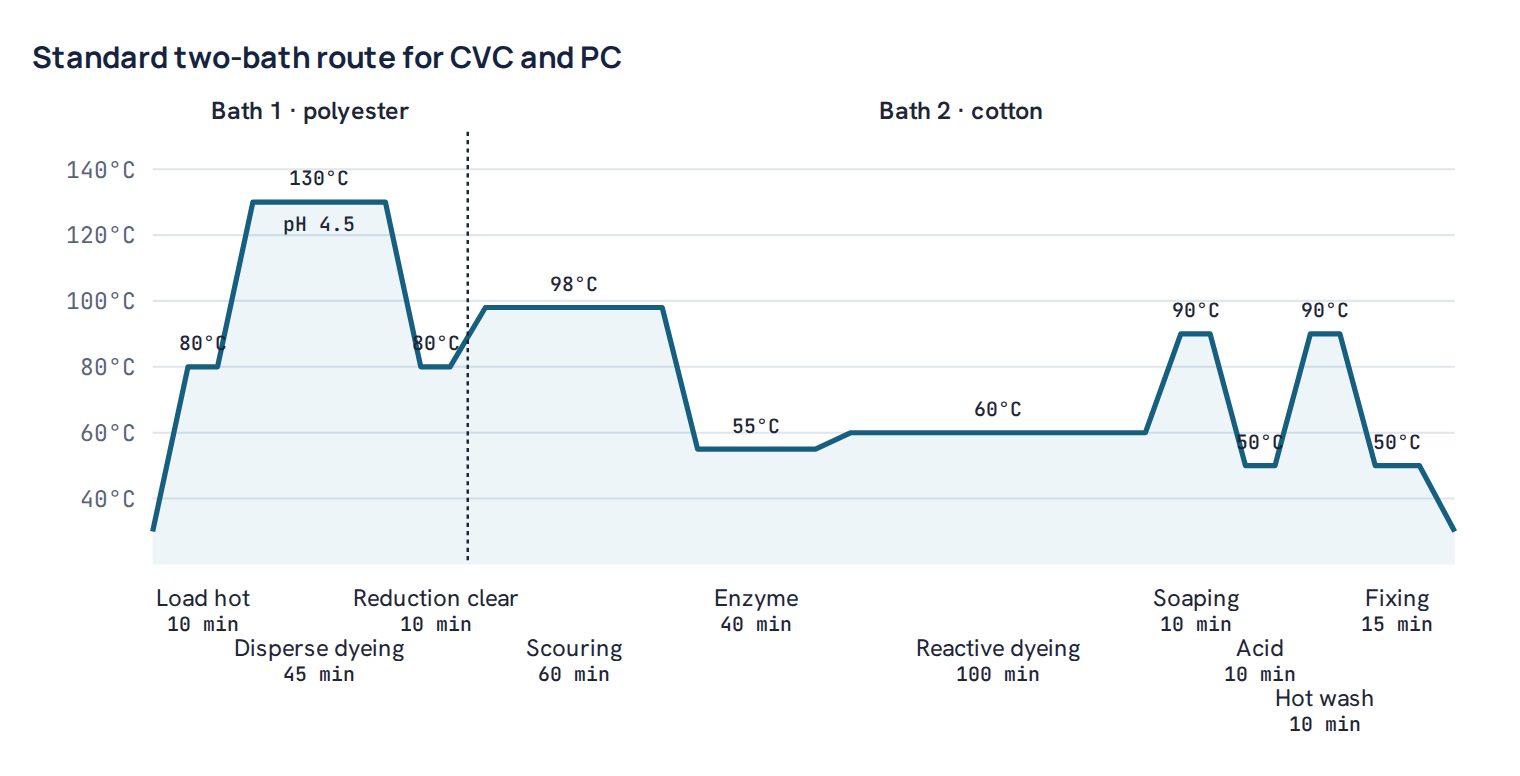
- Load hot at 80°C for 10 minutes.
- Disperse dyeing of the polyester at pH 4.5. For critical colours the bath heats from 90°C to 130°C at 1°C per minute, holds 45 minutes at 130°C, and cools at 1°C per minute before draining.
- Reduction clearing at 80°C for 10 minutes. This is not optional: without it the cotton part cannot be dyed properly.
- Scouring of the cotton part, the same as 100% cotton: 98°C for 60 minutes with caustic and peroxide.
- Enzyme at 55°C for 40 minutes.
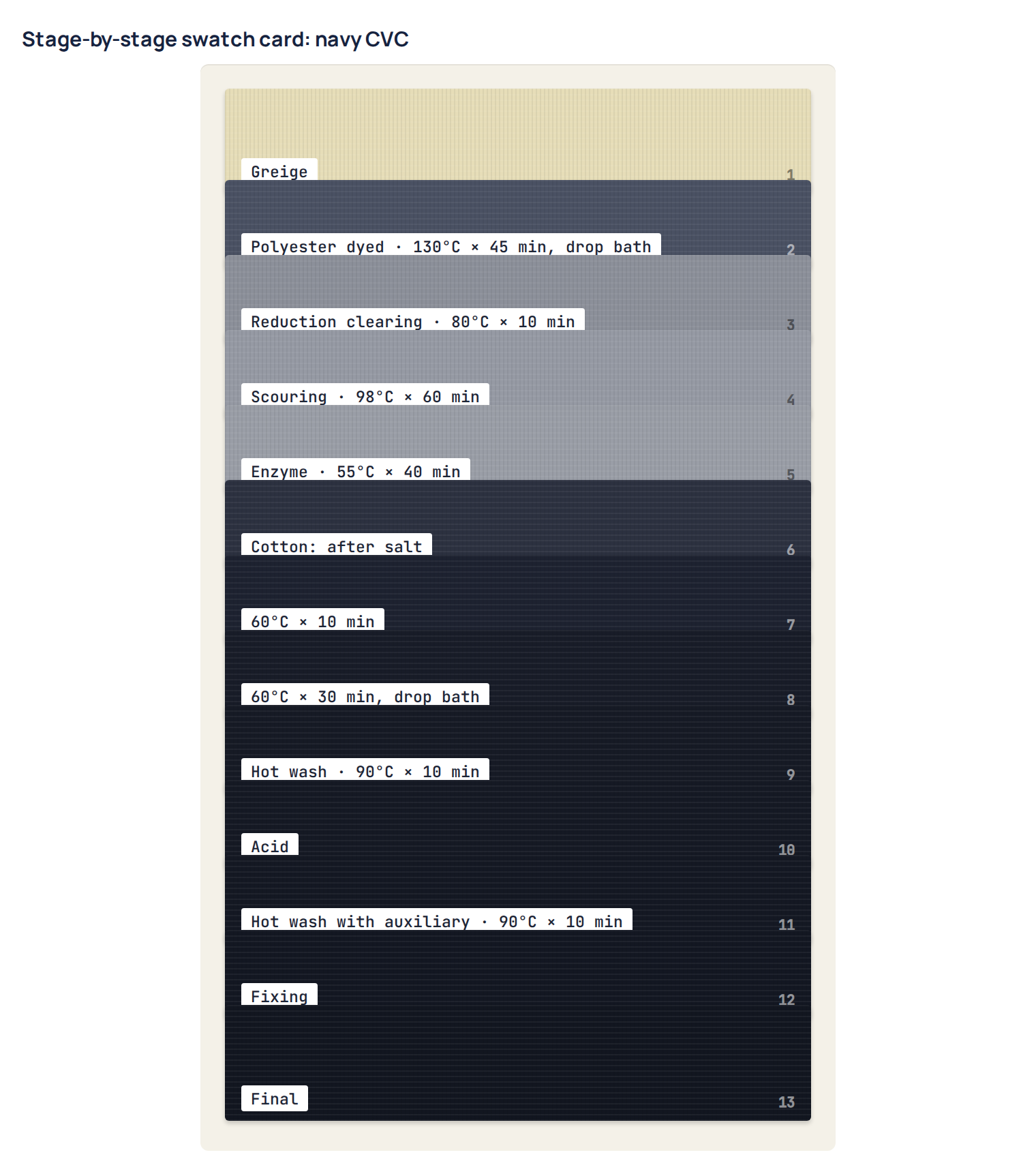
- Reactive dyeing of the cotton at 60°C: salt, then soda, then drop the bath.
- Wash-off: hot wash at 90°C for 10 minutes, acid, and a second hot wash at 90°C with a soaping auxiliary.
- Fixing for dark shades such as navy.
Light colours are the exception. For light-shade CVC the scour comes first, before the polyester bath: scour, then polyester, then cotton. Either order works; what matters is that the cotton is scoured before its reactive bath.
- Scouring is not done in the disperse bath. It is a separate step.
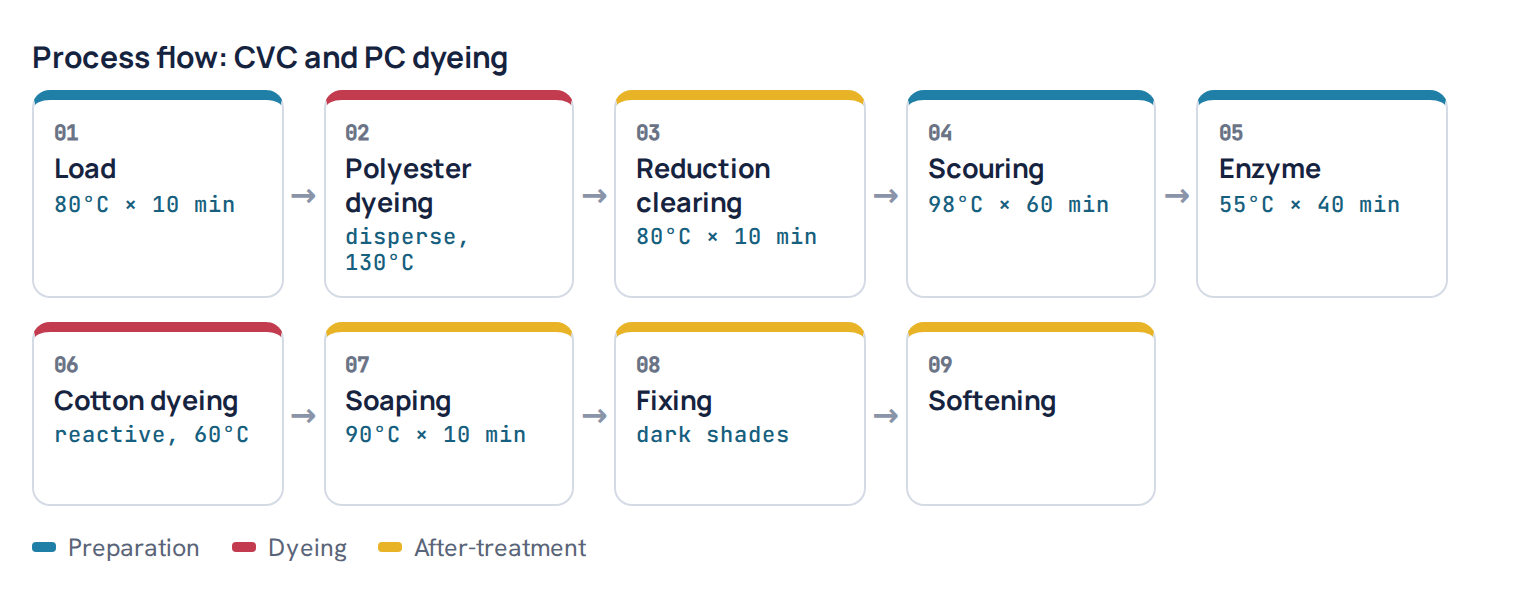
- The standard flow for CVC and PC is: polyester dyeing, then reduction clearing, then scouring, then enzyme, then cotton dyeing.
- For light colours we scour first, then dye the polyester, then the cotton. Scouring before or after the polyester makes no difference to the result.
- Reduction clearing after the polyester is a must. Without it you cannot dye the cotton part.
- For critical colours the disperse bath goes from 90°C to 130°C at 1°C per minute, and cools from 130°C at 1°C per minute before draining. The dyebath pH is 4.5.
Why the enzyme sits between the two baths
On 100% cotton the order is scour, enzyme, dye. On CVC the polyester is dyed first, and then the cotton part begins. The enzyme and the scour belong to the cotton part only, since the enzyme works on cotton and does nothing to polyester. So they come after the polyester bath and before the reactive bath.
Bath 2: the reactive curves for the cotton part
The cotton part of CVC is dyed with the same reactive curves as 100% cotton. Our process sheets list the same curves for 100% cotton, PC and CVC:
- Standard 60°C curve: colour, salt in portions, soda in two steps (1 g/L linear, then the rest at 70% progressive).
- Migration step: 80°C × 20 minutes after the salt, for large-molecule dyes and critical shades.
- Navy (80/60): dye and salt at 80°C, fixation at 60°C.
- Turquoise and Reactive Blue 19: their own hotter curves.
See the 100% cotton dyeing process for each curve step by step.
What CVC looks like at delivery
From our finishing records of 2,514 cotton-polyester batches (see the full GSM and shrinkage study), CVC and PC are the most predictable fabrics we finish. Compared with 100% cotton:
| Measure | CVC / PC | 100% cotton |
|---|---|---|
| Median finished GSM vs required | −2.3% | −5.0% |
| Parts within ±5% of required GSM | 67% | 47% |
| Median length shrinkage | 4% | 6% |
| Parts with length shrinkage within 5% | 82% | 47% |
| Light parts fixed by washing | 54% | 75% |
| GSM gain when a light part is washed | +8% | +11% |
By fabric type
| CVC / PC fabric type | Batches | Median finished GSM vs required | Within ±5% | Median length shrinkage | Median width shrinkage |
|---|---|---|---|---|---|
| Fleece / terry | 1,408 | −1.9% | 74% | 3% | 2% |
| Rib / interlock | 506 | −2.8% | 58% | 4% | 2% |
| Single jersey | 394 | −2.2% | 63% | 4% | 2% |
| Pique | 109 | −4.4% | 53% | 5% | 2% |
| Waffle | 56 | −3.4% | 51% | 4% | 4% |
CVC fleece and terry are the best result in the whole study: 74% of parts within GSM tolerance. The polyester holds the loop structure while the cotton relaxes.
Limitations of CVC and how to handle them
- Light GSM does not wash out. Only 54% of light CVC parts come back within tolerance after washing, and 35% stay light. Fix the construction in knitting.
- Two-bath time and cost. Two dyeing baths, two wash-offs and a hot 130°C stage make CVC one of the longest routes in the dye house.
- Harsh hand feel. The main buyer complaint. CVC does not have the soft handle of 100% cotton.
- Shade matching two fibres. Each part must be matched on its own, and the final shade is the mix of both.
- CVC with elastane. Adding elastane lowers GSM accuracy from 67% to 49% of parts, even with heat setting.
- Polyester has no shrink property. In CVC or PC the polyester holds the structure, so the fabric cannot shrink, and washing changes the GSM very little.
- GSM only goes up when the fabric shrinks and the dia comes down. That is why a light CVC batch stays light after washing.
- The real remedy is in development: change the yarn count, or change the stitch length and knit the fabric a little tighter.
- The main complaint on CVC is hand feel. The fabric feels harsh, a harder type of handle, not the soft hand feel of cotton.
- Apart from that, CVC normally gets no complaints.

Textile engineer with 14+ years in dyeing and fabric development. He writes every guide on Dyeing Solution from real production work. Full profile