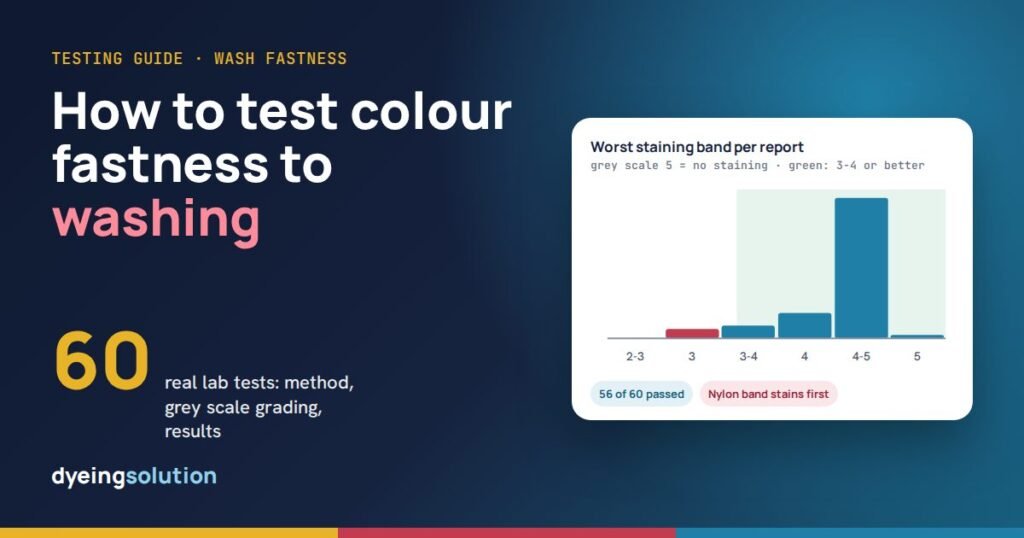
How the lab tests colour fastness to washing with a multifibre strip, step by step, how the grey scales are read, and what 60 real lab tests on knit developments showed.
About this guide. The method below is written from the public ISO and AATCC standards in plain words. The data comes from our own lab reports on 95 new knit developments, each tested by an accredited lab to the buyer’s standard, so you can see what real results look like.
At a glance
60Wash fastness tests in our data
93%Passed
40°C × 30 minMost common test (A1S)
3-4Usual staining minimum
What the test measures
Colour fastness to washing shows how a coloured fabric behaves in a domestic or commercial wash: how much its own colour changes, and how much colour it gives off onto other fabrics in the same wash.
Equipment
- A laboratory washing machine with a rotating water bath and stainless steel containers (a launder tester), running at 40 rpm.
- Stainless steel balls (10 for the common A1S test) for mechanical action.
- The reference detergent named in the standard, and sodium perborate for tests that include it.
- Multifibre adjacent fabric, a sewing machine, an oven or drying rack below 60°C, the grey scales and a viewing cabinet.
How the test is done, step by step (ISO 105-C06)
- Prepare the composite specimen. Cut the fabric 100 × 40 mm and sew it along one short edge to a piece of multifibre fabric of the same size, face to the strip.
- Make up the wash liquor: reference detergent at 4 g/l in water (plus 1 g/l sodium perborate in the A2S version).
- Load the container with 150 ml of liquor, the steel balls and the composite specimen, and preheat to the test temperature.
- Run the test: 40°C for 30 minutes for A1S, the most common test in our reports. Other versions (B, C, D, E) run hotter for fabrics that will be washed hotter.
- Rinse twice in water, squeeze out, open the stitching on three sides and dry hanging at no more than 60°C, with the fabric and strip touching only at the stitched edge.
- Assess colour change and the staining on each band with the grey scales.
Grading: the two grey scales
Two results are reported. Colour change compares the tested specimen with an untested piece of the same fabric, using the grey scale for colour change. Staining compares each band of the multifibre strip with an unused strip, using the grey scale for staining. Both run from 5 (no change, no staining) to 1 (severe), in half grades, and are assessed in a viewing cabinet under daylight (D65).
The multifibre strip has six bands: acetate, cotton, nylon, polyester, acrylic and wool. Each band shows whether the dye that came off would mark that kind of fibre in a mixed wash or in a garment made of different fabrics.
Example result. “Change 4; staining: acetate 4, cotton 4, nylon 3, polyester 3-4, acrylic 4-5, wool 4-5.” Against a minimum of change 4 and staining 3-4, this fails on the nylon band.
What real results look like
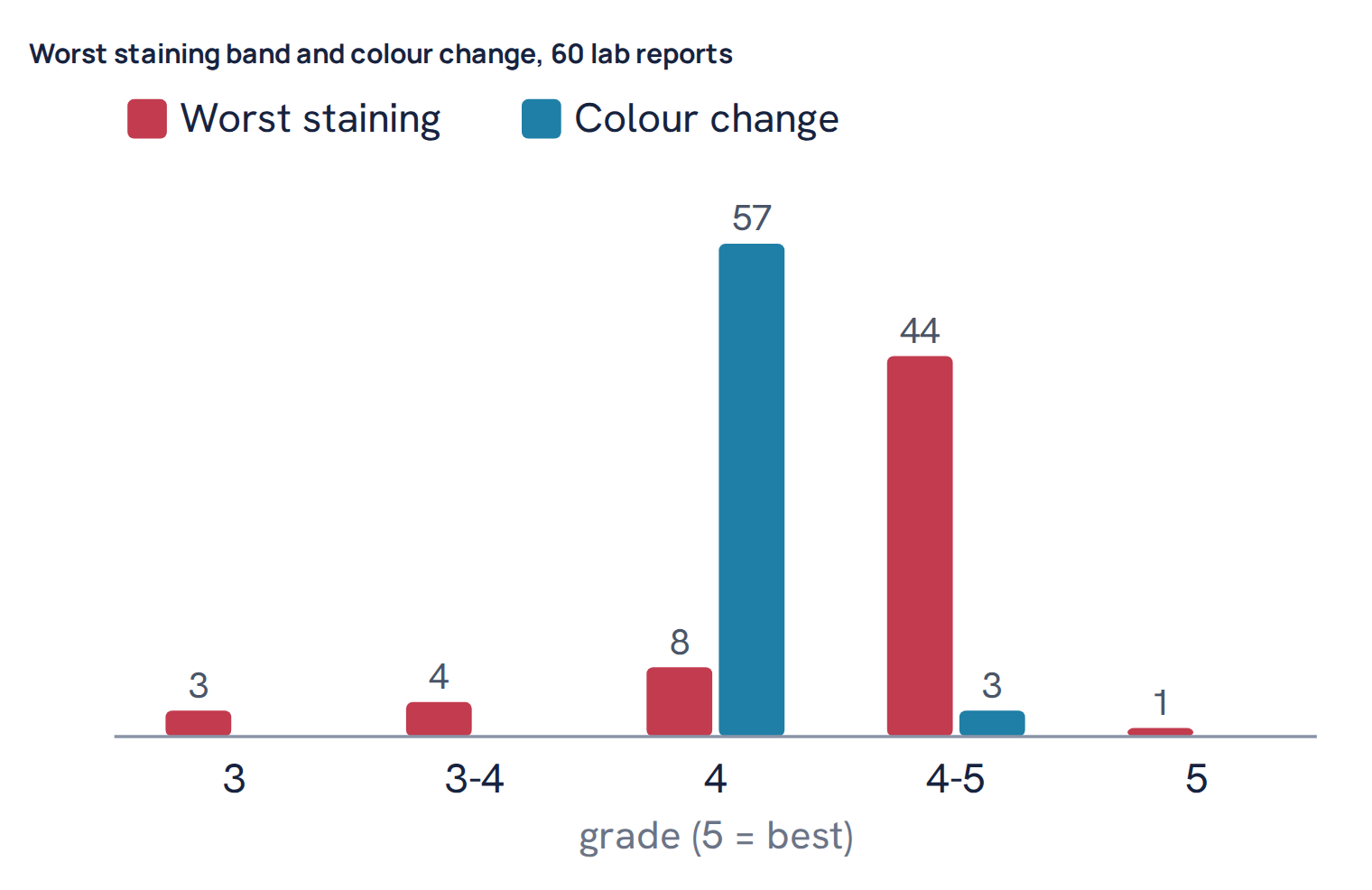
56 of 60 batches passed. Colour change rarely decides the result; it is the staining, usually on the nylon band, that fails.
| Fabric | Failed |
|---|---|
| With polyester | 4 of 25 |
| Without polyester | 0 of 35 |
Fabrics with polyester fail more often: the disperse dye on the polyester part stains nylon, polyester and acetate if it is not fully reduction cleared, or if the fabric is finished too hot and the dye moves back to the surface.
If a batch fails, see why knit fabric fails staining: 9 real cases.
Common mistakes that change the result
- Too few steel balls or the wrong liquor volume, which changes the mechanical action.
- Drying the composite folded, so the strip picks up extra colour while drying.
- Using an ordinary household detergent instead of the reference detergent.
- Assessing under shop lighting instead of daylight in a viewing cabinet.
From the floor
- In wash fastness, polyester is the main issue. With cotton, if the hot wash and soaping are done properly, there is practically no chance of a fail.
- Polyester fastness depends on two things. First, the disperse dye: use high-fastness disperse dyes, because low-quality disperse dyes give poor fastness. Second, the drying temperature: cotton is normally dried at 140–150°C on the stenter and compactor, but fabric with polyester must be dried at 100–110°C. Miss that and the fastness goes bad.
- This is hardest to control at development stage. Development batches are small, 10, 15 or 20 kg, and they come to the stenter one after another between standard rolls run hot for cotton. The temperature has to be brought down for each small polyester roll and taken back up after it, so it is easy to miss.
- We follow a standard operating procedure for better fastness. When it is followed, the chance of a wash fastness fail is close to none.
Questions
What does A1S mean in ISO 105-C06?
The test at 40°C for 30 minutes with 150 ml of liquor and 10 steel balls, without perborate. A2S is the same with perborate added.
Which fibre stains most in a wash fastness test?
In our data, nylon. It picks up both disperse dye from polyester and loose reactive dye from cotton.
What grade is a pass for wash fastness?
Most buyers ask for colour change 4 and staining 3-4; some ask for staining 4.
Related: the wash-off that gets deep shades to wet rubbing 3.

Textile engineer with 14+ years in dyeing and fabric development. He writes every guide on Dyeing Solution from real production work. Full profile