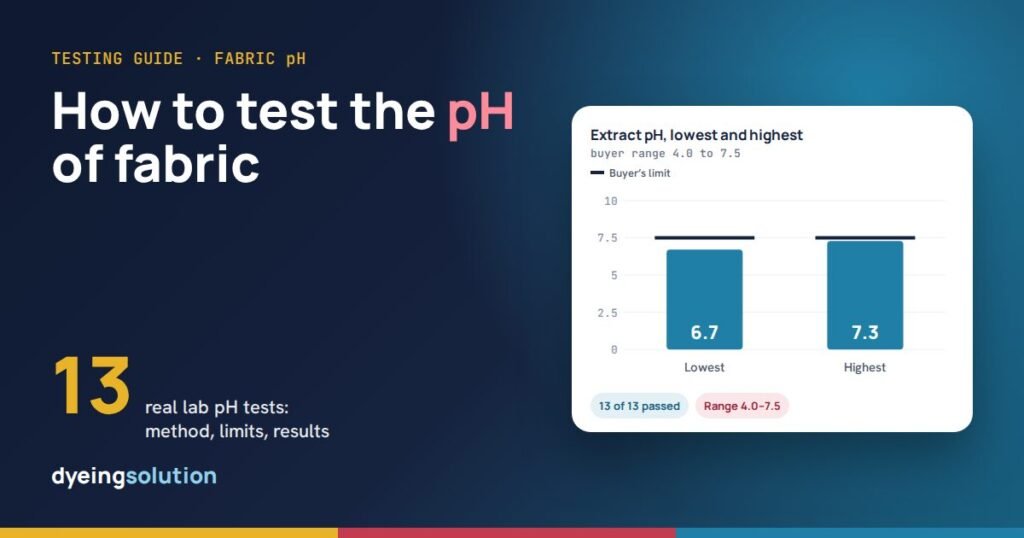
How the lab measures the pH of a fabric’s water extract (ISO 3071), step by step, why buyers ask for pH 4.0 to 7.5, and what our lab reports showed.
About this guide. The method below is written from the public ISO and AATCC standards in plain words. The data comes from our own lab reports on 95 new knit developments, each tested by an accredited lab to the buyer’s standard, so you can see what real results look like.
At a glance
13pH tests in our data
13 of 13Passed
4.0–7.5Usual range
6.7–7.3Our results
What the test measures
The pH of the water extract shows whether chemicals left in the fabric make it acid or alkaline. Garments are worn against the skin, and skin is slightly acid, so most buyers ask for a fabric pH between 4.0 and 7.5. After reactive dyeing, the risk is alkali (soda ash) left in the fabric; after neutralisation, the risk is too much acid.
Equipment
- A pH meter with a glass electrode, calibrated with standard buffer solutions.
- Distilled or deionised water, or 0.1 M potassium chloride solution as the standard allows.
- A mechanical shaker, glass flasks with stoppers, and a balance.
How the test is done (ISO 3071)
- Cut the fabric into small pieces, about 5 mm square, and weigh 2 g.
- Extract: put the pieces in 100 ml of water (or 0.1 M KCl) in a stoppered flask and shake for 2 hours at room temperature.
- Measure the pH of the extract with the calibrated meter, at a known temperature.
- Repeat with further specimens and report the result of the repeat extracts.
Example. Extract pH 7.1 against a range of 4.0–7.5: pass. An extract at 8.4 would point to soda ash left after dyeing.
What real results look like
All 13 of our pH reports passed, between 6.7 and 7.3, against a range of 4.0–7.5. With a proper wash-off, acid neutralisation and a final rinse, fabric pH is rarely a problem.
Common mistakes that change the result
- A meter that has not been calibrated that day.
- Tap water instead of distilled water for the extract.
- Pieces cut too big, so the extract does not reach the inside of the fabric.
From the floor
- After the dye bath is dropped we give a hot wash at 70–80°C, then a rinse or three block washes, then neutralise with acid, then soap and wash clear.
- Done in that order, with the acid neutralisation after the washes, the fabric pH stays in range.
Questions
What pH should finished fabric have?
Most buyers ask for 4.0 to 7.5, close to the slightly acid pH of skin.
Why would fabric pH be high after dyeing?
Soda ash used to fix reactive dye was not fully washed out or neutralised.

Textile engineer with 14+ years in dyeing and fabric development. He writes every guide on Dyeing Solution from real production work. Full profile