Nylon is water resistant but not waterproof on its own: the fibre absorbs only about 4% water and dries fast, but water passes through the weave. Water resistant vs repellent vs waterproof, ripstop, coatings, nylon vs polyester and care.
At a glance
~4%water uptake
Resistantnot waterproof
Coatingmakes it waterproof
Nofabric softener
Nylon is water resistant, but plain nylon fabric is not waterproof. The nylon fibre absorbs only a little water, about 4% of its weight, and a tightly woven nylon sheds light rain and dries quickly. Water still gets through the gaps between the yarns under steady rain or pressure. Nylon jackets, tents and bags become truly waterproof only when a coating or membrane is added, and most also get a water-repellent finish on the outside so drops bead and roll off.
This guide explains the difference between water resistant, water repellent and waterproof, why nylon behaves the way it does with water, what ripstop nylon is, how coatings and membranes work, how nylon compares with polyester outdoors, and how to keep a nylon garment shedding water. It is written from the textile-processing side, where we dye and finish nylon knits and see how the fibre takes up water, dye and heat.
Water resistant, water repellent and waterproof are not the same
These three words are often used as if they meant the same thing. They do not:
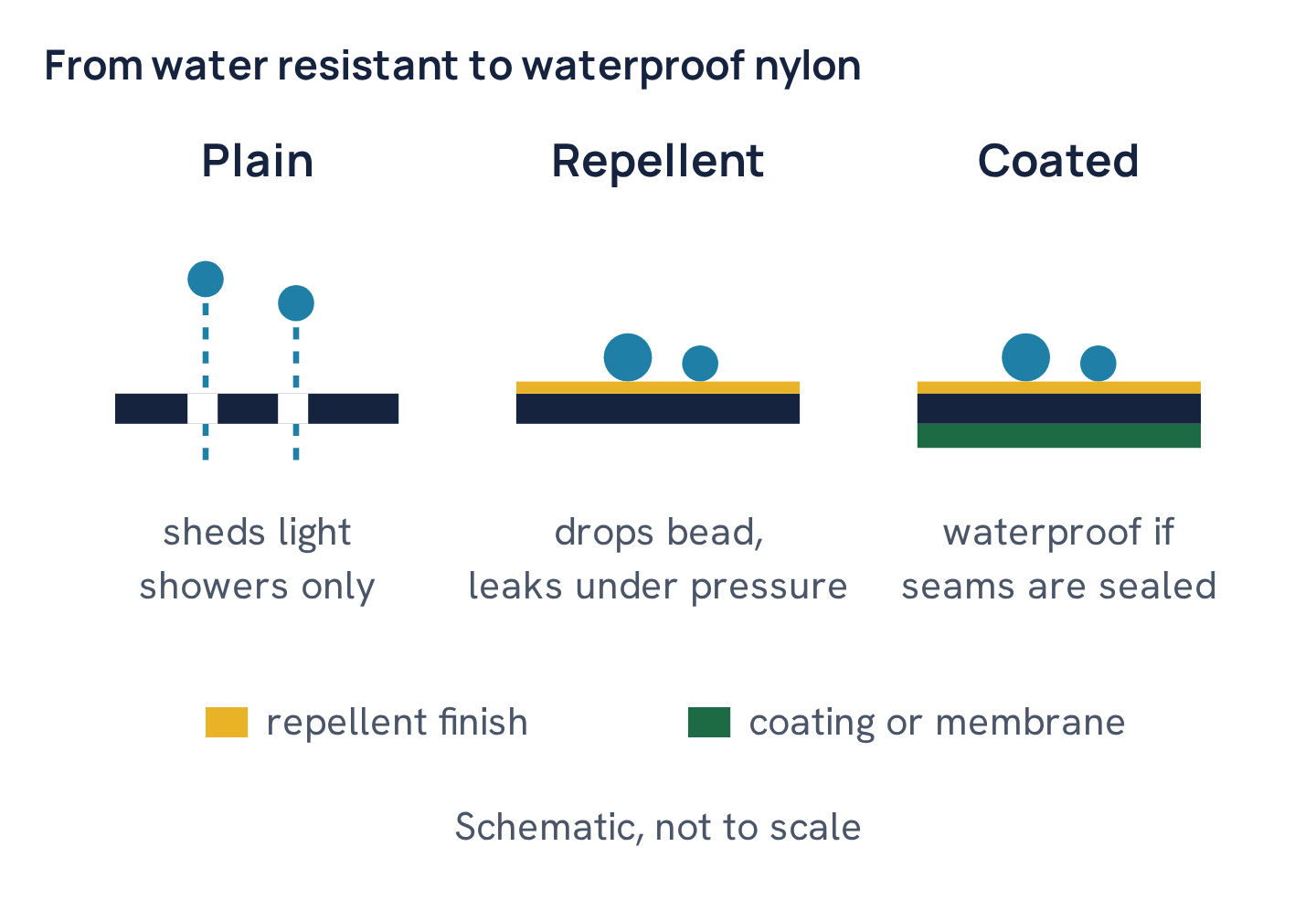
- Water resistant means the fabric slows water down. It copes with a light shower or a splash for a short time, then lets water through. A tightly woven nylon windbreaker is water resistant.
- Water repellent means the outer surface has been treated so water forms beads and rolls off instead of soaking in. This is a finish, not a barrier: under pressure, water still passes.
- Waterproof means a continuous barrier, a coating or a membrane, stops liquid water even under pressure. Rain jackets and tents need this, and their seams must also be taped or sealed.
A nylon garment can be one, two or all three. Check the product description: “water resistant” alone usually means no waterproof layer.
Why nylon resists water
Nylon is a synthetic polyamide. Its chains contain amide groups that attract some water, but far less than cotton or rayon. Typical moisture regain is around 4–4.5%, compared with roughly 8% for cotton and 13% for rayon. In practice that means:
- The fibre stays light when wet. Nylon does not soak up water like a cotton towel, so a wet nylon shell is not much heavier than a dry one.
- It dries fast. Most of the water sits on and between the fibres, not inside them, so it evaporates quickly.
- Fine filaments pack tightly. Nylon is made as smooth continuous filaments that can be woven very densely, leaving small gaps for water to pass.
Nylon absorbs a little more water than polyester, and when wet it can relax and sag slightly. That is one reason outdoor brands sometimes prefer polyester for rain covers and nylon for parts that need strength and abrasion resistance.
Is ripstop nylon waterproof?
Not on its own. Ripstop is a weave, not a waterproof treatment: thicker reinforcing yarns are woven in a small grid so that a tear stops at the next line instead of running across the fabric. Uncoated ripstop nylon is light, strong and water resistant. Ripstop used for tents, tarps and rain shells is usually coated with polyurethane or silicone, which makes it waterproof. If a product says “ripstop nylon” without mentioning a coating, treat it as water resistant only.
How nylon is made waterproof
| Treatment | What it does | Typical use |
|---|---|---|
| Durable water repellent (DWR) finish | Makes water bead and roll off the outer surface | Almost all outdoor shells, often on top of a coating |
| Polyurethane (PU) coating | A thin continuous layer on the back of the fabric blocks water | Rain jackets, bags, tent floors |
| Silicone coating | Very water-shedding, light and slippery | Tarps, tents, ultralight gear |
| Laminated membrane | A thin porous film bonded to the fabric stops liquid water but lets vapour out | Breathable waterproof jackets |
Waterproofness is measured as hydrostatic head: how tall a column of water, in millimetres, the fabric can hold back before it leaks. A fabric that holds only a few hundred millimetres is water resistant; rain gear is usually rated in the thousands of millimetres or more. The seams matter too: every stitch hole leaks unless it is taped or sealed.
Nylon vs polyester for water resistance
Both are synthetic, both resist water far better than cotton, and both are used for outdoor gear. The differences:
- Absorption: polyester absorbs even less (about 0.4%), so it stays a little drier and keeps its shape better when wet.
- Strength and abrasion: nylon is tougher and more abrasion resistant for the same weight, which is why it is used for packs, straps and hard-wearing shells.
- Sun: polyester generally holds up better to long UV exposure.
- Feel: nylon is usually softer and smoother in light shells.
For an everyday water-resistant windbreaker either works. For a tent fly left in the sun, polyester has an edge; for a hard-wearing backpack, nylon does.
What happens to nylon in the dye house
Nylon’s relationship with water also shows in dyeing. It is dyed in water with acid dyes, which bond to the amine end groups of the fibre while the pH is slowly lowered and the bath is heated towards boiling. Because the fibre takes up some water, it swells slightly and the dye can diffuse in. Water-repellent finishes, by contrast, are always applied after dyeing, because a repellent fabric would refuse the dye bath. See how acid dyes work on nylon and the 100% nylon knit dyeing process for the full route.
Common mistake: washing a water-repellent nylon jacket with fabric softener. Softener coats the fibres with a water-loving film and can destroy the beading effect. Wash with a plain detergent or a technical wash, rinse well, and never add softener.
Why a nylon jacket starts to “wet out”
A jacket that used to bead water but now looks dark and soaked on the outside has not necessarily started leaking. Usually the repellent finish has worn off or is clogged with dirt and body oils, so the outer fabric soaks up water. The waterproof coating behind it may still keep you dry, but the soaked outer layer stops vapour escaping and you feel damp and cold. Cleaning the jacket and refreshing the repellent finish usually restores the beading.
Where nylon’s water resistance is useful
Because nylon sheds light water, dries quickly and is strong for its weight, it is used wherever gear gets damp and must stay light:
- Windbreakers and packable jackets: tightly woven, often with a repellent finish; good for showers and wind, not for long rain.
- Swim shorts and swimwear: nylon and nylon-spandex dry fast and stay light in water.
- Backpacks and bags: tough nylon with a coating on the inside resists rain and abrasion.
- Tents and tarps: coated ripstop nylon is light and strong, and waterproof once coated and seam-sealed.
- Umbrellas: densely woven nylon or polyester with a repellent finish.
- Hiking trousers: nylon or nylon-spandex for quick drying after a shower or a stream crossing.
How to check a nylon garment’s water resistance at home
You do not need a lab to get a rough idea:
- The drop test: sprinkle a few drops of water on the outside. If they bead into round drops and roll off, the repellent finish is working. If they spread and darken the fabric, it is not.
- The press test: hold the fabric over a cup with a little water on top and press gently with a finger. Water coming through quickly means there is no waterproof layer.
- Look inside: a shiny, smooth or rubbery inner surface, or a separate inner layer, usually means a coating or membrane. Taped seams on the inside are a sign the garment is meant to be waterproof.
- Read the label: waterproof gear usually states a waterproof rating or names a waterproof layer; “water resistant” alone usually means none.
Labs measure the same things with standard methods: a spray test for surface repellency and a hydrostatic pressure test for waterproofness. Results depend on how the fabric was woven, finished and coated, not only on the fibre.
Worked example. A light, uncoated ripstop nylon windbreaker keeps you dry on a short walk in drizzle and is dry again ten minutes after the rain stops. On a two-hour hike in steady rain, water works through the weave and the shoulders get wet. For that hike you need a jacket with a coating or membrane, taped seams and a repellent finish, whether its face fabric is nylon or polyester.
How to keep nylon shedding water
- Wash when dirty: dirt and skin oils spoil the repellent finish.
- Use a mild detergent, no softener, no bleach, and rinse thoroughly.
- Close zips and fasteners before washing.
- If the care label allows, a short, low-heat tumble dry helps many repellent finishes recover.
- When water stops beading after cleaning, re-apply a spray-on or wash-in repellent made for synthetics.
- Do not iron nylon hot: it softens at high heat and can glaze or melt.
Summary
- Nylon is water resistant: it absorbs only about 4% water and dries fast.
- Plain nylon fabric is not waterproof; water passes through the weave under pressure.
- Water repellent finishes make water bead; coatings or membranes make nylon waterproof.
- Ripstop is a tear-stopping weave, not a waterproof treatment.
- Keep repellency by washing without softener and refreshing the finish when needed.
Questions
Is nylon water resistant?
Yes. Nylon absorbs only about 4% of its weight in water, dries quickly and a tight nylon weave sheds light rain. It is not waterproof without a coating or membrane.
Is nylon waterproof?
Plain nylon fabric is not waterproof. Water gets through the gaps between yarns under steady rain or pressure. Nylon becomes waterproof when coated or laminated and the seams are sealed.
Is ripstop nylon waterproof?
Not on its own. Ripstop is a tear-resistant grid weave. Uncoated ripstop is water resistant; coated ripstop used for tents and rain gear is waterproof.
Is nylon or polyester better in rain?
Both resist water well. Polyester absorbs even less and keeps its shape better when wet; nylon is stronger and more abrasion resistant.
Why does my nylon jacket soak through?
Usually the water-repellent finish has worn off or is clogged with dirt. Wash it without softener and re-apply a repellent finish to restore beading.

Textile engineer with 14+ years in dyeing and fabric development. He writes every guide on Dyeing Solution from real production work. Full profile