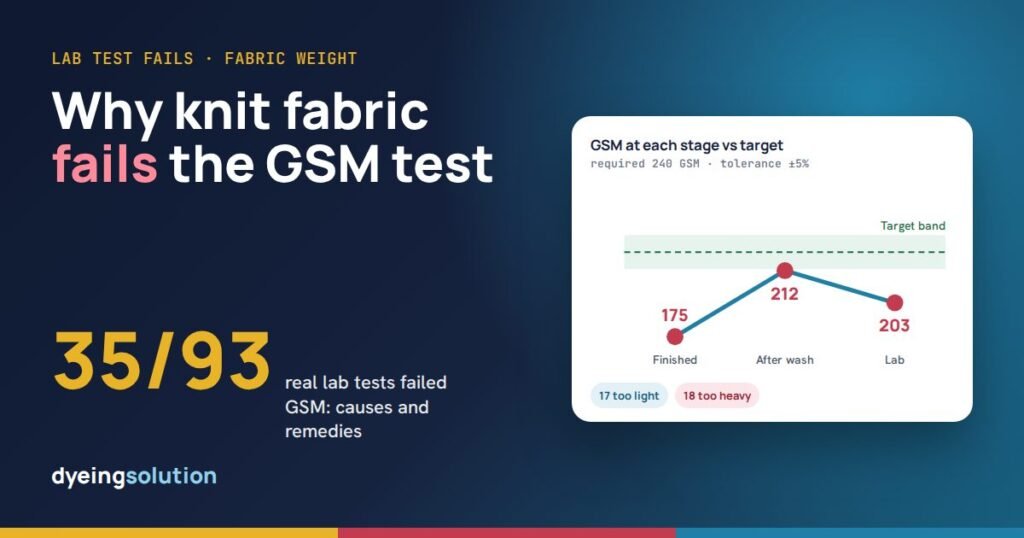
Over 95 new fabric developments, each one tested in the lab, GSM failed in 35 batches. Every fabric type has its own dyeing and finishing route, so here they are case by case: how each fabric was made and finished, what the lab found, and the cause and remedy.
About this series. These findings come from 95 development batches: new and uncommon knit fabrics such as design rib, crepe rib, jacquard, slub and yarn-dyed jersey, Lycra pointelle, waffle and three-thread fleece. Each batch was knitted, dyed and finished as a development sample, then tested by an accredited lab to the buyer’s standard. When a test failed, we found the actual cause on the floor and changed the next batch until it passed.
At a glance
35 of 93Batches failed GSM
17 / 18Too light / too heavy
+5.5%Lab vs finished GSM (median)
±5%Most common tolerance
How the lab measures GSM
GSM (grams per square metre) is measured by cutting specimens of a known area, usually 100 cm², and weighing them. The common standards are EN 12127, ISO 3801 and ASTM D3776. The fabric is first conditioned at 20 ± 2°C and 65 ± 4% relative humidity, so it is tested relaxed and at a standard moisture content.
Most buyers allow ±5% on the required GSM (62 of our 93 reports). Some allow −5% / +8% (27 reports), which gives more room on the heavy side; a few are tighter, at ±4% or ±3%.
The factory’s finished GSM is not the lab GSM
In the factory the finished GSM is checked straight off the compactor, when the fabric is warm, dry and still under finishing tension. In the lab the same fabric has rested and absorbed moisture. In 77 of 89 batches the lab measured more than the factory’s finished GSM, a median of 5.5% higher; even among batches that passed, the lab read about 4% higher. So fabric that leaves the factory 5% light will fail, and a texture fabric that leaves on target can gain 25–40% as it relaxes.
Which fabrics fail, and in which direction
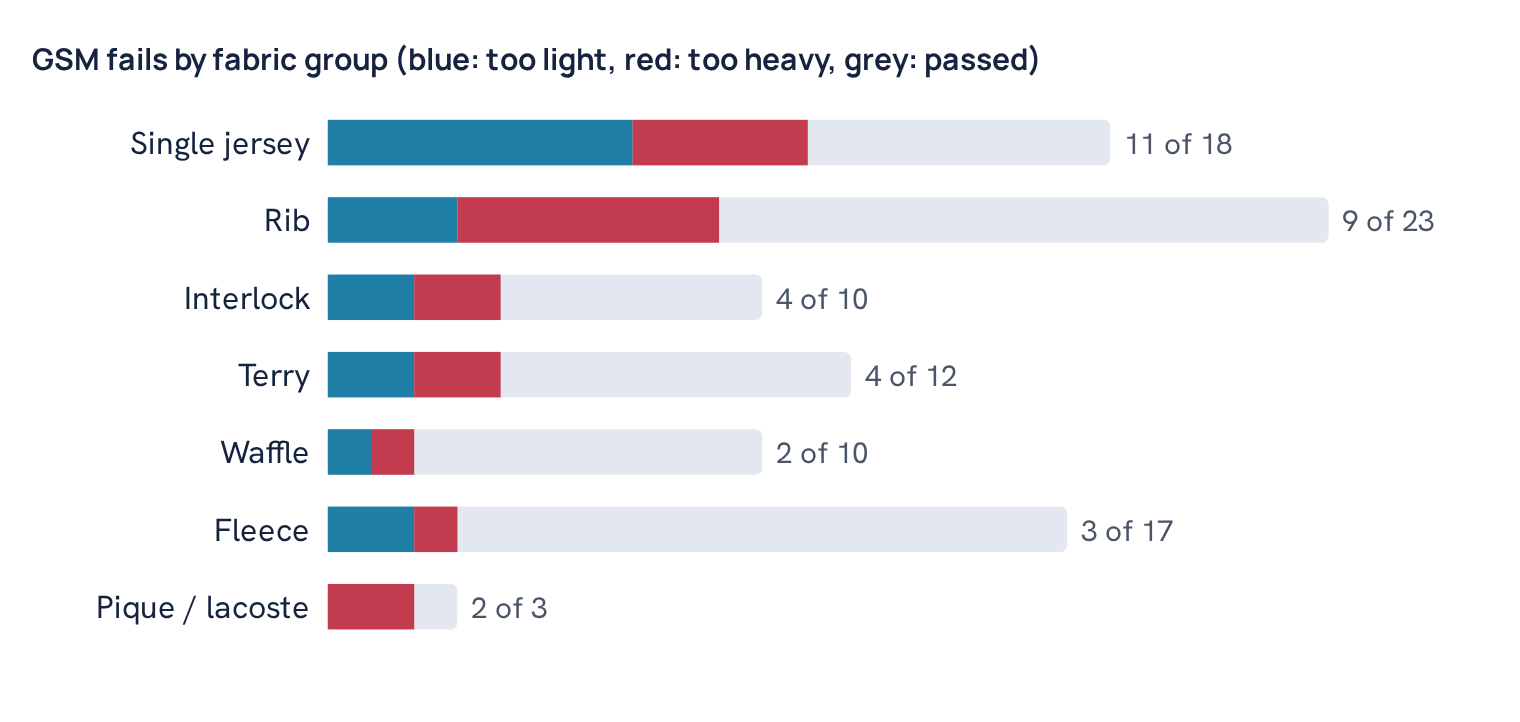
- Single jersey fails most, and mostly light: 11 of 18, mainly plain, slub, yarn-dyed and twill jerseys finished under weight.
- Rib fails mostly heavy: design rib, crepe rib, jacquard rib and ottoman gained weight when the structure relaxed.
- Fleece is the most stable: only 3 of 17 failed.
| Direction | Cases | Typical pattern |
|---|---|---|
| Too light | 17 | Already light when it left finishing; most often single jersey, slub, yarn-dyed and Lycra fabrics. |
| Too heavy | 18 | On target or near it after finishing, then gained weight as the texture relaxed; mostly rib, waffle and pique. |
How to read each case
Each case shows the fabric as it was knitted, the route it took through dyeing and finishing, the GSM at each point (finished in the factory, after a factory wash, and in the lab), and the cause and remedy. The lab measures GSM on conditioned, relaxed fabric (EN 12127, ISO 3801 or ASTM D3776); in our records it read a median 5.5% above the factory’s finished GSM.
Single jersey: 11 cases
Single jersey is dyed as a tube turned inside out unless it is heat set or singed; then it is slit, processed open width and back sewn before dyeing.
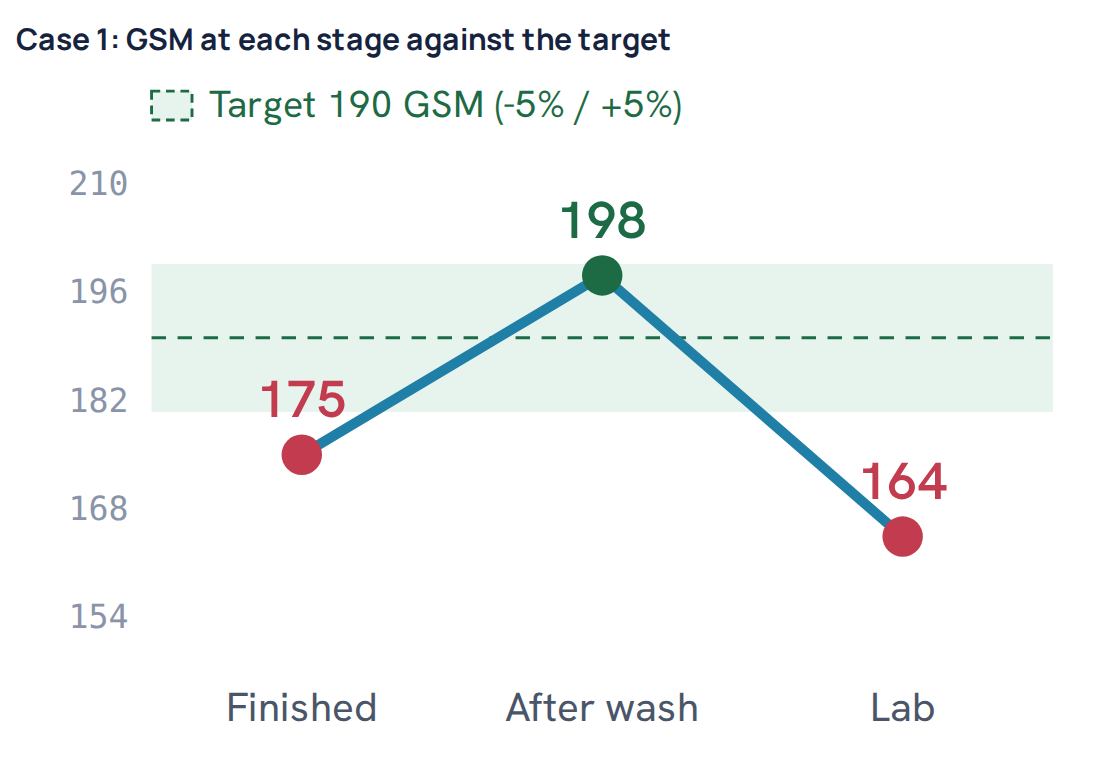
Case 1: Twill jersey, 190 GSM, too light
- Yarn: 30/1 combed + 30/1 combed
- Stitch length: 20
- Machine: 34″ × 24G
- Required: 180 cm, 190 GSM ±5%
- Finished: 177 cm, 175 GSM
Route: Greige → Slitting → Singeing → Back sewing → Dyeing → Stenter → Compacting
Results
- Finished GSM (factory): 175
- GSM after wash (factory): 198
- Lab GSM: 164
- Off target: -13.4%
- Shrinkage (tumble): length -12%, width -2%
- Spirality: 2%
Other tests that failed in the same lab report: Shrinkage.
Cause and remedy
Cause: The fabric left finishing already light: 175 GSM against 190 required (-8%). The lab could not find weight that was never there.
Cause: The width was not over-stretched, so the weight was missing from the knitting: the loop was too long or the yarn too fine for the target.
Remedy: Shorten the stitch length (or use a coarser count) in knitting for the next batch, so the greige carries enough weight.
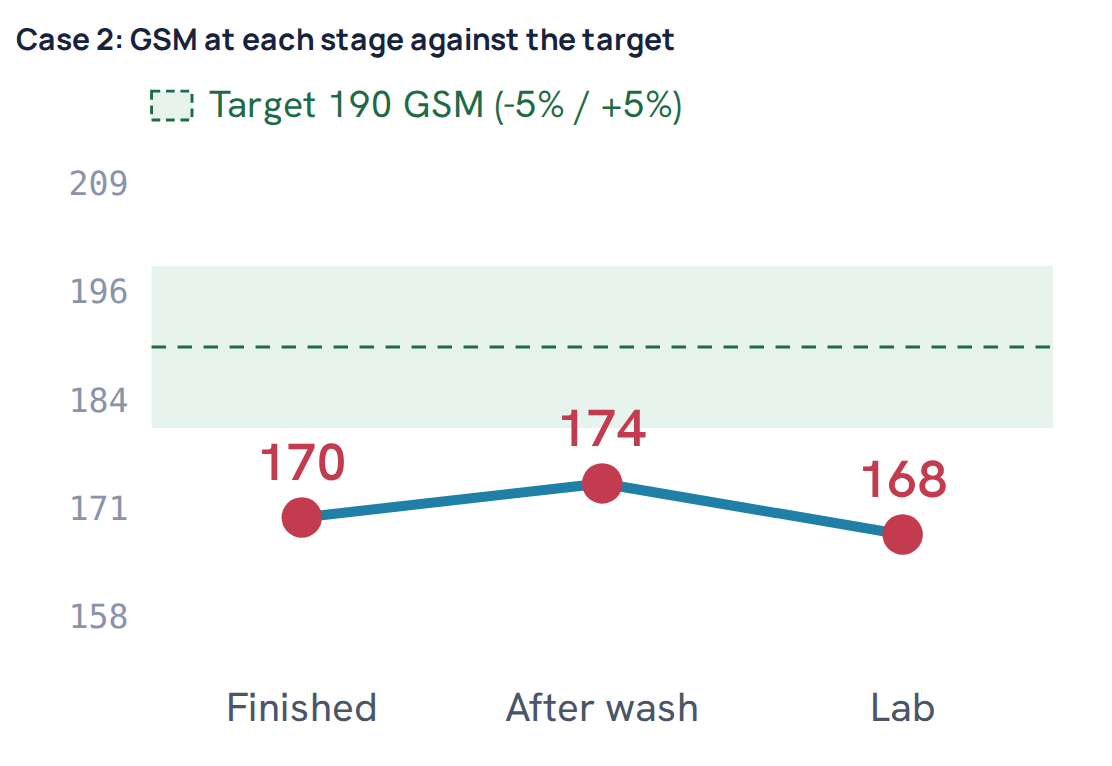
Case 2: Yarn-dyed double jersey, 190 GSM, too light
- Yarn: 22/1 CVC 60/40 slub yarn-dyed + 22/1 CVC 60/40 yarn-dyed
- Stitch length: 33.5+21.5
- Machine: 30″ × 20G
- Required: 140 cm, 190 GSM ±5%
- Finished: 145 cm, 170 GSM
Route: Greige → Dyeing → Stenter → Compacting
Results
- Finished GSM (factory): 170
- GSM after wash (factory): 174
- Lab GSM: 168
- Off target: -11.6%
- Shrinkage (tumble): length -2%, width -5%
- Spirality: 3%
Other tests that failed in the same lab report: none.
Cause and remedy
Cause: The fabric left finishing already light: 170 GSM against 190 required (-11%). The lab could not find weight that was never there.
Cause: It was also finished 5 cm wider than required (145 against 140). Stretching for width spreads the same yarn over more area and lowers GSM.
Remedy: Finish at the required width, not wider, and give more overfeed on the stenter and compactor to build weight.
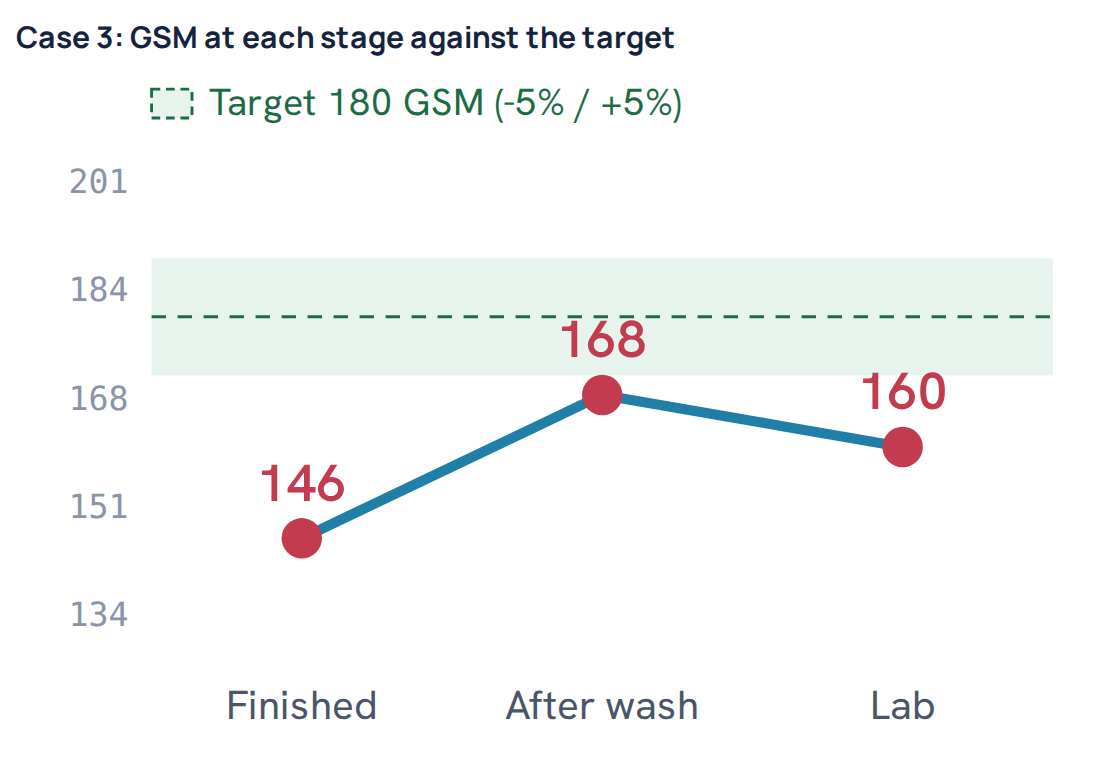
Case 3: Slub single jersey, 180 GSM, too light
- Yarn: 40/1 cotton + 22/1 cotton slub
- Stitch length: 20.5+21
- Machine: 38″ × 20G
- Required: 180 cm, 180 GSM ±5%
- Finished: 150 cm, 146 GSM
Route: Greige → Dyeing → Stenter → Compacting
Results
- Finished GSM (factory): 146
- GSM after wash (factory): 168
- Lab GSM: 160
- Off target: -11.1%
- Shrinkage (tumble): length -10%, width +200%
- Spirality: 3%
Other tests that failed in the same lab report: Bursting strength.
Cause and remedy
Cause: The fabric left finishing already light: 146 GSM against 180 required (-19%). The lab could not find weight that was never there.
Cause: The width was not over-stretched, so the weight was missing from the knitting: the loop was too long or the yarn too fine for the target.
Remedy: Shorten the stitch length (or use a coarser count) in knitting for the next batch, so the greige carries enough weight.
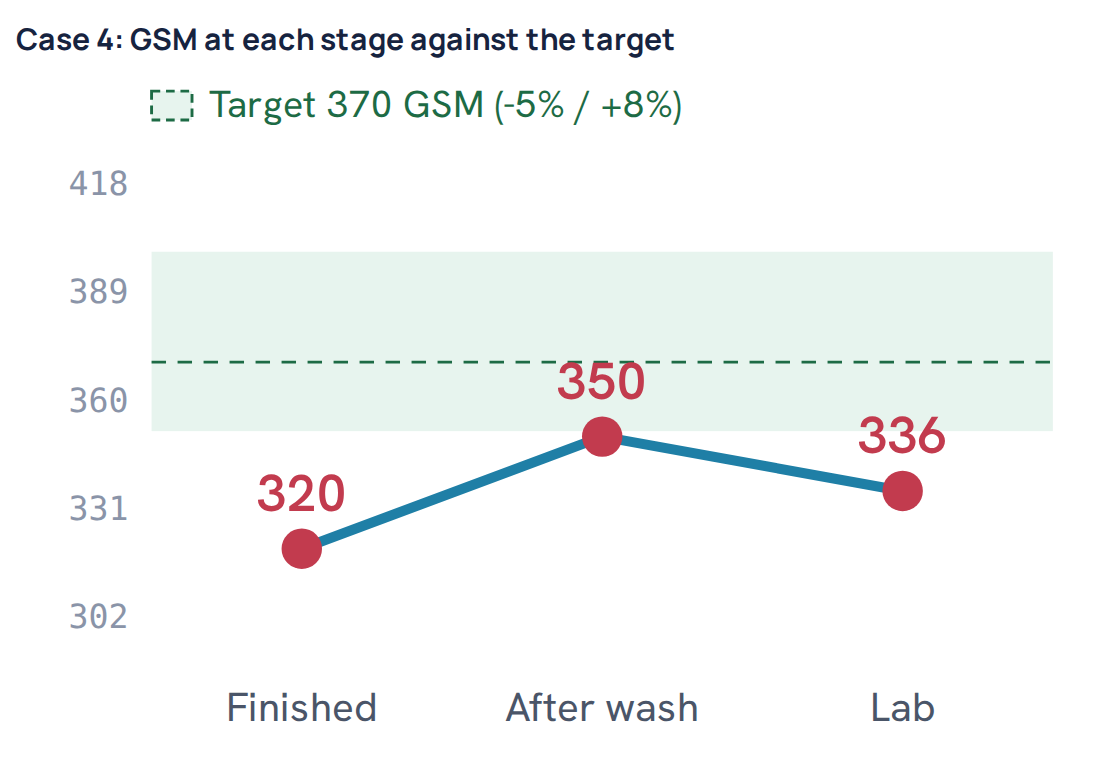
Case 4: Slub heavy jersey, 370 GSM, too light
- Yarn: 20/2 ply combed + 20/1 combed + 20/1 combed slub
- Stitch length: 39.5
- Machine: 30″ × 16G
- Required: 160 cm, 370 GSM -5% +8%
- Finished: 145 cm, 320 GSM
Route: Greige → Slitting → Heat setting → Back sewing → Dyeing → Stenter → Compacting
Results
- Finished GSM (factory): 320
- GSM after wash (factory): 350
- Lab GSM: 336
- Off target: -9.3%
- Shrinkage (tumble): length -4%, width -2%
- Spirality: 2%
Other tests that failed in the same lab report: none.
Cause and remedy
Cause: The fabric left finishing already light: 320 GSM against 370 required (-14%). The lab could not find weight that was never there.
Cause: The width was not over-stretched, so the weight was missing from the knitting: the loop was too long or the yarn too fine for the target.
Remedy: Shorten the stitch length (or use a coarser count) in knitting for the next batch, so the greige carries enough weight.
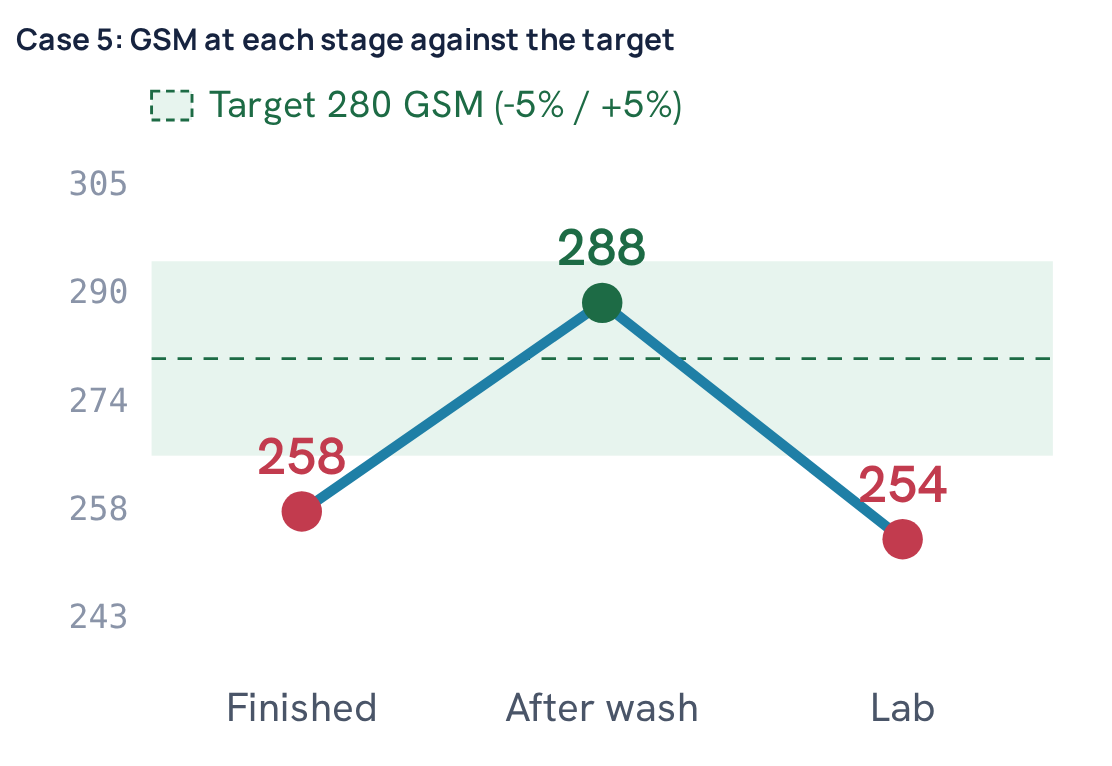
Case 5: Yarn-dyed single jersey, 280 GSM, too light
- Yarn: 26/2 ply cotton yarn-dyed
- Stitch length: 37
- Machine: 34″ × 16G
- Required: 155 cm, 280 GSM ±5%
- Finished: 170 cm, 258 GSM
Route: Greige → Slitting → Singeing → Back sewing → Dyeing → Stenter → Compacting
Results
- Finished GSM (factory): 258
- GSM after wash (factory): 288
- Lab GSM: 254
- Off target: -9.3%
- Shrinkage (tumble): length -4%, width -8%
- Spirality: 2%
Other tests that failed in the same lab report: Shrinkage, Rubbing fastness, Light fastness.
Cause and remedy
Cause: The fabric left finishing already light: 258 GSM against 280 required (-8%). The lab could not find weight that was never there.
Cause: It was also finished 15 cm wider than required (170 against 155). Stretching for width spreads the same yarn over more area and lowers GSM.
Remedy: Finish at the required width, not wider, and give more overfeed on the stenter and compactor to build weight.
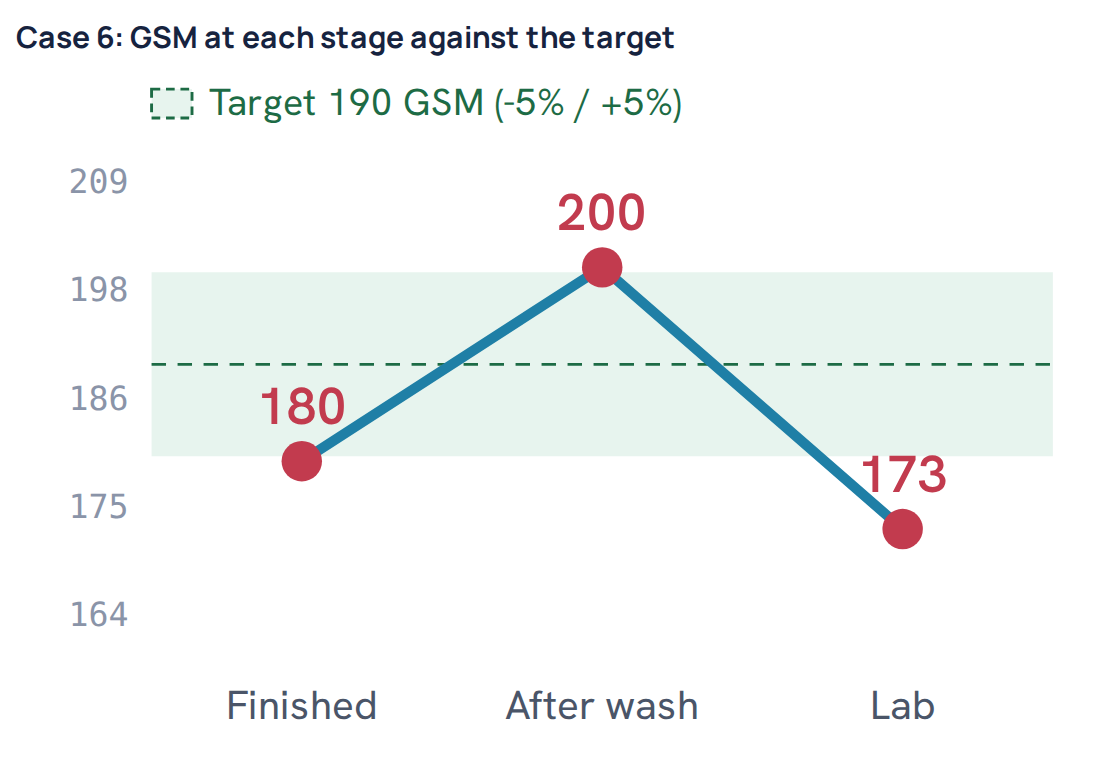
Case 6: Yarn-dyed twill jersey, 190 GSM, too light
- Yarn: 30/1 cotton yarn-dyed + 30/1 cotton yarn-dyed
- Stitch length: 20
- Machine: 34″ × 24G
- Required: 180 cm, 190 GSM ±5%
- Finished: 185 cm, 180 GSM
Route: Greige → Slitting → Singeing → Back sewing → Dyeing → Stenter → Compacting
Results
- Finished GSM (factory): 180
- GSM after wash (factory): 200
- Lab GSM: 173
- Off target: -8.9%
- Shrinkage (tumble): length -8%, width -4%
- Spirality: 3%
Other tests that failed in the same lab report: Shrinkage.
Cause and remedy
Cause: The fabric left finishing already light: 180 GSM against 190 required (-5%). The lab could not find weight that was never there.
Cause: It was also finished 5 cm wider than required (185 against 180). Stretching for width spreads the same yarn over more area and lowers GSM.
Remedy: Finish at the required width, not wider, and give more overfeed on the stenter and compactor to build weight.
Case 7: Lycra single jersey, 180 GSM, too light
- Yarn: 34/1 organic cotton + 30D Lycra
- Stitch length: 29
- Machine: 30″ × 28G
- Required: 180 cm, 180 GSM ±5%
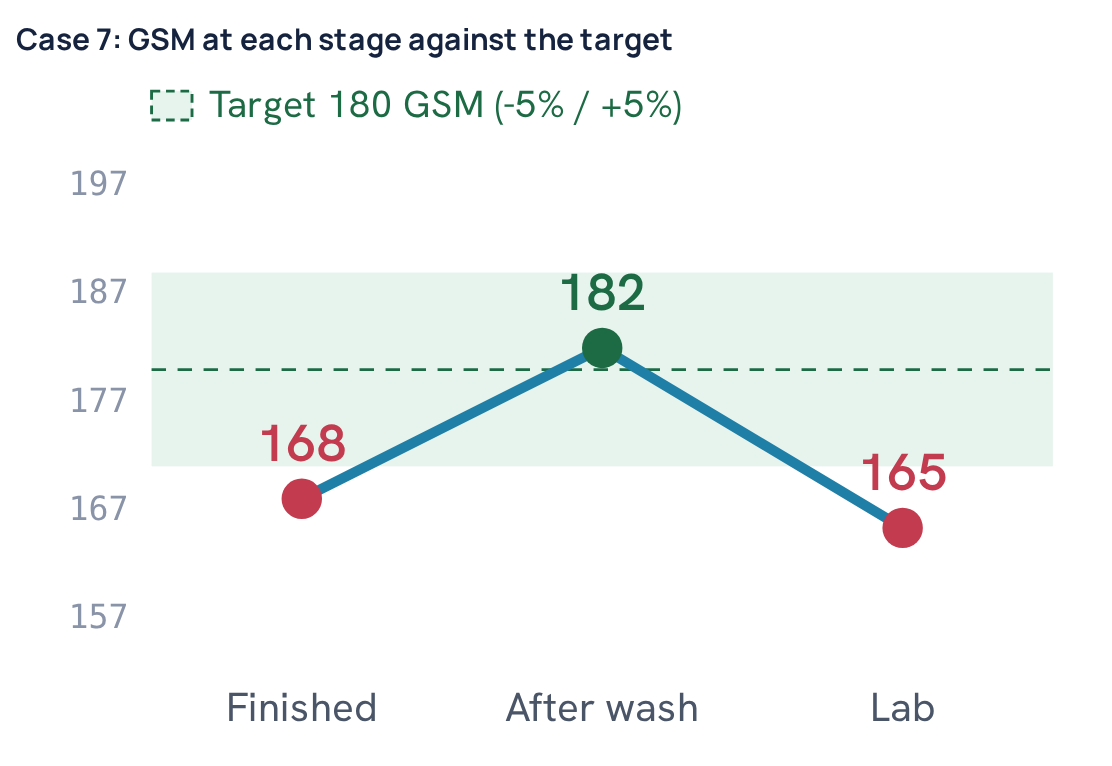
- Finished: 180 cm, 168 GSM
Route: Greige → Slitting → Heat setting → Singeing → Back sewing → Dyeing → Stenter → Compacting
Results
- Finished GSM (factory): 168
- GSM after wash (factory): 182
- Lab GSM: 165
- Off target: -8.2%
- Shrinkage (tumble): length -7%, width -2%
- Spirality: 2%
Other tests that failed in the same lab report: Shrinkage, Bursting strength.
Cause and remedy
Cause: The fabric left finishing already light: 168 GSM against 180 required (-7%). The lab could not find weight that was never there.
Cause: The width was not over-stretched, so the weight was missing from the knitting: the loop was too long or the yarn too fine for the target.
Remedy: Shorten the stitch length (or use a coarser count) in knitting for the next batch, so the greige carries enough weight.
Case 8: Yarn-dyed single jersey, 150 GSM, too heavy
- Yarn: 34/1 cotton mélange + 34/1 cotton
- Stitch length: 30.2
- Machine: 36″ × 20G
- Required: 180 cm, 150 GSM ±5%
- Finished: 172 cm, 150 GSM
Route: Greige → Slitting → Singeing → Back sewing → Dyeing → Stenter → Compacting
Results
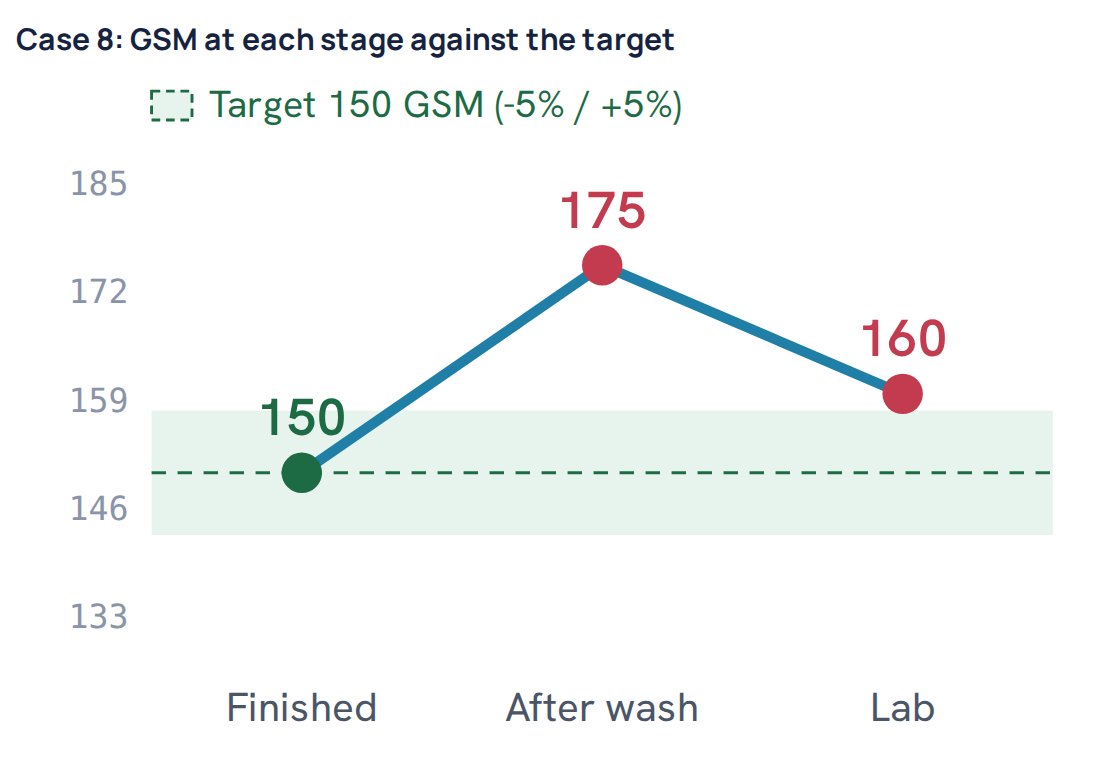
- Finished GSM (factory): 150
- GSM after wash (factory): 175
- Lab GSM: 160
- Off target: +6.3%
- Shrinkage (tumble): length -8%, width -2%
- Spirality: 3%
Other tests that failed in the same lab report: Shrinkage, Spirality.
Cause and remedy
Cause: The fabric gained weight as it relaxed: 150 GSM after finishing, 175 after washing, 160 in the lab. The structure closed up once the finishing tension was released.
Cause: It was finished 8 cm narrower than required (172 against 180). A narrower fabric carries the same yarn on less area, so GSM goes up.
Cause: Length shrinkage after tumble dry was -8%, so the fabric shrank and got heavier in use.
Remedy: Finish to the full required width.
Remedy: Finish this texture slightly under the target GSM, because it gains weight when it relaxes; stabilise it with heat setting or more compaction so it does not close up later.
Case 9: Yarn-dyed jacquard single jersey, 210 GSM, too heavy
- Yarn: 24/1 combed yarn-dyed
- Stitch length: 18
- Machine: 34″ × 18G
- Required: 140 cm, 210 GSM ±5%
- Finished: 160 cm, 190 GSM
Route: Greige → Slitting → Singeing → Back sewing → Dyeing → Stenter → Compacting
Results
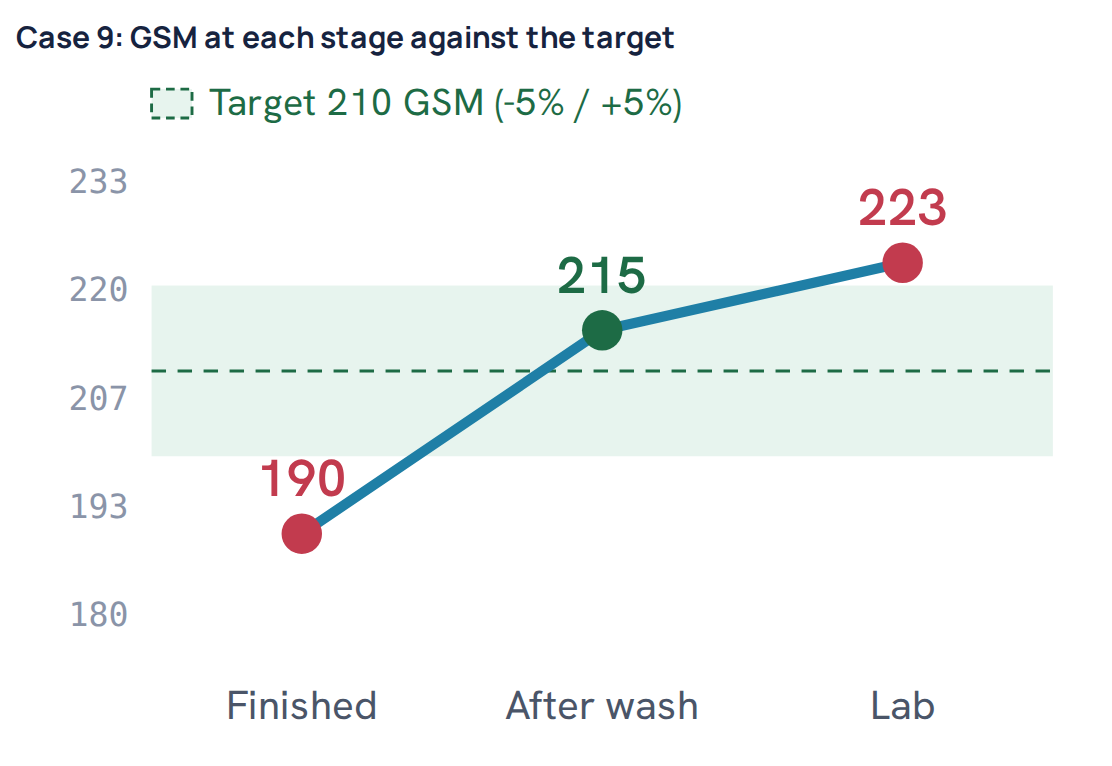
- Finished GSM (factory): 190
- GSM after wash (factory): 215
- Lab GSM: 223
- Off target: +6.3%
- Shrinkage (tumble): length -8%, width -2%
- Spirality: 2%
Other tests that failed in the same lab report: none.
Cause and remedy
Cause: The fabric gained weight as it relaxed: 190 GSM after finishing, 215 after washing, 223 in the lab. The structure closed up once the finishing tension was released.
Cause: Length shrinkage after tumble dry was -8%, so the fabric shrank and got heavier in use.
Remedy: Finish this texture slightly under the target GSM, because it gains weight when it relaxes; stabilise it with heat setting or more compaction so it does not close up later.
Case 10: Yarn-dyed lycra single jersey, 200 GSM, too heavy
- Yarn: 50/1 cotton + 75D polyester + 20D Lycra
- Stitch length: 24.5+21.0
- Machine: 38″ × 24G
- Required: 185 cm, 200 GSM ±5%
- Finished: 182 cm, 206 GSM
Route: Greige → Slitting → Heat setting → Back sewing → Dyeing → Stenter → Compacting
Results
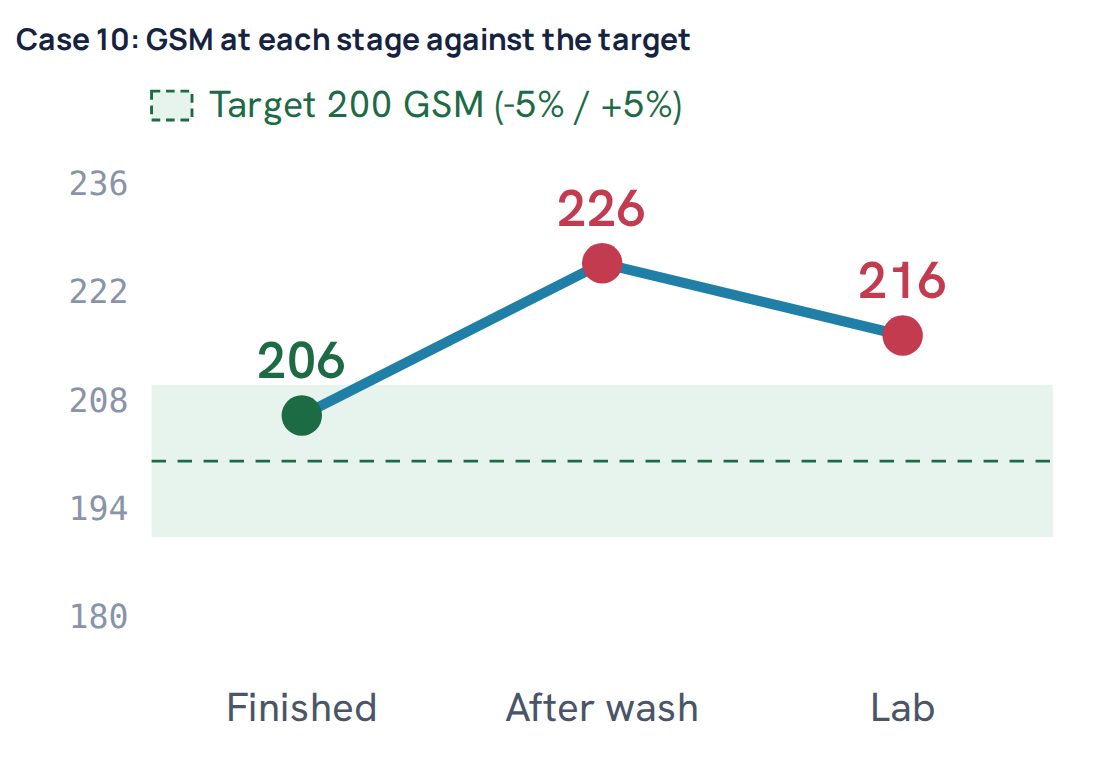
- Finished GSM (factory): 206
- GSM after wash (factory): 226
- Lab GSM: 216
- Off target: +8.2%
- Shrinkage (tumble): length -2%, width -2%
- Spirality: 2%
Other tests that failed in the same lab report: none.
Cause and remedy
Cause: The fabric gained weight as it relaxed: 206 GSM after finishing, 226 after washing, 216 in the lab. The structure closed up once the finishing tension was released.
Cause: It was finished 3 cm narrower than required (182 against 185). A narrower fabric carries the same yarn on less area, so GSM goes up.
Remedy: Finish to the full required width.
Remedy: Finish this texture slightly under the target GSM, because it gains weight when it relaxes; stabilise it with heat setting or more compaction so it does not close up later.
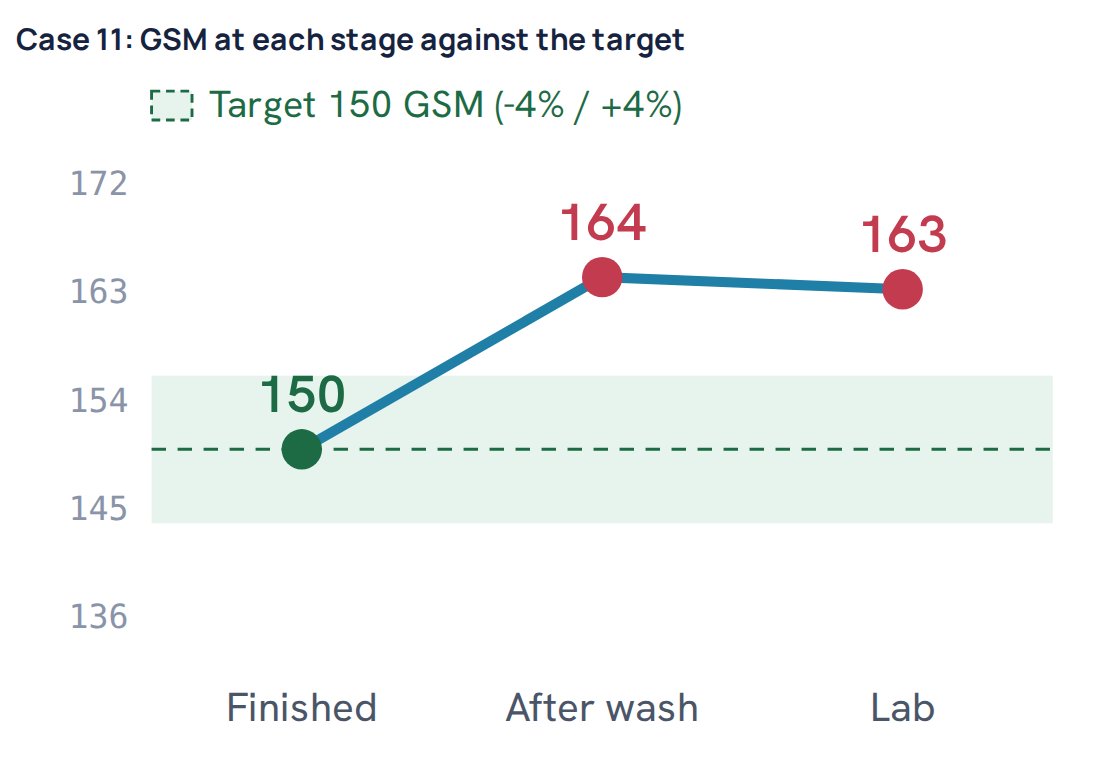
Case 11: Single jersey, 150 GSM, too heavy
- Yarn: 30/1 long-staple cotton
- Stitch length: 27
- Machine: 30″ × 28G
- Required: 165 cm, 150 GSM ±4%
- Finished: 172 cm, 150 GSM
Route: Greige → Slitting → Singeing → Back sewing → Dyeing → Stenter → Compacting
Results
- Finished GSM (factory): 150
- GSM after wash (factory): 164
- Lab GSM: 163
- Off target: +8.7%
- Shrinkage (tumble): length -7%, width -8%
- Spirality: 3%
Other tests that failed in the same lab report: none.
Cause and remedy
Cause: The fabric gained weight as it relaxed: 150 GSM after finishing, 164 after washing, 163 in the lab. The structure closed up once the finishing tension was released.
Cause: Length shrinkage after tumble dry was -7%, so the fabric shrank and got heavier in use.
Remedy: Finish this texture slightly under the target GSM, because it gains weight when it relaxes; stabilise it with heat setting or more compaction so it does not close up later.
Rib: 9 cases
Rib is a stable double knit. It is heat set only when heavy, tight, Lycra body rib or a design rib that needs its width fixed.
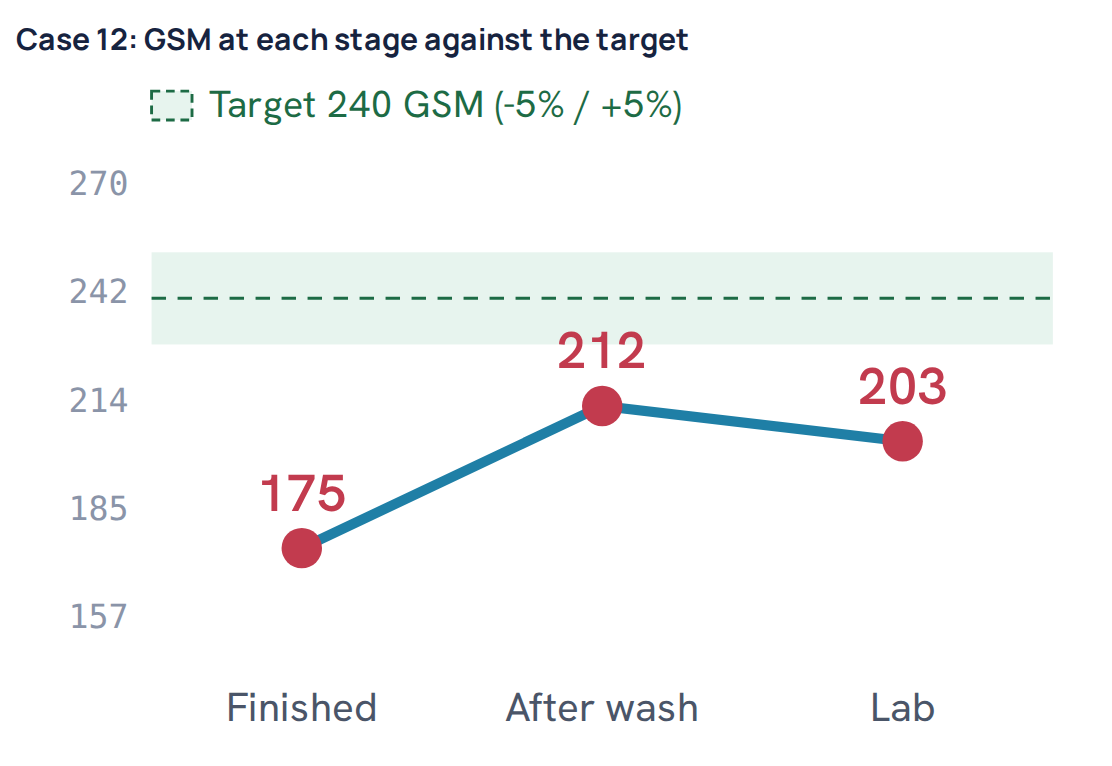
Case 12: Jacquard rib, 240 GSM, too light
- Yarn: 34/1 combed + 75D polyester air-covered
- Stitch length: 45+27.5
- Machine: 34″ × 18G
- Required: 150 cm, 240 GSM ±5%
- Finished: 165 cm, 175 GSM
Route: Greige → Slitting → Heat setting → Back sewing → Dyeing → Stenter → Compacting
Results
- Finished GSM (factory): 175
- GSM after wash (factory): 212
- Lab GSM: 203
- Off target: -15.5%
- Shrinkage (tumble): length -3%, width -5%
- Spirality: 2%
Other tests that failed in the same lab report: Snagging, Fibre analysis.
Cause and remedy
Cause: The fabric left finishing already light: 175 GSM against 240 required (-27%). The lab could not find weight that was never there.
Cause: It was also finished 15 cm wider than required (165 against 150). Stretching for width spreads the same yarn over more area and lowers GSM.
Remedy: Finish at the required width, not wider, and give more overfeed on the stenter and compactor to build weight.
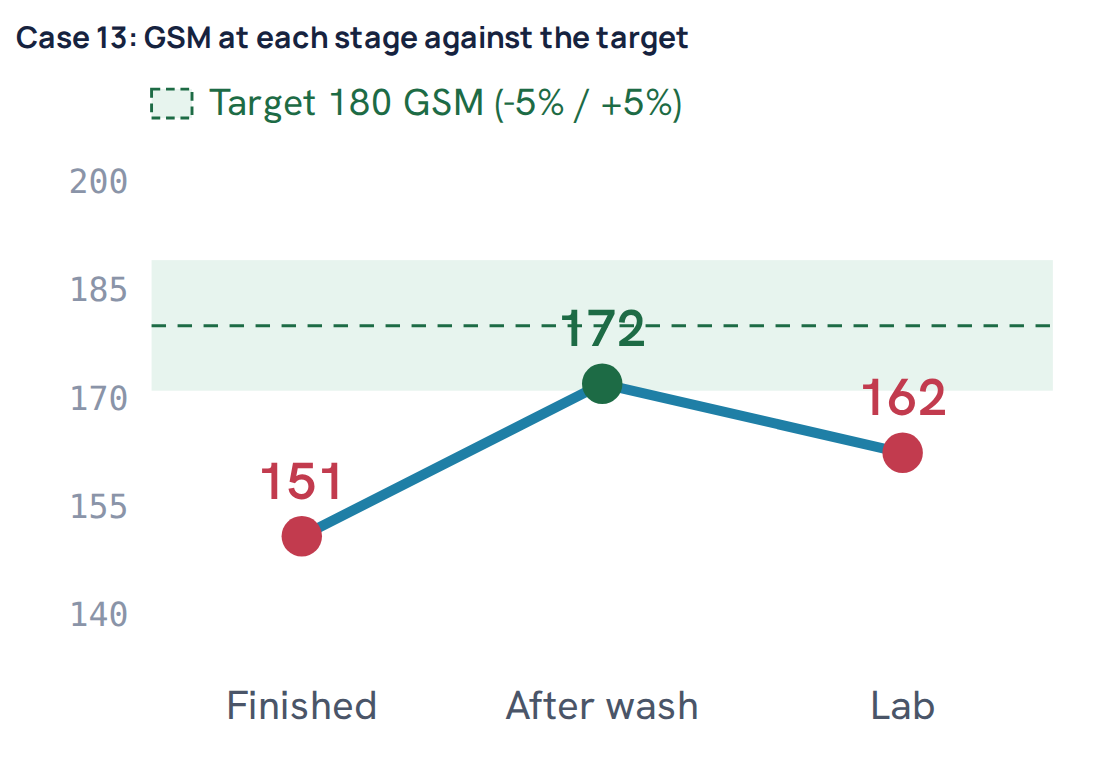
Case 13: 1×1 rib, 180 GSM, too light
- Yarn: 40/1 cotton
- Stitch length: 24.5
- Machine: 32″ × 18G
- Required: 145 cm, 180 GSM ±5%
- Finished: 148 cm, 151 GSM
Route: Greige → Dyeing → Stenter → Compacting
Results
- Finished GSM (factory): 151
- GSM after wash (factory): 172
- Lab GSM: 162
- Off target: -9.7%
- Shrinkage (tumble): length -8%, width -6%
- Spirality: 3%
Other tests that failed in the same lab report: none.
Cause and remedy
Cause: The fabric left finishing already light: 151 GSM against 180 required (-16%). The lab could not find weight that was never there.
Cause: It was also finished 3 cm wider than required (148 against 145). Stretching for width spreads the same yarn over more area and lowers GSM.
Remedy: Finish at the required width, not wider, and give more overfeed on the stenter and compactor to build weight.
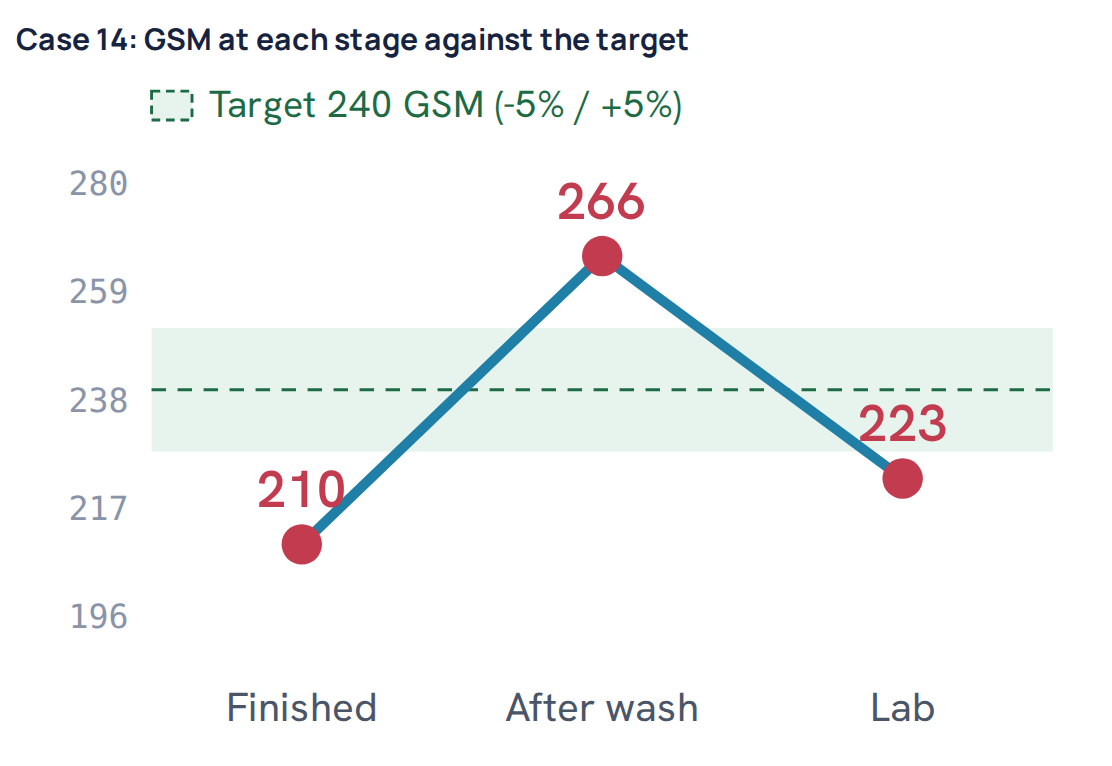
Case 14: Lycra pointelle rib, 240 GSM, too light
- Yarn: 30/1 organic cotton + 30D Lycra
- Stitch length: 3.1
- Machine: 34″ × 18G
- Required: 170 cm, 240 GSM ±5%
- Finished: 165 cm, 210 GSM
Route: Greige → Slitting → Heat setting → Back sewing → Dyeing → Stenter → Compacting
Results
- Finished GSM (factory): 210
- GSM after wash (factory): 266
- Lab GSM: 223
- Off target: -7.2%
- Shrinkage (tumble): length -8%, width -4%
- Spirality: 2%
Other tests that failed in the same lab report: Shrinkage.
Cause and remedy
Cause: The fabric left finishing already light: 210 GSM against 240 required (-12%). The lab could not find weight that was never there.
Cause: The width was not over-stretched, so the weight was missing from the knitting: the loop was too long or the yarn too fine for the target.
Remedy: Shorten the stitch length (or use a coarser count) in knitting for the next batch, so the greige carries enough weight.
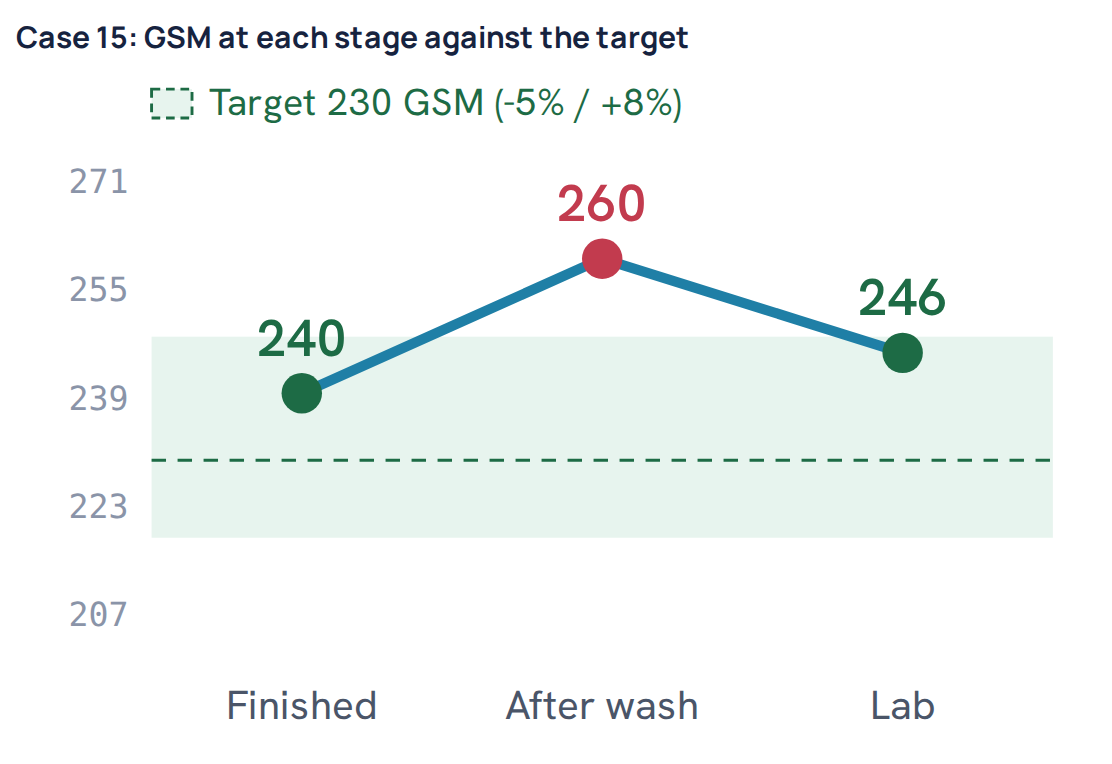
Case 15: Slub design rib, 230 GSM, too heavy
- Yarn: 22/1 cotton slub
- Stitch length: 23+27
- Machine: 36″ × 20G
- Required: 155 cm, 230 GSM -5% +8%
- Finished: 160 cm, 240 GSM
Route: Greige → Dyeing → Stenter → Compacting
Results
- Finished GSM (factory): 240
- GSM after wash (factory): 260
- Lab GSM: 246
- Off target: +7.0%
- Shrinkage (tumble): length -7%, width +200%
- Spirality: 3%
Other tests that failed in the same lab report: Shrinkage, Spirality.
Cause and remedy
Cause: The fabric gained weight as it relaxed: 240 GSM after finishing, 260 after washing, 246 in the lab. The structure closed up once the finishing tension was released.
Cause: Length shrinkage after tumble dry was -7%, so the fabric shrank and got heavier in use.
Remedy: Finish this texture slightly under the target GSM, because it gains weight when it relaxes; stabilise it with heat setting or more compaction so it does not close up later.
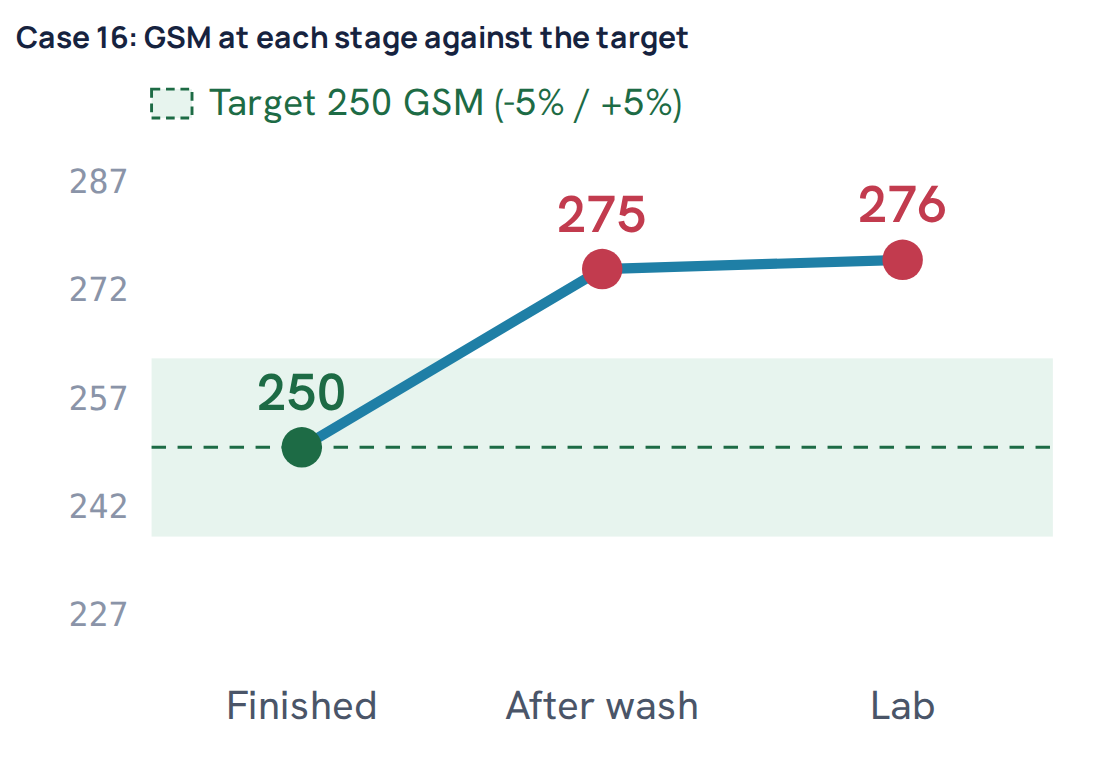
Case 16: 1×1 lycra rib, 250 GSM, too heavy
- Yarn: 34/1 cotton viscose 60/40 + 30D Lycra
- Stitch length: 27
- Machine: 32″ × 18G
- Required: 140 cm, 250 GSM ±5%
- Finished: 142 cm, 250 GSM
Route: Greige → Dyeing → Stenter → Compacting
Results
- Finished GSM (factory): 250
- GSM after wash (factory): 275
- Lab GSM: 276
- Off target: +10.5%
- Shrinkage (tumble): length -5%, width -3%
- Spirality: 2%
Other tests that failed in the same lab report: Shrinkage.
Cause and remedy
Cause: The fabric gained weight as it relaxed: 250 GSM after finishing, 275 after washing, 276 in the lab. The structure closed up once the finishing tension was released.
Cause: Length shrinkage after tumble dry was -5%, so the fabric shrank and got heavier in use.
Remedy: Finish this texture slightly under the target GSM, because it gains weight when it relaxes; stabilise it with heat setting or more compaction so it does not close up later.
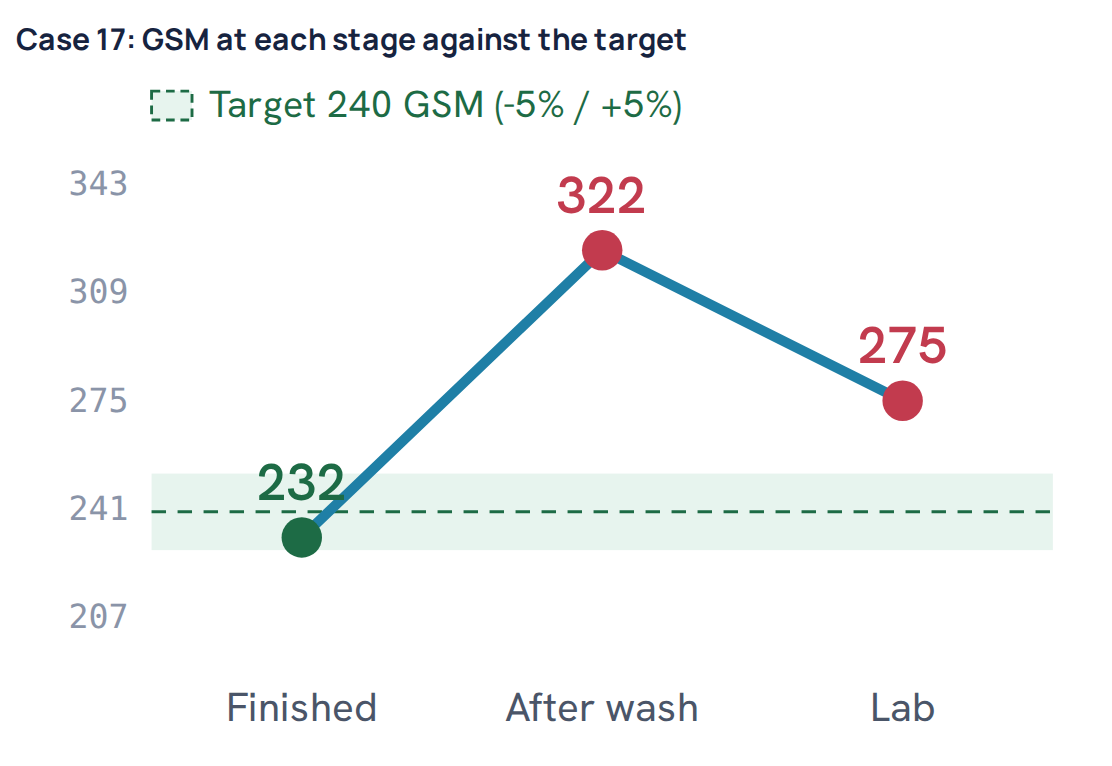
Case 17: Jacquard rib, 240 GSM, too heavy
- Yarn: 30/1 combed + 75D air-covered
- Stitch length: 36.5+30.5
- Machine: 34″ × 18G
- Required: 140 cm, 240 GSM ±5%
- Finished: 144 cm, 232 GSM
Route: Greige → Dyeing → Stenter → Compacting
Results
- Finished GSM (factory): 232
- GSM after wash (factory): 322
- Lab GSM: 275
- Off target: +14.5%
- Shrinkage (tumble): length -2%, width -2%
- Spirality: 2%
Other tests that failed in the same lab report: none.
Cause and remedy
Cause: The fabric gained weight as it relaxed: 232 GSM after finishing, 322 after washing, 275 in the lab. The structure closed up once the finishing tension was released.
Remedy: Finish this texture slightly under the target GSM, because it gains weight when it relaxes; stabilise it with heat setting or more compaction so it does not close up later.
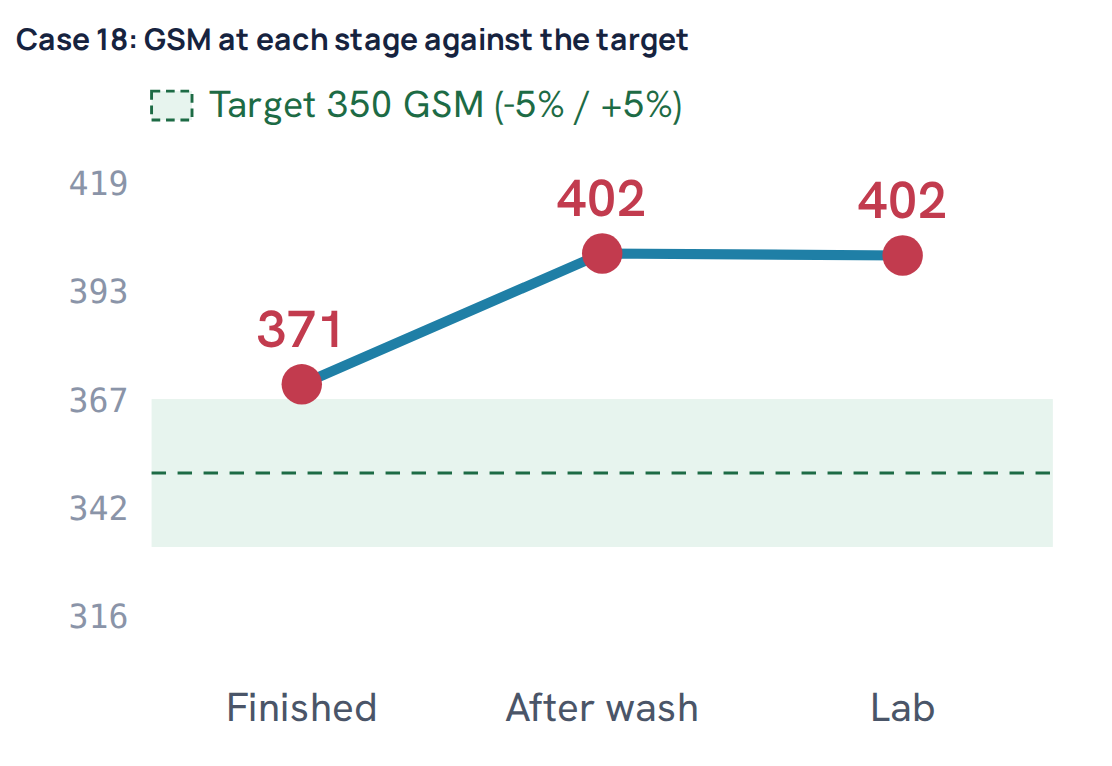
Case 18: Double ottoman rib, 350 GSM, too heavy
- Yarn: 26/1 CVC 60/40
- Stitch length: 37+35.5+21+18.5
- Machine: 34″ × 18G
- Required: 160 cm, 350 GSM ±5%
- Finished: 162 cm, 371 GSM
Route: Greige → Slitting → Heat setting → Back sewing → Dyeing → Stenter → Compacting
Results
- Finished GSM (factory): 371
- GSM after wash (factory): 402
- Lab GSM: 402
- Off target: +14.7%
- Shrinkage (tumble): length -4%, width -2%
- Spirality: 2%
Other tests that failed in the same lab report: Wash fastness.
Cause and remedy
Cause: The fabric gained weight as it relaxed: 371 GSM after finishing, 402 after washing, 402 in the lab. The structure closed up once the finishing tension was released.
Cause: It was already heavy after finishing: 371 against 350.
Remedy: Finish this texture slightly under the target GSM, because it gains weight when it relaxes; stabilise it with heat setting or more compaction so it does not close up later.
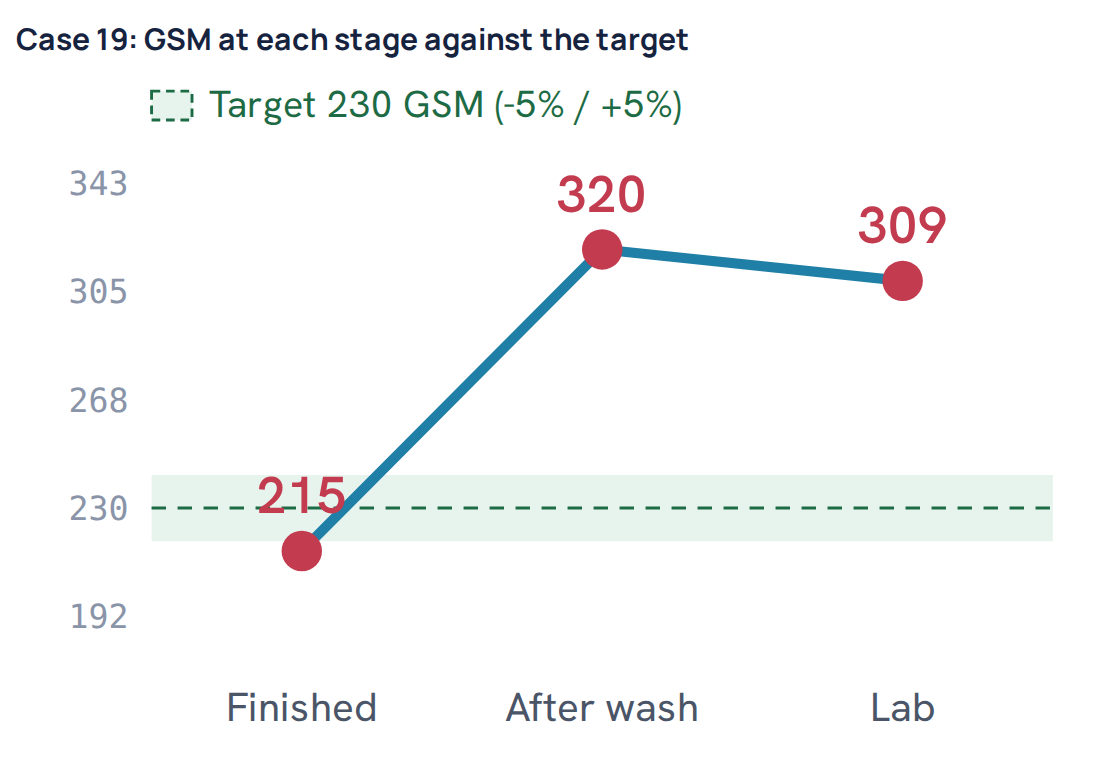
Case 19: Design rib, 230 GSM, too heavy
- Yarn: 34/1 combed
- Stitch length: 21.5+37
- Machine: 34″ × 18G
- Required: 150 cm, 230 GSM ±5%
- Finished: 126 cm, 215 GSM
Route: Greige → Slitting → Singeing → Back sewing → Dyeing → Stenter → Compacting
Results
- Finished GSM (factory): 215
- GSM after wash (factory): 320
- Lab GSM: 309
- Off target: +34.3%
- Shrinkage (tumble): length -5%, width -5%
- Spirality: 2%
Other tests that failed in the same lab report: none.
Cause and remedy
Cause: The fabric gained weight as it relaxed: 215 GSM after finishing, 320 after washing, 309 in the lab. The structure closed up once the finishing tension was released.
Cause: It was finished 24 cm narrower than required (126 against 150). A narrower fabric carries the same yarn on less area, so GSM goes up.
Cause: Length shrinkage after tumble dry was -5%, so the fabric shrank and got heavier in use.
Remedy: Finish to the full required width.
Remedy: Finish this texture slightly under the target GSM, because it gains weight when it relaxes; stabilise it with heat setting or more compaction so it does not close up later.
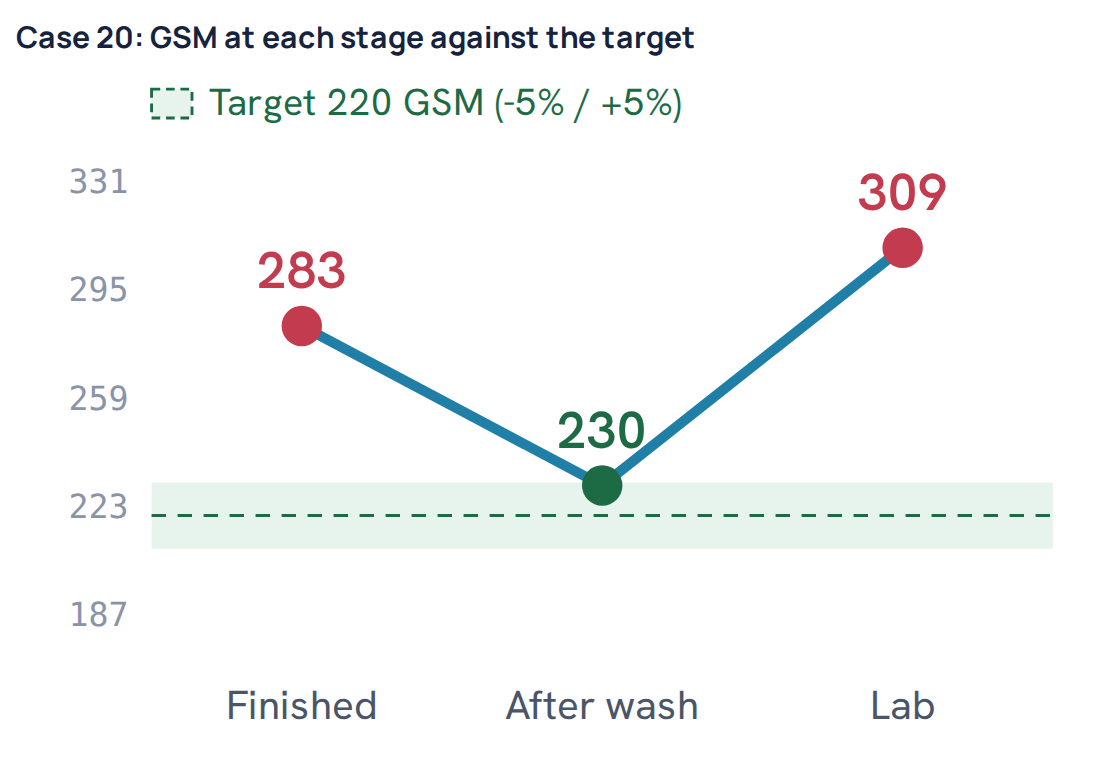
Case 20: Crepe rib, 220 GSM, too heavy
- Yarn: 30/1 combed + 75D air-covered polyester
- Stitch length: 36+34+27.0
- Machine: 34″ × 18G
- Required: 135 cm, 220 GSM ±5%
- Finished: 143 cm, 283 GSM
Route: Greige → Slitting → Heat setting → Back sewing → Dyeing → Stenter → Compacting
Results
- Finished GSM (factory): 283
- GSM after wash (factory): 230
- Lab GSM: 309
- Off target: +40.5%
- Shrinkage (tumble): length -2%, width -2%
- Spirality: 2%
Other tests that failed in the same lab report: none.
Cause and remedy
Cause: It was already heavy after finishing: 283 against 220.
Remedy: Finish this texture slightly under the target GSM, because it gains weight when it relaxes; stabilise it with heat setting or more compaction so it does not close up later.
Interlock: 4 cases
Interlock is a stable double knit; Lycra interlock is always heat set to fix the stretch and width.
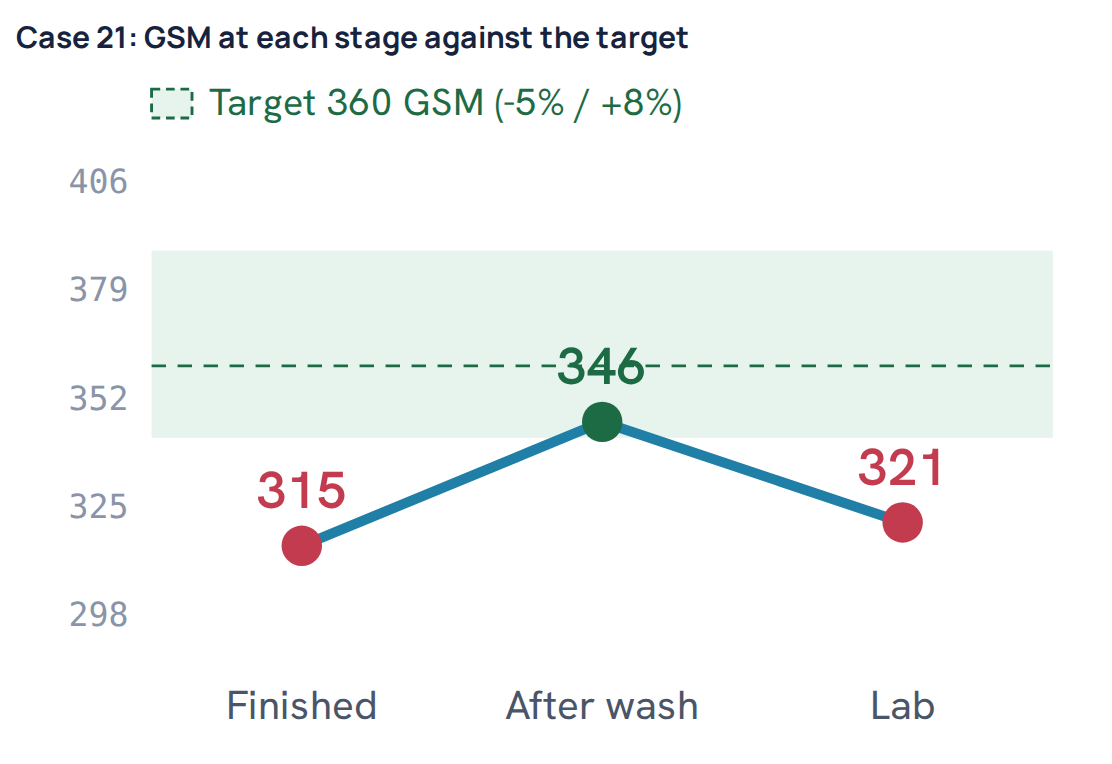
Case 21: Lycra interlock, 360 GSM, too light
- Yarn: 34/1 combed + 30D Lycra
- Stitch length: 28.5
- Machine: 38″ × 24G
- Required: 180 cm, 360 GSM -5% +8%
- Finished: 195 cm, 315 GSM
Route: Greige → Slitting → Heat setting → Back sewing → Dyeing → Stenter → Compacting
Results
- Finished GSM (factory): 315
- GSM after wash (factory): 346
- Lab GSM: 321
- Off target: -10.9%
- Shrinkage (tumble): length -5%, width -2%
- Spirality: 2%
Other tests that failed in the same lab report: none.
Cause and remedy
Cause: The fabric left finishing already light: 315 GSM against 360 required (-12%). The lab could not find weight that was never there.
Cause: It was also finished 15 cm wider than required (195 against 180). Stretching for width spreads the same yarn over more area and lowers GSM.
Remedy: Finish at the required width, not wider, and give more overfeed on the stenter and compactor to build weight.
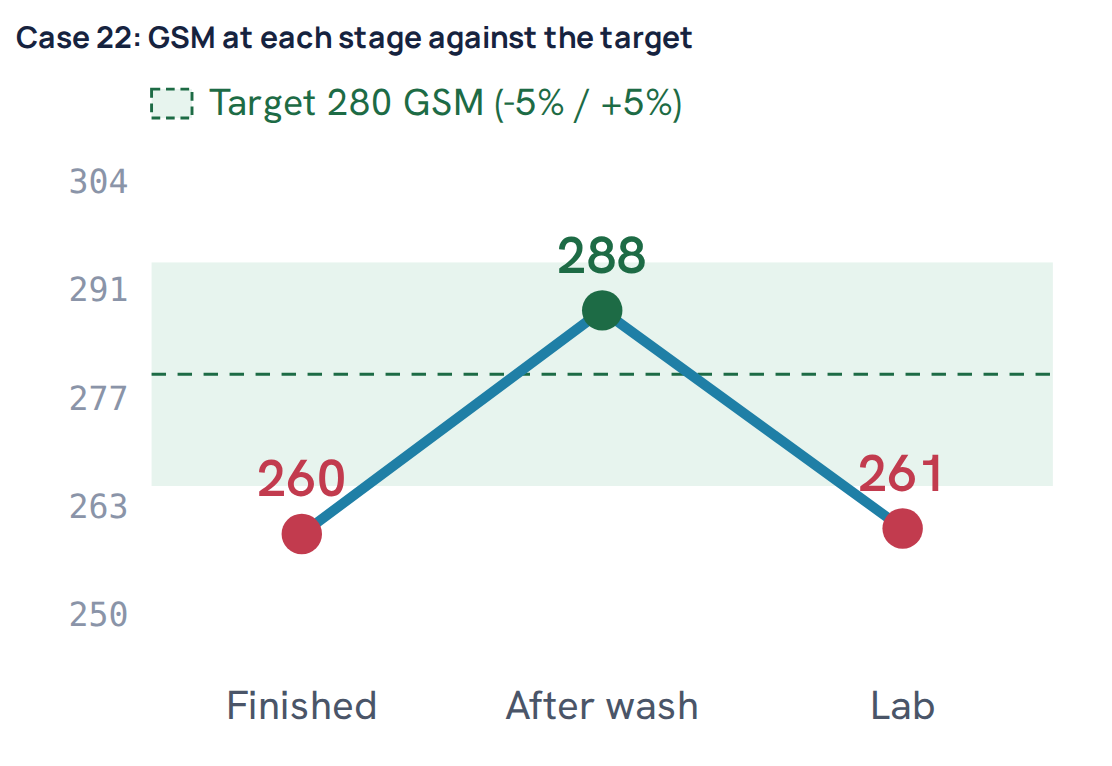
Case 22: Lycra interlock, 280 GSM, too light
- Yarn: 40/1 cotton + 20D Lycra dyeable
- Stitch length: 29.5
- Machine: 38″ × 24G
- Required: 190 cm, 280 GSM ±5%
- Finished: 166 cm, 260 GSM
Route: Greige → Slitting → Heat setting → Back sewing → Dyeing → Stenter → Compacting
Results
- Finished GSM (factory): 260
- GSM after wash (factory): 288
- Lab GSM: 261
- Off target: -6.9%
- Shrinkage (tumble): length -8%, width -3%
- Spirality: 3%
Other tests that failed in the same lab report: Shrinkage.
Cause and remedy
Cause: The fabric left finishing already light: 260 GSM against 280 required (-7%). The lab could not find weight that was never there.
Cause: The width was not over-stretched, so the weight was missing from the knitting: the loop was too long or the yarn too fine for the target.
Remedy: Shorten the stitch length (or use a coarser count) in knitting for the next batch, so the greige carries enough weight.
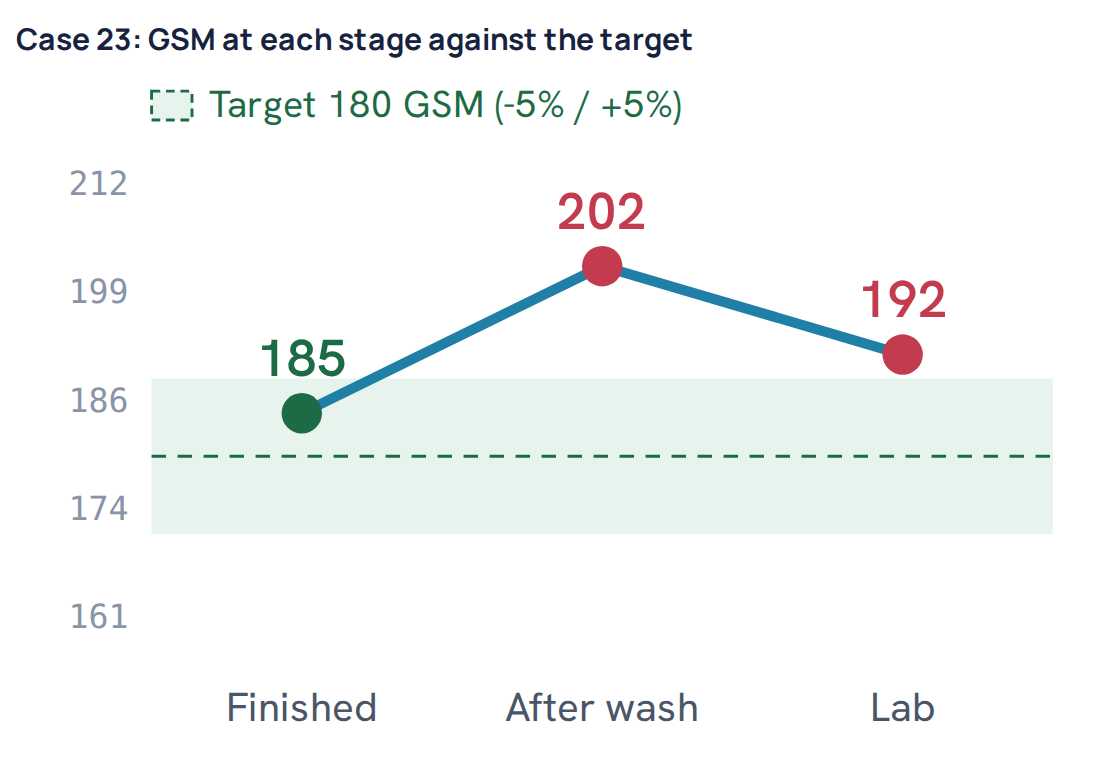
Case 23: Yarn-dyed design interlock, 180 GSM, too heavy
- Yarn: 40/1 CVC 60/40 + 50D polyester yarn-dyed
- Stitch length: 25.5+22.0
- Machine: 36″ × 28G
- Required: 180 cm, 180 GSM ±5%
- Finished: 193 cm, 185 GSM
Route: Greige → Dyeing → Stenter → Compacting
Results
- Finished GSM (factory): 185
- GSM after wash (factory): 202
- Lab GSM: 192
- Off target: +6.6%
- Shrinkage (tumble): length -5%, width -4%
- Spirality: 2%
Other tests that failed in the same lab report: Fibre analysis.
Cause and remedy
Cause: The fabric gained weight as it relaxed: 185 GSM after finishing, 202 after washing, 192 in the lab. The structure closed up once the finishing tension was released.
Cause: Length shrinkage after tumble dry was -5%, so the fabric shrank and got heavier in use.
Remedy: Finish this texture slightly under the target GSM, because it gains weight when it relaxes; stabilise it with heat setting or more compaction so it does not close up later.
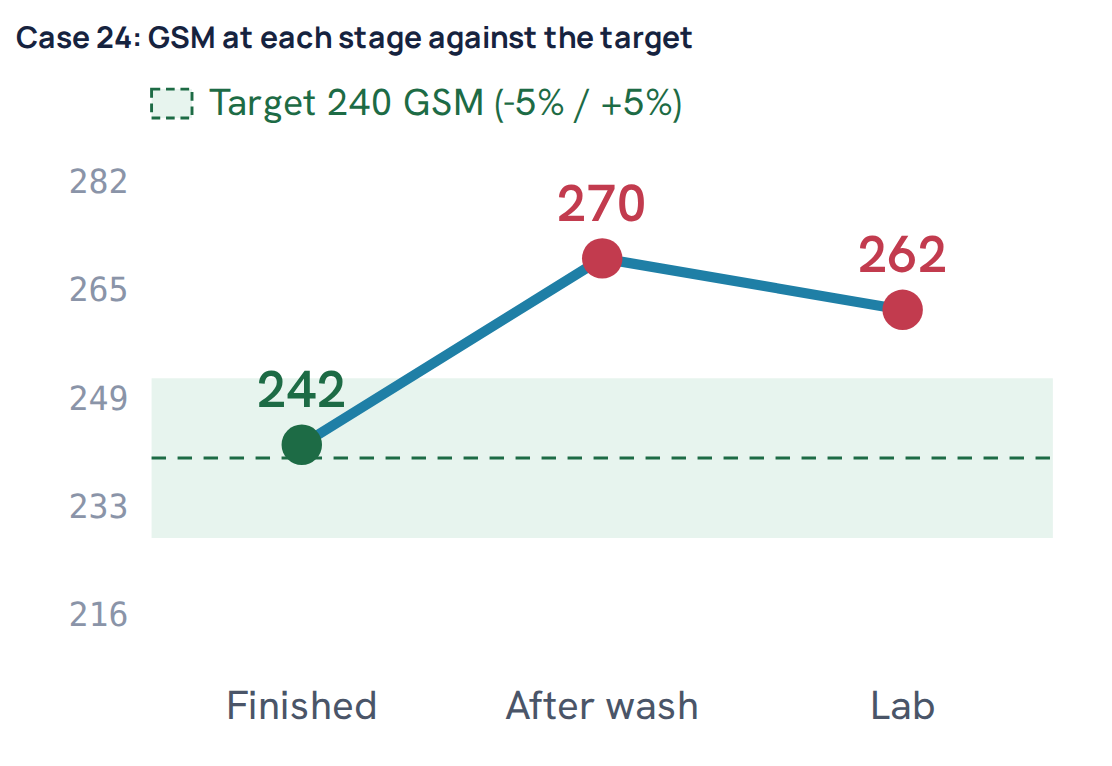
Case 24: Double tuck lycra bonded interlock, 240 GSM, too heavy
- Yarn: 40/1 cotton modal 50/50 + 40D Lycra
- Stitch length: 26
- Machine: 38″ × 24G
- Required: 180 cm, 240 GSM ±5%
- Finished: 182 cm, 242 GSM
Route: Greige → Slitting → Heat setting → Back sewing → Dyeing → Stenter → Compacting
Results
- Finished GSM (factory): 242
- GSM after wash (factory): 270
- Lab GSM: 262
- Off target: +9.3%
- Shrinkage (tumble): length -7%, width -2%
- Spirality: 3%
Other tests that failed in the same lab report: Shrinkage.
Cause and remedy
Cause: The fabric gained weight as it relaxed: 242 GSM after finishing, 270 after washing, 262 in the lab. The structure closed up once the finishing tension was released.
Cause: Length shrinkage after tumble dry was -7%, so the fabric shrank and got heavier in use.
Remedy: Finish this texture slightly under the target GSM, because it gains weight when it relaxes; stabilise it with heat setting or more compaction so it does not close up later.
Terry: 4 cases
Terry is dyed loop side inside. Heavy terry (350 GSM and up) is heat set before dyeing.
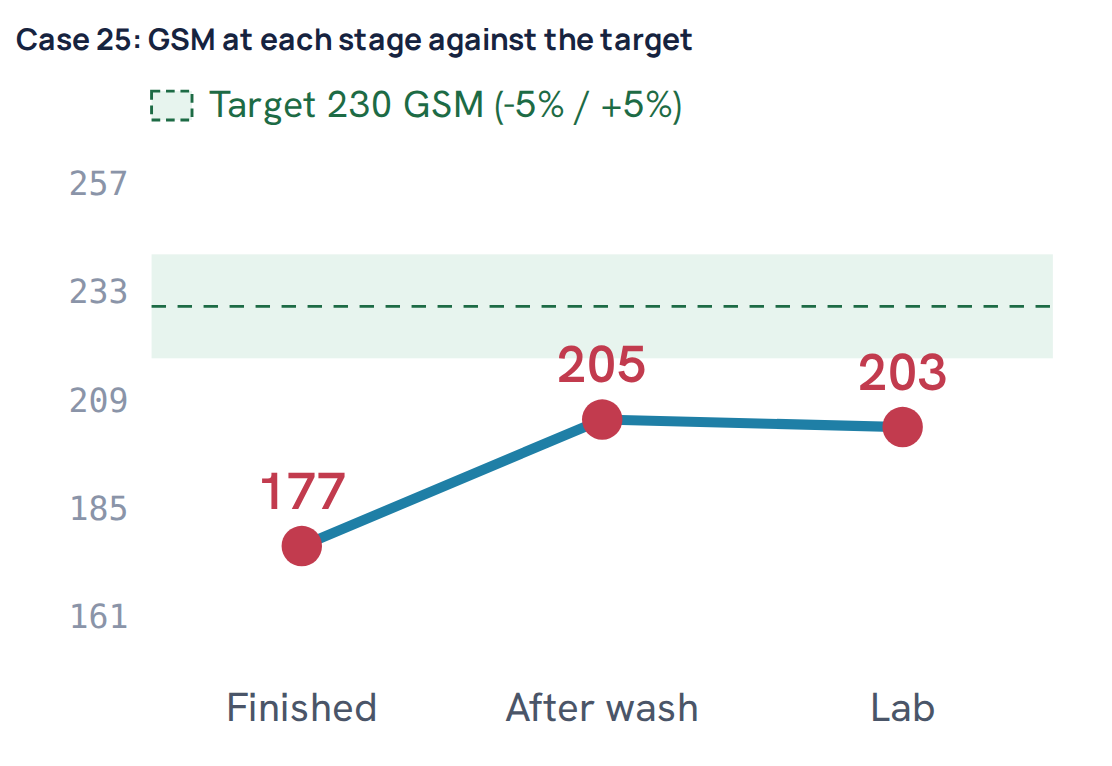
Case 25: Lycra design terry, 230 GSM, too light
- Yarn: 40/1 combed + 30D Lycra
- Stitch length: 20+16
- Machine: 34″ × 24G
- Required: 138 cm, 230 GSM ±5%
- Finished: 140 cm, 177 GSM
Route: Greige → Slitting → Heat setting → Back sewing → Dyeing → Stenter → Compacting
Results
- Finished GSM (factory): 177
- GSM after wash (factory): 205
- Lab GSM: 203
- Off target: -11.6%
- Shrinkage (tumble): length -10%, width +200%
- Spirality: 2%
Other tests that failed in the same lab report: none.
Cause and remedy
Cause: The fabric left finishing already light: 177 GSM against 230 required (-23%). The lab could not find weight that was never there.
Cause: It was also finished 2 cm wider than required (140 against 138). Stretching for width spreads the same yarn over more area and lowers GSM.
Remedy: Finish at the required width, not wider, and give more overfeed on the stenter and compactor to build weight.
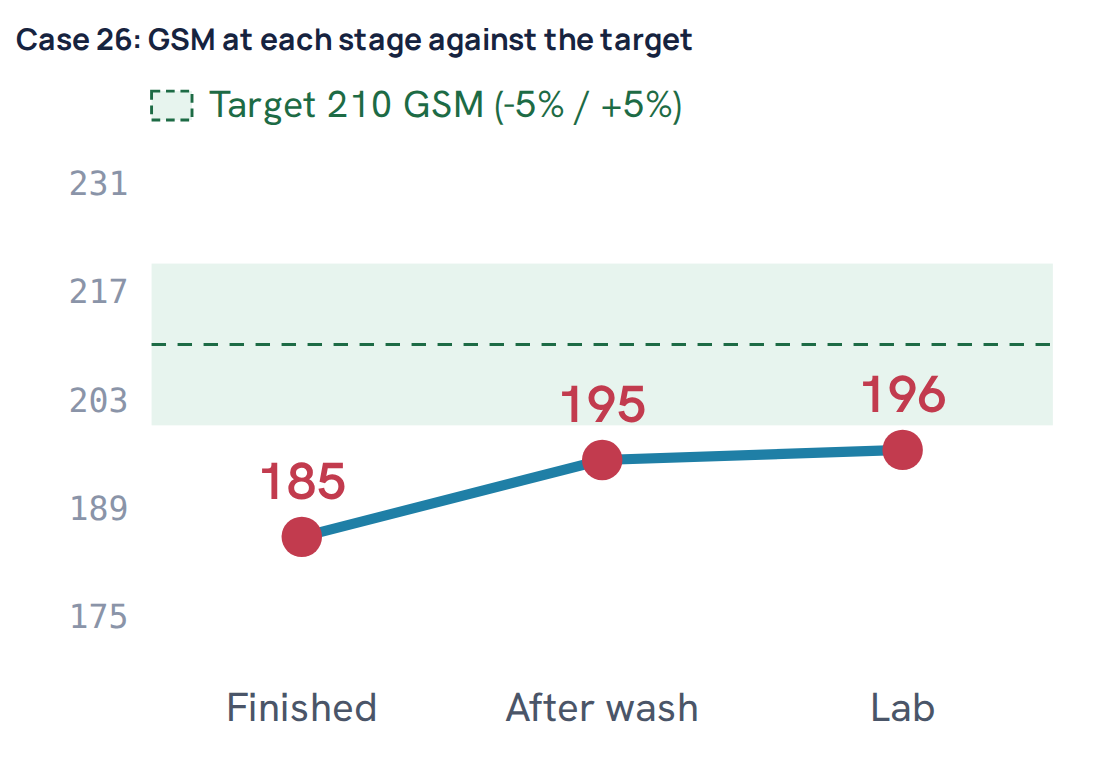
Case 26: Yarn-dyed design terry, 210 GSM, too light
- Yarn: 32/1 cotton yarn-dyed + 22/1 cotton yarn-dyed
- Stitch length: 31.5+18.5
- Machine: 30″ × 24G
- Required: 170 cm, 210 GSM ±5%
- Finished: 170 cm, 185 GSM
Route: Greige → Slitting → Singeing → Back sewing → Dyeing → Stenter → Compacting
Results
- Finished GSM (factory): 185
- GSM after wash (factory): 195
- Lab GSM: 196
- Off target: -6.5%
- Shrinkage (tumble): length -15%, width +1000%
- Spirality: 3%
Other tests that failed in the same lab report: Shrinkage.
Cause and remedy
Cause: The fabric left finishing already light: 185 GSM against 210 required (-12%). The lab could not find weight that was never there.
Cause: The width was not over-stretched, so the weight was missing from the knitting: the loop was too long or the yarn too fine for the target.
Remedy: Shorten the stitch length (or use a coarser count) in knitting for the next batch, so the greige carries enough weight.
Case 27: Design terry, 270 GSM, too heavy
- Yarn: 26/1 cotton + 20/1 cotton
- Stitch length: 4.25+1.75
- Machine: 34″ × 16G
- Required: 160 cm, 270 GSM ±5%
- Finished: 162 cm, 274 GSM
Route: Greige → Dyeing → Stenter → Compacting
Results
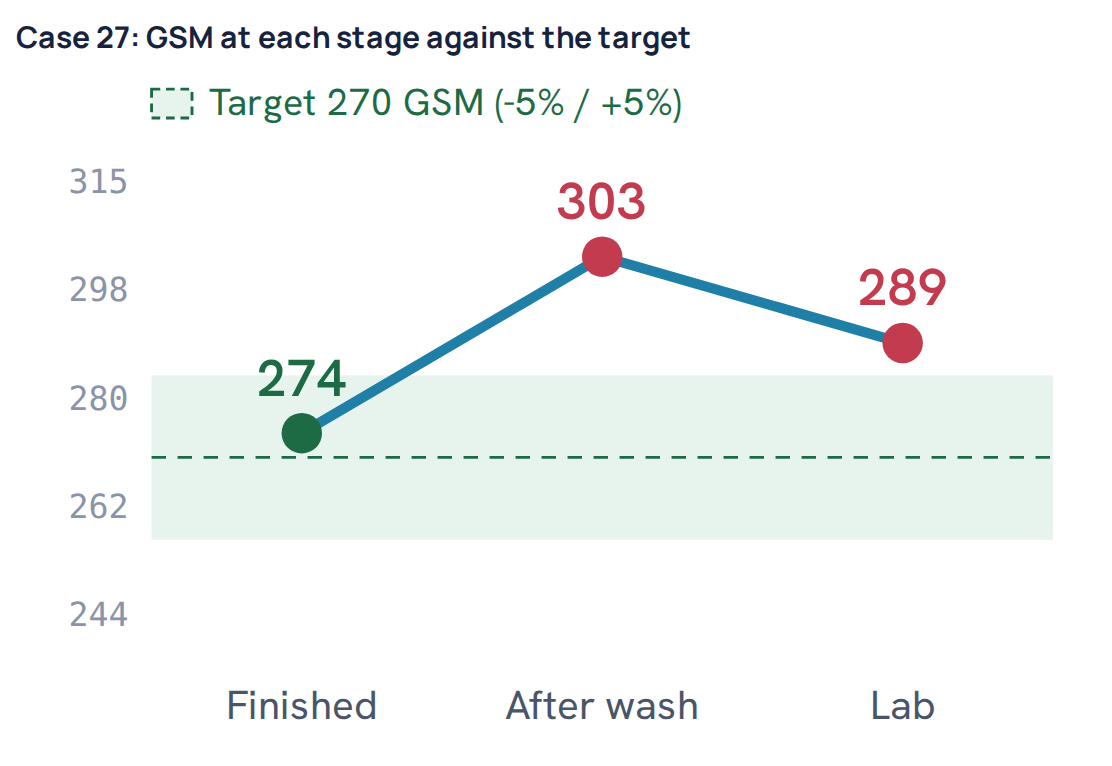
- Finished GSM (factory): 274
- GSM after wash (factory): 303
- Lab GSM: 289
- Off target: +7.0%
- Shrinkage (tumble): length -18%, width -5%
- Spirality: 3%
Other tests that failed in the same lab report: Shrinkage.
Cause and remedy
Cause: The fabric gained weight as it relaxed: 274 GSM after finishing, 303 after washing, 289 in the lab. The structure closed up once the finishing tension was released.
Cause: Length shrinkage after tumble dry was -18%, so the fabric shrank and got heavier in use.
Remedy: Finish this texture slightly under the target GSM, because it gains weight when it relaxes; stabilise it with heat setting or more compaction so it does not close up later.
Case 28: Diagonal terry, 360 GSM, too heavy
- Yarn: 26/1 CVC 60/40 + 26/1 CVC 60/40 + 26/3 CVC 60/40 twisted
- Stitch length: 46+37+18.0
- Machine: 30″ × 16G
- Required: 160 cm, 360 GSM -5% +8%
- Finished: 162 cm, 365 GSM
Route: Greige → Slitting → Heat setting → Back sewing → Dyeing → Stenter → Compacting
Results
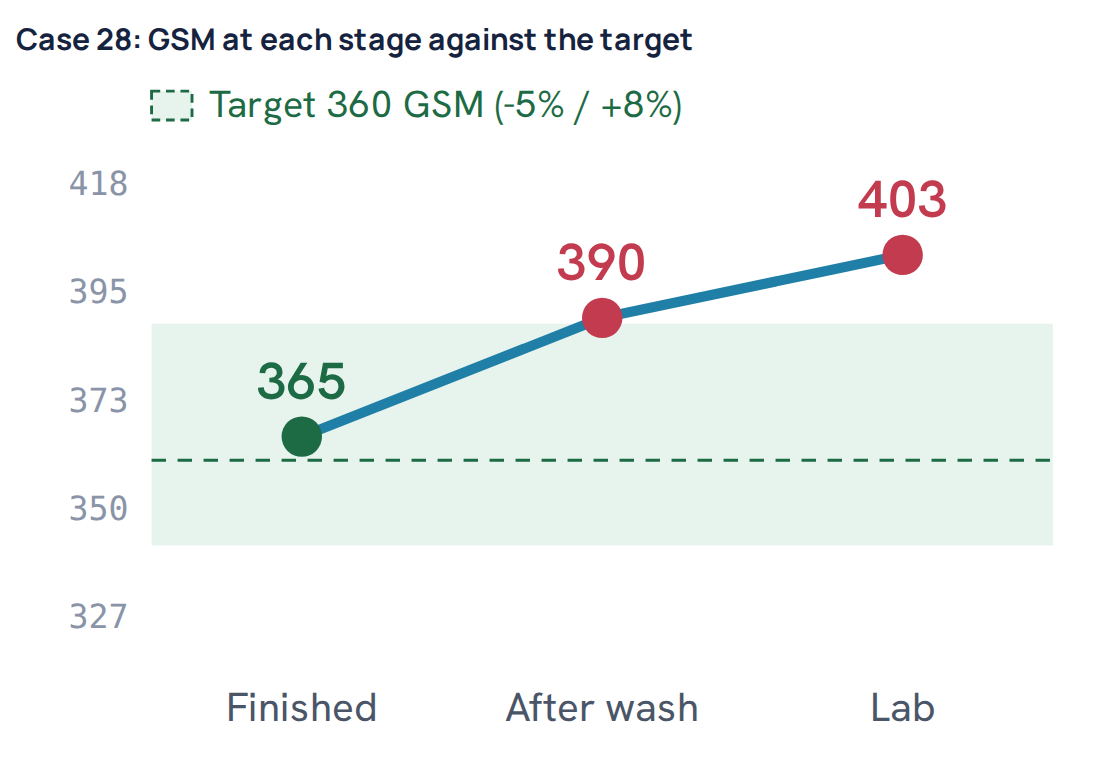
- Finished GSM (factory): 365
- GSM after wash (factory): 390
- Lab GSM: 403
- Off target: +12.0%
- Shrinkage (tumble): length -5%, width -4%
- Spirality: 2%
Other tests that failed in the same lab report: none.
Cause and remedy
Cause: Length shrinkage after tumble dry was -5%, so the fabric shrank and got heavier in use.
Remedy: Finish this texture slightly under the target GSM, because it gains weight when it relaxes; stabilise it with heat setting or more compaction so it does not close up later.
Waffle: 2 cases
Waffle is a loose texture knit: no enzyme, singed when a clean face is needed, and its GSM must be checked after washing.
Case 29: Waffle, 350 GSM, too light
- Yarn: 24/1 combed + 20/1 combed
- Stitch length: 30+26.5
- Machine: 34″ × 18G
- Required: 180 cm, 350 GSM ±5%
- Finished: 190 cm, 226 GSM
Route: Greige → Slitting → Singeing → Back sewing → Dyeing → Stenter → Compacting
Results
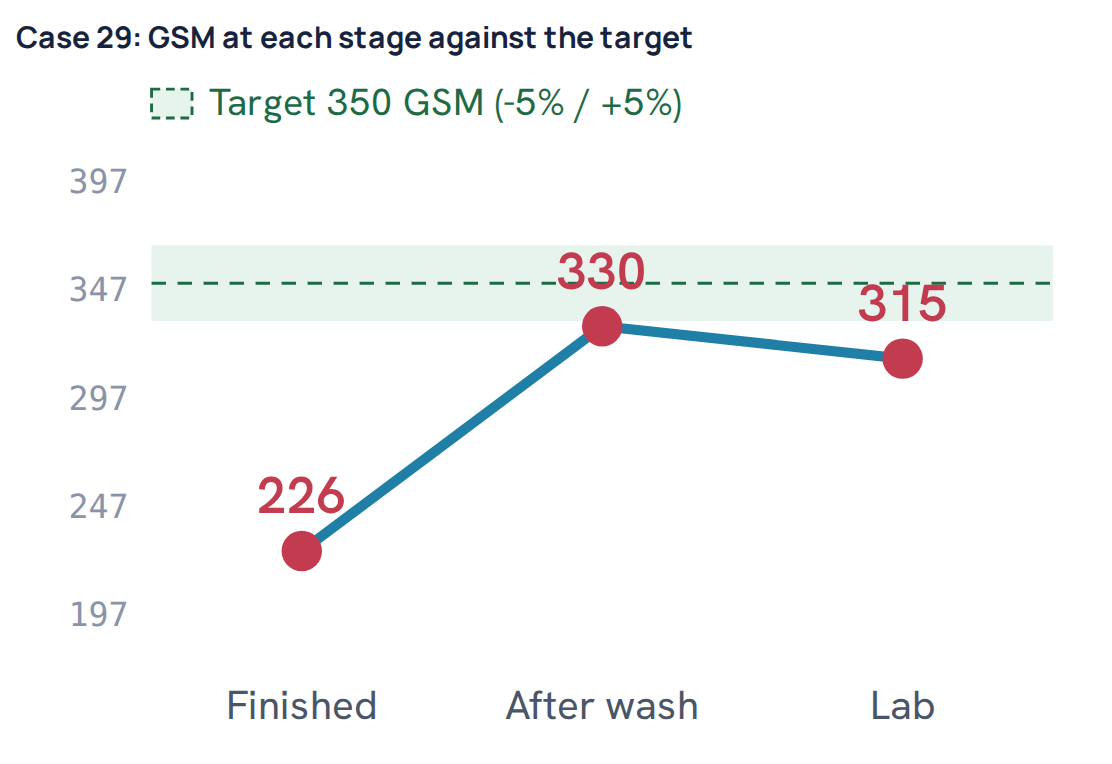
- Finished GSM (factory): 226
- GSM after wash (factory): 330
- Lab GSM: 315
- Off target: -10.0%
- Shrinkage (tumble): length -8%, width -15%
- Spirality: 2%
Other tests that failed in the same lab report: none.
Cause and remedy
Cause: The fabric left finishing already light: 226 GSM against 350 required (-35%). The lab could not find weight that was never there.
Cause: It was also finished 10 cm wider than required (190 against 180). Stretching for width spreads the same yarn over more area and lowers GSM.
Remedy: Finish at the required width, not wider, and give more overfeed on the stenter and compactor to build weight.
Case 30: Waffle, 270 GSM, too heavy
- Yarn: 20/1 CVC 60/40
- Stitch length: 29+19.0
- Machine: 44″ × 18G
- Required: 190 cm, 270 GSM -5% +8%
- Finished: 187 cm, 234 GSM
Route: Greige → Dyeing → Stenter → Compacting
Results
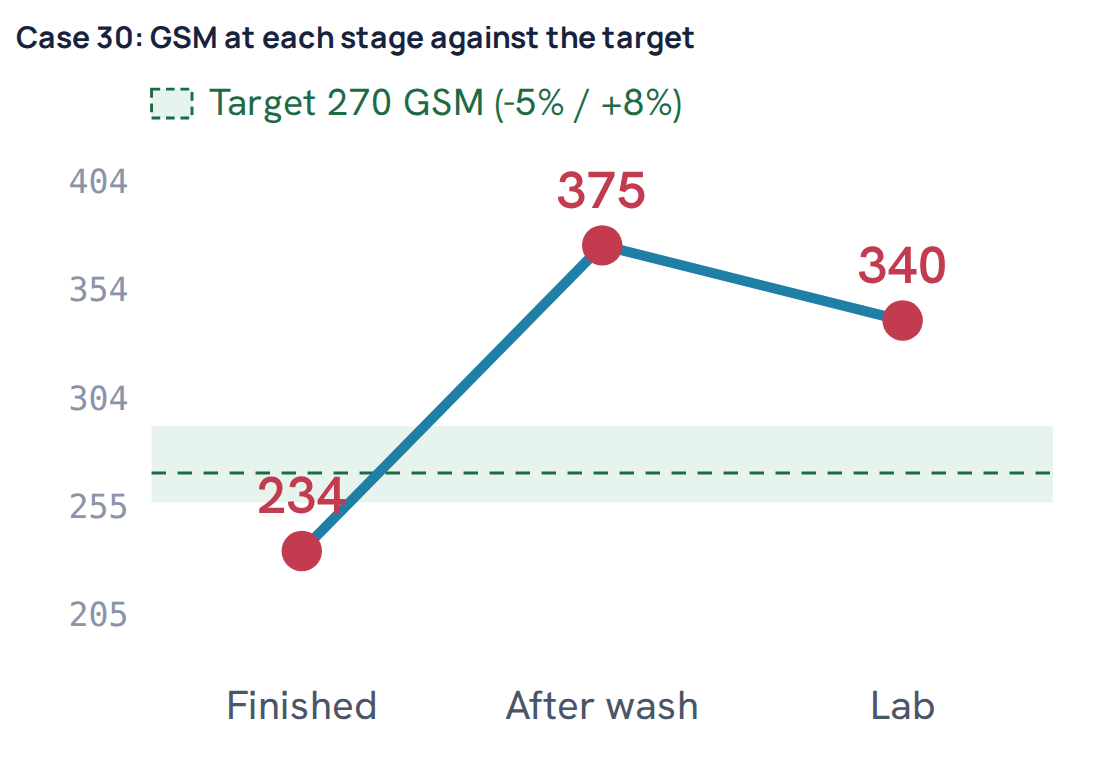
- Finished GSM (factory): 234
- GSM after wash (factory): 375
- Lab GSM: 340
- Off target: +26.0%
- Shrinkage (tumble): length -5%, width -3%
- Spirality: 2%
Other tests that failed in the same lab report: Perspiration fastness.
Cause and remedy
Cause: The fabric gained weight as it relaxed: 234 GSM after finishing, 375 after washing, 340 in the lab. The structure closed up once the finishing tension was released.
Cause: It was finished 3 cm narrower than required (187 against 190). A narrower fabric carries the same yarn on less area, so GSM goes up.
Cause: Length shrinkage after tumble dry was -5%, so the fabric shrank and got heavier in use.
Remedy: Finish to the full required width.
Remedy: Finish this texture slightly under the target GSM, because it gains weight when it relaxes; stabilise it with heat setting or more compaction so it does not close up later.
Fleece: 3 cases
Fleece is dyed loop side inside; fleece of 350 GSM and up is heat set before dyeing.
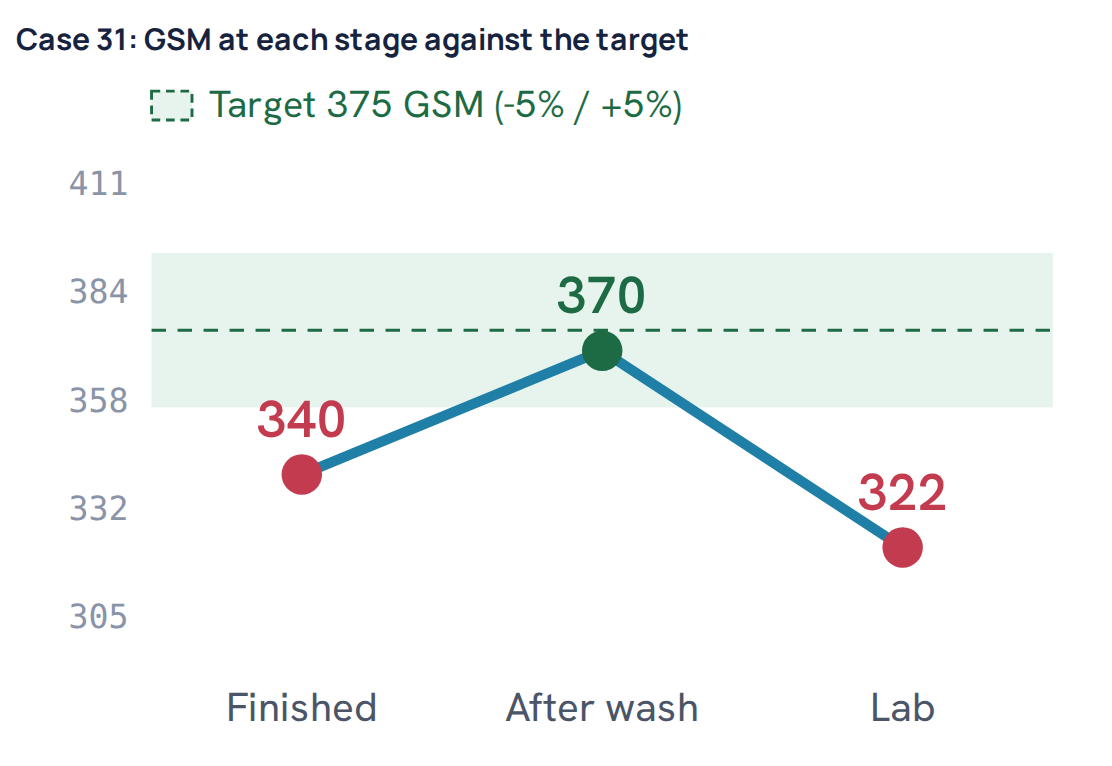
Case 31: Fleece, 375 GSM, too light
- Yarn: 34/1 cotton + 30/1 cotton + 8/1 carded
- Stitch length: 41.5+36+17
- Machine: 30″ × 20G
- Required: 175 cm, 375 GSM ±5%
- Finished: 155 cm, 340 GSM
Route: Greige → Dyeing → Stenter → Compacting
Results
- Finished GSM (factory): 340
- GSM after wash (factory): 370
- Lab GSM: 322
- Off target: -14.1%
- Shrinkage (tumble): length -12%, width +200%
- Spirality: 2%
Other tests that failed in the same lab report: Shrinkage.
Cause and remedy
Cause: The fabric left finishing already light: 340 GSM against 375 required (-9%). The lab could not find weight that was never there.
Cause: The width was not over-stretched, so the weight was missing from the knitting: the loop was too long or the yarn too fine for the target.
Remedy: Shorten the stitch length (or use a coarser count) in knitting for the next batch, so the greige carries enough weight.
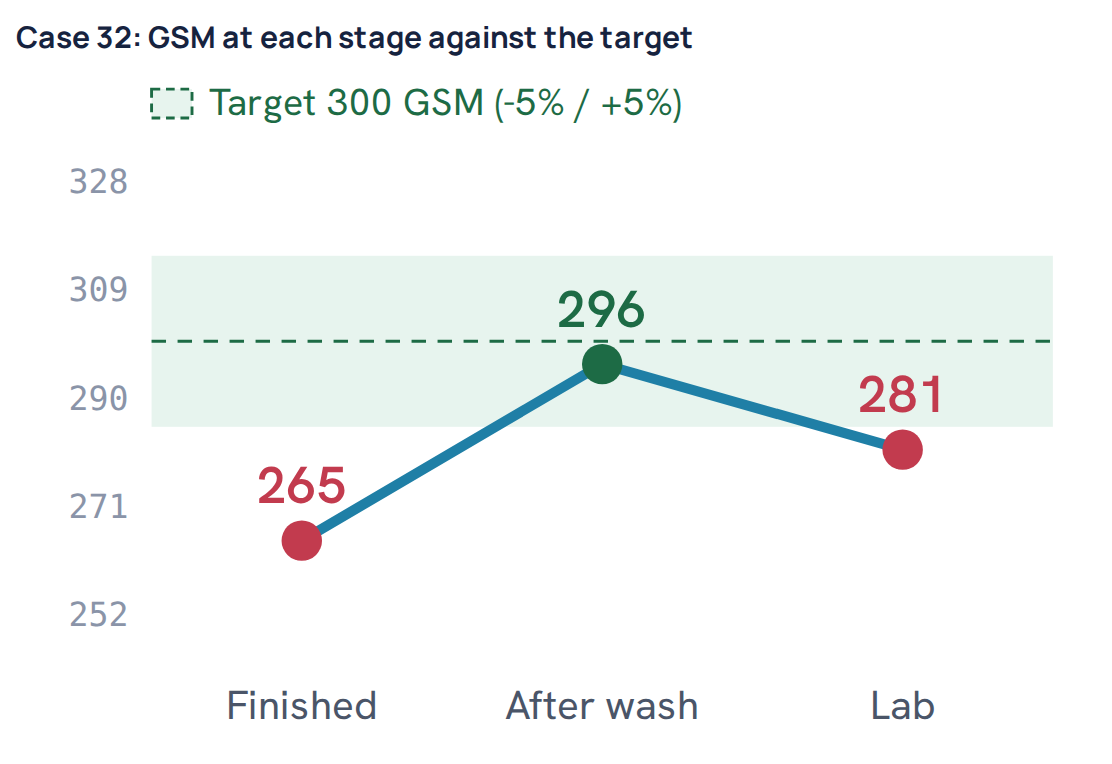
Case 32: Fleece, 300 GSM, too light
- Yarn: 32/1 combed + 75D polyester + 12/1 CVC 60/40
- Stitch length: 45.5+29+15.5
- Machine: 30″ × 20G
- Required: 145 cm, 300 GSM ±5%
- Finished: 150 cm, 265 GSM
Route: Greige → Dyeing → Stenter → Compacting
Results
- Finished GSM (factory): 265
- GSM after wash (factory): 296
- Lab GSM: 281
- Off target: -6.3%
- Shrinkage (tumble): length -4%, width -2%
- Spirality: 2%
Other tests that failed in the same lab report: Rubbing fastness.
Cause and remedy
Cause: The fabric left finishing already light: 265 GSM against 300 required (-12%). The lab could not find weight that was never there.
Cause: It was also finished 5 cm wider than required (150 against 145). Stretching for width spreads the same yarn over more area and lowers GSM.
Remedy: Finish at the required width, not wider, and give more overfeed on the stenter and compactor to build weight.
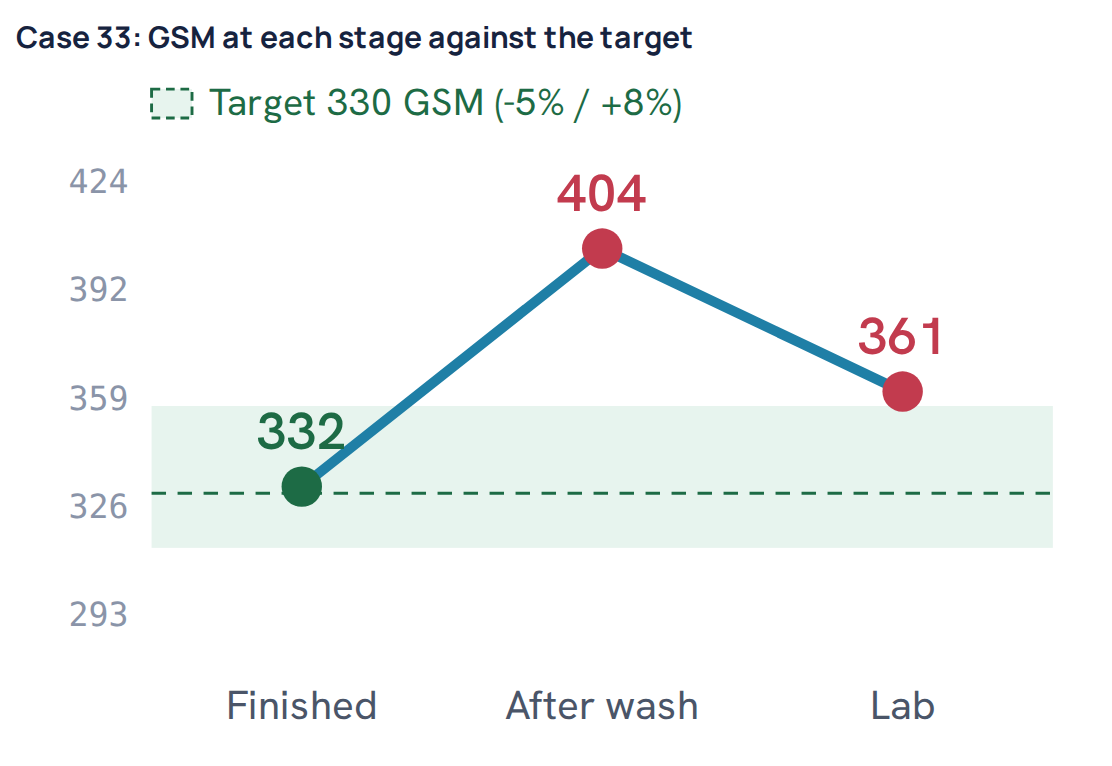
Case 33: Fleece, 330 GSM, too heavy
- Yarn: 30/1 combed + 26/1 CVC 60/40 + 8/1 carded
- Stitch length: 47.5+39.5+20
- Machine: 30″ × 16G
- Required: 165 cm, 330 GSM -5% +8%
- Finished: 170 cm, 332 GSM
Route: Greige → Dyeing → Stenter → Compacting
Results
- Finished GSM (factory): 332
- GSM after wash (factory): 404
- Lab GSM: 361
- Off target: +9.3%
- Shrinkage (tumble): length -7%, width -4%
- Spirality: 3%
Other tests that failed in the same lab report: Wash fastness, Rubbing fastness, Pilling.
Cause and remedy
Cause: The fabric gained weight as it relaxed: 332 GSM after finishing, 404 after washing, 361 in the lab. The structure closed up once the finishing tension was released.
Cause: Length shrinkage after tumble dry was -7%, so the fabric shrank and got heavier in use.
Remedy: Finish this texture slightly under the target GSM, because it gains weight when it relaxes; stabilise it with heat setting or more compaction so it does not close up later.
Pique and lacoste: 2 cases
Pique follows the single jersey rules; it is dried relaxed after the stenter to take out length shrinkage.
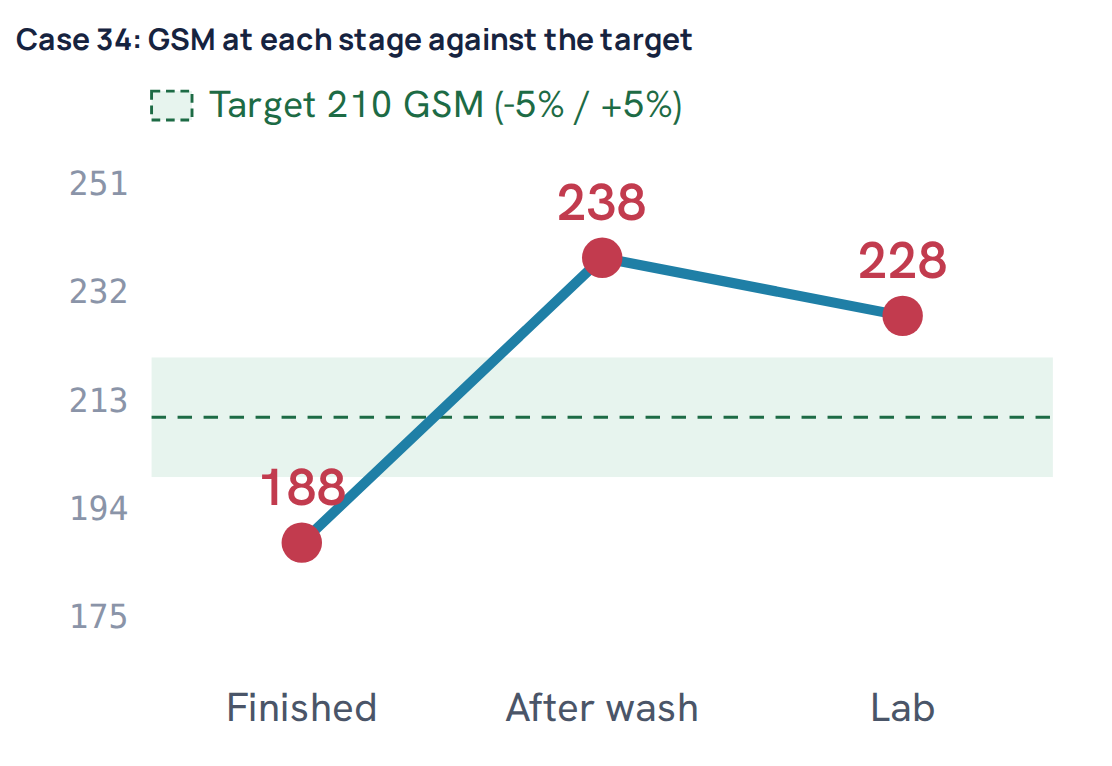
Case 34: Design pique, 210 GSM, too heavy
- Yarn: 34/1 cotton organic 2 ply
- Stitch length: 41
- Machine: 30″ × 16G
- Required: 165 cm, 210 GSM ±5%
- Finished: 165 cm, 188 GSM
Route: Greige → Slitting → Singeing → Back sewing → Dyeing → Stenter → Compacting
Results
- Finished GSM (factory): 188
- GSM after wash (factory): 238
- Lab GSM: 228
- Off target: +8.5%
- Shrinkage (tumble): length -10%, width -6%
- Spirality: 3%
Other tests that failed in the same lab report: none.
Cause and remedy
Cause: The fabric gained weight as it relaxed: 188 GSM after finishing, 238 after washing, 228 in the lab. The structure closed up once the finishing tension was released.
Cause: Length shrinkage after tumble dry was -10%, so the fabric shrank and got heavier in use.
Remedy: Finish this texture slightly under the target GSM, because it gains weight when it relaxes; stabilise it with heat setting or more compaction so it does not close up later.
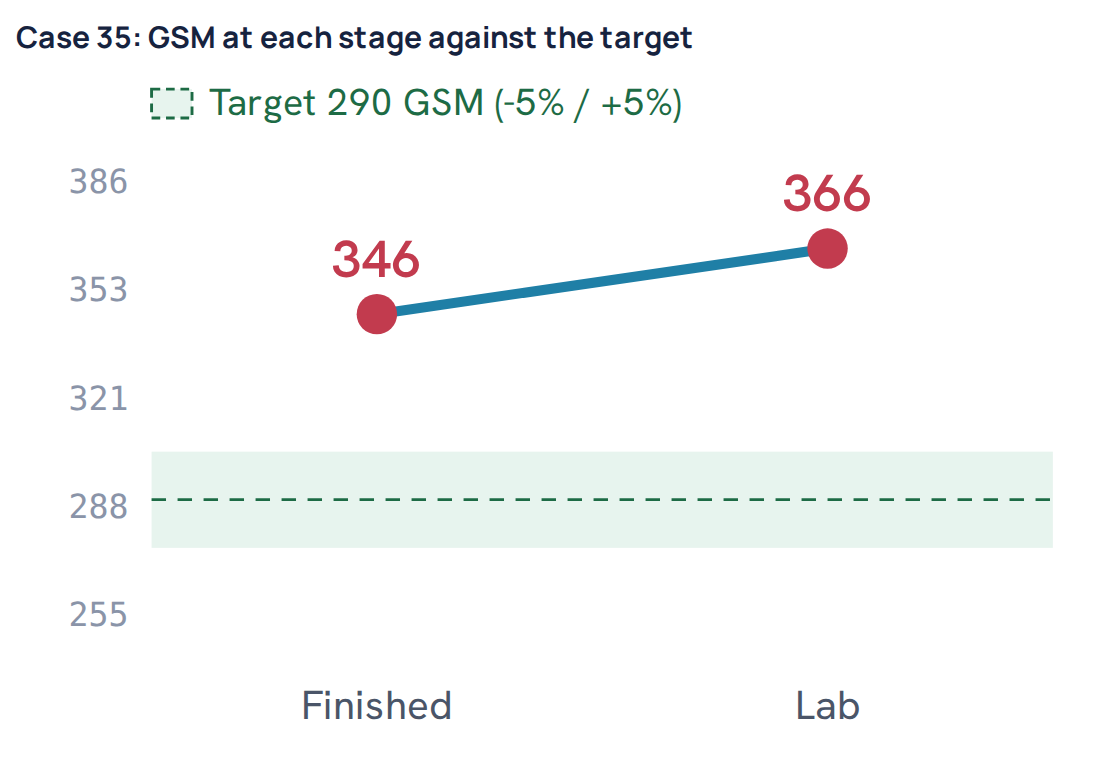
Case 35: Yarn-dyed single lacoste, 290 GSM, too heavy
- Yarn: 26/1 combed 2 ply yarn-dyed
- Stitch length: 33.5+32.5
- Machine: 34″ × 16G
- Required: 180 cm, 290 GSM ±5%
- Finished: 180 cm, 346 GSM
Route: Greige → Dyeing → Stenter → Compacting
Results
- Finished GSM (factory): 346
- GSM after wash (factory): —
- Lab GSM: 366
- Off target: +26.1%
- Shrinkage (tumble): length -4%, width -8%
- Spirality: 2%
Other tests that failed in the same lab report: none.
Cause and remedy
Cause: It was already heavy after finishing: 346 against 290.
Remedy: Finish this texture slightly under the target GSM, because it gains weight when it relaxes; stabilise it with heat setting or more compaction so it does not close up later.
From the floor: what I learned from these 35 cases
- Reach the required GSM. The closer the fabric is to its GSM, the better it performs in the lab, in bursting as well.
- A tightly knitted fabric holds its GSM and pills less; a loosely knitted one goes light and pills more.
- Heat setting is decided partly by GSM and construction: a tight knit is heat set whatever its GSM, and design fabrics are heat set to fix the design at the width where it shows.
- Let the fabric relax 12 to 24 hours before cutting, so the GSM you measure is the GSM the garment will have.
Questions
What is the GSM tolerance for knit fabric?
Usually ±5% of the required GSM; some buyers allow −5% / +8%.
Why is the lab GSM higher than the factory’s finished GSM?
The lab tests relaxed, conditioned fabric. Fabric measured warm and under tension off the compactor reads lighter; in our records the gap was about 5%.
Related: shrinkage and GSM after wash calculator · knit GSM from stitch length.

Textile engineer with 14+ years in dyeing and fabric development. He writes every guide on Dyeing Solution from real production work. Full profile