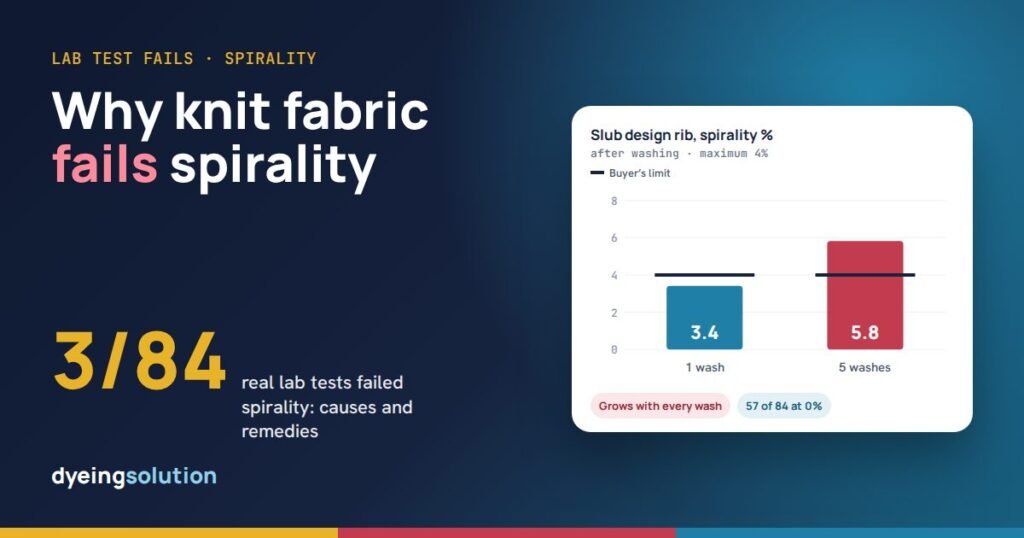
Over 95 new fabric developments, each one tested in the lab, spirality was tested 84 times and failed only 3 times. Here are those cases: how each was knitted, dyed and finished, what the lab found after one and five washes, and the cause and remedy.
About this series. These findings come from 95 development batches: new and uncommon knit fabrics such as slub design rib, yarn-dyed mélange jersey and flat-back rib. Each batch was knitted, dyed and finished as a development sample, then tested by an accredited lab to the buyer’s standard. When a test failed, we found the actual cause on the floor and changed the next batch until it passed.
At a glance
3 of 84Reports failed spirality
57 of 84Measured 0%
+1.3Points added from 1 to 5 washes
4%Most common maximum
How the lab tests spirality
Spirality (also called torque or twist) is when the wales of a knit fabric no longer run straight down but lean to one side after washing, so side seams twist round the body. The lab marks a square on the fabric or garment (ISO 16322-2), washes and dries it as the buyer asks, and measures how far the wale line has moved from vertical. The result is given as a percentage of the marked length.
Most buyers allow up to 4%; some allow 3% or less.
Which fabrics fail
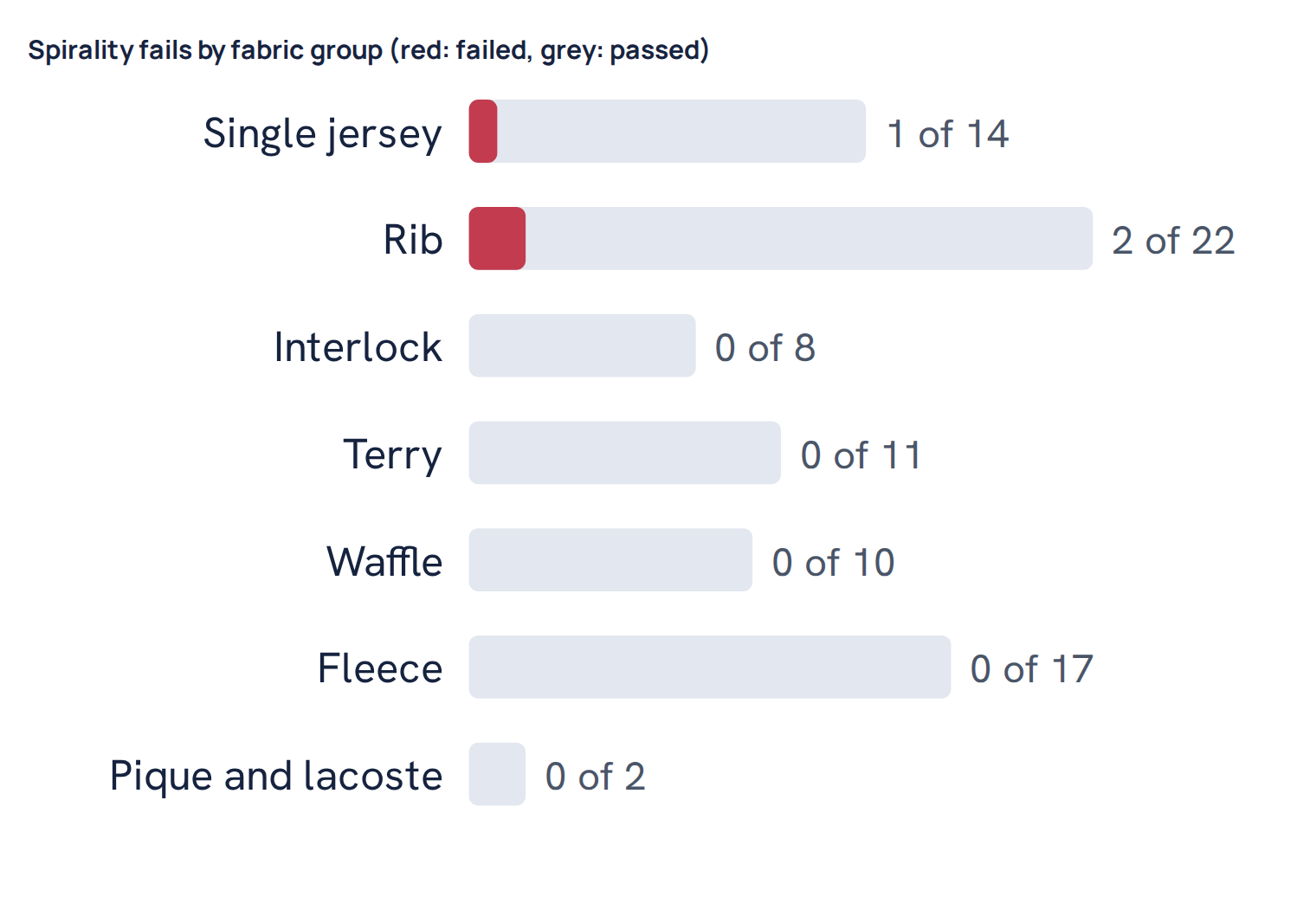
Spirality is rare. In 57 of 84 reports the lab measured 0%: rib, interlock, waffle and most double-knit fabrics are balanced and do not twist. It belongs to single-faced fabrics and to rib knitted from twist-lively single yarn.
It grows with every wash
Where the lab tested after one and five washes, spirality rose by 1.3 points on average. A fabric that is just inside the limit after one wash can be outside it after five, so a single-wash pass is not proof.
How to read each case
Each case shows the fabric as it was knitted, the route it took through dyeing and finishing, the spirality on the factory tumble test and in the lab, and the cause and remedy.
Single jersey: 1 case
Single jersey is dyed as a tube turned inside out unless it is heat set or singed; then it is slit, processed open width and back sewn before dyeing.
Case 1: Yarn-dyed single jersey, 150 GSM, 6.7% against 4%
- Yarn: 34/1 cotton mélange + 34/1 cotton
- Fibre (declared): 100% Cotton
- Stitch length: 30.2
- Machine: 36″ × 20G
- Required: 180 cm, 150 GSM
- Finished: 172 cm, 150 GSM
Lab test: ISO 16322-2; Normal cycle 40°C machine wash, tumble dry, 1 wash
Route: Greige → Slitting → Singeing → Back sewing → Dyeing → Stenter → Compacting
Results
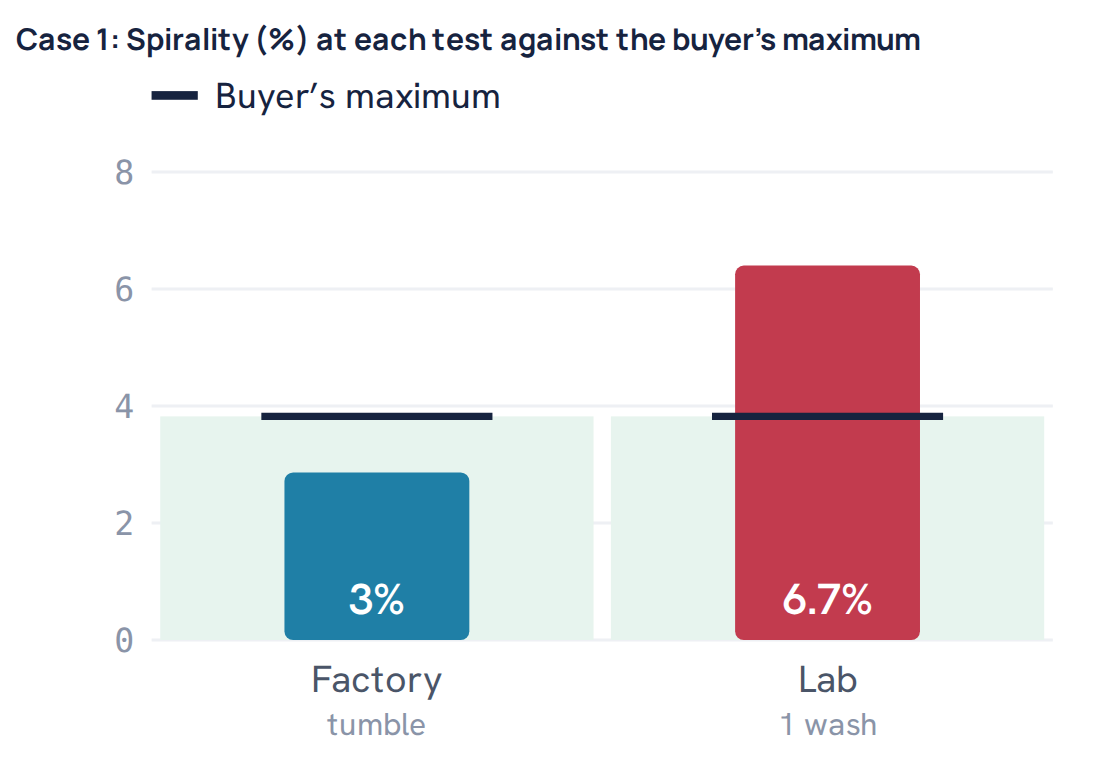
- Factory tumble: 3%
- Lab, 1 wash: 6.7%
- Maximum: 4%
Other tests that failed in the same lab report: Shrinkage, GSM.
Cause and remedy
Cause: The fabric is knitted from single (not plied) yarn. The twist in the yarn creates torque, and the torque turns the wales into a spiral once the fabric relaxes in washing.
Cause: The buyer’s test uses tumble drying, which relaxes the fabric fully and shows the most spirality.
Cause: It was finished 8 cm narrower than required (172 against 180). Changing the width up or down in finishing distorts the wale line and adds to spirality.
Cause: Improper finishing, with the width taken up and down, also lets the twist show.
Remedy: Balance the torque: use S- and Z-twist yarn on alternate feeders, or a plied yarn.
Remedy: Finish open width on the stenter with the wale line properly controlled, at the required width.
Remedy: Check spirality on a factory wash with the buyer’s drying method before delivery; the quick tumble figure on our sheet did not show this fail.
Rib: 2 cases
Rib is a stable double knit. It is heat set only when heavy, tight, Lycra body rib or a design rib that needs its width fixed.
Case 2: Slub design rib, 230 GSM, 5.8% against 4%
- Yarn: 22/1 cotton slub
- Fibre (declared): 100% Cotton
- Stitch length: 23+27
- Machine: 36″ × 20G
- Required: 155 cm, 230 GSM
- Finished: 155 cm, 226 GSM
Lab test: ISO 16322-2; Machine wash 40°C, line dry, 1 wash
Route: Greige → Dyeing → Stenter → Compacting
Results
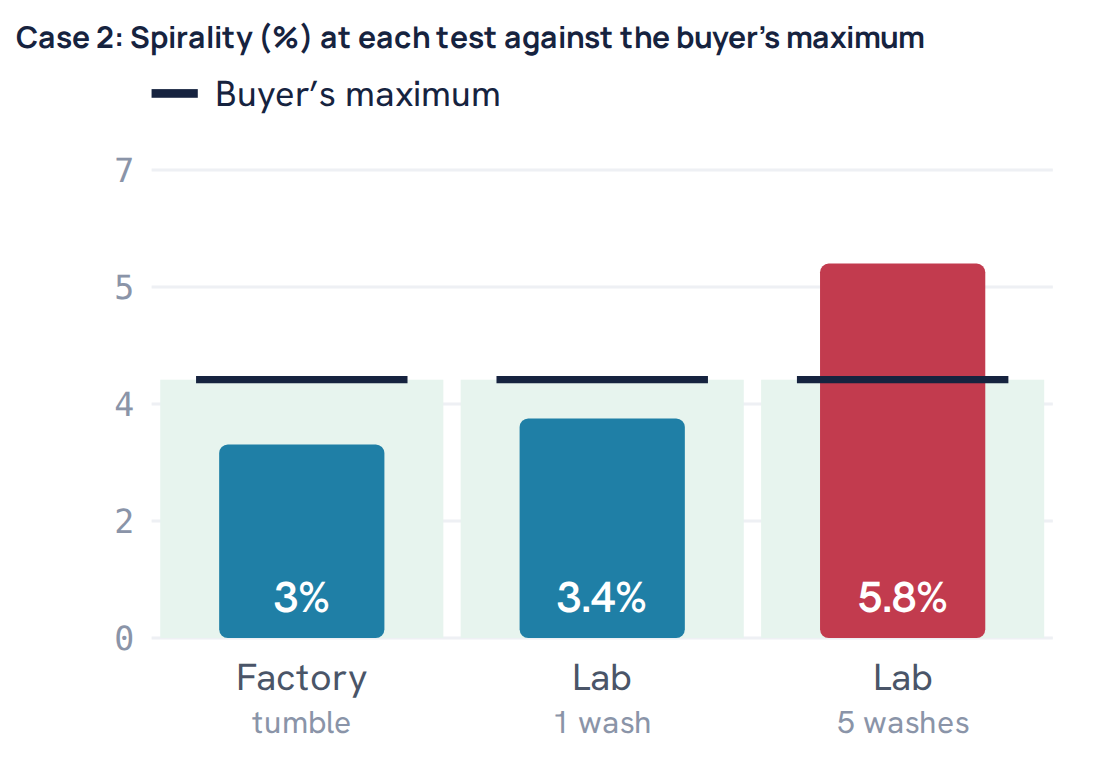
- Factory tumble: 3%
- Lab, 1 wash: 3.4%
- Lab, 5 washes: 5.8%
- Maximum: 4%
Other tests that failed in the same lab report: Shrinkage, GSM.
Cause and remedy
Cause: The fabric is knitted from single (not plied) yarn. The twist in the yarn creates torque, and the torque turns the wales into a spiral once the fabric relaxes in washing.
Cause: Slub yarn has uneven twist along its length, which makes the twist-liveliness worse.
Cause: Spirality grew with washing: 3.4% after one wash, 5.8% after five. The fabric had not reached its relaxed state when it was finished.
Cause: Improper finishing, with the width taken up and down, also lets the twist show.
Remedy: Balance the torque: use S- and Z-twist yarn on alternate feeders, or a plied yarn.
Remedy: Finish open width on the stenter with the wale line properly controlled, at the required width.
Remedy: Check spirality on a factory wash with the buyer’s drying method before delivery; the quick tumble figure on our sheet did not show this fail.
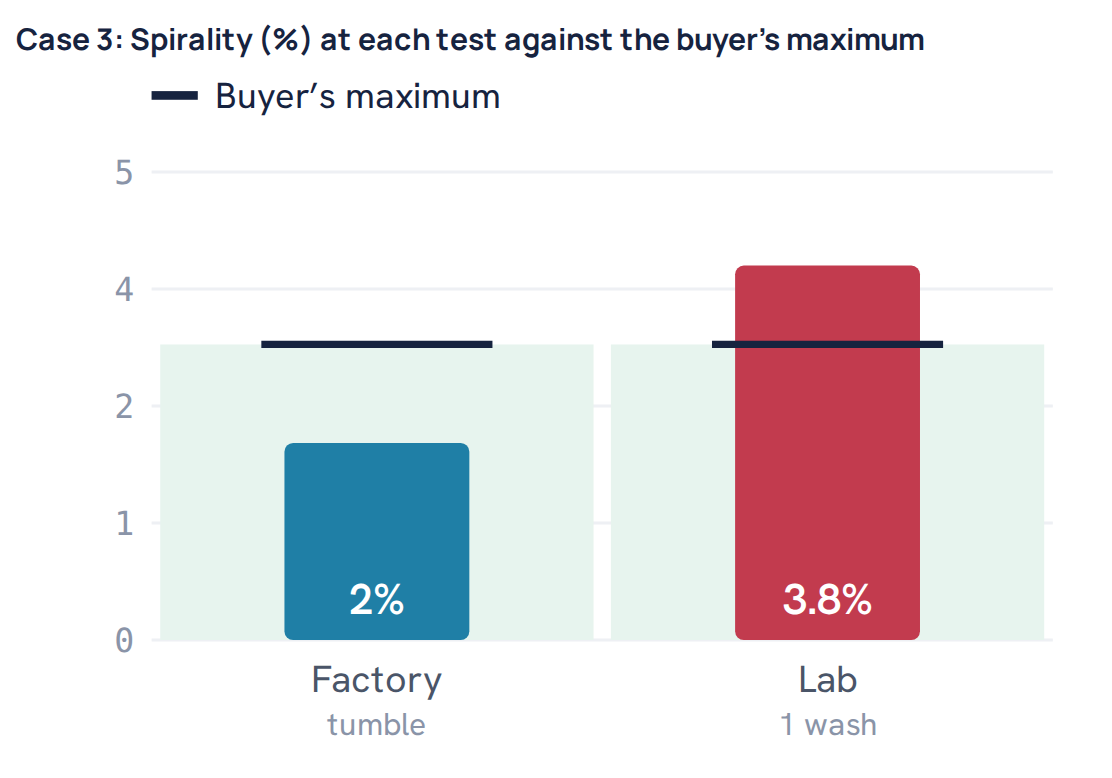
Case 3: Flat back rib, 260 GSM, 3.8% against 3%
- Yarn: 26/1 combed
- Fibre (declared): 95% Cotton 5% Elastane
- Stitch length: 28.5+23.0
- Machine: 34″ × 18G
- Required: 150 cm, 260 GSM
- Finished: 151 cm, 276 GSM
Lab test: ISO 16322-2; Normal program, 40°C, line dry, one wash
Route: Greige → Slitting → Singeing → Back sewing → Dyeing → Stenter → Compacting
Results
- Factory tumble: 2%
- Lab, 1 wash: 3.8%
- Maximum: 3%
Other tests that failed in the same lab report: Shrinkage.
Cause and remedy
Cause: The fabric is knitted from single (not plied) yarn. The twist in the yarn creates torque, and the torque turns the wales into a spiral once the fabric relaxes in washing.
Cause: It contains elastane but was not heat set, so nothing fixed the loop shape before dyeing.
Cause: Improper finishing, with the width taken up and down, also lets the twist show.
Remedy: Balance the torque: use S- and Z-twist yarn on alternate feeders, or a plied yarn.
Remedy: Heat set elastane fabric before dyeing to fix the structure.
Remedy: Finish open width on the stenter with the wale line properly controlled, at the required width.
Remedy: Check spirality on a factory wash with the buyer’s drying method before delivery; the quick tumble figure on our sheet did not show this fail.
From the floor: what I learned from these 3 cases
- Spirality comes from the yarn twist. The twist creates torque, and the torque gives spirality.
- Improper finishing makes it worse: when the width is taken up and down, plus or minus, spirality gets worse.
- The remedy is alternate S- and Z-twist yarn on the knitting machine, and finishing open width on the stenter with the wale line properly controlled. Then there is no problem.
Questions
What spirality is acceptable in knit fabric?
Most buyers allow up to 4% after washing; some ask for 3% or less.
Why does single jersey twist after washing?
The twist in a single yarn wants to untwist, and in a single-faced fabric that pulls the wales sideways when the fabric relaxes.
How do you reduce spirality?
Use S- and Z-twist yarn on alternate feeders, or a plied yarn, and finish open width on the stenter with the wale line controlled and the width kept at the requirement.
Related: shrinkage and GSM after wash calculator.

Textile engineer with 14+ years in dyeing and fabric development. He writes every guide on Dyeing Solution from real production work. Full profile