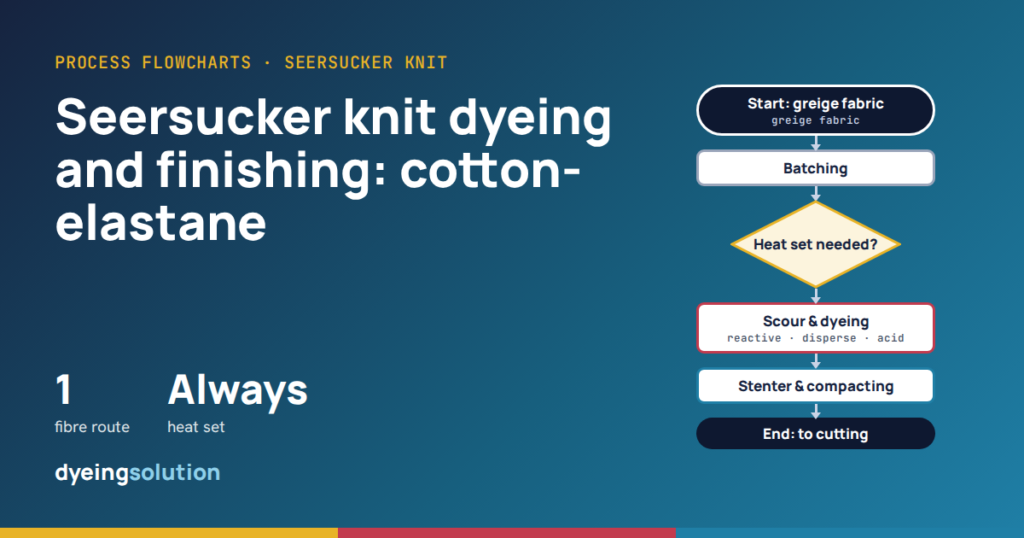
Knit seersucker has puckered stripes, and in our records it is cotton with elastane, heat set before dyeing. Here is the route from greige fabric to the cutting table.
At a glance
Cotton + LycraFibre in our records
AlwaysHeat set
PuckersMust survive finishing
Seersucker knit has stripes that pucker against flat stripes. On a knit the effect comes from the structure or from elastane in some courses and not others, which makes those stripes gather. It is used for summer tops and dresses.
This is a rare fabric in our records, so this article gives the route and the rules rather than statistics.
How it is dyed
Cotton-elastane seersucker follows the cotton-elastane route: heat setting first, a cooler scour at 80°C to protect the elastane, and reactive dyeing at 60°C. The puckers are the design, so the width at heat setting and on the stenter must leave them visible.
The puckering is protected by controlled heat setting and gentle finishing: do not overstretch on the stenter or over-compact.
Set the width to the approved finished width from the buyer’s measurement or spec. There is no single universal width for seersucker.
The sequence before the dyeing machine
Every chart below follows the same sequence before dyeing. Steps a fabric does not need simply drop out; they are drawn dashed.
- Greige inspection, then batching. A fabric that stays a tube is turned inside out here.
- If it needs heat setting, singeing or mercerising: slitting first. None of these is ever done on a tube.
- If it needs heat setting: heat setting in open width.
- If it needs singeing: singeing in open width, after checking the flame cannot damage the fabric.
- If it is mercerised: mercerising, then drying.
- If the fabric was opened: back sewing, to make it a tube again with the face side inside (the loop side, for terry).
- Loading into the dyeing machine, then scouring, bleaching and dyeing, single part or double part as the fibre needs.
Flowchart
Cotton-elastane seersucker knit
Full fibre process: Cotton-elastane dyeing process.
Dyeing and finishing: Cotton-elastane seersucker knit
Common faults and buyer complaints
Puckers flatten. Reduce stenter and compactor tension.
Uneven puckering. Control yarn and Lycra tension in knitting.
Width and shrinkage. Control heat setting and the stenter.
Crease marks. Gentle handling.
GSM variation. Control stitch length and finishing.

Textile engineer with 14+ years in dyeing and fabric development. He writes every guide on Dyeing Solution from real production work. Full profile