When a batch is uneven and cannot be corrected by topping, the dye has to come off. Here is the stripping process from our floor: the main stripping bath at 98°C, the reducing bath adjusted for dark, light and viscose fabrics, and what to check before redyeing.
At a glance
98°C × 50Stripping bath
100°CReducing bath
3 variantsDark, light, viscose
98°C × 40Mandatory scour after
Stripping is the last resort for a batch that is off shade, uneven or patchy and cannot be brought right with a topping addition. Reactive dye is bonded to the cotton, so it does not simply wash out: the stripping bath has to break down the dye with alkali, heat and a stripping agent, and a reducing bath with hydrose removes what is left. It costs time, water and fabric strength, so it is done once, properly, and followed by a check before the fabric is redyed.
The route for stripping
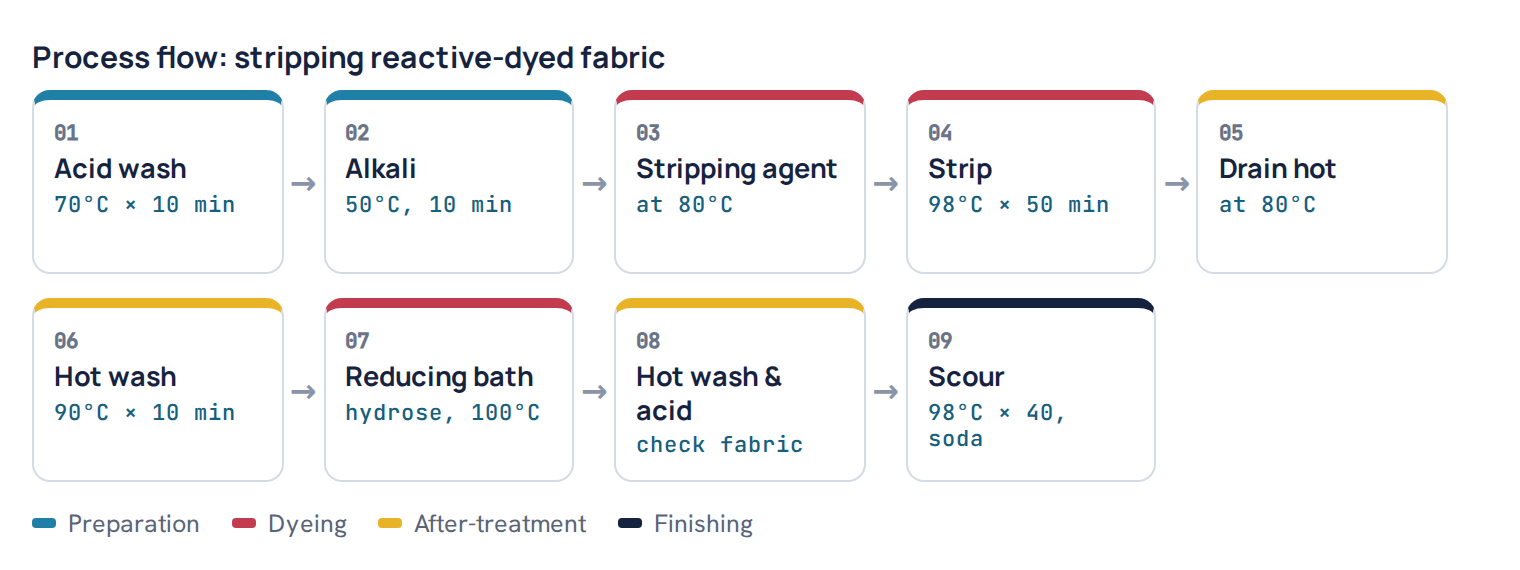
- Load the fabric. Acid wash with a wetting agent at 70°C for 10 minutes, then drain.
- Fill and heat to 50°C. Dose the caustic or soda over 10 minutes and run 5 minutes.
- Heat to 80°C and inject the stripping agent (5 g/L).
- Run 98°C × 50 minutes.
- Cool to 80°C and drain directly.
- Normal hot at 90°C for 10 minutes, drain, and give one normal wash.
- Reducing bath, adjusted by shade (below).
- Check the fabric, acid, and then scour at 98°C × 40 minutes with soda ash and peroxide before redyeing. This scour is mandatory.
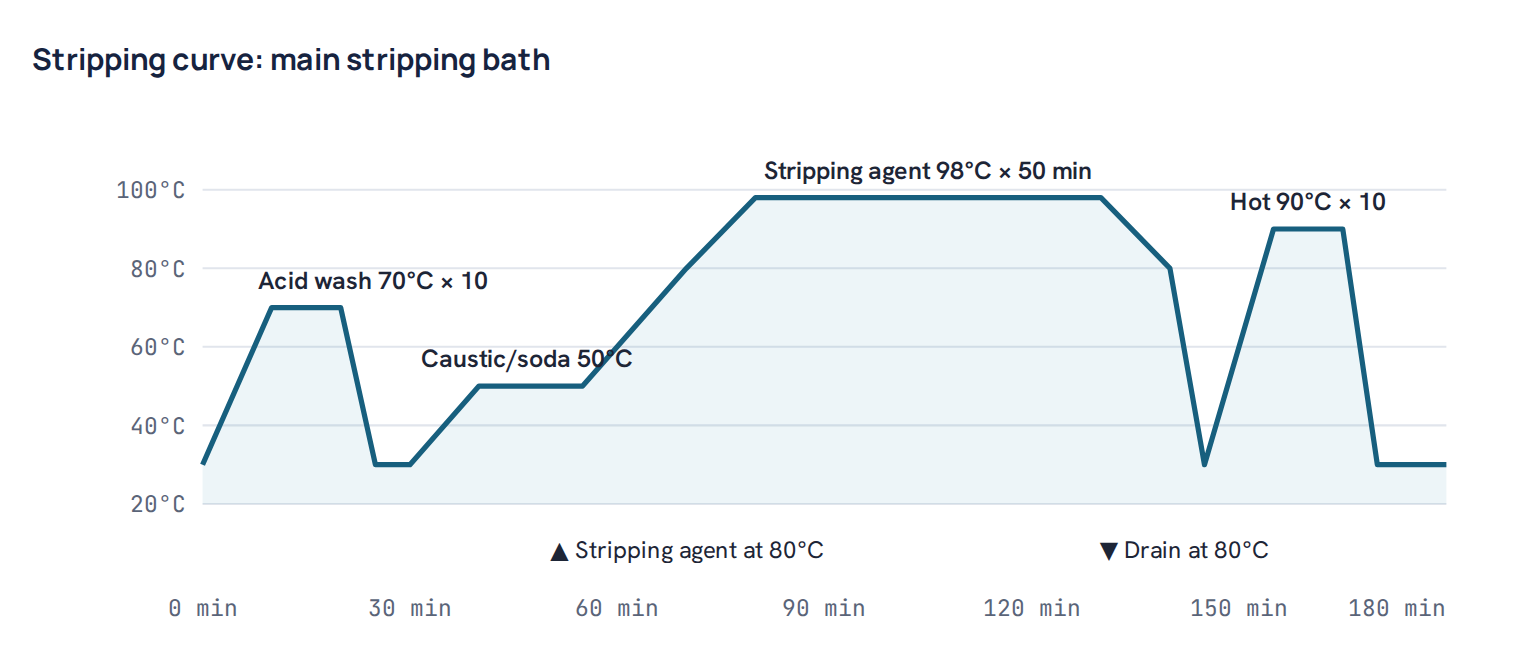
Tip: drain directly from 80°C after the stripping bath. Letting the bath cool further gives the stripped dye a chance to go back onto the fabric.
The reducing bath by shade
After the main stripping bath, a second bath with hydrose (sodium hydrosulphite) removes the rest of the colour. It starts with an acid wash and wetting agent at 70°C, and the chemicals change with the shade and the fibre:
| Dark, turquoise and bright blue (ocean-type) shades | Light shades | Viscose and modal | |
|---|---|---|---|
| Salt | 14 g/L | 10 g/L | 10 g/L |
| Alkali | Caustic 2.8 g/L | Caustic 2.8 g/L | Soda ash 10 g/L |
| First run | 100°C × 20 min | 100°C × 20 min | 100°C × 20 min |
| Reducing bath (after cooling to 75°C) | Soda 4 g/L + hydrose 10 g/L | Hydrose 12 g/L | Hydrose 10 g/L |
| Second run | 100°C × 50 min | 100°C × 30 min | 100°C × 50 min |
| Finish | Cool 75°C, drain, hot wash, acid | Same | Same |
Viscose and modal get soda ash instead of caustic, the same gentler alkali used in their scour. Light shades need only a 30-minute reducing run; dark, turquoise and bright blue shades need 50 minutes.
- The bright blue and ocean-type colours are special, difficult colours, so they get the strongest reducing bath with the dark and turquoise shades.
- On these colours, testing shows the stripping brings back evenness, but the colour does not come off completely.
After stripping
- Cool to 75°C and drain.
- Normal hot wash, then acid.
- Check the fabric: colour removed, even, and strength still acceptable.
- Scour at 98°C for 40 minutes with soda ash (4 g/L) and hydrogen peroxide (2.5 g/L), then redye.
- After stripping, a scour at 98°C for 40 minutes is mandatory in every stripping process. It is what gives the evenness.
- We use soda ash in this scour, not caustic. The fabric has already seen caustic in the dyeing and peroxide in the first scour, so soda keeps the strength from being damaged.
Stripping with a multifunctional reducing agent
Instead of the stripping-agent route above, the colour can also be stripped with a multifunctional reducing agent: an acid wash at 70°C, pH 4.5 at 60°C, the reducing agent at 60°C for 10 minutes, then 90°C for 50 minutes (heating and cooling at 2°C per minute), a cool to 78°C, drain, a hot wash and a soda scour.
- Stripping is only for cotton. Nylon and polyester are never stripped.
- Nylon is dyed with acid dyes and polyester with disperse dyes; these colours will not come off with a reducing agent.
Limitations of stripping
- Strength loss. The fabric’s physical strength can fall.
- Damaged loops. Especially on fleece, the loops can be damaged.
- Not a full colour removal on difficult colours. On bright blue and ocean-type shades the evenness comes back but some colour stays.
- Stripping is done to remove unevenness.
- After stripping, physical strength can fall and loops can be damaged, especially on fleece. Apart from that there are no other problems.

Textile engineer with 14+ years in dyeing and fabric development. He writes every guide on Dyeing Solution from real production work. Full profile