Lyocell is dyed with the same reactive dyes as cotton, but almost every step is gentler and slower. Here is the process we run, why each step is different from cotton, and what lyocell looks like at delivery.
At a glance
70–80°CScour-bleach (cotton: 98°C)
10 / 20 / 70Salt and soda in three portions
Anti-creaseIn every wet stage
Enzyme lastAfter dyeing, not before
Lyocell is a regenerated cellulose fibre, so it takes the same reactive dyes as cotton. The difference is how it behaves wet. It swells strongly, it creases easily in the rope, and its surface fibrillates, splitting into fine hairs when it is rubbed wet. Every change in the lyocell process is there to protect the fabric from those three things.
The route for 100% lyocell
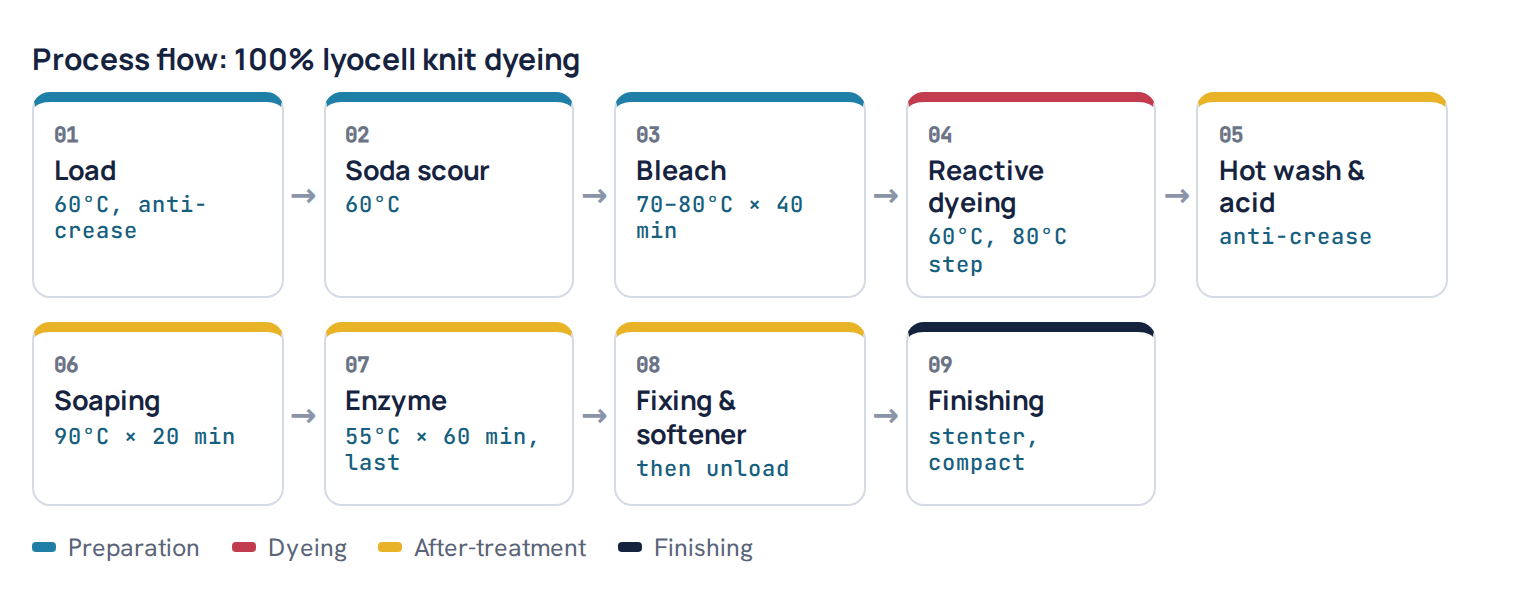
- Loading: at 60°C, with wetting and anti-crease agents already in the bath
- Scouring: soda ash at 60°C for 20 minutes
- Bleaching: peroxide at 70–80°C for 40 minutes
- Reactive dyeing: colour in two halves, salt and soda in three portions
- Wash-off: anti-crease hot washes, acid, soaping at 90°C
- Enzyme: 1% at 55°C for 60 minutes, after dyeing
- Finishing: stenter and compactor
Pretreatment: soda at 60°C, bleach at 70–80°C
The fabric is loaded at 60°C into a bath that already holds a wetting agent and an anti-crease agent (2 g/L each), and runs 5 minutes. A scouring agent and soda ash (2 g/L) are dosed over 5 minutes, and the bath runs at 60°C for 20 minutes.
The bath then goes to 70–80°C. A detergent and hydrogen peroxide (1 g/L) are dosed over 5 minutes, and it runs 40 minutes. After draining, the fabric gets a hot wash at 70°C for 10 minutes and an acid rinse with a peroxide killer.
Compare that with 100% cotton: 98°C for 60 minutes with 2 g/L caustic and 2.5 g/L peroxide. Lyocell gets a lower temperature, soda ash instead of caustic, and less than half the peroxide.
Common fault: treating lyocell like cotton in pretreatment. A hot, strong alkaline scour on lyocell gives crease marks and a hairy, fibrillated surface that no later step can remove.
Soda at 60°C is best for lyocell, and 80°C is best for the scour. We use 70–80°C instead of 98°C because lyocell is a regenerated cellulose fibre. It comes out of regeneration already very white. Cotton is the opposite: it has a dull shade and a lot of natural colour, which is why cotton needs 98°C. Lyocell is white to begin with, so there is no need to go to 98°C. 80°C is enough.
The dyeing curve
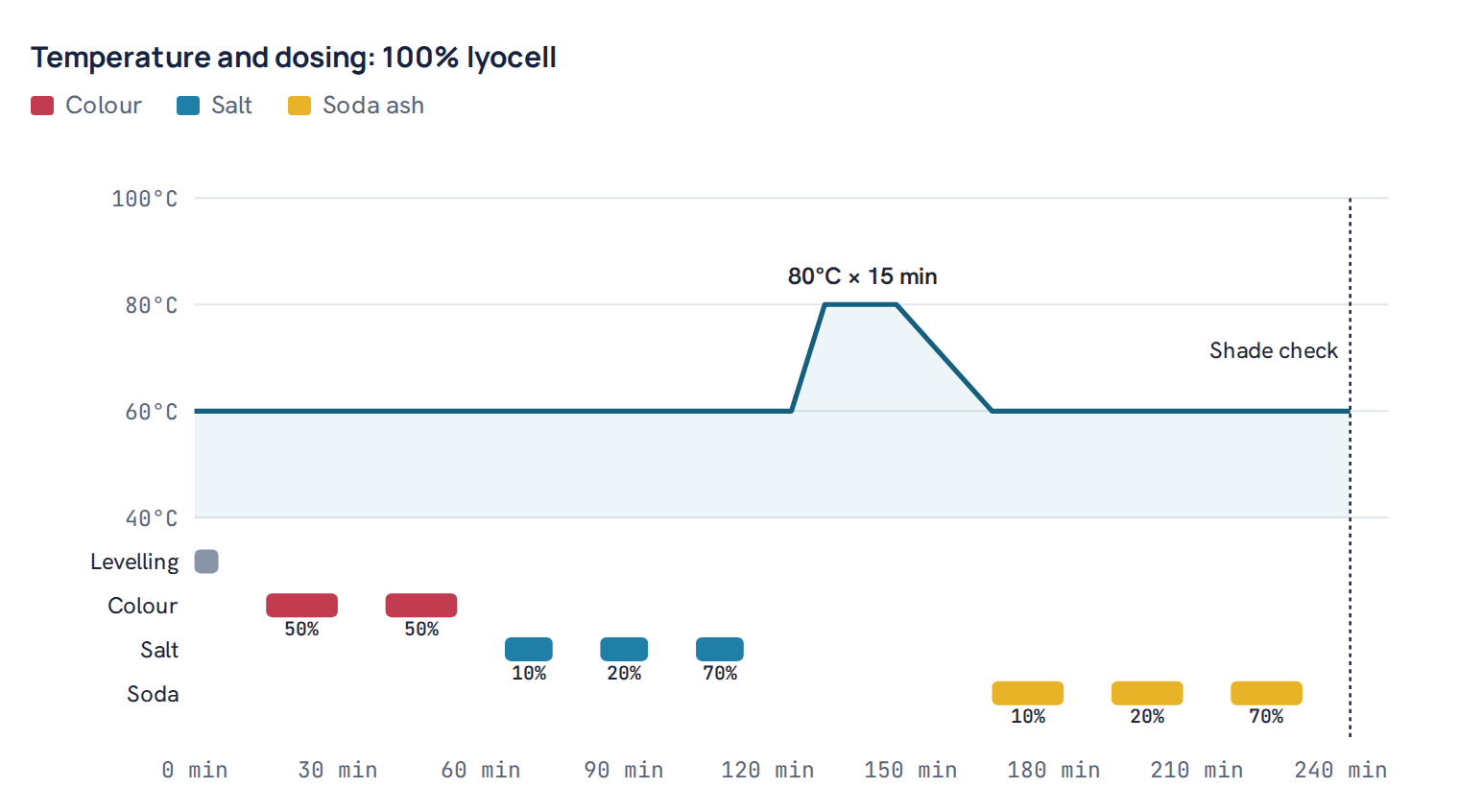
Everything in the lyocell curve is split into smaller steps. Lyocell takes up reactive dye faster than cotton, so the colour, the salt and the soda all go in slowly and in portions.
Step by step
- At 60°C, dose the levelling agent over 5 minutes and run 10 minutes.
- Dose half the colour over 15 minutes, run 10 minutes, then the second half over 15 minutes and run 10 minutes.
- Dose the salt in three portions of 10%, 20% and 70%, each over 10 minutes with 10 minutes of run time after it.
- Heat to 80°C and run 15 minutes, then cool back to 60°C.
- Dose the soda ash in three portions of 10%, 20% and 70%, each over 15 minutes with 10 minutes of run time after it.
- Check the shade.
Tip: the 10/20/70 split means the first two portions only start the reaction. The dye gets time to spread evenly before the big 70% portion drives most of the fixation.
Our general curve for all regenerated fibres (lyocell, viscose and modal) is close to this one, with the salt in three equal thirds at 80°C and the soda in three steps of 0.5 g/L, 1 g/L and the rest.
Wash-off and the enzyme at the end
- Drop the bath and wash.
- Two hot washes at 60°C for 10 minutes with the anti-crease agent in the bath.
- Acid at 60°C for 20 minutes.
- Soaping at 90°C for 20 minutes.
- Enzyme, 1%, at 55°C for 60 minutes.
- Fixing and softener, then unload.
On cotton the enzyme comes before dyeing. On lyocell it comes last.
In dyeing, lyocell goes through a lot of mechanical action: reel speed, pump speed, friction. Rubbing again and again makes it hairy. If we do the enzyme first, the dyeing makes it hairy again. So we do the enzyme at the very last stage, after soaping. Then just fixing and softener, and the fabric is unloaded. That is the best way.
What lyocell looks like at delivery
Lyocell is the hardest fibre in our finishing records. In our GSM and shrinkage study, lyocell blends had the lowest share of parts within GSM tolerance of any fibre family. 100% lyocell on its own is even more extreme:
| Fabric | Batches | Median finished GSM vs required | Within ±5% | More than 5% light | Median length shrinkage | Worst 10% length | Washed GSM vs required | Light parts fixed by washing |
|---|---|---|---|---|---|---|---|---|
| 100% lyocell | 27 | −19.0% | 0% | 100% | 9% | 15% | −3.3% | 48% |
| Lyocell + elastane | 96 | −7.8% | 11% | 86% | 8% | 12% | +3.9% | 57% |
Every one of the 27 plain lyocell batches finished more than 5% light, with a median of 19% under the required GSM, and even after washing the median stayed below target. Adding elastane helps a lot: lyocell-elastane is heat set in almost every case, and the heat setting holds the structure.
27 plain lyocell batches is a small sample; read the first row with care.
Limitations of 100% lyocell and how to handle them
- Shade variation. The main problem. Lyocell cannot take many topping additions, so a 100% accurate shade is hard to deliver. Get the recipe right from the lab and dose slowly, so the first shade is close.
- Unevenness. More likely than on cotton. The split colour dosing and the 10/20/70 salt and soda are there to control it.
- Friction marks. Marks that look like salt spots, caused by friction in the rope. Keep the anti-crease agent in every wet stage.
- Hairiness. Removed by the enzyme at the very end.
- Very light GSM and high length shrinkage. Heat set before dyeing where possible, fix the construction in knitting, and plan compaction for 8–9% length shrinkage.
The common complaint on lyocell is shade variation. You cannot do many topping additions on it, so the shade varies and we cannot give 100% accurate shading. Unevenness is also more likely. Lyocell often gets friction marks, which look like salt spots. Strength is fine; that is not the problem.

Textile engineer with 14+ years in dyeing and fabric development. He writes every guide on Dyeing Solution from real production work. Full profile