Lyocell is a strong, smooth fibre made from wood pulp in a closed-loop process. What it is made of, whether it is natural, plastic or toxic, lyocell vs cotton, viscose and modal, and how it shrinks, from our records.
At a glance
Wood pulpclosed-loop process
7%median length shrinkage
17%within GSM tolerance
300lyocell-blend batches
Lyocell is a soft, strong fibre made from wood pulp dissolved in a recyclable solvent. Like viscose and modal, it is regenerated cellulose: natural raw material, re-formed into fibre in a factory. Lyocell is the strongest of the three, especially when wet, and it is known for a smooth, cool, silky handle, good drape and high moisture absorption. It is used in T-shirts, shirts, dresses, denim, bedding and underwear, often blended with cotton.
This guide explains what lyocell is made of, whether it is natural, plastic or toxic, lyocell versus cotton, viscose and modal, and how it behaves in dyeing and washing, with figures from our records of 300 lyocell-blend batches.
What is lyocell fabric made of?
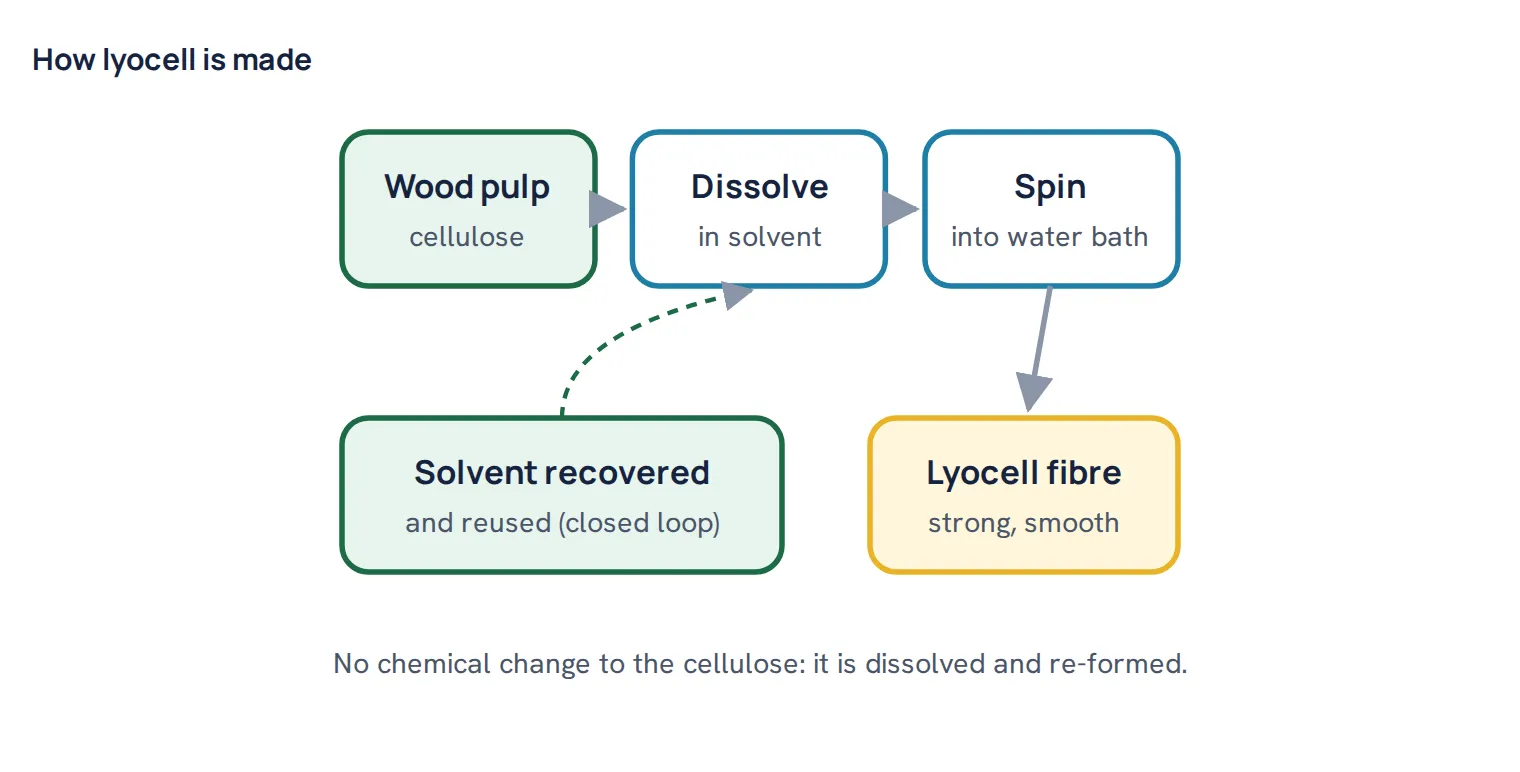
Lyocell starts as wood pulp, usually from eucalyptus, beech or other fast-growing trees. Instead of the chemical reaction used for viscose, the cellulose is dissolved directly in an organic solvent (N-methylmorpholine N-oxide, often shortened to NMMO). The solution is pushed through fine holes into a water bath, where the cellulose comes out as fibre, and the solvent is washed out and recovered for reuse. Because almost all the solvent goes round again, this is called a closed-loop process.
Is lyocell natural, synthetic or plastic?
Lyocell is not plastic. It is pure cellulose, the same material as cotton, and it is biodegradable under suitable conditions. Like viscose and modal it is called semi-synthetic or regenerated: the raw material is natural, the fibre is made in a factory.
Is lyocell fabric toxic?
The finished fibre is not considered toxic and is widely used for underwear and bedding. The solvent used to make it is far less hazardous than the carbon disulphide used for viscose, and it is recovered and reused. That is why lyocell is usually described as the cleaner of the wood-based fibres. Finishes added later, such as some softeners or easy-care resins, are a separate question for any fabric.
Lyocell vs cotton
| Point | Lyocell | Cotton |
|---|---|---|
| Feel | Smooth, cool, silky | Soft, matt |
| Drape | Fluid | Stiffer |
| Moisture | Absorbs a lot, feels cool | Absorbs well |
| Strength | High, also when wet | Good, stronger wet |
| Surface | Can fibrillate (go fuzzy) if rubbed wet | Stable |
| Shrinkage (our records) | Median 7% in length (blends) | Median 6% in length |
| Price | Higher | Lower |
Lyocell vs viscose and modal
All three come from wood. Viscose is the softest and cheapest but weak when wet; modal is a stronger, more stable viscose; lyocell is made by a different process and is the strongest, with the cleanest production. Lyocell’s special weakness is fibrillation: when wet fibres are rubbed, their surface splits into tiny hairs that look like a peach-skin haze or white streaks. Mills control this with gentle handling and enzyme treatment.
Does lyocell shrink?
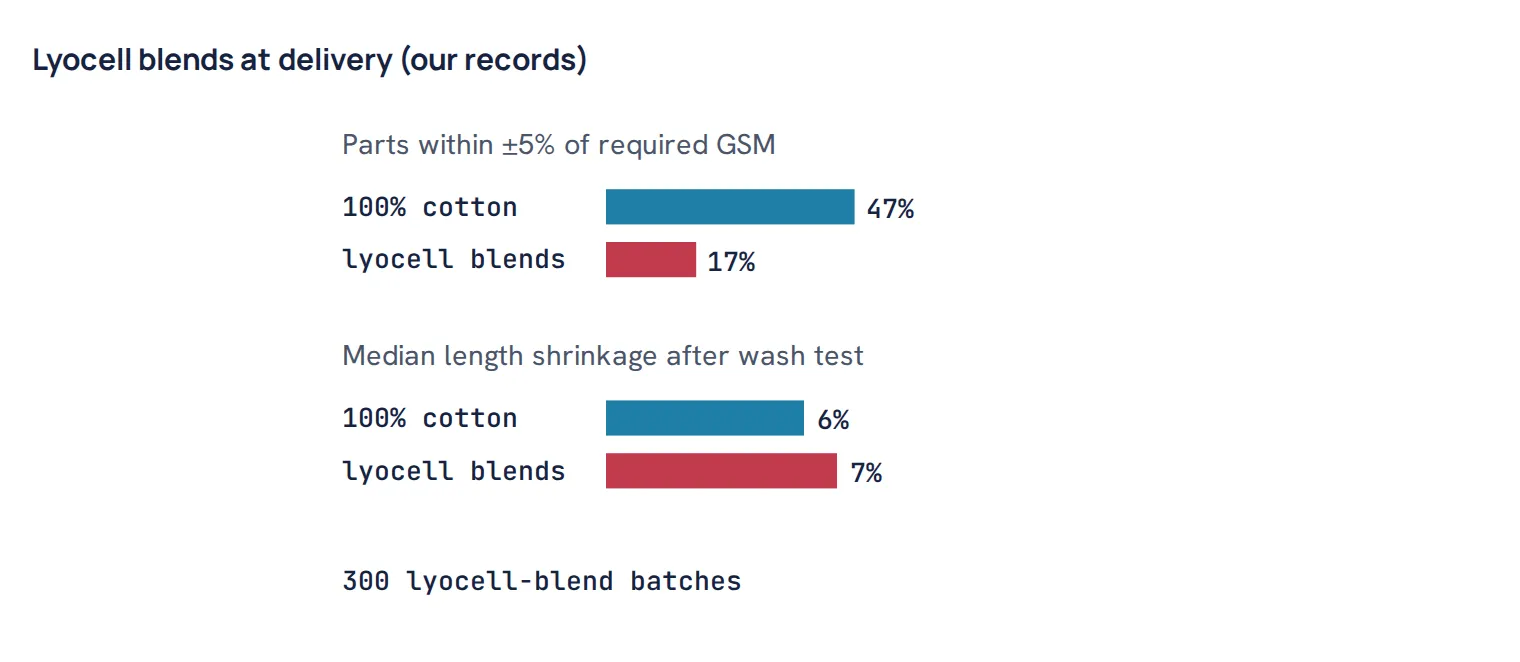
Yes, especially in knit blends. In our records of 300 lyocell-blend batches, the median length shrinkage after the wash test was 7%, and the worst tenth shrank 12% or more. Lyocell blends were the hardest of all fibre families to finish on weight: only 17% of parts finished within ±5% of the required GSM, with a median of 8.7% light. Only 32% kept length shrinkage within 5%. All fibres are compared in does fabric shrink after washing.
- Cotton-lyocell fabric is very loose and shrinks a lot, so it goes heavy as soon as it is washed. You cannot really control that in finishing.
- What helps is heat setting the fabric before dyeing starts. That brings it under some control. If you wait until finishing, it is too late.
- The real remedies are in development, before the fabric reaches the dye house: change the yarn count, or change the stitch length and knit the fabric a little tighter.
How lyocell is dyed
Lyocell takes the same reactive dyes as cotton. The differences are about protecting the wet fibre: a gentler scour at 60°C and bleach at 70–80°C instead of near-boiling, anti-crease agent in every wet stage because lyocell swells and creases easily in rope form, and the enzyme treatment after dyeing, not before, to remove the fibrillated surface. The full route is in the 100% lyocell knit dyeing process.
Common mistake: running lyocell fabric hot and fast in rope form like cotton. The swollen fibre creases and rubs, and the surface fibrillates into white streaks and a hazy look that does not come out. Gentle loading, anti-crease agent and controlled speed prevent most of it.
How to care for lyocell
- Wash at 30°C on a gentle cycle, inside out, to limit rubbing.
- Avoid overloading the machine; friction while wet causes fuzzing.
- Dry on a line or flat; low heat if tumble dried.
- Iron on medium heat while slightly damp.
Worked example. A brand wants a 50/50 cotton-lyocell T-shirt at 160 GSM. Our records show lyocell blends finishing a median 8.7% light and shrinking 7%, so the fabric is best knitted a little tighter at development stage and heat set before dyeing, rather than corrected on the compactor afterwards.
Summary
- Lyocell is regenerated cellulose from wood, made in a closed-loop solvent process.
- It is not plastic, and it is considered the cleanest of the wood-based fibres.
- It is stronger than viscose and modal, smooth, cool and absorbent, but can fibrillate.
- Lyocell blends shrank a median 7% in our records and were the hardest to finish on weight.
- Wash cool and gently, inside out, to keep the surface smooth.
Questions
What is lyocell fabric made of?
Wood pulp. The cellulose is dissolved in an organic solvent, spun into a water bath to re-form as fibre, and the solvent is recovered and reused.
Is lyocell toxic?
The finished fibre is not considered toxic. Its solvent is far less hazardous than the chemicals used for viscose and is recycled in a closed loop.
Is lyocell natural or synthetic?
Semi-synthetic: it is pure cellulose from wood, like cotton chemically, but the fibre is made in a factory. It is not plastic.
Is lyocell better than cotton?
It is smoother, cooler and drapes better, and absorbs more moisture. Cotton is cheaper, more stable and does not fibrillate. Blends combine the two.
Does lyocell shrink?
Yes. In our records lyocell-blend knits shrank a median 7% in length after washing, and the worst tenth shrank 12% or more.

Textile engineer with 14+ years in dyeing and fabric development. He writes every guide on Dyeing Solution from real production work. Full profile