Mercerized cotton is treated with strong caustic soda under tension, making each fibre round and smooth: more lustre, more strength and deeper colour. Mercerized yarn vs fabric, uses for thread and crochet yarn, and how it is dyed.
At a glance
Causticplus tension
Lustreround, smooth fibre
Deeperdyes more readily
95°Cmilder scour in our process
Mercerized cotton is cotton that has been treated with a strong caustic soda solution while held under tension. The treatment makes each cotton fibre swell and become rounder and smoother, so it reflects light better and looks lustrous, almost silky. It also becomes stronger and takes dye more readily, giving deeper, brighter colours. You find mercerized cotton in premium polo shirts and T-shirts, in crochet and embroidery threads, and in sewing thread.
This guide explains what mercerization does to the fibre, mercerized cotton yarn versus mercerized fabric, mercerized cotton versus ordinary cotton, what mercerized cotton thread and yarn are used for, and how mercerized knit fabric is dyed.
What mercerization does to cotton
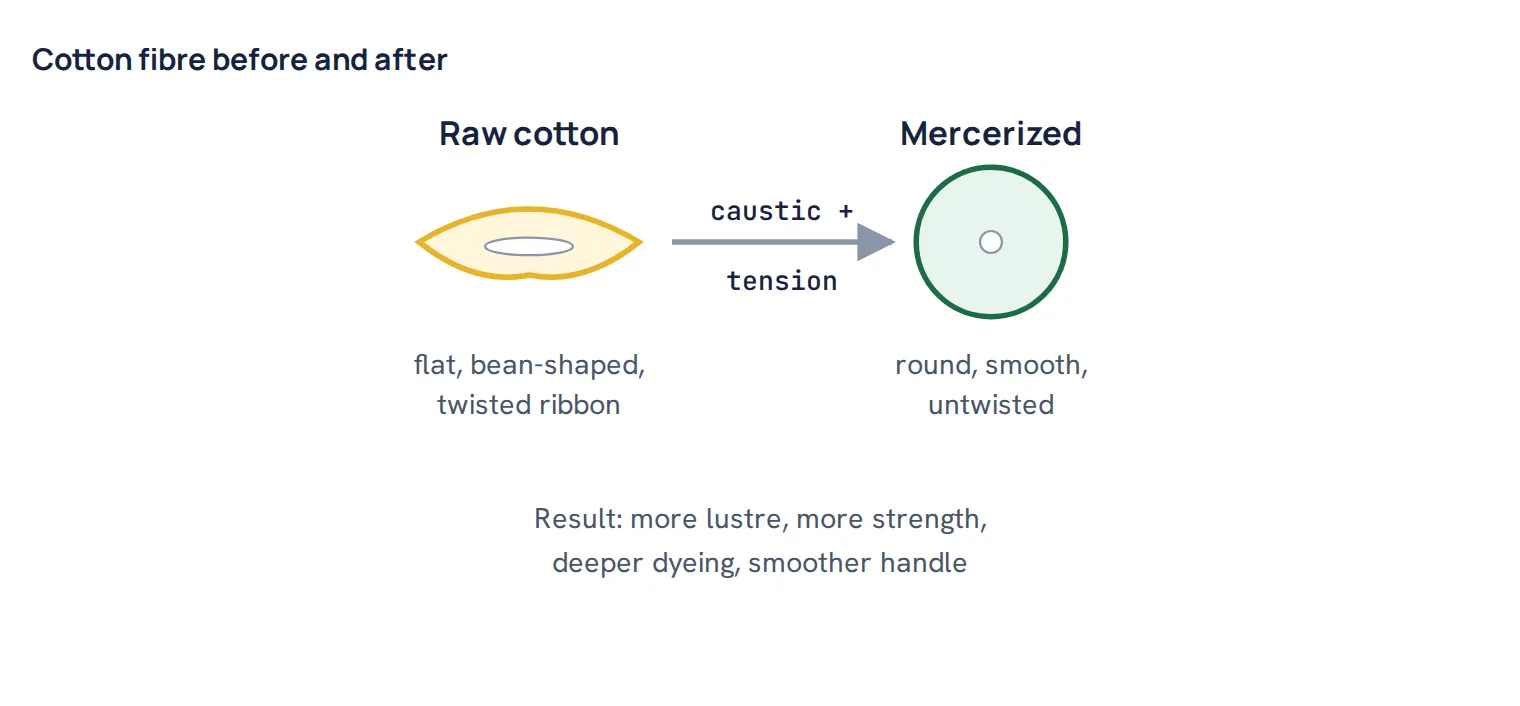
A raw cotton fibre is a flat, twisted ribbon with a bean-shaped cross-section and a hollow centre. When it is soaked in concentrated caustic soda, typically around 20–25%, the fibre swells strongly, the twists open out and the cross-section becomes rounder. If the yarn or fabric is held under tension while this happens, and then the caustic is washed out and neutralised, the fibre stays in its new, smooth, round shape. The process is named after John Mercer, who discovered the effect in the 1840s; the tension method that gives the lustre came later.
Mercerized cotton vs ordinary cotton
| Point | Mercerized cotton | Ordinary cotton |
|---|---|---|
| Look | Lustrous, slight sheen | Matt |
| Handle | Smooth, cool, crisp | Soft, slightly fuzzy |
| Strength | Higher | Normal |
| Dye uptake | Higher: deeper, brighter shades | Normal |
| Shrinkage | More stable | Normal |
| Fuzz and pilling | Lower, especially if singed | Higher |
| Cost | Higher | Lower |
Because mercerized cotton absorbs dye more readily, the same recipe gives a deeper shade than on ordinary cotton. Lab dips must be made on mercerized fabric, not on ordinary cotton, or the bulk shade will come out too dark.
Mercerized yarn vs mercerized fabric
Mercerization can be done at two stages:
- Yarn mercerization. The yarn is usually singed (gassed) to remove surface hair, then mercerized in hanks or on a continuous range under tension. This gives the highest lustre and is used for premium knit fabrics, crochet and embroidery threads. You will see it called “gassed mercerized cotton”.
- Fabric mercerization. Woven fabric is mercerized open width on a chain or chainless range; knit fabric is mercerized in tubular or open form on special machines. This improves lustre and dye uptake of the whole fabric.
What is mercerized cotton yarn and thread used for?
- Crochet and knitting yarn: crisp stitch definition, sheen and bright colours; ideal for lace, amigurumi, dishcloths and summer garments.
- Embroidery floss and sewing thread: stronger, smoother and more lustrous than plain cotton thread.
- Premium polo shirts and T-shirts: a smooth, cool, slightly shiny fabric that keeps its colour and shape.
- Shirting and fine woven fabrics: lustre and better dyeing.
For crochet and knitting, mercerized cotton yarn is less fuzzy and shows stitches clearly, but it is less soft and less elastic than unmercerized cotton.
How mercerized knit fabric is dyed
Mercerized cotton has already been through strong alkali, so it does not need the full 98°C scour that ordinary cotton gets. In our process for mercerized knit fabric, the scour-bleach runs at 95°C, there is no enzyme step, the dye goes in at 60°C, salt is added in three steps at 80°C and soda ash in three steps. Yarn-mercerized fabric gets a short acid treatment first. The full route is in the mercerised knit fabric dyeing process.
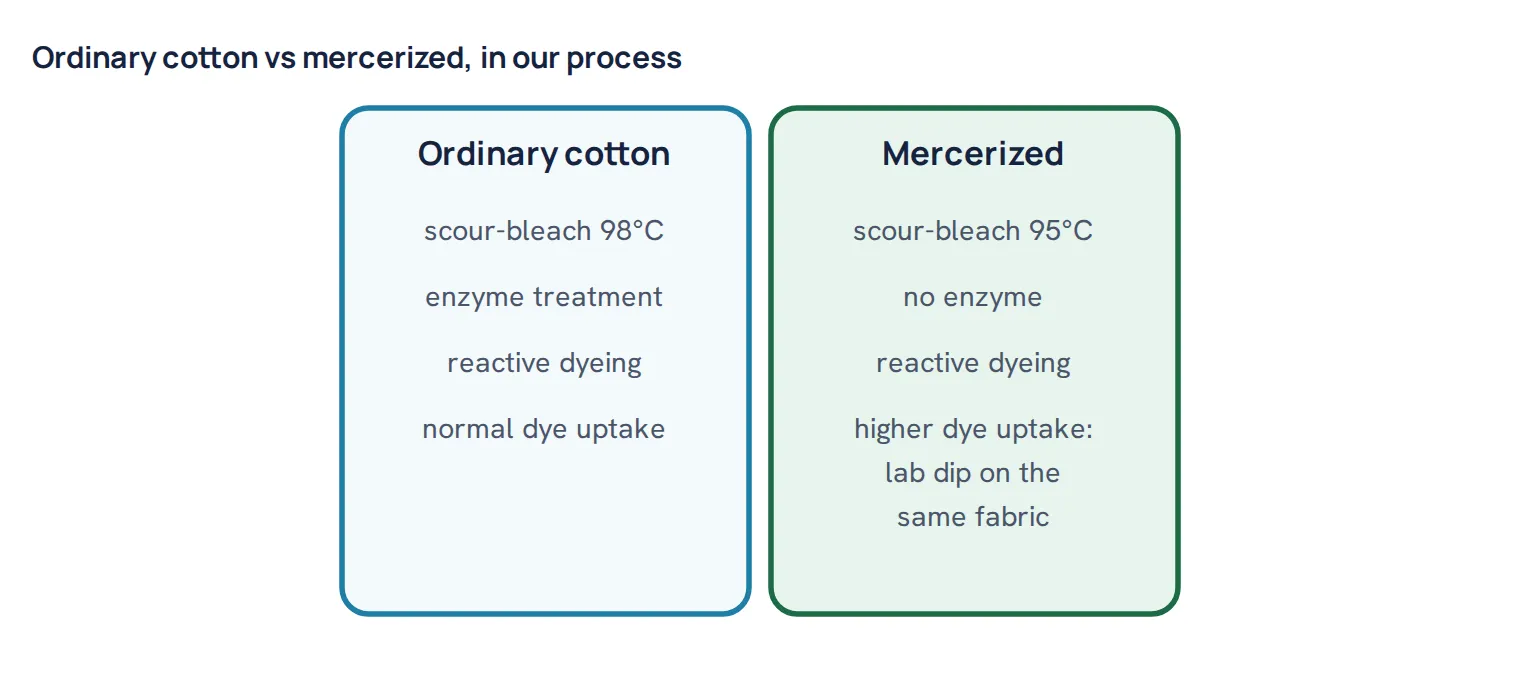
Common mistake: approving a lab dip on ordinary cotton and running it on mercerized fabric. The mercerized fabric takes up more dye, and the bulk comes out darker and brighter than the approved shade.
Can you get the mercerized look without mercerizing?
Partly. Singeing, a hot alkaline treatment, an enzyme treatment and finishing without softener can give ordinary cotton a cleaner, crisper surface with a little more lustre at lower cost. It does not match true mercerization for sheen or dye uptake. We describe this route in fake mercerised knit fabric.
Worked example. A buyer wants a navy polo with a slight sheen and a crisp hand. A gassed, mercerized 2-ply cotton yarn knitted into pique gives exactly that, with a deeper navy for the same dye. If the budget does not allow mercerized yarn, singed ordinary cotton with an enzyme finish and no softener gets part of the look.
Summary
- Mercerized cotton is treated with strong caustic soda under tension.
- Its fibres become round and smooth: more lustre, more strength, deeper dyeing.
- Yarn mercerization gives the most lustre; it is used for polo fabric, crochet yarn and thread.
- Mercerized knit gets a milder scour, no enzyme, and needs lab dips on the same fabric.
Questions
What is mercerized cotton?
It is cotton treated with concentrated caustic soda while under tension. The fibres swell into a rounder, smoother shape, giving more lustre, strength and dye uptake.
What is the difference between mercerized cotton and regular cotton?
Mercerized cotton is shinier, smoother, stronger and dyes deeper and brighter. Regular cotton is matt, softer and slightly fuzzy, and costs less.
What is mercerized cotton yarn used for?
Crochet and knitting where clear stitches and sheen matter, embroidery floss and sewing thread, and premium polo and T-shirt fabrics.
Is mercerized cotton good for clothing?
Yes. It gives a smooth, cool, lustrous fabric that keeps its colour and shape well, which is why it is used in premium polos and tees.
Does mercerized cotton shrink?
It is more dimensionally stable than ordinary cotton, so it usually shrinks less, though knit fabric can still relax a little after washing.

Textile engineer with 14+ years in dyeing and fabric development. He writes every guide on Dyeing Solution from real production work. Full profile