Rayon fibre is not elastic, but rayon fabric can stretch: woven rayon barely does, rayon jersey stretches easily, and rayon-spandex stretches and springs back. Why rayon grows when worn, how it compares with cotton and modal, and how to keep its shape.
At a glance
Wovenlittle stretch
Knitstretches
Spandexadds recovery
Weakwhen wet
Rayon itself is not a stretchy fibre, but rayon fabric can stretch depending on how it is made. A woven rayon such as challis or twill has very little stretch, except on the diagonal. A knitted rayon jersey stretches easily because of its looped structure. Rayon blended with spandex (elastane) stretches and springs back. The catch is recovery: plain rayon stretches out and does not fully return, especially when wet, which is why rayon garments can grow and bag at the knees, elbows and seat.
This guide explains how much rayon stretches and why, woven vs knit vs rayon-spandex, why rayon “grows” when worn and washed, how rayon compares with cotton, polyester and modal for stretch, how factories control it, and how to choose and care for rayon so it keeps its shape. It draws on how we process rayon (viscose) and viscose-elastane knits in the dye house.
Is rayon stretchy?
The short answer has three parts:
- The fibre: rayon fibre can extend a fair amount before it breaks, more when wet than dry, but it has poor elastic recovery. Pull it and it stays longer instead of snapping back.
- The fabric construction: woven fabrics barely stretch along the threads; knitted fabrics stretch through their loops. This is the biggest factor.
- Added elastane: a few percent of spandex gives rayon fabric real stretch and recovery, which plain rayon does not have.
So a rayon blouse may feel stiff along the grain, a rayon T-shirt will stretch comfortably, and a rayon-spandex dress will stretch and spring back.
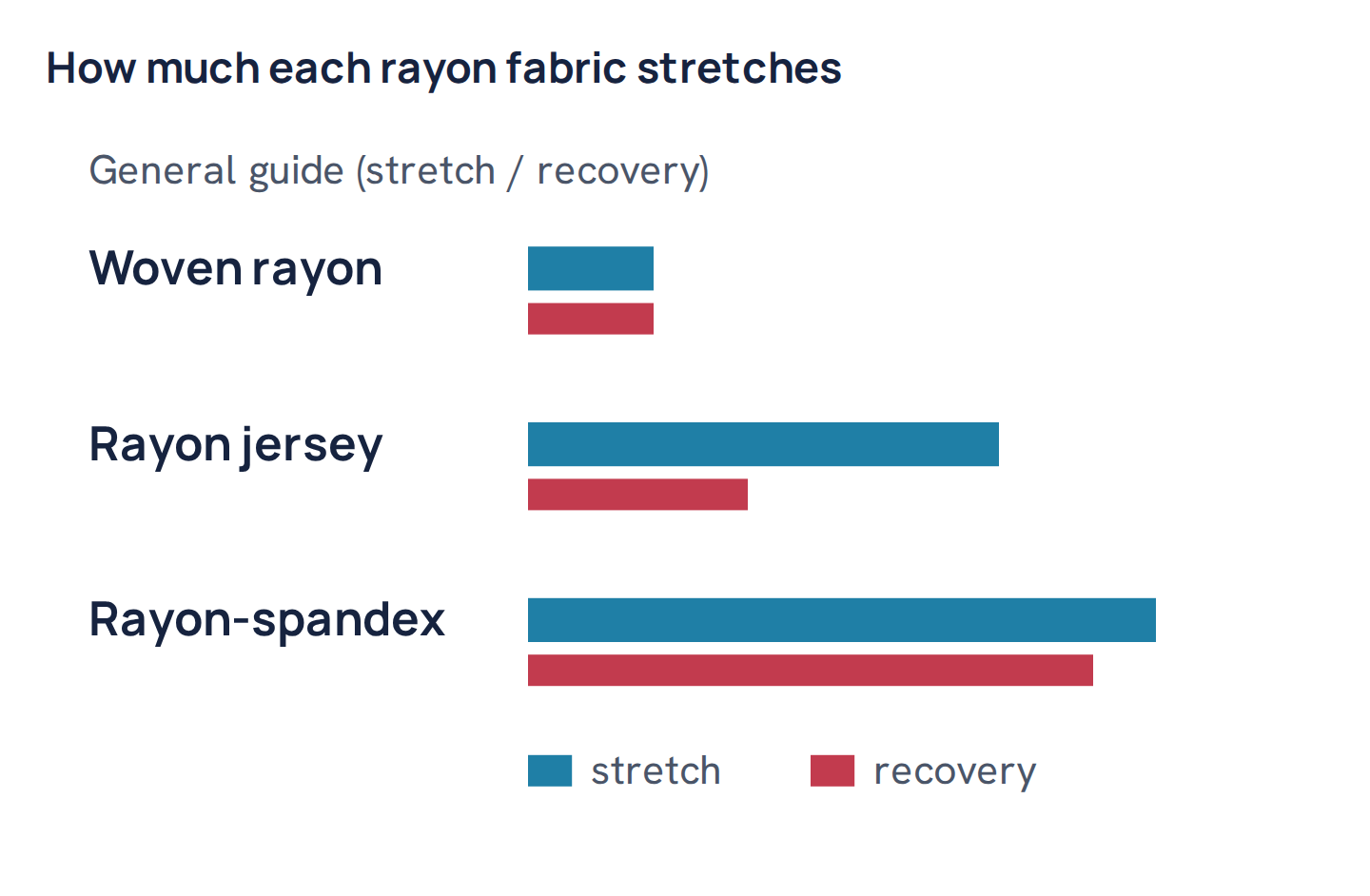
Woven rayon: little stretch
Most rayon dresses, blouses and Hawaiian shirts are woven: challis, crepe, twill or poplin. In a woven fabric the yarns run straight lengthwise and crosswise and interlace tightly, so the fabric hardly stretches along either direction. It does stretch on the bias, the 45° diagonal, which is why bias-cut rayon skirts drape and cling so well. A woven rayon garment fits by its cut, not by stretch, so choose your normal size and expect little give.
Rayon jersey: stretchy but slow to recover
Knitted rayon, usually single jersey, is made of rows of interlocking loops. Pull it and the loops open out, so the fabric stretches easily, especially across the width. Because rayon’s recovery is poor, the loops do not fully close again. A 100% rayon T-shirt or knit dress can feel lovely and fluid, but after a day of wear it may have grown slightly at the elbows or hem, and after washing it may have shrunk again. That cycle of growing when worn and shrinking when washed is typical of rayon knits.
Rayon-spandex: stretch with recovery
Most fitted rayon tops, dresses and leggings are rayon with 3–8% spandex. The elastane is a highly elastic fibre that stretches several times its length and snaps back, so it pulls the rayon back into shape after each stretch. Rayon-spandex gives the softness and drape of rayon with the fit of a stretch fabric. See what is elastane for how spandex works.
Spandex has its own limits: heat, chlorine and age weaken it. A rayon-spandex garment dried hot or worn for years slowly loses its snap and starts to behave more like plain rayon.
Why rayon stretches out when wet
Rayon is regenerated cellulose with a less ordered structure than cotton. When it gets wet, water gets between the cellulose chains, the fibre swells, and it loses a large part of its strength. In this weakened state the fibre extends easily under load and does not recover. That is why you should never hang a wet rayon garment from its shoulders on a thin hanger, wring it, or pull it into shape hard while wet. The weight of the water alone can stretch a knit rayon dress longer.
It is also why rayon shrinks so much in the wash. In our finishing records of 164 viscose knit batches, the median length shrinkage after the wash test was 9%, the highest of any common fibre. The fabric had been stretched during processing; water lets it relax back, and then it relaxes further. See does rayon shrink.
Rayon vs cotton, polyester and modal for stretch
| Fibre | Stretch in a plain knit | Recovery | Wet behaviour |
|---|---|---|---|
| Rayon (viscose) | Good | Poor | Weak, stretches out easily |
| Modal | Good | Fair | Stronger than rayon, holds shape better |
| Cotton | Good | Fair | Stronger when wet, bags less |
| Polyester | Good | Good | Unchanged when wet |
| Any of these + spandex | Very good | Very good | Depends on base fibre; spandex adds recovery |
If you love rayon’s drape but want a garment that keeps its shape, modal is the natural upgrade: it is made from the same family of fibres but holds much more strength when wet. See what is modal fabric.
Rayon stretch in common garments
- Rayon blouses and shirts (woven): little stretch; fit comes from the cut, so check shoulder and chest measurements.
- Rayon dresses (woven challis or crepe): drape and swing, but no real stretch except on the bias.
- Rayon T-shirts and knit tops: stretch easily and feel fluid; expect some growth during wear.
- Rayon-spandex dresses and tops: stretch and recover; the best choice for fitted styles.
- Rayon-nylon-spandex ponte: a stable, stretchy double knit for trousers and structured dresses; holds shape far better than single jersey.
- Rayon leggings: almost always with spandex; plain rayon leggings would bag at the knees within hours.
How factories control rayon stretch and growth
In the dye house, rayon and rayon-elastane need careful handling to stop them stretching during processing:
- Heat setting rayon-elastane before dyeing fixes the width and stretch of the elastane.
- Gentle wet processing: a milder scour and dyeing at about 60°C, with careful machine speed, because wet rayon is weak.
- Low tension drying: the fabric is dried with overfeed so it is not pulled long.
- Compacting: the fabric is pushed back in length to reduce later shrinkage.
- Wash testing: length, width and GSM are checked after a wash to see how far it relaxes.
Even with this care, viscose-elastane remains hard to finish exactly: in our process records heat setting brings its length shrinkage down to about 10%, but three out of four parts still finish light and relax later. The full route is in the viscose-elastane dyeing process.
Common mistake: buying a 100% rayon knit dress a size small because it “stretches”. It will stretch, but it will also grow in length with wear and shrink back unevenly in the wash. Buy rayon knits in your true size, and choose rayon-spandex if you want a close, stable fit.
How to stretch rayon that has shrunk
A rayon garment that shrank in the wash can often be eased back a little, because the fibre extends well when damp:
- Soak it in lukewarm water with a little hair conditioner for 15–20 minutes.
- Press the water out gently without wringing.
- Lay it flat on a towel and gently ease it to the size you want, working evenly.
- Let it dry flat, weighting the edges lightly if needed.
This works best on knits and recovers a few centimetres, not a full size. Woven rayon shrinkage is harder to reverse.
How to keep rayon from stretching out
- Wash cold on a gentle cycle, inside out, in a mesh bag for knits.
- Never wring; roll in a towel to remove water.
- Dry knits flat; hang woven rayon on a wide, padded hanger.
- Fold knit rayon instead of hanging it in the wardrobe.
- Rotate garments; give rayon a rest between wears so it can relax.
- Avoid hot dryers, which weaken spandex and make shrinkage worse.
Worked example. A 100% rayon jersey dress measures 100 cm long new. After a day’s wear it hangs about 2 cm longer; washed cold and dried flat, it comes back close to 95–97 cm, in line with the 9% median shrinkage in our viscose records when washed less carefully. The same dress in rayon with 5% spandex grows less during wear and keeps a more consistent length, because the elastane pulls it back.
Summary
- Rayon fibre extends but recovers poorly, especially when wet.
- Woven rayon has little stretch; rayon jersey stretches; rayon-spandex stretches and recovers.
- Rayon grows when worn and shrinks when washed: a median 9% in our knit records.
- Modal or rayon-spandex keeps shape better than plain rayon.
- Wash cold, never wring, dry flat, and buy rayon knits in your true size.
Questions
Is rayon stretchy?
Rayon fibre extends but has poor recovery. Woven rayon has little stretch, rayon jersey stretches through its loops, and rayon with spandex stretches and springs back.
Does rayon stretch out over time?
Yes. Plain rayon grows with wear, especially at knees, elbows and seat, because it recovers poorly. Washing then shrinks it back.
Does rayon stretch when wet?
Yes. Wet rayon loses much of its strength and stretches easily, so never wring it or hang it wet from the shoulders.
Is rayon spandex stretchy?
Yes. A few percent spandex gives rayon real stretch and recovery, which is why it is used for fitted tops, dresses and leggings.
Can you stretch rayon back after shrinking?
Partly. Soak it in lukewarm water with hair conditioner, press out the water, ease it to size and dry it flat. Knits recover better than woven rayon.

Textile engineer with 14+ years in dyeing and fabric development. He writes every guide on Dyeing Solution from real production work. Full profile