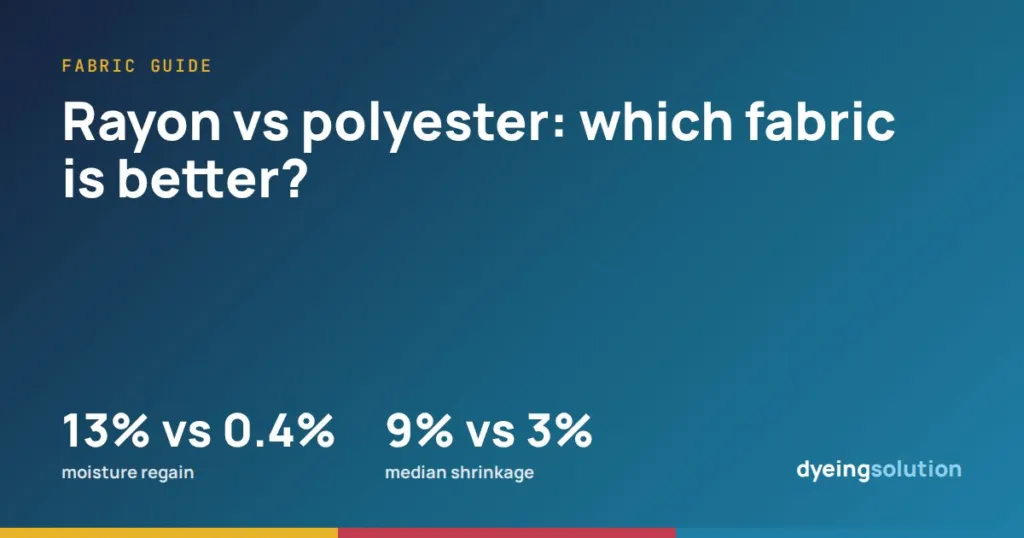
Rayon is more breathable, softer and cooler; polyester is stronger, dries faster and barely shrinks. Rayon vs polyester compared point by point, with shrinkage data from our finishing records, plus blends and which to choose for each garment.
At a glance
13% vs 0.4%moisture regain
9% vs 3%median shrinkage
Coolvs durable
Blendssplit the difference
Rayon is more breathable, softer and cooler than polyester; polyester is stronger, more durable, quicker drying and barely shrinks. The two often look alike on the hanger, both smooth and drapey, but they are opposite fibres. Rayon is regenerated cellulose made from wood, close to cotton in chemistry. Polyester is a synthetic polymer made from oil. That difference decides how each one feels, how it handles sweat, how it behaves in the wash and how long it lasts.
This guide compares rayon and polyester point by point: what they are, breathability, softness, durability, shrinkage, wrinkles, pilling, colour, care, cost and environmental impact, with figures from our dye-house finishing records. It also explains rayon-polyester blends and which fabric to choose for different garments.
What each fibre is
Rayon (viscose) is made by dissolving wood cellulose chemically and re-forming it as fibre. It is semi-synthetic: natural raw material, factory-made fibre. It absorbs water readily and is biodegradable under suitable conditions. See what is viscose fabric.
Polyester is a fully synthetic polymer, polyethylene terephthalate, made from petroleum chemicals and melted and spun into fibre. It absorbs almost no water, is very strong and stable, and does not biodegrade in normal conditions.
Rayon vs polyester at a glance
| Point | Rayon | Polyester |
|---|---|---|
| Raw material | Wood cellulose | Oil-based polymer |
| Moisture regain | About 13% | About 0.4% |
| Breathability in heat | High, feels cool | Low unless engineered for sport |
| Feel | Soft, silky, cool | Smooth, can feel slick or warm |
| Strength | Moderate dry, weak wet | High, wet or dry |
| Shrinkage (our knit records) | Median 9% in length | Median 3% in length |
| Wrinkles | Creases easily | Resists creasing |
| Drying | Slow | Fast |
| Static | Little | Can build static |
| Pilling | Low to moderate | Pills stay attached |
| Biodegradable | Yes, under suitable conditions | No |
Breathability and comfort
This is where rayon wins clearly. Rayon absorbs more moisture than cotton, so it takes up sweat from your skin and feels cool. Plain polyester absorbs almost nothing; in a hot, humid room a polyester blouse can trap sweat against the skin and feel clammy. Modern sports polyester uses shaped fibres and wicking finishes to move sweat along the surface and dry fast, which works well during exercise, but for everyday clothes in the heat most people find rayon more comfortable.
Shrinkage and stability
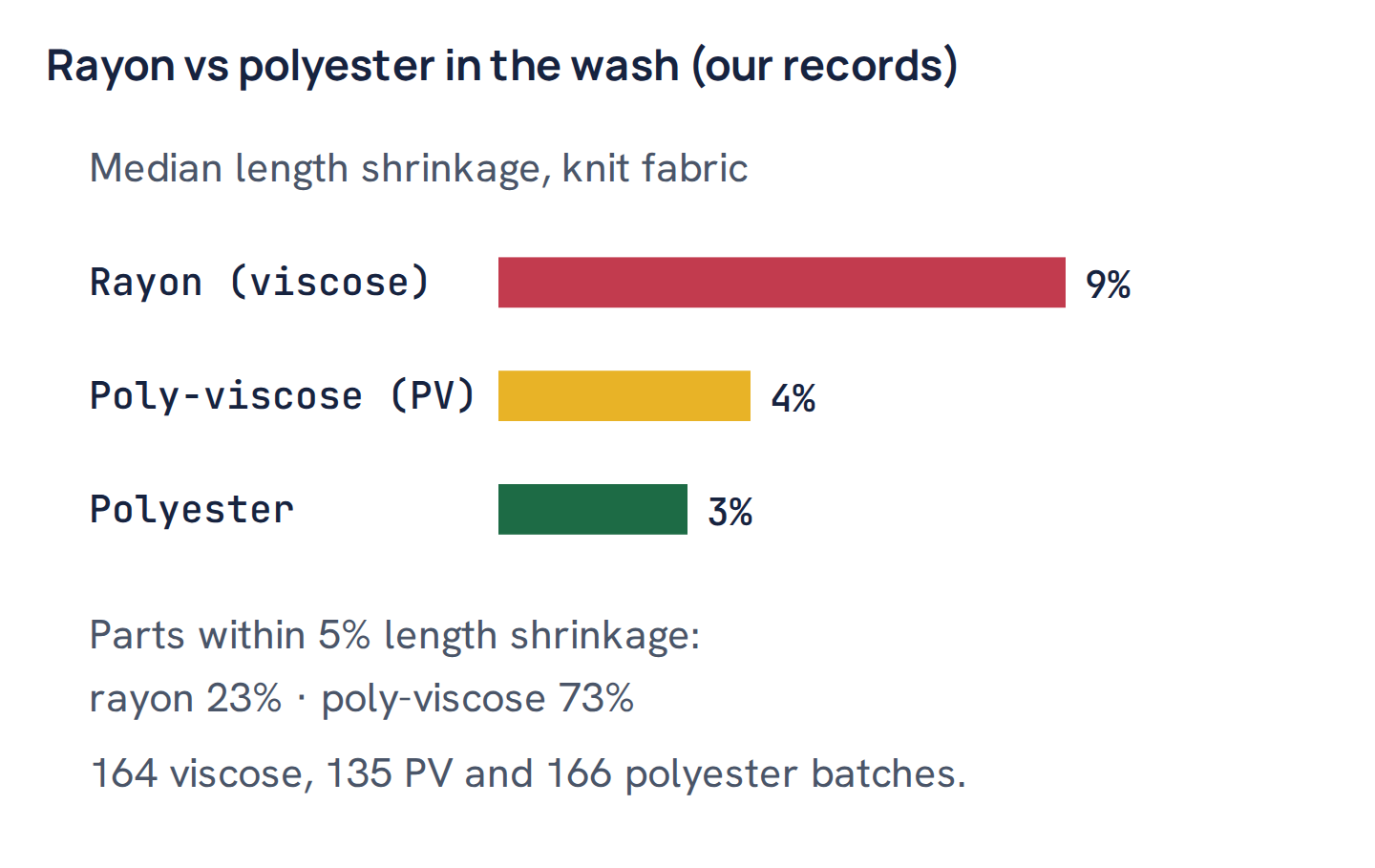
In our finishing records, 100% viscose knit shrank a median 9% in length after the wash test, the worst tenth 14% or more, and only 23% of parts stayed within a 5% shrinkage limit. Polyester knit shrank a median 3%. Polyester-viscose (PV) blends sat in between at a median 4%, with 73% of parts within the 5% limit, because the polyester holds the structure while the rayon relaxes. If a garment must keep an exact size, polyester or a PV blend is far safer than 100% rayon. See does rayon shrink and does polyester shrink.
Durability and care
Polyester is tougher. It keeps its strength when wet, resists abrasion, holds its shape, dries quickly and seldom needs ironing. Rayon loses a large part of its strength when wet, can stretch and distort, creases easily and needs cool, gentle washing. A polyester shirt can be thrown in a normal wash; a rayon shirt needs a gentle cycle and flat or hanging drying. For travel and easy care, polyester wins.
Pilling and appearance over time
Polyester’s strength has one downside: when the surface fuzzes and pills, the strong fibres hold the pills on, so a worn polyester knit can look bobbly. Rayon pills less and its pills tend to wear away, but rayon can lose its smooth appearance in other ways, such as distortion, shine at seams from ironing, and creasing. Rayon’s colours stay bright; polyester’s colours are also very fast once properly dyed and cleared.
Colour and dyeing
The two fibres need completely different dyes. Rayon takes reactive and direct dyes at around 60°C, the same family used for cotton, and gives brilliant shades. Polyester needs disperse dyes applied at about 130°C under pressure, followed by reduction clearing to remove surface dye. A rayon-polyester blend must be dyed with both dye classes, one for each fibre. That is why blends cost more to dye and why home dyes, which are made for cellulose, only colour the rayon part. See reactive vs disperse dye.
Rayon-polyester blends
Blending gives a fabric that drapes and breathes better than polyester and keeps its size and shape better than rayon. Common uses include T-shirts (often with cotton in a tri-blend), dress fabrics, suiting, school uniforms and linings. The more polyester, the more stable and the less breathable the fabric. A tri-blend of polyester, cotton and rayon is popular for soft, heathered T-shirts; see what is tri-blend.
Common mistake: treating a rayon dress like a polyester one because they look similar. A hot wash and tumble dry that a polyester dress survives can shrink a rayon dress by 10% or more in length and leave it twisted. Check the fibre content before washing.
Cost
Both fibres are inexpensive compared with silk, wool or premium cotton, which is why they dominate fast fashion. Plain polyester is usually the cheapest fabric to produce in volume and the cheapest to care for over the garment’s life, since it needs no ironing and little special handling. Rayon fabric is similar in price, sometimes a little higher, but rayon garments can cost more in practice because they need gentler washing and are more likely to be ruined by a careless wash. Modal and lyocell, the premium relatives of rayon, cost noticeably more than either.
Environmental impact
Neither is impact-free. Polyester is made from fossil fuel, sheds microfibres in the wash and does not biodegrade; recycled polyester reduces the use of new oil. Rayon comes from a renewable resource and biodegrades, but conventional viscose production uses chemicals that must be recovered and treated; standards vary a lot between producers. Modal and lyocell, made by better-controlled processes, are often considered the more responsible cellulose options.
How to tell rayon from polyester
If a label is missing or you are not sure, these checks help:
- Feel: rayon feels cool, soft and slightly heavy in the hand; polyester often feels smoother, slicker and a little warmer.
- The crush test: squeeze a corner in your fist for ten seconds. Rayon keeps deep creases; polyester springs back with few creases.
- The water drop: a drop of water soaks into rayon quickly; on polyester it sits longer before spreading, unless the fabric has a wicking finish.
- Static: polyester clings and crackles in dry weather; rayon rarely does.
- Burn behaviour (lab method): rayon burns like paper and leaves soft grey ash; polyester melts, shrinks from the flame and leaves a hard bead. This is how textile labs make a first check, but it is a fire hazard and should only be done on a tiny snipped sample, safely, if at all.
Labs confirm fibre content with standard chemical and microscopic tests, which also measure the blend percentages; see how fibre content is tested.
Rayon vs polyester for common garments
| Garment | Better choice | Why |
|---|---|---|
| Summer dress | Rayon | Cool, breathable, drapes beautifully |
| Running top | Polyester | Wicks and dries fast, holds shape when sweaty |
| Office blouse | Either, or a blend | Rayon for comfort, polyester for crease resistance |
| Travel shirt | Polyester or blend | Packs without creasing, dries overnight |
| Pyjamas | Rayon | Soft, cool, absorbs night sweat |
| Jacket lining | Rayon for comfort, polyester for price | Rayon breathes and does not cling |
Which should you choose?
- Hot, humid weather and casual wear: rayon, for comfort.
- Sportswear and heavy sweating: technical polyester, for fast drying.
- Travel and easy care: polyester or a rayon-polyester blend.
- Flowing dresses and soft blouses: rayon or a rayon-rich blend.
- Uniforms and workwear: polyester-rich blends, for durability and size stability.
- Linings: rayon breathes and does not cling; polyester is cheaper and tougher.
Worked example. Two summer blouses look the same. The 100% rayon one will feel cooler in the heat but must be washed cold and hung to dry, and it may shrink a little in length. The 100% polyester one will feel warmer and slightly clammy on a humid day but can go in a normal wash and come out wrinkle-free. A 65/35 rayon-polyester blouse would split the difference.
Summary
- Rayon is cellulose from wood; polyester is an oil-based synthetic.
- Rayon breathes, absorbs sweat and feels cool; polyester absorbs almost no moisture.
- Polyester is stronger, dries faster, wrinkles less and barely shrinks: a median 3% against 9% for rayon in our knit records.
- Blends combine rayon’s comfort with polyester’s stability.
- Choose rayon for comfort in heat, polyester for durability and easy care.
Questions
Is rayon better than polyester?
For comfort in warm weather, yes: rayon breathes and absorbs sweat. Polyester is better for durability, fast drying, wrinkle resistance and size stability.
Is rayon more breathable than polyester?
Yes. Rayon absorbs about 13% moisture against about 0.4% for polyester, so it takes sweat from the skin and feels cooler.
Does rayon shrink more than polyester?
Yes. In our knit records rayon shrank a median 9% in length and polyester 3%.
Is rayon a synthetic like polyester?
No. Rayon is semi-synthetic: it is made from natural wood cellulose. Polyester is fully synthetic, made from oil.
Why blend rayon and polyester?
The blend drapes and breathes better than polyester and keeps its size and shape better than rayon. Our poly-viscose records showed a median 4% shrinkage.

Textile engineer with 14+ years in dyeing and fabric development. He writes every guide on Dyeing Solution from real production work. Full profile