Poly cotton is a blend of polyester and cotton in one yarn: durable, easy care and shrink-resistant. Blend ratios, PC vs CVC, poly cotton vs cotton, how it is dyed, and what our finishing records show.
At a glance
65/35typical PC blend
4%median shrinkage
82%within 5% shrinkage
2 bathsto dye both fibres
Poly cotton is fabric made from a blend of polyester and cotton fibres, spun together into one yarn. It combines the softness and breathability of cotton with the strength, shape-holding and easy care of polyester. Poly cotton shrinks and wrinkles less than 100% cotton, dries faster and costs less, which is why it is used for T-shirts, polo shirts, uniforms, workwear, school wear, bed sheets and sweatshirts.
This guide explains what poly cotton is, the common blend ratios, poly cotton vs CVC and 100% cotton, how it is dyed, and what our finishing records show about how blends behave.
What is poly cotton made of?
Cotton is a natural plant fibre; polyester is a synthetic fibre made from oil. In poly cotton the two are mixed as staple fibres before spinning, so every yarn contains both. Common ratios are:
- 65/35 polyester/cotton (often called PC): more polyester, strongest and easiest care, used in workwear and uniforms.
- 50/50: an even balance, common in T-shirts and sweatshirts.
- 60/40 or 80/20 cotton/polyester (called CVC, “chief value cotton”): more cotton, softer, closer to a cotton feel. See what is CVC fabric.
Polyester-rich blends are labelled PC or poly-cotton; cotton-rich blends are usually labelled CVC. Both are poly cotton in the broad sense.
Poly cotton vs 100% cotton
| Point | Poly cotton | 100% cotton |
|---|---|---|
| Feel | Smooth, slightly less soft | Soft, natural |
| Breathability | Good, less than cotton | Very good |
| Shrinkage (our records) | Median 4% in length | Median 6% in length |
| Wrinkles | Fewer | More |
| Drying | Faster | Slower |
| Strength and durability | Higher | Good |
| Pilling | More likely (polyester holds pills) | Pills wear off |
| Price | Lower | Higher |
Why poly cotton holds its size
Cotton swells in water and shrinks back when the fabric relaxes; polyester hardly absorbs water and does not shrink in a normal wash. In a blend the polyester holds the loop structure, so the whole fabric moves much less. In our finishing records, cotton-polyester blends (CVC and PC) were the easiest fabrics to finish on target: 67% of parts finished within ±5% of the required GSM, against 47% for 100% cotton, and 82% kept length shrinkage within 5%, against 47% for cotton.
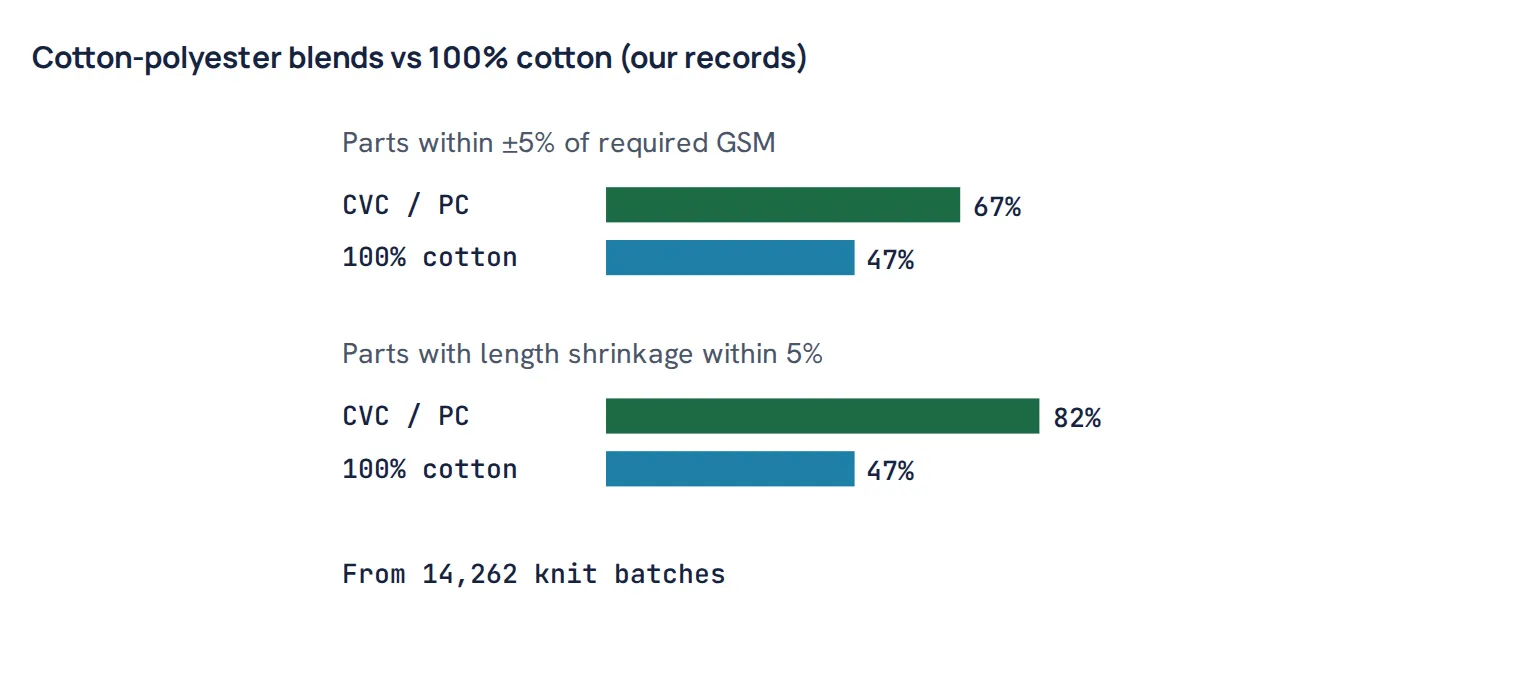
- Polyester has no shrink property. In a CVC or PC fabric the polyester holds the structure, so the fabric cannot shrink, and washing changes the GSM very little.
- That is why a light CVC batch stays light after washing. The wash is not the fix for it.
How poly cotton is dyed
Each fibre needs its own dye. Polyester takes disperse dye at about 130°C under pressure; cotton takes reactive dye at about 60°C with salt and alkali. So a solid-colour poly cotton is usually dyed in two baths, polyester first, then cotton, and the two shades must match each other. If only one part is dyed, the result is a two-tone or heather look. This is why blends are more expensive to dye than 100% cotton and why home dyes, which only colour the cotton, give poly cotton a paler shade; see reactive vs disperse dye.
Common mistake: expecting a wash to bring a light poly cotton batch up to weight. With 100% cotton the fabric shrinks in the wash and the GSM rises, but the polyester in a blend stops it shrinking. In our records light CVC and PC parts gained only about 8% in the wash and 35% were still light afterwards. The fix is in knitting, not finishing.
Is poly cotton good?
For everyday clothes that are washed often and need to keep their size and colour, poly cotton is a very good, practical choice: uniforms, school wear, workwear, sports tees and bed sheets. For maximum softness, breathability in heat, or sensitive skin, 100% cotton is usually preferred. The main downside of blends is pilling, because the strong polyester fibres hold pills on the surface instead of letting them wear off; see why clothes pill.
How to care for poly cotton
- Wash at 30–40°C; it tolerates frequent washing well.
- Tumble dry on low or line dry; it dries quickly.
- Iron on a medium setting if needed; it wrinkles less than cotton.
- Wash inside out to reduce pilling.
Worked example. A school uniform supplier wants polo shirts that keep their size after many hot washes. A 65/35 PC or 60/40 CVC pique will shrink and wrinkle far less than 100% cotton, and in our records blends kept length shrinkage within 5% in 82% of parts. The trade-off is a slightly less soft feel and a higher pilling risk, which a compact or combed cotton component and an anti-pilling finish can reduce.
Summary
- Poly cotton is a blend of polyester and cotton spun into one yarn.
- PC means polyester-rich (for example 65/35); CVC means cotton-rich (for example 60/40).
- It shrinks and wrinkles less than cotton: in our records 82% of blend parts stayed within 5% shrinkage.
- It is dyed in two baths, disperse for polyester and reactive for cotton.
- It is durable and easy care, but less breathable than cotton and more prone to pilling.
Adding rayon: a polyester-cotton-rayon blend gives a softer, drapier shirt; see what is tri-blend.
Questions
What is poly cotton?
A fabric made from polyester and cotton fibres blended in the same yarn, combining cotton’s comfort with polyester’s strength and easy care.
What is the difference between poly cotton and CVC?
Both are cotton-polyester blends. PC or poly-cotton usually means polyester-rich, such as 65/35; CVC means cotton-rich, such as 60/40.
Does poly cotton shrink?
Much less than cotton. In our records cotton-polyester blends had a median length shrinkage of 4%, and 82% of parts stayed within 5%.
Is poly cotton breathable?
Yes, but less than 100% cotton, because polyester absorbs little moisture. Cotton-rich blends breathe better than polyester-rich ones.
Does poly cotton pill?
It can pill more than cotton, because strong polyester fibres hold pills on the surface. Washing inside out and good yarn quality help.

Textile engineer with 14+ years in dyeing and fabric development. He writes every guide on Dyeing Solution from real production work. Full profile