
Pills form when surface fibres rub up and tangle; polyester holds them on. Why fleece, terry and sweatpants pill most, what our lab reports show, how factories reduce pilling, and how to stop pilling on sweatpants at home.
At a glance
7%pilling fails, 266 results
9 of 16fleece/terry fails at 2,000 rubs
Polyesterholds pills on
Inside outeasiest home fix
Sweatpants, joggers, hoodies and fleece pill because their soft, hairy surface is made for comfort, and that same surface is easy to rub into small balls of fibre. Pills form where the fabric rubs most: between the thighs, at the seat, on the cuffs and under bag straps. Blends with polyester often look worse, because polyester fibres are too strong to break, so the pills stay attached instead of falling away. You cannot make a fleece pill-proof at home, but you can slow pilling down a lot, and factories can prevent much of it before the fabric is sold.
This guide explains how pills form, why fleece and loop-back fabrics are the worst offenders, what our lab reports show, how factories reduce pilling and how to stop pilling on sweatpants and track pants at home.
How a pill forms
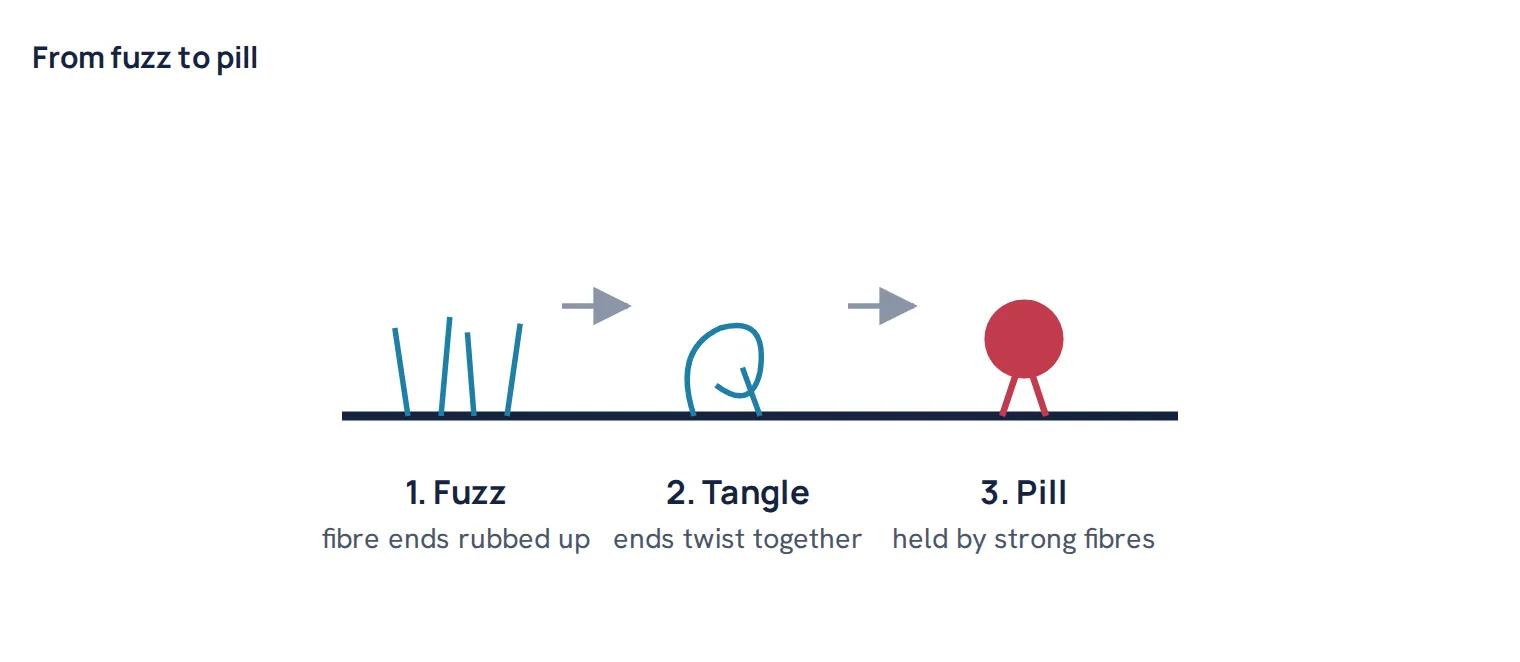
Pilling happens in three stages. First, rubbing pulls loose fibre ends to the surface, forming fuzz. Second, the fuzz tangles into small balls. Third, the balls either break off or, if the anchoring fibres are strong, stay attached and collect more fibre. Cotton fibres are relatively weak, so cotton pills tend to wear off; polyester fibres are strong, so polyester and CVC pills stay on and become very visible.
Why fleece and sweatpants pill so much
- Brushed or looped surface. Fleece is brushed to raise a soft pile; French terry has open loops on the back. Both put lots of loose fibre on the surface, ready to tangle.
- Coarse, soft loop yarn. The loop yarn in fleece and terry is usually coarse and lightly twisted to make it soft and bulky, so its fibres pull out easily.
- Polyester content. CVC fleece is popular because it is warm and stable, but the polyester anchors the pills.
- Constant rubbing. Inner thighs, seat and cuffs of sweatpants are rubbed with every step and every sit.
What our lab reports show
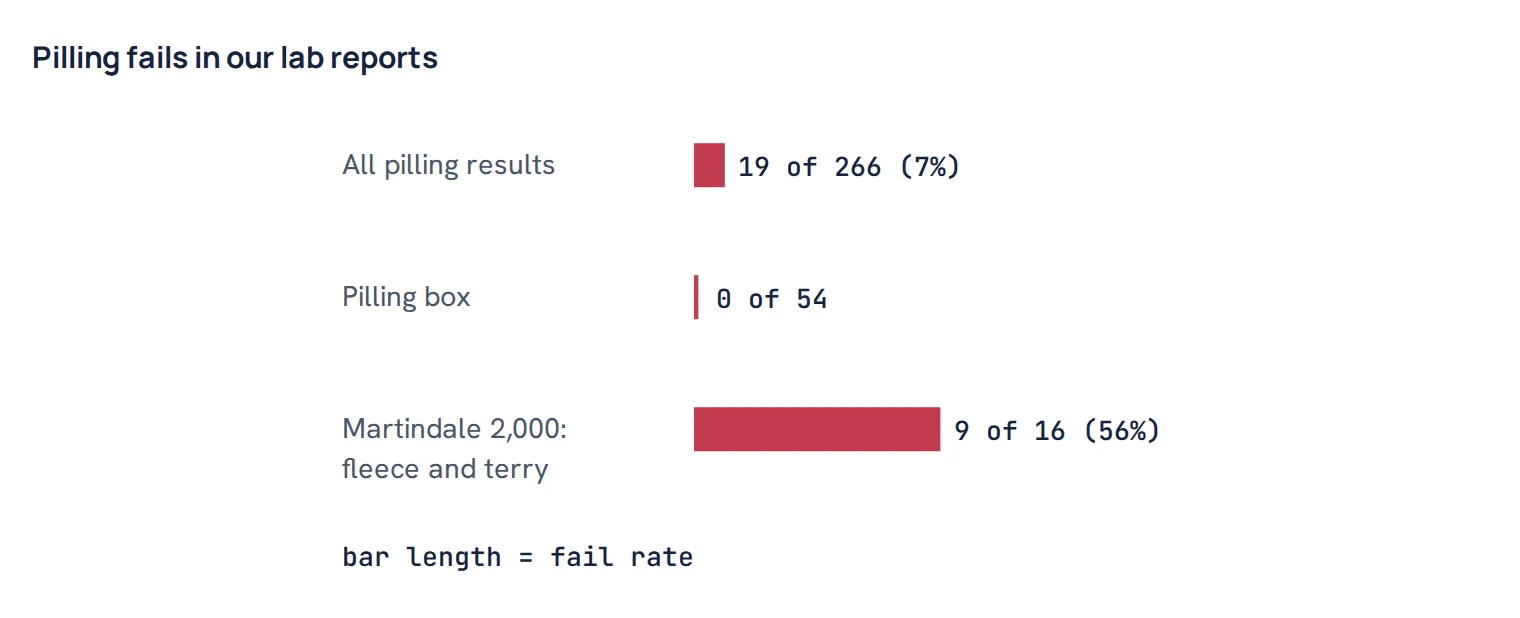
In our 316 outside lab reports on knit developments, 266 included a pilling result and only 19 failed (7%). The fails were concentrated in heavy brushed and loop-back fabrics: mostly CVC fleece and terry around 330 GSM, tested on the Martindale method at 2,000 rubs. In the first 85 reports, every pilling fail was a fleece or terry around 330 GSM with a coarse loop yarn, and none of those fabrics had been singed or heat set.
The test setting mattered as much as the fabric. None of 54 fabrics tested in the pilling box failed, while 9 of 16 fleece and terry fabrics failed on the Martindale at 2,000 cycles; the same kind of fabric that gave grade 4–5 at 1,000 cycles could drop to 2–3 at 2,000. See why fleece and terry fail the pilling test and how the pilling tests work.
How factories reduce pilling
- Better yarn: longer-staple fibre, compact or combed yarn and a little more twist in the loop yarn keep fibres anchored.
- Singeing: burning off surface fibres before dyeing, common on terry and waffle.
- Enzyme (bio-polishing) on cotton: removes protruding cotton fibres; it cannot remove polyester fuzz.
- Heat setting of polyester-rich fabrics, which helps lock fibres in.
- Anti-pilling finishes that bind fibre ends on the surface.
- Tighter knitting and moderate brushing and shearing on fleece.
Polyester-rich pills are the hardest to prevent, because cotton enzymes do not touch them; the choice of yarn and heat setting matter most there. The dyeing and finishing routes are in the fleece dyeing and finishing flowchart.
Common mistake: brushing a CVC fleece harder to make it softer for the sample. The extra pile looks great in the showroom and fails the Martindale at 2,000 rubs.
How to stop pilling on sweatpants and track pants
- Wash inside out so the surface is not rubbed by other garments.
- Use a gentle cycle and cool water, and do not overload the machine.
- Wash with similar soft items, not with jeans, towels or anything with zips and Velcro.
- Skip the tumble dryer or use low heat; tumbling is a strong source of rubbing.
- Use a liquid detergent; some powders are more abrasive.
- Remove pills early with a fabric shaver or comb, gently, before they collect more fibre.
Worked example. Two pairs of grey joggers look the same in the shop: one 100% cotton terry, one CVC fleece. After three months the cotton pair looks a little worn but smooth, because its pills broke off; the CVC fleece shows clusters of pills on the thighs and seat that stay until shaved. For low-pilling joggers, cotton or a singed, tightly knitted terry is the safer buy.
Summary
- Pills form from surface fuzz; strong polyester fibres hold them on.
- Fleece and terry pill most because of their brushed or looped surface and soft loop yarn.
- In our lab reports, heavy fleece and terry failed 9 of 16 Martindale tests at 2,000 rubs.
- Factories reduce pilling with better yarn, singeing, enzymes and finishes; at home, wash inside out, gently, and avoid the dryer.
Questions
Why do sweatpants pill so much?
Their soft brushed or looped surface puts loose fibre on the outside, and the thighs and seat are rubbed constantly. Polyester in the blend keeps the pills attached.
How do you stop pilling on sweatpants?
Wash them inside out on a gentle, cool cycle with similar soft items, avoid the tumble dryer and remove early pills with a fabric shaver.
Does cotton or polyester pill more?
Polyester and CVC pills are more visible because strong polyester fibres keep the pills attached. Cotton forms pills too, but they tend to break off.
Can pilling be prevented?
It can be greatly reduced at the factory with better yarn, singeing, enzyme treatment on cotton, heat setting and anti-pilling finishes, and at home with gentle washing.
Why does fleece pill more than jersey?
Fleece is brushed to raise a soft pile of loose fibre, and it uses a coarse, soft loop yarn. Both make it much easier for fibres to tangle into pills.

Textile engineer with 14+ years in dyeing and fabric development. He writes every guide on Dyeing Solution from real production work. Full profile