CVC means Chief Value Cotton: a cotton-polyester blend with more cotton than polyester, such as 60/40. How it compares with cotton and PC, how a CVC shirt wears, how it is dyed and what our test records show.
At a glance
CVCChief Value Cotton
60/40most common blend
2 dyesdisperse + reactive
11 of 19tested blends read low on cotton
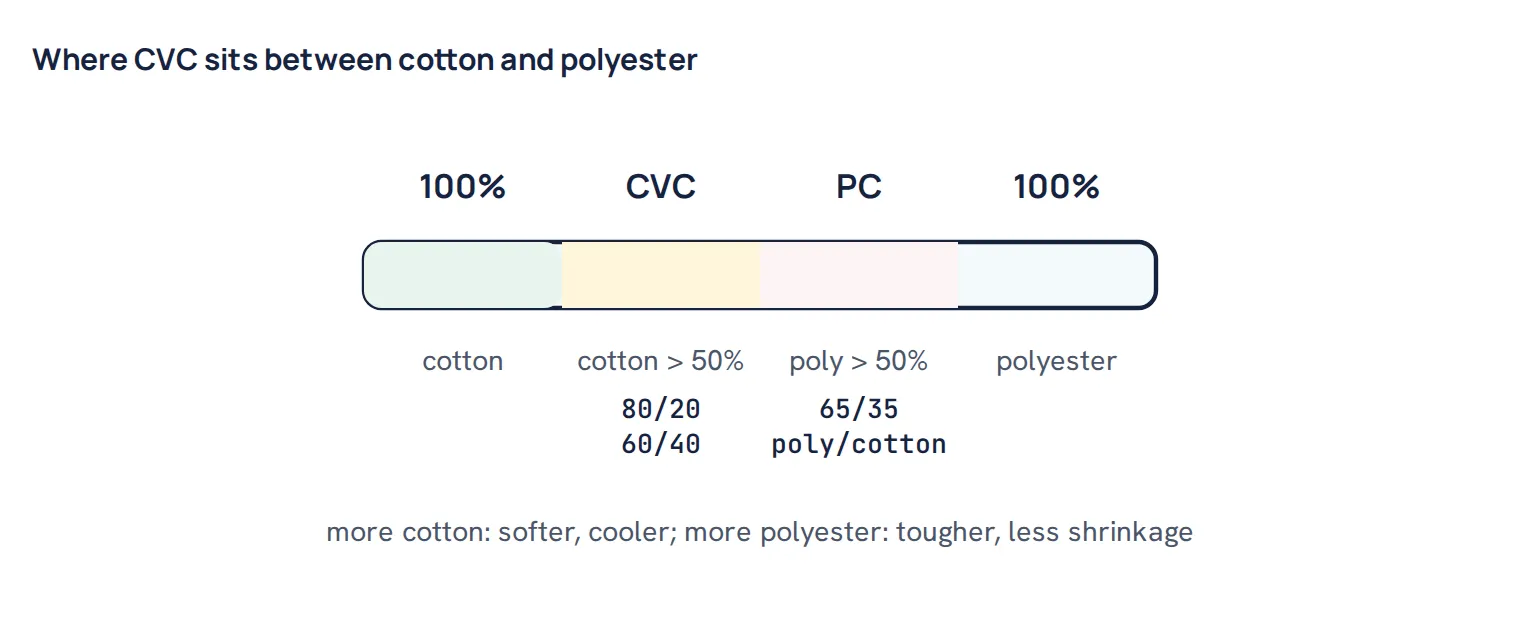
CVC fabric is a cotton-polyester blend in which cotton is the larger part. The letters stand for “Chief Value Cotton” (often written “chief value of cotton”). You see it on T-shirt, polo and sweatshirt labels as “CVC 60/40” or “CVC 80/20”, meaning 60% cotton and 40% polyester, or 80% cotton and 20% polyester. If polyester is the larger part, the fabric is usually called PC (polyester-cotton), for example 65/35.
This guide explains what CVC is, the common blend ratios, how it compares with 100% cotton and with PC, how a CVC shirt feels and wears, how it is dyed, and what goes wrong with it in testing, using our own dye-house and lab records.
What CVC means on a label
“CVC” tells you two things: the fabric is a blend of cotton and polyester, and cotton is more than half of it. The numbers after it give the exact split by weight, cotton first. A label might say “CVC 60/40 jersey, 180 GSM”: that is single jersey knitted from yarn of 60% cotton and 40% polyester, finished at 180 grams per square metre (see what GSM means).
The blend is usually made at the yarn stage. Cotton and polyester staple fibres are mixed before spinning, so every yarn carries both fibres. That intimate mix is why a CVC fabric behaves as one material rather than a cotton face and a polyester back.
Common CVC blend ratios
- CVC 80/20: feels close to cotton, with a little more strength and shape retention. Common in fleece and sweatshirts.
- CVC 60/40: the classic “tri-season” T-shirt and polo blend. Softer than PC, more stable than 100% cotton, and a favourite for promotional and team wear.
- CVC 52/48 to 55/45: just cotton-majority, often used where a lighter, smoother fabric is wanted at a lower price.
Elastane can be added to any of these for stretch, written for example as “CVC 57/38/5” (cotton/polyester/elastane).
CVC vs 100% cotton vs PC
| Point | 100% cotton | CVC (cotton-rich) | PC (poly-rich) |
|---|---|---|---|
| Handle | Softest, most natural | Soft, slightly smoother | Smoother, can feel synthetic |
| Moisture and comfort | Absorbs most | Good | Lower; dries faster |
| Shrinkage | Highest | Lower | Lowest |
| Wrinkling | Wrinkles most | Less | Least |
| Strength, abrasion | Good | Better | Best |
| Pilling | Pills shed off | Pills can stay attached | Pills stay attached |
| Dyeing | One dye class (reactive) | Two (disperse + reactive) | Two (disperse + reactive) |
| Typical cost | Higher | Middle | Lower |
The pilling point surprises people. Polyester fibres are strong, so when fibres tangle into a small ball on the surface, the ball is held on by fibres that will not break. On 100% cotton the weaker fibres let pills fall away. A CVC sweatshirt therefore can look more pilled after wear than a cotton one, even though it is “stronger”.
What a CVC shirt is like to wear
A “CVC shirt” or CVC T-shirt feels much like cotton but keeps its shape and size better after washing, wrinkles less and dries faster. It is slightly less absorbent and a little warmer in hot, humid weather than pure cotton. For printing, CVC takes water-based and plastisol screen prints well; for sublimation, the cotton part does not take the dye, so sublimation prints on CVC look faded compared with polyester.
Care is simple: wash at 30–40°C, avoid very hot tumble drying and iron on a medium setting. Very hot ironing or pressing can affect the polyester part and its colour.
How CVC fabric is dyed
Because it contains two fibres, CVC needs two dye classes. Polyester takes disperse dye at about 130°C; cotton takes reactive dye at about 60°C. In knit dyeing the usual route is two baths: disperse first with a reduction clear, then scour and enzyme for the cotton, then reactive dyeing and wash-off. It is one of the longest routes in the dye house. The details are in the CVC fabric dyeing process, and the two dye classes are compared in reactive vs disperse dye.
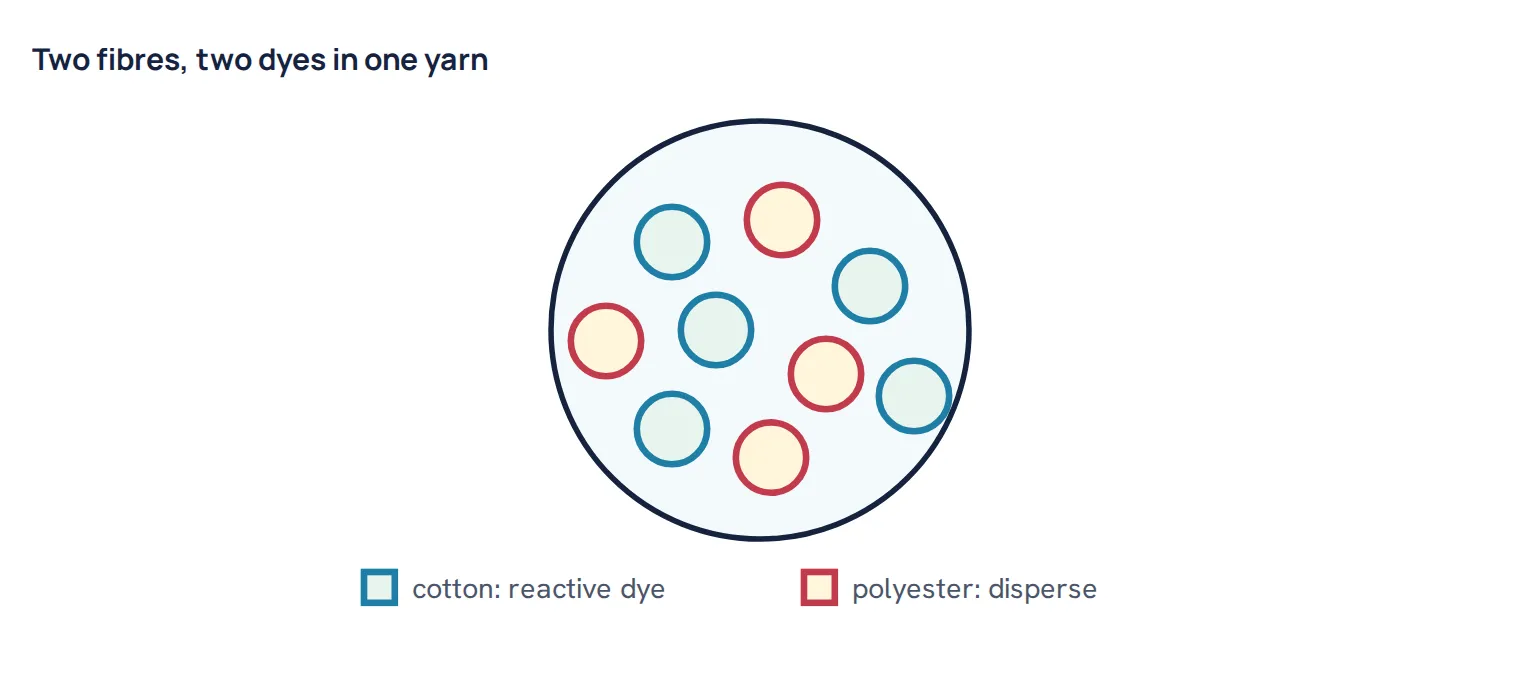
The hardest part is getting both fibres to the same shade. If the polyester is dyed lighter or darker than the cotton, the fabric shows a frosty or heathered look that is not wanted, and it changes again under different light. That is why CVC lab dips are checked on both fibres and under several light sources before bulk.
Common mistake: matching a CVC lab dip only on the face under daylight. The cotton and polyester can match in daylight and split under shop lights, so the garment looks two colours in the store.
What our records show about CVC
In our finishing records of 2,514 cotton-polyester batches, CVC and PC were the most predictable fabrics we finish for GSM and shrinkage, because polyester stabilises the cotton. Adding elastane changed that: the share of parts finished within GSM tolerance fell from 67% to 49%, even with heat setting.
In outside lab testing, CVC and PC were not immune to GSM fails: 25 of 75 CVC/PC GSM results in our 316 lab reports failed (33%), against 37% for 100% cotton (see why knit fabric fails the GSM test).
Fibre content is another trap. In 11 of the 19 cotton-polyester fabrics we had tested for composition, the lab found less cotton than declared. A typical case is a fabric declared 60/40 coming back near 54/46, outside the usual ±3 point allowance. Cotton loses some weight in scouring and the polyester does not, so the finished ratio drifts towards polyester (see fibre content test fails).
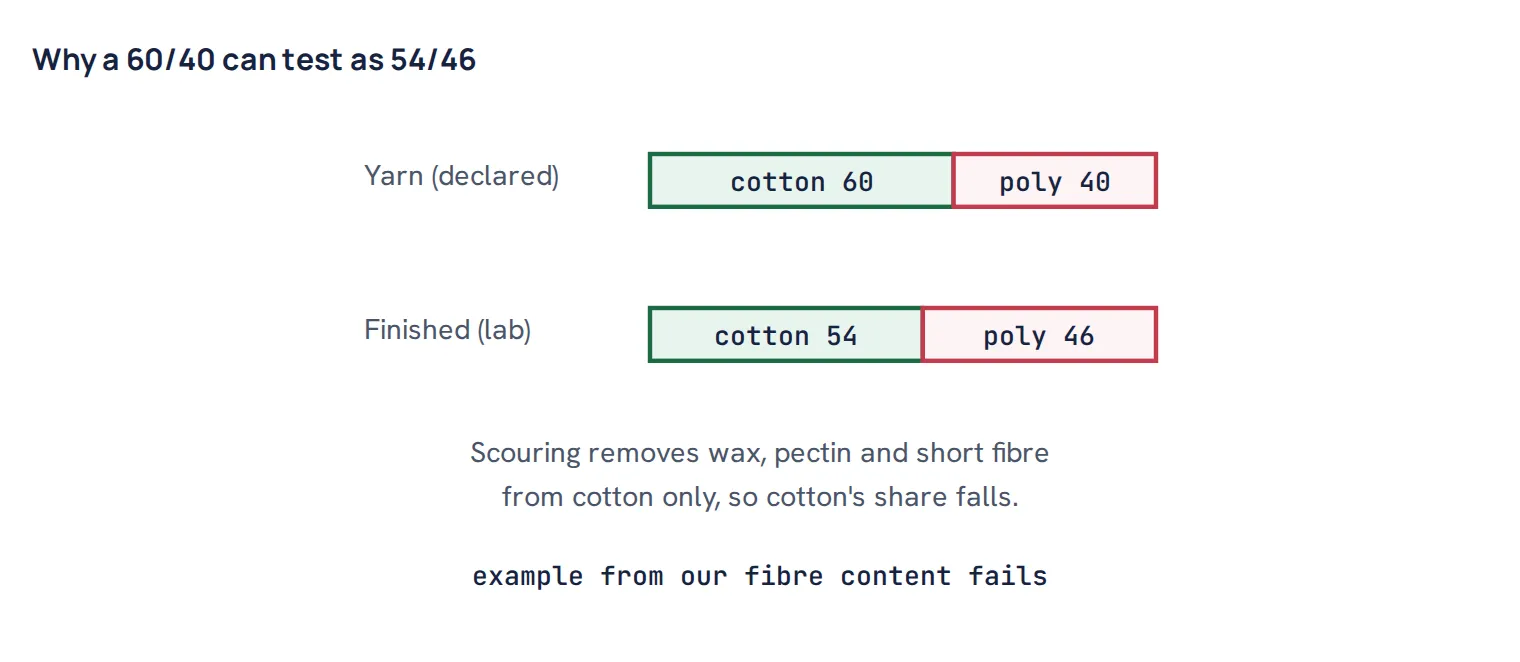
Worked example. A buyer orders “CVC 60/40, 200 GSM”. The yarn is spun 60/40. After scouring and enzyme the cotton part loses a few percent of its weight, so the finished fabric may test around 56/44 to 58/42, still inside ±3 points, or outside it if the loss is larger. If the yarn sits right at the limit, test a finished swatch before the buyer’s lab does, or spin the yarn a point or two richer in cotton.
Is CVC a good fabric?
For everyday T-shirts, polos, sweatshirts and uniforms, CVC is a sensible middle choice: most of the comfort of cotton with better shape, lower shrinkage and lower cost. Choose 100% cotton when softness and breathability matter most, such as baby wear, premium basics and hot climates. Choose PC or 100% polyester for sports and performance wear where quick drying and toughness matter more than a natural handle.
Summary
- CVC means Chief Value Cotton: a cotton-polyester blend with more than 50% cotton, such as 60/40 or 80/20.
- PC is the polyester-rich version, such as 65/35.
- CVC is softer than PC and more stable than cotton, but pills can stay attached.
- It needs two dyes, disperse and reactive, and both fibres must match in shade.
- The finished blend ratio can drift towards polyester after scouring; check it before testing.
Questions
What does CVC stand for in fabric?
CVC stands for Chief Value Cotton. It means a cotton-polyester blend in which cotton is the larger part, for example 60% cotton and 40% polyester.
What is the difference between CVC and PC fabric?
Both are cotton-polyester blends. In CVC cotton is more than 50%; in PC polyester is the larger part, such as 65% polyester and 35% cotton.
Is a CVC shirt good?
For everyday T-shirts and polos, yes: it feels close to cotton but shrinks and wrinkles less and keeps its shape better. It is a little less breathable than 100% cotton and pills can stay attached.
Does CVC fabric shrink?
It shrinks less than 100% cotton because the polyester part is stable, but the cotton part can still shrink a few percent if the fabric was not properly finished.
How is CVC fabric dyed?
With two dye classes: disperse dye for the polyester at about 130°C and reactive dye for the cotton at about 60°C, usually in two separate baths with a reduction clear in between.

Textile engineer with 14+ years in dyeing and fabric development. He writes every guide on Dyeing Solution from real production work. Full profile