Cotton fibre barely stretches, but cotton fabric can: wovens hardly stretch, knits stretch through their loops, and cotton with elastane stretches and springs back. Why cotton stretches out with wear, shrinks back in the wash, and how to keep its shape.
At a glance
Wovenlittle stretch
Knitstretches
6%median shrinkage
180–190°Celastane heat set
Cotton fibre itself barely stretches, but cotton fabric can stretch depending on how it is made. A woven cotton such as poplin, canvas or rigid denim has very little stretch. A knitted cotton such as jersey or rib stretches easily because its loops can open out. Cotton with a few percent elastane (spandex) stretches and springs back. Plain cotton also stretches out over time: knees bag, collars widen and jeans loosen with wear, and the next wash pulls them back in.
This guide explains how much cotton stretches and why, woven vs knit vs stretch cotton, why cotton clothes stretch out with wear, why they shrink back in the wash, how to stretch cotton that has shrunk, and how factories control stretch and recovery. It draws on our dye-house work with cotton and cotton-elastane knits, which make up the largest share of our finishing records.
Does cotton stretch?
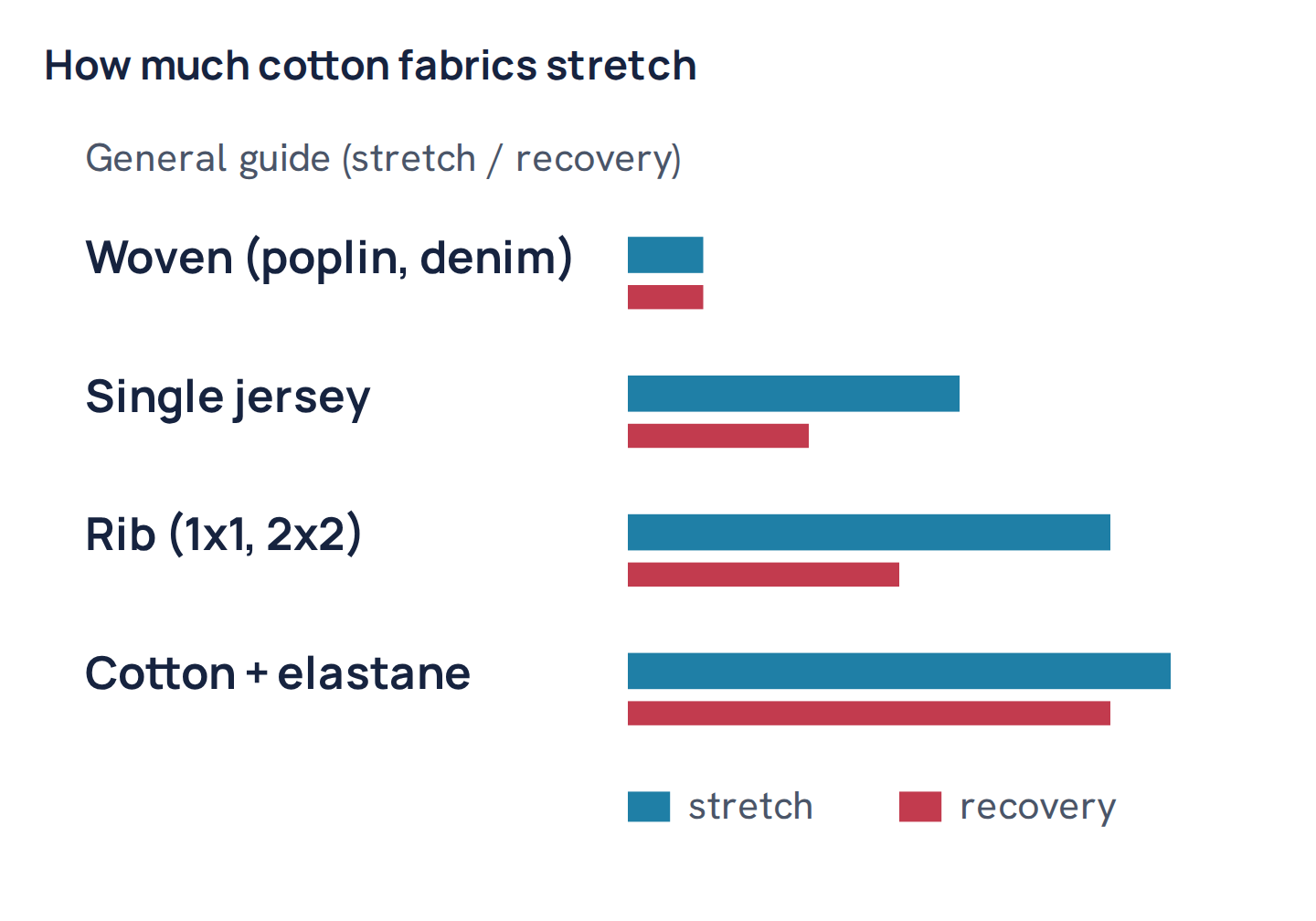
A single cotton fibre can extend only a few percent before breaking, and it recovers poorly. So any useful stretch in cotton clothing comes from the fabric construction or from added elastane:
- Woven cotton: yarns interlace straight up and down and across, so the fabric hardly stretches along the grain. It gives a little on the bias (diagonal).
- Knitted cotton: yarns form interlocking loops that open when pulled, so jersey stretches well across the width and moderately along the length; rib stretches even more across.
- Cotton with elastane: a small amount of spandex, usually 2–8%, gives real stretch and recovery to wovens and knits alike.
Why cotton clothes stretch out over time
When you wear a cotton garment, your body pulls on it: knees bend, elbows flex, you sit, and the fabric at those points is held stretched for hours. Because cotton recovers poorly, the yarns and loops stay slightly extended, so the fabric “grows” in those places. Body heat and moisture make cotton a little more pliable, which speeds this up. That is why cotton jeans feel tighter in the morning and looser by evening, and why cotton T-shirts slowly lengthen and develop wavy hems or necklines.
Why cotton shrinks back in the wash
Washing reverses some of that growth. Water swells cotton fibres and relaxes the loops and yarns, which pull back towards their natural, shorter shape, especially with heat and tumbling. Knit fabric is also stretched lengthwise during manufacture, so it keeps relaxing for the first few washes. In our finishing records of 7,429 batches of 100% cotton knit, the median length shrinkage after the wash test was 6%; single jersey about 5%, rib and interlock 7%, and pique 10%. See does cotton shrink.
This stretch-and-shrink cycle is normal for cotton. Elastane reduces it by pulling the fabric back during wear as well as in the wash.
Does cotton stretch over time permanently?
Partly. Each wear-and-wash cycle is mostly reversible, but over many months, areas that are stretched hard and often, such as T-shirt necklines, jean knees and seat, and sweater cuffs, lose their shape for good, because fibres slip within the yarn and some break. Rib collars and cuffs with elastane resist this much better than plain cotton rib.
Cotton vs cotton-elastane
| Point | 100% cotton | Cotton + 2–8% elastane |
|---|---|---|
| Stretch | From construction only | Much more, in both directions |
| Recovery | Poor; grows with wear | Good; springs back |
| Fit | Relaxed, loosens over the day | Close, holds shape |
| Breathability | Very good | Very good, slightly closer fit |
| Heat sensitivity | Tolerates hot washing | Elastane weakened by heat |
| Median shrinkage (our records) | 6% | 6% |
See what is elastane for how the stretch fibre works.
Stretch in common cotton garments
- T-shirts (single jersey): stretch comfortably across the body; necklines and hems slowly grow.
- Rib tops and tank tops: very stretchy across; fit closely, especially with elastane.
- Jeans: rigid 100% cotton denim barely stretches at first, then gives at the knees and seat; stretch denim with 1–3% elastane fits closely and recovers better.
- Chinos and shirts (woven): little stretch unless labelled stretch.
- Socks and underwear: almost always cotton with nylon and elastane for fit.
Cotton knits that hold their shape best
Not all cotton knits stretch out equally. Some structures recover better:
- Interlock: a double knit that is smooth on both sides and more stable than single jersey; used for polos and baby clothes. See what is interlock fabric.
- Pique: a textured knit with tuck stitches; holds shape well across the body, though it shrinks most in length (a median 10% in our cotton records).
- Heavier single jersey: a denser knit from coarser yarn grows less than a thin, loose one.
- Compact or ring-spun yarns: stronger, smoother yarns resist stretching and pilling better; see what is ring spun cotton.
- Rib with elastane: the standard for collars and cuffs that must spring back.
How factories control stretch in cotton knits
In the dye house, stretch and recovery are partly decided by how the fabric is handled:
- Heat setting cotton-elastane at about 180–190°C before dyeing fixes the width and stretch; in our records 97% of cotton-elastane parts were heat set.
- Low-tension processing: cotton is weakest at the stretch it is held at, so the fabric is moved gently and dried with overfeed so it is not pulled long.
- Compacting: pushes the loops back together in length to reduce later shrinkage.
- Testing: length and width are checked after a wash test, and stretch fabrics can be tested for elongation and recovery.
For cotton-elastane fabric the normal heat-setting temperature is 180 to 190 °C. We heat set Lycra fabric to control its stretch, which is normally very high.
Common mistake: buying 100% cotton jeans or tees a size too small “because cotton stretches”. They will loosen with wear, but they will also shrink back in every wash, so they feel tight again each time. Buy your true size, or choose a stretch blend for a close fit.
Breaking in rigid cotton jeans
Rigid, 100% cotton denim feels stiff at first and gradually moulds to the body as the cotton yarns relax at the knees, hips and seat. Wearing them for long periods, bending and sitting speeds this up. Each wash tightens them again, which is why some people wash raw denim rarely. Stretch denim with a small amount of elastane fits closely from the first wear and recovers better, but loses that recovery faster if dried hot.
How to stretch cotton that has shrunk
- Soak the garment in lukewarm water with a spoonful of hair conditioner or baby shampoo for 20–30 minutes.
- Press out the water gently; do not wring.
- Lay it flat on a towel and gently pull it towards the size you want, working evenly in small steps.
- Hold it in shape as it dries, using weights at the edges or by wearing it while slightly damp for knits.
This can recover a few centimetres on a cotton knit. Large shrinkage, or shrinkage in woven cotton, is much harder to reverse.
Worked example. A 100% cotton single jersey T-shirt measures 72 cm long new. After a day of wear it hangs about 1–2 cm longer at the hem. Washed hot and tumble dried, it can come back about 5% shorter than new, around 68–69 cm, in line with the 5% median for single jersey in our records. Washed cool and line dried, it stays much closer to its bought length.
How to keep cotton from stretching out
- Fold knits instead of hanging them; hanging stretches shoulders and length.
- Rotate jeans and tees so they rest between wears.
- Wash cool and dry low to limit the shrink-and-stretch cycle.
- Reshape collars and hems while damp after washing.
- Choose cotton with elastane for fitted garments.
Summary
- Cotton fibre hardly stretches; cotton fabric stretches through its knit or weave.
- Woven cotton has little stretch; jersey and rib stretch; cotton-elastane stretches and recovers.
- Cotton grows with wear and shrinks back in the wash: a median 6% length shrinkage in our knit records.
- Factories heat set cotton-elastane at 180–190°C to control its stretch.
- Buy your true size, wash cool, and fold knits to keep their shape.
Questions
Does cotton stretch?
Cotton fibre hardly stretches. Knitted cotton stretches through its loops, woven cotton barely stretches, and cotton with elastane stretches and recovers.
Does cotton stretch over time?
Yes. Cotton recovers poorly, so knees, elbows, necklines and hems grow with wear. Washing shrinks much of it back.
Do 100% cotton jeans stretch?
Yes, rigid cotton denim loosens at the knees and seat with wear, then tightens again after washing.
Does cotton stretch more than polyester?
Cotton knits stretch out and recover less; polyester recovers better and keeps its shape.
How do you stretch shrunken cotton?
Soak it in lukewarm water with hair conditioner, press out the water, gently pull it to size and let it dry flat in shape.

Textile engineer with 14+ years in dyeing and fabric development. He writes every guide on Dyeing Solution from real production work. Full profile