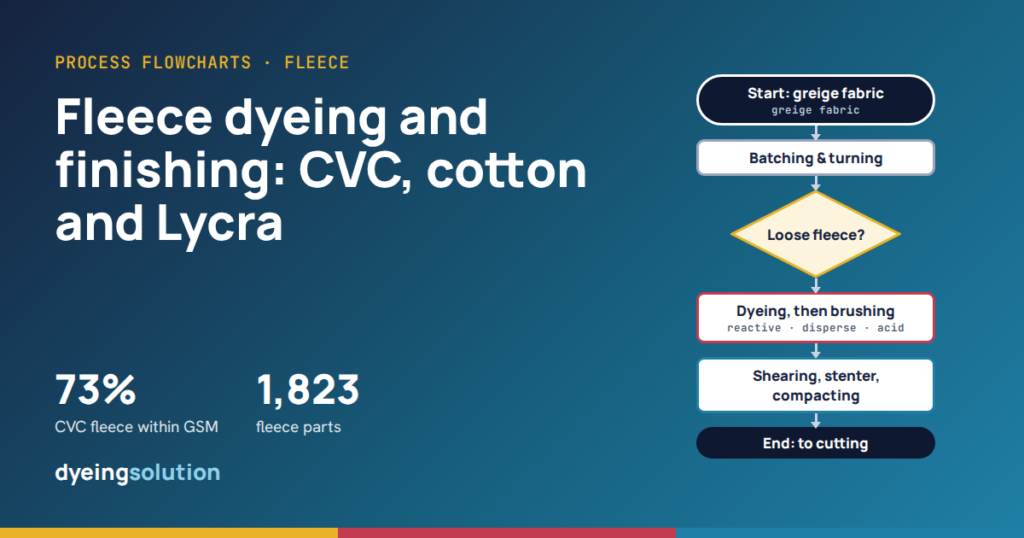
Fleece is the heaviest common knit we dye, and the most stable when it is CVC. It is also the fabric where a careless enzyme step can cost you the bursting test. Here is the route for each fibre, from greige fleece to the cutting table, with what our records show.
At a glance
1,823Fleece parts in our records
290Median required GSM
73%CVC fleece within GSM tolerance
350 GSMHeat set from here
Fleece is a three-thread knit. A face yarn and a tie yarn make a single jersey face, and a thick loop yarn is laid into the back. After dyeing, the back loops are brushed up into the soft pile that makes fleece warm. In our records 69% of fleece is CVC, usually a cotton face with a polyester or PC loop yarn, at blends from 60/40 to 80/20.
| CVC fleece blend (cotton/polyester) | Parts |
|---|---|
| 60/40 | 412 |
| 55/45 | 200 |
| 80/20 | 151 |
| 50/36 | 145 |
| 75/25 | 125 |
| 65/35 | 80 |
| 50/50 | 57 |
Fleece by fibre: what our records show
| Fibre or blend | Parts | Median required GSM | Within ±5% GSM | More than 5% light | Median length shrinkage | Median width shrinkage | Heat set |
|---|---|---|---|---|---|---|---|
| CVC / PC | 1,265 | 300 | 73% | 20% | 3% | grows 2% | 9% |
| 100% cotton | 402 | 320 | 38% | 59% | 10% | grows 2% | 17% |
| Cotton-elastane | 114 | 240 | 41% | 54% | 8% | 2% | 96% |
CVC fleece is one of the most stable fabrics in our records: 73% of parts finish within GSM tolerance and the median length shrinkage is only 3%. 100% cotton fleece is a different fabric to handle. Its median length shrinkage is 10%, and one part in ten shrinks 15% or more. The polyester loop yarn is what holds CVC fleece steady. Fleece also tends to grow slightly in width after washing rather than shrink.
When fleece is heat set
Heat setting is not only about crease marks. Its main job is dimensional stability: the fabric must not shrink or go out of shape later. So the decision is made on several things together:
- Fibre content. With polyester or nylon in it, the fabric is heat set like 100% polyester.
- Elastane. Lycra fabric is heat set.
- GSM. Fleece from 350 GSM is heat set.
- Construction. A tightly knitted fabric is heat set whatever its GSM.
- Width and stability requirement. When the buyer’s width or dimensional stability has to be held, it is heat set.
- Design fabrics. Loose designs and 3D-effect fabrics often show their design only at one width. Heat setting fixes the fabric at that width, so the design stays visible.
In our records only 9% of CVC fleece and 17% of cotton fleece was heat set, at median required weights of 300 and 320 GSM, while cotton-elastane fleece was heat set 96% of the time.
- Heat setting is not done only to remove crease marks. We decide it from the fibre content, whether there is Lycra or elastane, the GSM, the fabric construction, and the width and dimensional stability requirement.
- If there is polyester or nylon, we heat set it like 100% polyester.
- If the construction is tight, it must be heat set, whatever the GSM.
- For a loose design fabric, for example a 3D effect, the design shows only at a certain dia. We heat set it to keep the design stable and visible.
CVC fleece: the polyester part is dyed
When the loop yarn is polyester or CVC, the polyester part has to be dyed for a solid shade, whether the fleece is CVC or PC. That means two baths: disperse dye on the polyester at 130°C, then reactive dye on the cotton. Only a mélange effect is made by dyeing the cotton alone.
- If the loop is polyester or CVC, we must dye the polyester part. It is a double-part dyeing.
- Only for a mélange effect is the cotton part dyed alone. For a solid shade, CVC or PC, fleece is always double-part dyed.
The enzyme step and bursting strength
Fleece is knitted from three yarns, and the binding (tie) yarn that holds the loops in is usually cotton only. An enzyme cleans cotton by taking a little of it away. A heavy enzyme treatment can weaken that binding yarn until it cuts, and then the loops come out and the fabric fails bursting strength. When the loop yarn has more polyester in it, as in CVC and PC fleece, bursting is usually not a problem.
So fleece gets a light enzyme: about 0.15% is our basic ratio for fleece and for terry, adjusted to the enzyme supplier and the water. A loose fleece gets no enzyme at all.
When a fabric cannot take an enzyme but the buyer still wants a clean, smooth face, it is singed instead. Singeing is always done in open width: the fabric is slit after batching and then singed, after heat setting when the fabric is heat set. It appears in every chart below as a step that runs only in that case.
Singeing is critical, so first check whether the flame can damage the fabric. Polyester fabric cannot be singed: the flame hardens the polyester. CVC fabric and fleece can be singed only when the face side is cotton yarn.
In one real case, a loose fleece of about 320 GSM dyed to a very light shade went through the normal enzyme step, 0.15% at 55°C for 40 minutes. The swatch cut after the enzyme stage already had holes, and the finished fabric showed pin holes on the face and a hole through the brushed back. It failed bursting strength. The dose was normal; the mistake was giving a loose fleece an enzyme at all.
Common fault: giving a loose fleece the same enzyme step as a tight one. The cotton binding yarn weakens, the loops come out, and the fabric fails bursting strength.
Bursting strength is tested on the finished fabric in the testing lab, against the buyer’s minimum in kPa. In our test reports, finished fleece usually passes with room to spare: for example 215 and 249 kPa against a requirement of 125 kPa.
- If the loop has more polyester, CVC or PC, bursting is not an issue.
- The problem is that fleece uses three yarns, and the binding yarn is only cotton. A heavy enzyme damages the cotton, the binding gets cut, and the loops come out. So we use less enzyme on fleece.
- The enzyme dose depends on the supplier and the water. Our basic ratio is about 0.15% for fleece and 0.15% for terry.
- If the fabric structure is loose, we do not give an enzyme.
- Fabrics we cannot give an enzyme are singed instead, when the buyer needs a clean, smooth surface. Singeing is done in open width: slit after batching, then singed, after heat setting if it is heat set.
- Before singeing, check whether it can damage the fabric. Polyester fabric cannot be singed, because the flame makes the polyester hard. CVC or fleece can be singed only if the face side is cotton yarn.
- Bursting is not checked after dyeing. It is tested on the finished fabric in the testing lab, against the buyer requirement in kPa.
The sequence before the dyeing machine
Every chart below follows the same sequence before dyeing. Steps a fabric does not need simply drop out; they are drawn dashed.
- Greige inspection, then batching. A fabric that stays a tube is turned inside out here.
- If it needs heat setting, singeing or mercerising: slitting first. None of these is ever done on a tube.
- If it needs heat setting: heat setting in open width.
- If it needs singeing: singeing in open width, after checking the flame cannot damage the fabric.
- If it is mercerised: mercerising, then drying.
- If the fabric was opened: back sewing, to make it a tube again with the face side inside (the loop side, for terry).
- Loading into the dyeing machine, then scouring, bleaching and dyeing, single part or double part as the fibre needs.
Flowcharts by fibre
CVC fleece
Most fleece is CVC: a cotton face with a polyester or PC loop yarn on the back. In our records it is one of the most stable fabrics we finish. In our records: 1,265 parts, 73% within GSM tolerance, median length shrinkage 3%. Full process: CVC / PC dyeing process.
Dyeing and finishing: CVC fleece
100% cotton fleece
Heavy, soft and absorbent, but it shrinks far more than CVC fleece. In our records: 402 parts, 38% within GSM tolerance, median length shrinkage 10%. Full process: 100% cotton dyeing process.
Dyeing and finishing: 100% cotton fleece
Cotton-elastane fleece
Always heat set before dyeing, with a cooler 80°C scour to protect the elastane. In our records: 114 parts, 41% within GSM tolerance, median length shrinkage 8%. Full process: cotton-elastane dyeing process.
Dyeing and finishing: Cotton-elastane fleece
Brushing and shearing
Fleece is finished open width. Our brushing machines, and every machine after them, work on open fabric, so tubular fleece finishing belongs to the past. After dyeing the fabric is slit and dried on the stenter. When a peach finish is required, it comes next. Then the back loops are brushed up into pile, the fabric goes back on the stenter for width and GSM, and it is sheared: the raised pile is cut to an even height, which also helps against pilling. Shearing used to depend on the buyer; today it is standard. Compacting comes last.
- Fleece is always finished in open format now. Our brush machine and all the other machines are open width, so it is not done in tube.
- Every brushed fleece is sheared. Shearing was done on buyer requirement before, but now it is common.
- With a peach finish the order is: stenter, peach, brush, stenter, shearing, then compacting.
Common faults and buyer complaints
- Back loops pulling out. The loops come up and pull out onto the garment worn over the fleece. Use less enzyme, use a CVC or PC loop yarn instead of cotton, or shear the loops.
- Low strength. Use less enzyme, or singe the fabric instead of using an enzyme.
- Shrinkage. Fleece is a loose fabric and shrinkage is often argued with buyers. With polyester in it, it is rarely a problem.
- Shade variation. Fleece passes through many machines after dyeing: slitting, stenter, brushing, stenter, shearing, stenter. Each pass presses the fabric, and the shade can come out lighter and uneven.
- The main fleece fault is the back loops coming up and pulling out onto the garment worn over it.
- For this we can reduce the enzyme, use CVC or PC in the loop instead of cotton, or shear to cut the loops.
- If the strength is not good, we can reduce the enzyme or add singeing instead.
- Shrinkage is often argued by buyers because fleece is loose. With polyester there is no trouble.
- Fleece shade is hard to control because it passes so many steps, stenter, brushing, stenter, shearing, stenter. It gets pressed again and again and goes lighter, so there is some shade variation.

Textile engineer with 14+ years in dyeing and fabric development. He writes every guide on Dyeing Solution from real production work. Full profile