Polyester and rayon blends shrink a little: a median 4% in length in our polyester-viscose records, against 9% for pure rayon and 3% for polyester. Why, how the ratio changes it, the dryer and hot water, how factories control it, and how to wash polyester-rayon.
At a glance
4%PV median shrinkage
9%pure rayon
73%PV within 5%
Coolwash, low dry
Polyester and rayon blends shrink less than pure rayon, but more than pure polyester. In our finishing records, polyester-viscose (PV) knit fabric shrank a median 4% in length after the wash test, compared with 9% for 100% viscose (rayon) and 3% for polyester. The polyester does not shrink in normal washing and holds the structure; the rayon swells and relaxes in water and pulls the fabric in. So a polyester-rayon garment usually keeps its size well if it is washed cool and not dried hot, and the higher the polyester share, the more stable it is.
This guide explains why polyester-rayon (polyester-viscose) blends shrink, how much, how the ratio changes it, what happens in the dryer and with hot water, how tri-blends and polyester-rayon-spandex behave, how factories control shrinkage in these blends, and how to wash them. It draws on our dye-house finishing records, including 135 polyester-viscose knit batches.
Does polyester and rayon shrink?
A little. The two fibres behave very differently in water:
- Polyester absorbs almost no water (about 0.4%) and is heat set in the factory, so it barely changes size in a normal wash.
- Rayon (viscose) absorbs a lot of water (about 13%), swells strongly, loses much of its strength when wet and relaxes, so on its own it shrinks more than any other common fibre.
In a blend, the polyester acts like a skeleton that resists the rayon’s pull, so the fabric shrinks much less than pure rayon would.
How much does polyester-rayon shrink?
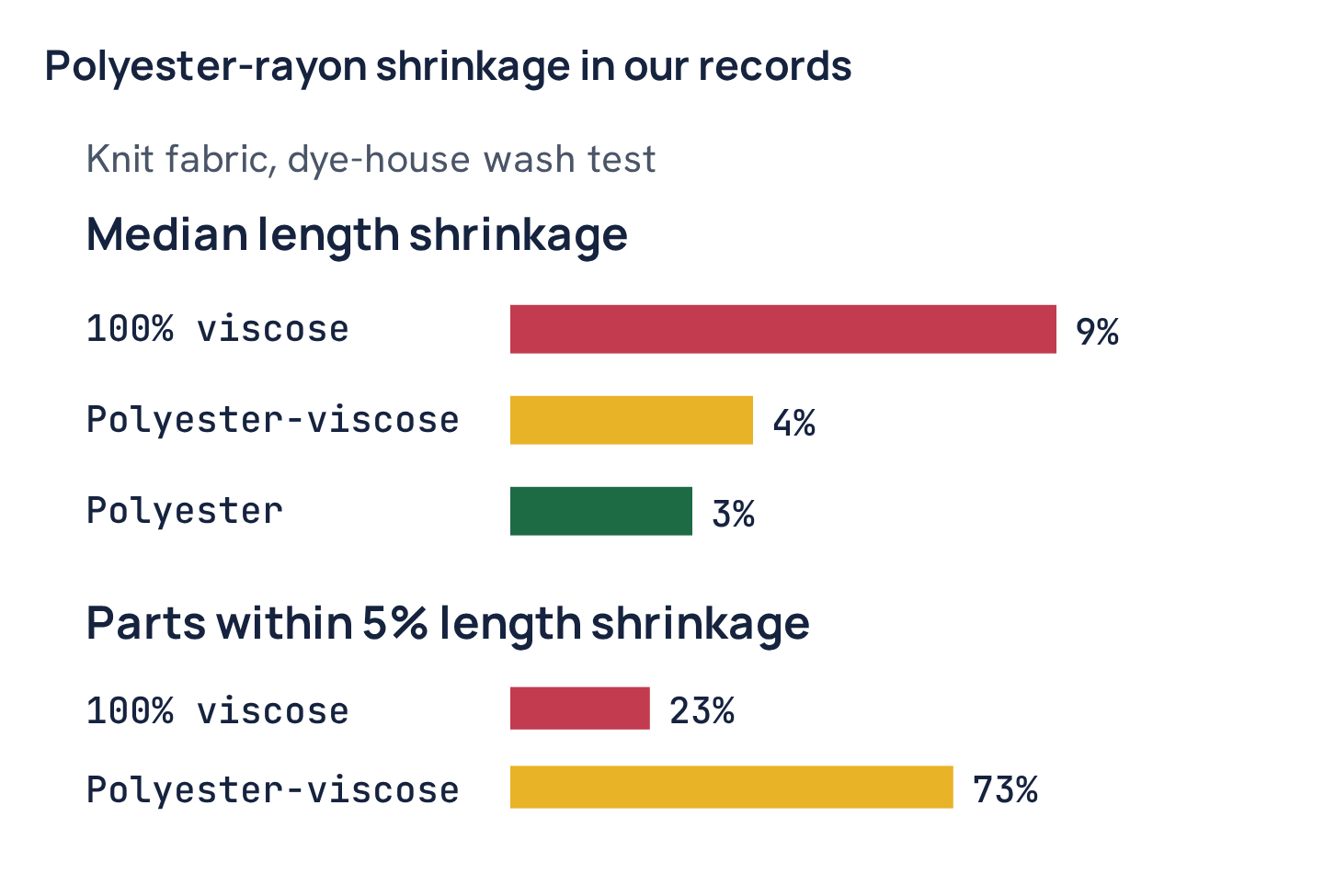
In our finishing records of 135 polyester-viscose knit batches, the median length shrinkage after the wash test was 4%, with the worst tenth reaching about 10%. 73% of PV parts kept length shrinkage within the usual 5% limit, against only 23% of 100% viscose parts. Width shrinkage was small, about 2% for most fabric families. For comparison, 100% viscose knit shrank a median 9%, and polyester knit a median 3%. See does rayon shrink and does polyester shrink.
The “worst tenth” figure is a reminder that blends are not immune: a poorly finished PV fabric, or one with a high rayon share, can still shrink as much as 10% if it is washed and dried hot.
How the blend ratio changes shrinkage
| Typical blend | Expected behaviour | Common uses |
|---|---|---|
| 65% polyester / 35% rayon | Very stable; behaves mostly like polyester | Suiting, uniforms, trousers |
| 50/50 | Stable with some movement in the first wash | T-shirts, dresses |
| Rayon-rich (e.g. 35/65) | Softer and drapier; shrinks more | Fashion tops, dresses |
| Polyester-rayon-spandex | Stable if washed cool; heat damages spandex | Ponte, fitted dresses, trousers |
| Tri-blend (polyester-cotton-rayon) | Low to medium shrinkage | Soft, heathered T-shirts |
As a rule of thumb, the more rayon in the blend, the softer and drapier the fabric, and the more it is likely to shrink. See what is tri-blend.
Does polyester and rayon shrink in the dryer?
It can, more than in the wash alone. Tumble drying combines heat, moisture and tumbling, which helps the rayon relax further. Very high heat can also affect the polyester, which can shrink or distort above the temperature it was heat set at. A PV blend dried on low heat and taken out slightly damp usually keeps its size well; dried on high for a long cycle, it can shrink noticeably and develop a slightly puckered look.
Does polyester and rayon shrink in hot water?
Hot water speeds up the rayon’s swelling and relaxation, so it can add shrinkage, especially in the first wash. Cool or warm water, around 30°C, keeps PV fabrics close to their bought size. Hot water can also set creases in the polyester part.
Why the rayon part still matters
Even though PV is far more stable than pure rayon, the rayon is still weak when wet. That means the fabric can distort if wrung or stretched while wet, even when its overall shrinkage is small. Treat PV gently in the wash, like rayon, even though it behaves more like polyester in the dryer.
How factories control shrinkage in PV fabrics
- Heat setting on a stenter fixes the polyester’s dimensions before or after dyeing.
- Gentle wet processing: the rayon part is dyed at moderate temperature with reactive dyes, the polyester at about 130°C with disperse dyes, so PV dyeing is a two-stage process.
- Moderate finishing temperatures: fabric with polyester is finished at about 100–110°C so disperse dye does not bleed.
- Overfeed drying and compacting to bring back the length lost in processing.
- Wash testing before delivery.
The full route is in the polyester-viscose dyeing process.
Polyester has no shrink property. In a CVC or PC fabric the polyester holds the structure, so the fabric cannot shrink, and washing changes the GSM very little.
The same principle applies to polyester-viscose: the polyester holds the structure, while the viscose provides softness and drape.
Common mistake: assuming a polyester-rayon garment can be washed like a polyester one and dried on high. The polyester part tolerates it; the rayon part relaxes and the fabric can shrink several percent and pucker. Wash cool and dry low.
Can you unshrink polyester and rayon?
Partly. Because the rayon is what shrinks, soaking the garment in lukewarm water with hair conditioner, pressing out the water and gently easing it back into shape while it dries flat can recover a little length. Shrinkage caused by high heat in the polyester part is much harder to reverse.
Worked example. A 65/35 polyester-viscose dress, 100 cm long, washed at 30°C and line dried, typically loses only a couple of centimetres in its first wash, in line with the 4% median in our PV records, and then stays stable. The same dress in 100% rayon, washed warm and tumble dried, could lose around 9 cm, the median for viscose in our records.
Polyester-rayon in suiting and school uniforms
Woven polyester-viscose is a classic fabric for affordable suits, trousers and school uniforms. It drapes better and feels softer than pure polyester, resists creasing better than pure viscose, and keeps its size when cared for properly. Most PV suiting is labelled for dry cleaning or gentle washing because of the interlinings and structure of tailored garments; the fabric itself is stable. School trousers and skirts in PV are usually machine washable at 30–40°C and should be line dried.
Why the first wash matters most
Most shrinkage in any knit happens in the first one to three washes, as the stresses put into the fabric during knitting, dyeing and finishing relax. A PV garment that has been washed cool and dried gently a few times will usually stay very close to that size for the rest of its life. If the first washes are hot and the drying is on high heat, the garment can lose more and may not recover.
How to wash polyester-rayon
- Wash at 30°C on a gentle cycle, inside out.
- Do not wring; press water out or use a short, low spin.
- Line dry or tumble on low, and remove promptly.
- Iron on a low to medium setting, ideally with a pressing cloth.
- Follow the care label, which is set by the more delicate fibre.
Polyester-rayon vs cotton-polyester
Both blends use polyester to stabilise a cellulose fibre. In our records, polyester-viscose shrank a median 4% and cotton-polyester (CVC and PC) also a median 4%. PV drapes more and feels smoother and slightly cooler; cotton-polyester feels more like a classic T-shirt and is a little sturdier when wet. Both are good easy-care choices when washed cool.
Ironing polyester-rayon fabric
Iron polyester-rayon on a low to medium setting, ideally inside out or with a pressing cloth. Too much heat can make the polyester shine and can flatten the fabric surface. A light steam relaxes creases well, because the rayon responds to moisture. Avoid pulling the fabric while it is hot and damp, which can stretch it out of shape.
Summary
- Polyester-rayon blends shrink a little: a median 4% in length in our PV records.
- That is far less than 100% rayon (9%) and slightly more than polyester (3%).
- More rayon means more softness and more shrinkage.
- Hot water and high-heat drying add shrinkage; wash cool and dry low.
- The rayon is weak when wet, so handle PV gently even though it is stable.
Questions
Does polyester and rayon shrink?
A little. Our polyester-viscose knit records show a median 4% length shrinkage, much less than pure rayon at 9%.
Does polyester rayon shrink in the dryer?
It can, especially on high heat. Dry it on low and remove it slightly damp to keep its size.
Which shrinks more, polyester or rayon?
Rayon. In our knit records rayon shrank a median 9% in length and polyester 3%.
Does more rayon mean more shrinkage?
Yes. Rayon-rich blends are softer and drapier but shrink more than polyester-rich blends.
How do you wash polyester and rayon?
At 30°C on a gentle cycle, inside out, without wringing, then line dry or tumble low.

Textile engineer with 14+ years in dyeing and fabric development. He writes every guide on Dyeing Solution from real production work. Full profile