Lyocell bamboo is lyocell fibre made from bamboo cellulose by a closed-loop solvent process: soft, cool and absorbent, and stronger and cleaner-made than bamboo viscose. How it is made, vs bamboo viscose and wood lyocell, fibrillation, shrinkage data and care.
At a glance
Closed loopsolvent process
Strongwhen wet
7%lyocell blend shrinkage
Fibrillationwatch for it
Lyocell bamboo fabric is lyocell fibre made from bamboo cellulose. Bamboo pulp is dissolved directly in a recyclable organic solvent and spun into fibre by the lyocell process, instead of the older viscose process used for most “bamboo” fabric. The result is a soft, smooth, cool, highly absorbent fibre that is noticeably stronger than bamboo viscose, especially when wet, and is made in a cleaner, closed-loop process. It is used for premium sheets, pyjamas, underwear, T-shirts and baby clothes.
This guide explains what lyocell bamboo is, how it is made, lyocell bamboo vs bamboo viscose, how it compares with cotton, modal and wood-based lyocell, its real advantages and its weaknesses such as fibrillation, how it is dyed and finished, and how to care for it. It draws on our dye-house work with lyocell and our finishing records of 300 lyocell-blend batches.
How lyocell bamboo is made
- Pulping: bamboo is chipped and processed into cellulose pulp.
- Direct dissolving: the pulp is dissolved directly in an organic solvent, usually N-methylmorpholine N-oxide (NMMO), without the chemical reaction used in viscose.
- Spinning: the clear solution is extruded through fine holes into a water bath, where the cellulose comes out as fibre.
- Washing and solvent recovery: the solvent is washed out of the fibre and recovered, typically at a very high rate, and reused.
- Finishing and cutting: the fibre is dried, finished and cut into staple for spinning.
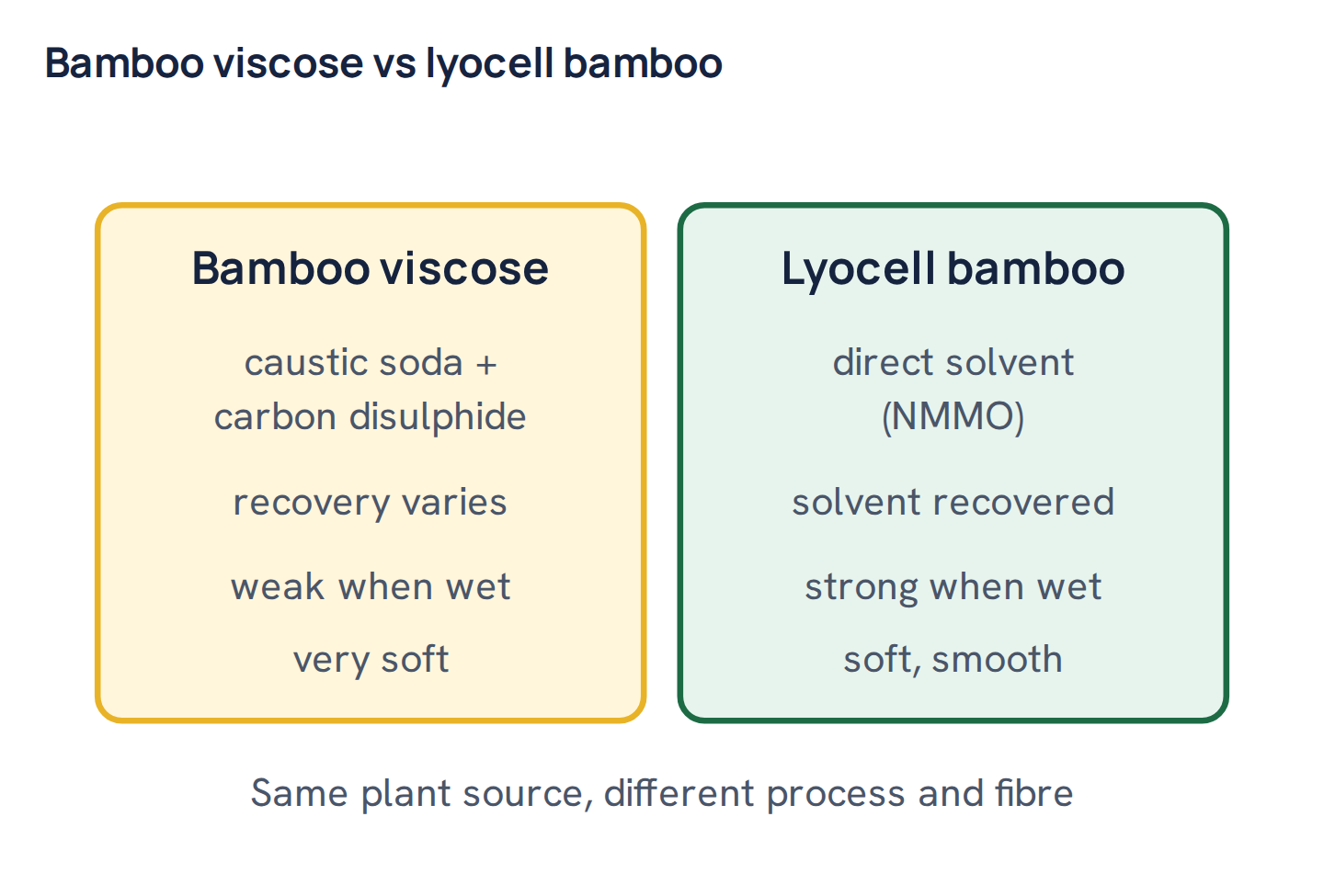
Because almost all the solvent goes round again, this is called a closed-loop process. It avoids the carbon disulphide used in the viscose route. See what is lyocell fabric for the process in general.
Lyocell bamboo vs bamboo viscose
| Point | Lyocell bamboo | Bamboo viscose |
|---|---|---|
| Process | Direct solvent, closed loop | Viscose chemical route |
| Main process chemicals | NMMO, recovered and reused | Caustic soda, carbon disulphide |
| Wet strength | High | Low |
| Feel | Smooth, cool, silky | Very soft, silky |
| Shrinkage tendency | Lower than viscose | High (viscose knit median 9% in our records) |
| Durability | Better | Lower |
| Price | Higher | Lower |
Most products simply labelled “bamboo” are bamboo viscose. When a product says “lyocell from bamboo” or “bamboo lyocell”, it is the stronger, cleaner-process fibre.
Lyocell bamboo vs wood lyocell
Lyocell can be made from many cellulose sources: eucalyptus, beech, other woods, or bamboo. Once the cellulose has been dissolved and re-formed, the fibre behaves almost the same whatever plant it came from. Differences between two lyocell fabrics come mainly from yarn, construction and finishing, not from the plant. Choosing bamboo over wood as the source is mostly about how the raw material is grown and sourced, not about the final fibre properties.
Advantages of lyocell bamboo
- Soft, smooth, cool feel with good drape.
- High moisture absorption and good breathability, comfortable for sleep and in heat.
- Strong when wet, so it holds shape better than viscose in washing.
- Cleaner production through solvent recovery.
- Biodegradable under suitable conditions.
- Bright colours with reactive dyes.
Weaknesses: fibrillation and shrinkage
Lyocell’s special weakness is fibrillation. When the wet fibre is rubbed, its surface splits into tiny hair-like fibrils, which show as a hazy, peach-skin look or white streaks, especially on dark colours. Mills control it with careful wet processing and enzyme treatment, and some fibres are made in a cross-linked form that fibrillates less. At home, rough, hot, heavily loaded washes encourage it.
Lyocell knits also shrink and relax. In our finishing records of 300 lyocell-blend batches, the median length shrinkage after the wash test was 7%, the worst tenth 12% or more, and lyocell blends were the hardest of all fibre families to finish on weight: only 17% of parts finished within ±5% of the required GSM. That is less shrinkage than viscose (median 9%) but more than cotton (6%).
Cotton-lyocell fabric is very loose and shrinks a lot, so it goes heavy as soon as it is washed. You cannot really control that in finishing. What helps is heat setting the fabric before dyeing starts. That brings it under some control.
How lyocell bamboo is dyed and finished
Lyocell takes the same reactive dyes as cotton and viscose. The differences in the dye house are about protecting the wet fibre: a gentler scour at around 60°C and bleach at 70–80°C instead of near-boiling, anti-crease agent in every wet stage because lyocell swells and creases in rope form, careful machine speed, and an enzyme treatment after dyeing to remove the fibrillated surface and give a clean, smooth finish. See the 100% lyocell knit dyeing process.
Common mistake: washing dark lyocell bamboo sheets or T-shirts in a hot, overloaded machine with towels. The wet fibres rub, fibrillate and develop a pale, hazy surface that does not wash out. Wash cool, inside out, in a lighter load.
Where lyocell bamboo is used
- Bed sheets and pillowcases: cool, smooth and moisture-absorbing for hot sleepers.
- Pyjamas and loungewear: soft and breathable.
- Underwear and baby clothes: gentle on skin.
- T-shirts and tops: often blended with cotton or elastane.
- Towels and robes: absorbent and soft, usually blended with cotton.
Is lyocell bamboo eco-friendly?
It is one of the better options among bamboo fabrics. Bamboo grows quickly with little irrigation, and the lyocell process recovers and reuses its solvent, avoiding the chemicals that make conventional viscose production polluting. Its overall footprint still depends on how the bamboo is grown, how much energy the factory uses, and what dyes and finishes are applied later. Certifications for the fibre producer and the finished product give the most reliable picture.
Lyocell bamboo vs cotton and modal
| Point | Lyocell bamboo | Cotton | Modal |
|---|---|---|---|
| Feel | Smooth, cool, silky | Soft, matt | Very soft, silky |
| Moisture absorption | High | High | High |
| Wet strength | High | High | Medium |
| Median shrinkage (our knit records) | 7% (lyocell blends) | 6% | 6% (modal blends) |
| Special weakness | Fibrillation | Wrinkles, shrinks | Gains weight after washing |
| Price | Higher | Lower | Higher |
Lyocell and modal are both premium, soft cellulose fibres. Lyocell is stronger and made in a cleaner process; modal is often a little softer and less prone to fibrillation. Cotton remains the easiest to care for.
Is lyocell bamboo good for hot sleepers?
Yes, it is one of the better bedding fibres for people who sleep hot. It absorbs moisture readily, feels cool and smooth, and releases moisture to the air quickly. Woven as sateen, it feels silky; as percale, crisper and cooler. Lighter colours hide fibrillation better than dark ones over time.
How to tell what you are buying
- “Lyocell from bamboo” or “bamboo lyocell”: the solvent-process fibre.
- “Viscose from bamboo” or “rayon from bamboo”: the viscose-process fibre.
- “Bamboo” alone: usually viscose; ask or check the full label.
- Blends: check the percentage of lyocell, cotton and elastane.
Worked example. Two sets of “bamboo” sheets feel equally soft in the shop. One is bamboo viscose, the other lyocell from bamboo. After a year of 40°C washing, the viscose sheets have shrunk a little more and feel thinner at the foot end; the lyocell sheets have held their size better, though the dark grey set shows slight surface haze from fibrillation. Washing both at 30°C in lighter loads would have kept them better still.
How to care for lyocell bamboo
- Wash at 30°C on a gentle cycle, inside out, in a lighter load.
- Use mild liquid detergent; avoid bleach.
- Line dry or tumble on low; remove promptly to limit creasing.
- Iron on medium while slightly damp, if needed.
- Wash dark colours separately and gently to limit fibrillation.
How to read a lyocell bamboo label
A clear label names the fibre type and the share of each fibre, for example lyocell from bamboo with a small share of elastane. Some labels only say bamboo, which usually means bamboo viscose. If the garment is sold as lyocell bamboo, look for the word lyocell on the care label itself, not just on the product page.
Summary
- Lyocell bamboo is lyocell fibre made from bamboo cellulose by a closed-loop solvent process.
- It is stronger when wet and made more cleanly than bamboo viscose.
- It is soft, cool and absorbent but can fibrillate if rubbed when wet.
- Lyocell blends shrank a median 7% in our records, less than viscose but more than cotton.
- Wash cool and gently in light loads to keep it smooth.
Questions
What is lyocell bamboo fabric?
Lyocell fibre made from bamboo cellulose, dissolved directly in a recyclable solvent and spun into fibre, giving a soft, cool, strong fabric.
Is lyocell bamboo better than bamboo viscose?
It is stronger when wet, holds its shape better and is made in a cleaner closed-loop process. It usually costs more.
Is lyocell from bamboo the same as wood lyocell?
Essentially yes. Lyocell is made by the same solvent process whatever the cellulose source; the plant changes, the finished fibre behaves almost the same.
Does lyocell bamboo shrink?
Somewhat. Our lyocell-blend knit records show a median 7% length shrinkage, less than viscose but more than cotton.
What is fibrillation in lyocell?
When wet lyocell fibres are rubbed, their surface splits into tiny fibrils that look like a hazy or peach-skin surface. Gentle washing limits it.

Textile engineer with 14+ years in dyeing and fabric development. He writes every guide on Dyeing Solution from real production work. Full profile