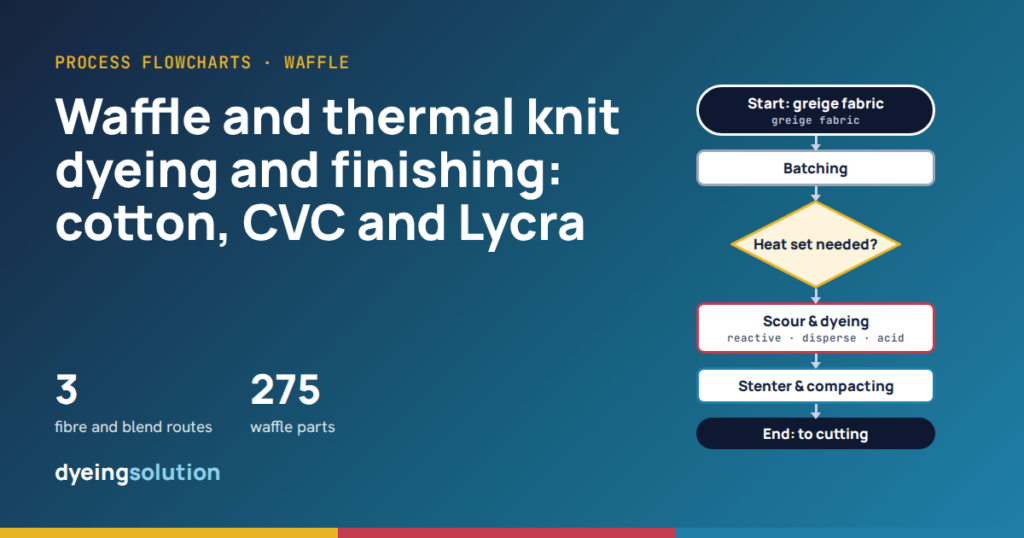
Waffle is a texture fabric: its square cells are what the buyer pays for, and it is one of the hardest fabrics to hold to GSM. Here is the route for each fibre, from greige waffle to the cutting table.
At a glance
275Parts in our records
250Median required GSM
32%Within GSM tolerance
39%Singed
Waffle (thermal) is a double knit with tuck and miss stitches that form a grid of square cells. The cells trap air, which is why it is used for thermal underwear and casual tops. The texture has to survive dyeing and finishing without being flattened or stretched out.
| Type in our records | Parts |
|---|---|
| Waffle | 145 |
| Ly Waffle | 40 |
| L/Waffle | 23 |
| Tuck Waffle | 11 |
| Slub Waffle | 6 |
| Mini Waffle | 5 |
| Yd Waffle | 5 |
| Micro Waffle | 5 |
By fibre: what our records show
| Fibre or blend | Parts | Median required GSM | Within ±5% GSM | More than 5% light | Median length shrinkage | Median width shrinkage | Heat set |
|---|---|---|---|---|---|---|---|
| 100% cotton | 117 | 280 | 23% | 74% | 8% | 10% | 1% |
| CVC / PC | 101 | 220 | 45% | 42% | 4% | 4% | 84% |
| Cotton-elastane | 41 | 280 | 29% | 61% | 9% | 7% | 90% |
Only 23% of cotton waffle finishes within GSM tolerance, and 39% of all waffle in our records was singed.
What makes waffle different
- Waffle is a very loose knit, so its shrinkage is very bad.
- Crease marks are normally not a big problem on waffle.
- We cannot use enzyme on cotton waffle: it is loose, and the enzyme would cost bursting strength. When the buyer needs a clean surface, we singe it instead. That is why so much waffle is singed.
- CVC or PC waffle takes the enzyme instead, because a polyester face cannot be singed.
Holding waffle GSM
- Waffle GSM is hard to hold because it is a loose knit.
- The most important thing is to wash it and check the GSM after washing. Without the wash you cannot see the real GSM, and you cannot control it.
The sequence before the dyeing machine
Every chart below follows the same sequence before dyeing. Steps a fabric does not need simply drop out; they are drawn dashed.
- Greige inspection, then batching. A fabric that stays a tube is turned inside out here.
- If it needs heat setting, singeing or mercerising: slitting first. None of these is ever done on a tube.
- If it needs heat setting: heat setting in open width.
- If it needs singeing: singeing in open width, after checking the flame cannot damage the fabric.
- If it is mercerised: mercerising, then drying.
- If the fabric was opened: back sewing, to make it a tube again with the face side inside (the loop side, for terry).
- Loading into the dyeing machine, then scouring, bleaching and dyeing, single part or double part as the fibre needs.
Flowcharts by fibre
- 100% cotton waffle and thermal knit
- CVC / PC waffle and thermal knit
- Cotton-elastane waffle and thermal knit
100% cotton waffle and thermal knit
In our records: 117 parts, 23% within GSM tolerance, median length shrinkage 8%, heat set 1%. Full process: 100% cotton dyeing process.
Dyeing and finishing: 100% cotton waffle and thermal knit
CVC / PC waffle and thermal knit
In our records: 101 parts, 45% within GSM tolerance, median length shrinkage 4%, heat set 84%. Full process: CVC / PC dyeing process.
Dyeing and finishing: CVC / PC waffle and thermal knit
Cotton-elastane waffle and thermal knit
In our records: 41 parts, 29% within GSM tolerance, median length shrinkage 9%, heat set 90%. Full process: Cotton-elastane dyeing process.
Dyeing and finishing: Cotton-elastane waffle and thermal knit
Common faults and buyer complaints
- The main waffle fault is shrinkage. Shrinkage fails.
Shrinkage failure. Waffle is loose and keeps shrinking after finishing. Relax it fully in finishing, then test GSM and shrinkage after washing before delivery.

Textile engineer with 14+ years in dyeing and fabric development. He writes every guide on Dyeing Solution from real production work. Full profile