The full route a 100% cotton knit takes through a winch dye house, with the dyeing curve we use for each shade depth and what the fabric looks like when it reaches the cutting table.
At a glance
ReactiveDye class
pH 6.5Levelling bath before colour
60°CStandard dyeing temperature
9 curvesChosen by shade and dye
100% cotton is the base of most knit dye houses. It is also the fibre where a small mistake early in the route turns into a shade, GSM or shrinkage problem at the end. This guide follows the route on our floor: how the fabric is prepared, which dyeing curve we choose for each shade, how it is washed off and finished, and what the finished fabric data says about cotton.
The route for 100% cotton
- Batching: one fabric construction and one yarn lot per batch
- Scouring and bleaching: remove wax and oil, make the fabric absorbent
- Enzyme (bio-polishing): clean the surface and reduce pilling
- Reactive dyeing: the curve depends on the shade
- Wash-off: drain, hot wash, neutralise, soap
- Fixing and softening: in the last bath
- Finishing: slitting, stenter, compacting
Scouring and bleaching
Scouring removes the natural wax and the knitting oil so the fabric wets out evenly. Bleaching with hydrogen peroxide removes the yellow tone so light and bright shades come out clean. On knits both are done together in one bath.
For normal 100% cotton, the scour-bleach bath runs at 98°C for 60 minutes with a wetting agent, a sequestering agent, caustic (2 g/L) and hydrogen peroxide (2.5 g/L). After draining, the fabric gets a hot wash and an acid rinse with a peroxide killer, so no peroxide is left when the dye goes in.
Mercerised fabric is scoured cooler, at 95°C for 45 minutes (soda ash 2 g/L, caustic 1 g/L, hydrogen peroxide 2.5 g/L). It has already been through strong alkali in mercerising, so it does not need the full 98°C scour.
A one-bath enzyme scour is not our normal route. We use it only when the fabric strength is already very poor: pH 4.5, enzyme and a mild scouring agent at 55°C for 50 minutes, then 80°C for 15 minutes to stop the enzyme.
Common fault: leaving peroxide in the fabric. It attacks reactive dye in the next bath, and the result looks like a dyeing fault (weak or uneven shade) even though it started in scouring.
Enzyme treatment
An acid cellulase enzyme removes the loose fibres on the surface. The face becomes cleaner and brighter, and the fabric pills less in wear. Most buyers ask for it on cotton knits. After the enzyme, the temperature is raised to 80°C to stop it working, otherwise it keeps weakening the fabric.
Mercerised fabric is the exception. It goes to dyeing with no enzyme treatment.
Choosing the dyeing curve
Every cotton batch is dyed with reactive dye in three phases: the dye goes on with salt, then soda ash fixes it to the fibre, then the loose dye is washed off. What changes from shade to shade is the order, the temperature and the speed of those additions. These are the curves we use on 100% cotton:
| Shade type | Levelling pH | Temperature | Dye and salt | Soda ash | Key point |
|---|---|---|---|---|---|
| Light shades | 6.5 | 60°C | Colour 20 min, then salt in two halves | 1 g/L over 20 min, rest over 25 min | Isothermal at 60°C |
| Deep shades | 6.5 | 60°C | Salt by recycle dosing (20 min), then colour 20 min | 1 g/L over 20 min, rest over 25 min | Salt goes in before the dye |
| All-in at 60°C | 6.5 | 60°C | Salt injected, then colour 25 min linear | 1 g/L linear over 25 min, rest over 25 min (70% progressive) | Salt and dye together from the start |
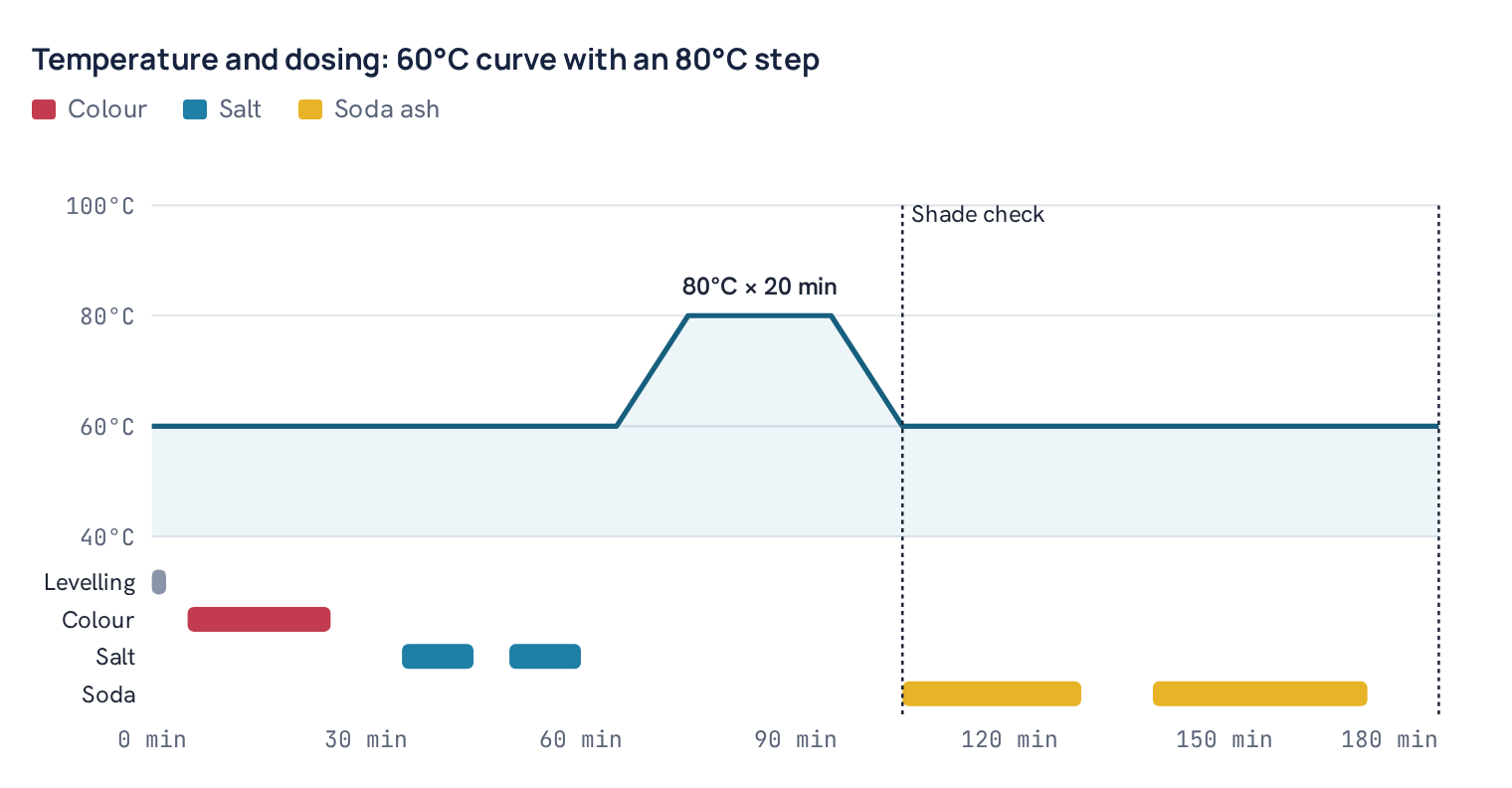
| Migration step (large-molecule dyes, critical shades) | — | 60°C, step to 80°C | Colour 20 min, salt in two halves, 80°C × 20 min, cool to 60°C | 1 g/L linear over 25 min, rest over 30 min (70% progressive) | 80°C × 20 min lets the dye migrate and penetrate |
| Navy (80/60) | 6.5 | 80°C, cool to 60°C | Salt injected at 80°C, colour 30 min, run 25 min, cool to 60°C | 1 g/L linear over 30 min, rest over 30 min (70% progressive) | Dye goes on hot, fixes at 60°C |
| Turquoise | 7.5 | 80°C, step to 90°C | Colour 35 min, salt in three thirds, 90°C × 20 min, cool to 60°C | 0.7 g/L over 30 min, rest over 30 min (70% progressive), then 80°C × 10 min | Highest temperature of all curves |
| Reactive Blue 19 (bright blue) | 6.5 | 80°C, cool to 60°C | Colour 30 min, salt in two halves at 80°C | 1 g/L over 25 min, rest over 25 min (70% progressive) | Dye and salt at 80°C, fixation at 60°C |
| Low temperature | — | 40°C | Salt 10 min, run 30 min, then colour 25 min | Soda over 20 min, then caustic over 30 min | Caustic added after soda |
| Crease-sensitive fabric | 8–9 | — | Anti-crease agent in the levelling bath, salt, colour 30 min | Soda over 30 min, then caustic over 25 min | Anti-crease agent from the start |
“70% progressive” means the soda goes in slowly at first and faster towards the end, so fixation starts gently. Soda amounts in g/L are the first portion; the rest of the recipe amount follows in the second portion.
Recycle dosing is how salt goes in on our machines. Bath liquor from the machine goes to the side tank, the salt is dissolved there in that liquor, and it is dosed back into the machine. On a normal curve the salt is dosed over 10 minutes after the colour at 60°C, followed by 10 minutes of run time. Then the soda goes in.
The migration step: 60°C with 80°C × 20 min
This curve is not for every dye. We use it for dyes with large molecules, such as hot-brand dyes and turquoise types, and for critical or light shades such as olive. The dye and salt go in at 60°C, then the bath is heated to 80°C for 20 minutes. That is the migration step: it lets the salt do its job properly and gives the large dye molecules time to get into the fibre before fixation. For all other shades, the soda follows straight after the salt. After cooling back to 60°C and a shade check, the soda goes in: 1 g/L in the first 25 minutes, the rest over 30 minutes.
Common fault: adding the soda too fast. The dye fixes on the surface before it has spread evenly, and you get a patchy or streaky shade that cannot be levelled afterwards.
Tip: always check the shade after the salt and before the soda. Once the soda is in, the dye is fixed, and a shade correction becomes a topping or a stripping job.
Wash-off, fixing and softening
After the final shade check the bath is dropped (BD), and the fabric gets a hot wash, an acid neutralisation and a hot soaping with a soaping agent to remove the dye that is not fixed. Where needed, a fixing agent (2 g/L) is added. A softener (1 g/L at pH 5–5.5) goes in the last bath.
Common fault: cutting the hot soaping short. The shade looks right on the machine, but the fabric fails wash and rubbing fastness later.
Special cotton fabrics
- Mercerised fabric: scoured at 95°C instead of 98°C, and no enzyme. Salt goes in three portions and the bath is heated to 80°C before cooling for fixation. Soda goes in three portions.
- Grey mélange overdyeing: soda scour and enzyme, then colour over 30 minutes and salt in two portions before a 80°C × 20 min step.
- Crease-sensitive fabric: an anti-crease agent goes into the levelling bath at pH 8–9, and fixation uses soda followed by caustic.
What 100% cotton looks like at delivery
From our finishing records of 7,429 100% cotton batches (see the full GSM and shrinkage study):
- Finished GSM: a median of -5.0% against required. 47% of parts are within ±5%, and 51% are more than 5% light.
- After washing: a light batch gains about 11% in GSM, and 75% of light parts come back within tolerance. Cotton responds to the wash better than any other fibre.
- Shrinkage: median length shrinkage 6% and width 2%. Only 47% of parts keep length shrinkage within 5%.
- Spirality: median 2%.
| 100% cotton fabric type | Batches | Median finished GSM vs required | Within ±5% | Median length shrinkage | Median width shrinkage |
|---|---|---|---|---|---|
| Single jersey | 4,906 | -5.0% | 46% | -5% | -2% |
| Rib / interlock | 939 | -4.4% | 50% | -7% | -4% |
| Fleece / terry | 885 | -4.5% | 50% | -8% | -2% |
| Pique | 439 | -5.8% | 39% | -10% | -2% |
| Waffle | 111 | -15.1% | 23% | -8% | -10% |
Limitations of 100% cotton and how to handle them
- High length shrinkage. Cotton relaxes when washed. Build the shrinkage control into finishing with overfeed and compaction, and set the target with a wash test, not by eye.
- Light GSM. Half of all cotton parts finish light. A wash usually brings them back, but the lasting fix is in knitting: yarn count or stitch length.
- Pique and waffle. Pique shrinks most in length; waffle finishes light and loses width. Finish waffle tension-free in a relax dryer and correct it in knitting.
- Pilling and fuzz. Handled by the enzyme step. Skipping it saves time but shows up in the buyer’s pilling test.
The main buyer complaint on cotton is fastness. It is not as good as it should be when lower-grade dyes are used or when the soaping is not done well. Red and turquoise shades give the most trouble. The other common complaint is hairiness: cotton fabric often comes out with too much surface fibre.

Textile engineer with 14+ years in dyeing and fabric development. He writes every guide on Dyeing Solution from real production work. Full profile