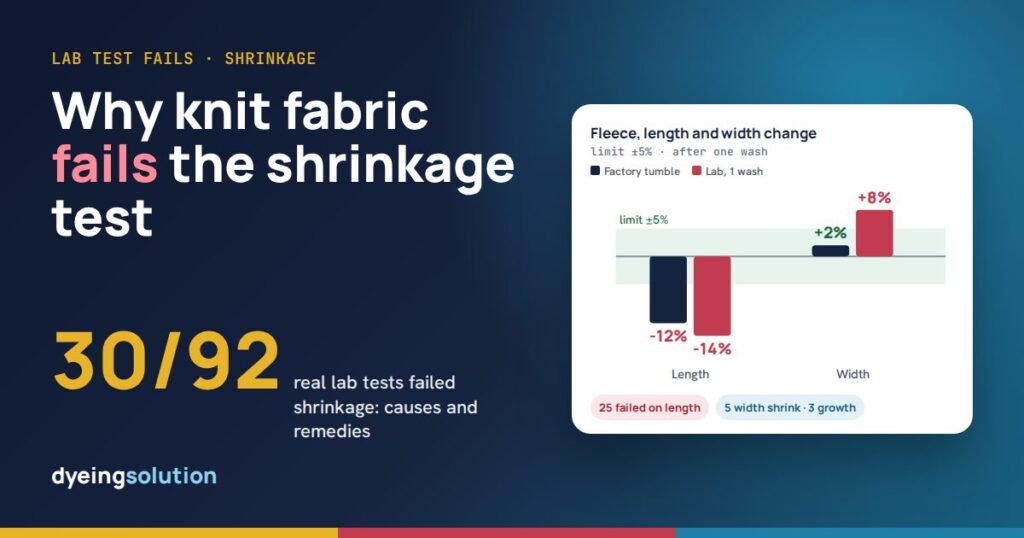
Over 95 new fabric developments, each one tested in the lab, shrinkage failed in 30 batches. Every fabric type has its own dyeing and finishing route, so here they are case by case: how each fabric was made and finished, what the factory tumble test said, what the lab found after one and five washes, and the cause and remedy.
About this series. These findings come from 95 development batches: new and uncommon knit fabrics such as design rib, drop-needle Lycra rib, yarn-dyed twill jersey, design terry, waffle, Lycra pointelle and diagonal fleece. Each batch was knitted, dyed and finished as a development sample, then tested by an accredited lab to the buyer’s standard. When a test failed, we found the actual cause on the floor and changed the next batch until it passed.
At a glance
30 of 92Batches failed shrinkage
25 of 30Failed on length
25 of 30Over −5% in the factory tumble test
−5% / +3%Most common limit
How the lab tests shrinkage
The lab marks the fabric (or the garment) with measured distances in length and width, washes and dries it under set conditions, and measures again. The change is reported in percent: minus is shrinkage, plus is growth. Most of our reports follow ISO 6330 for the washing and drying procedure, ISO 3759 for preparing, marking and measuring, and ISO 5077 for the calculation. A few follow AATCC 135 (three washes at about 41°C with tumble drying), and some buyers use their own in-house wash programmes.
The wash is usually 30°C or 40°C on a mild or normal programme, then line dried; some buyers ask for tumble drying. Many buyers test after one wash and again after five, because a fabric that is not fully relaxed keeps shrinking wash after wash.
The limits buyers set
| Limit | What it means | Seen in our reports |
|---|---|---|
| ±5% | Up to 5% shrinkage or 5% growth | Most common |
| −5% / +3% | Up to 5% shrinkage, but only 3% growth | Very common |
| ±3% | Tight; usually Lycra interlock and fine knits | Some buyers |
| −4% / +2% (3 washes) | AATCC 135, with tumble drying | Some buyers |
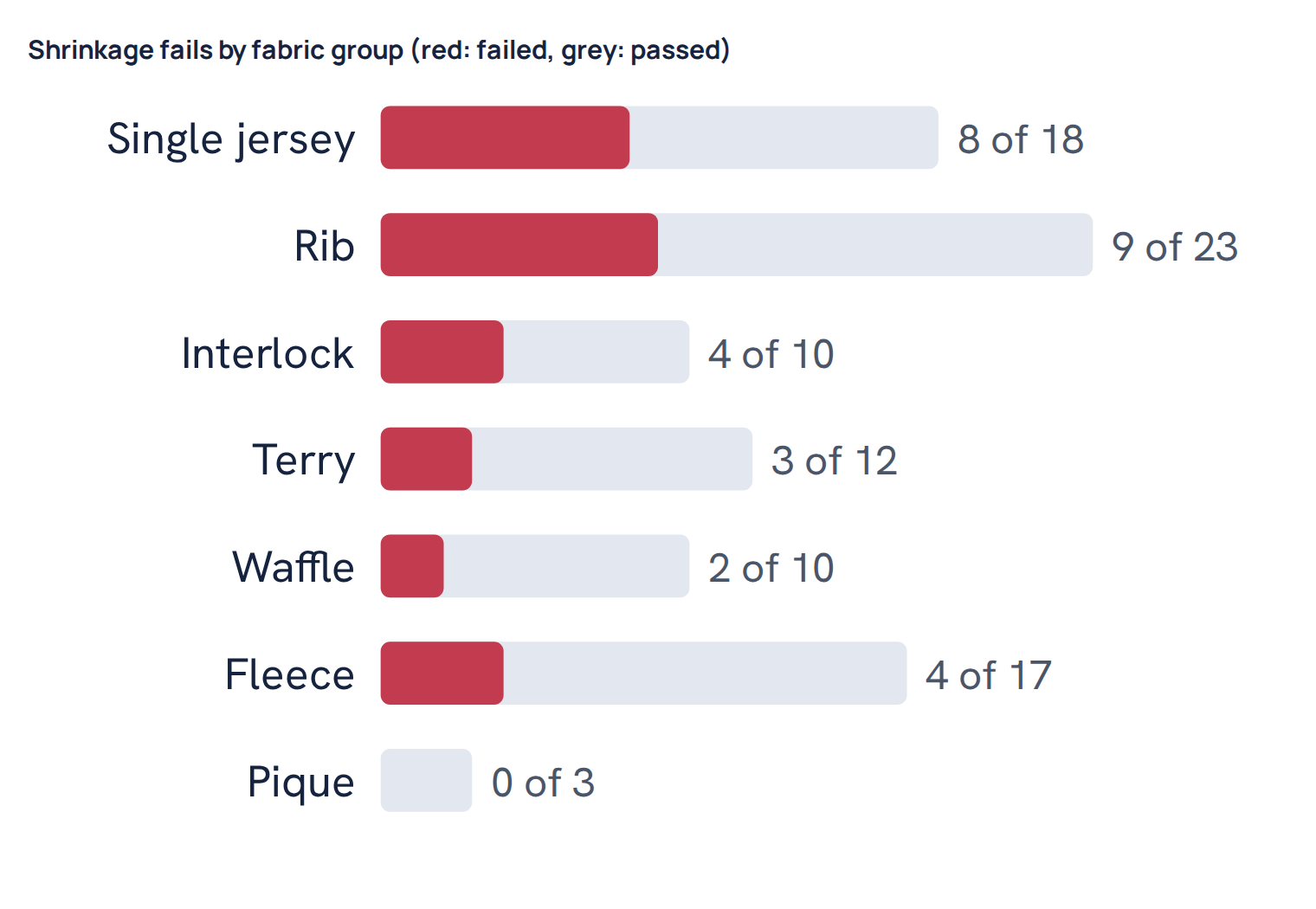
Which fabrics fail
What goes out of limit
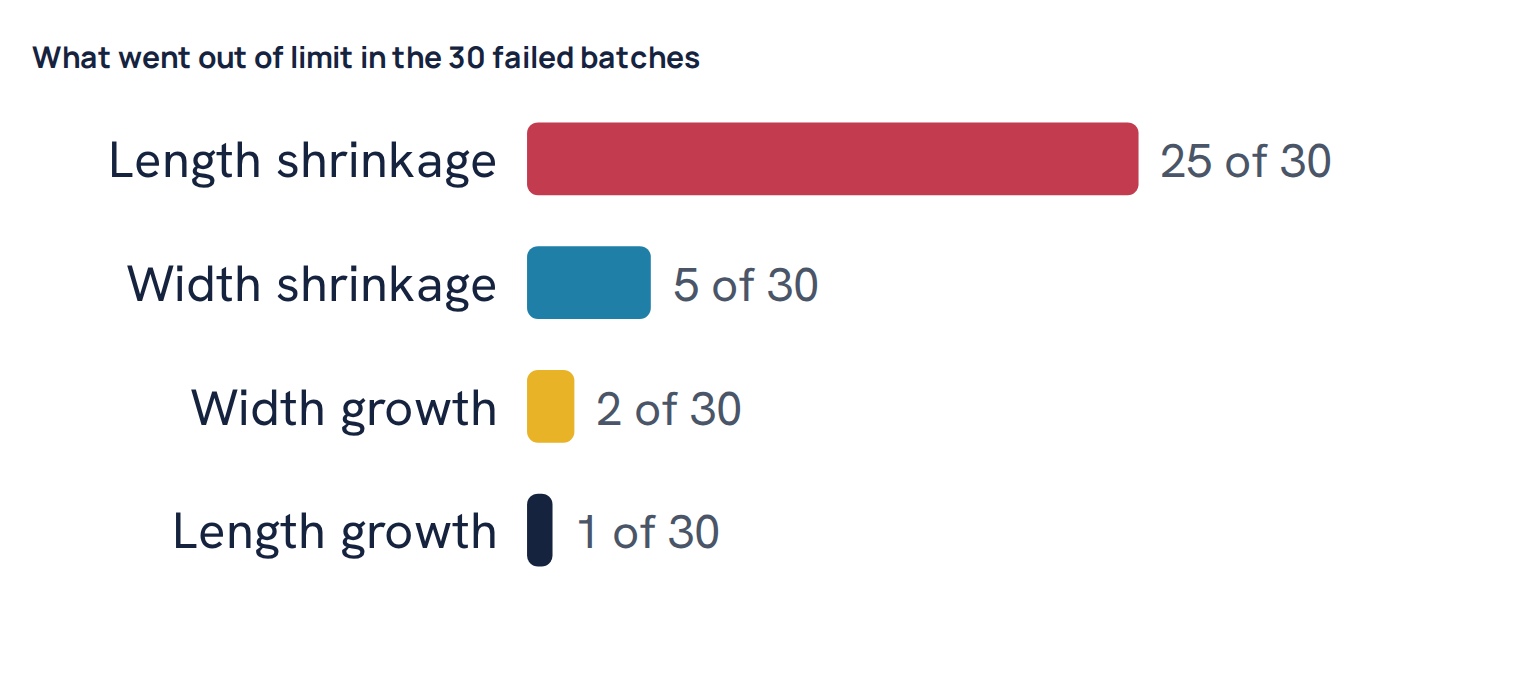
Length is the problem in almost every case. Knit fabric is pulled in length all through processing: on the winch or jet during dyeing, through the squeezer or hydro-extractor, and on the stenter. Unless that length is given back by overfeed and compaction, it comes back in the first wash.
Width follows how the fabric was finished. Where the fabric was finished wider than required it shrank in width; where it was finished narrower it grew. Of the batches that failed on width, 4 shrank after being finished wider than required, and 2 grew after being finished narrower.
Heat setting and singeing
| Pre-treatment | Failed | Rate |
|---|---|---|
| Heat set | 8 of 28 | 28% |
| Singed only | 8 of 17 | 47% |
| Neither | 14 of 48 | 29% |
Heat-set batches failed about as often as batches with no pre-treatment. Heat setting fixes the elastane and the width before dyeing, but it cannot protect the fabric from the length tension added afterwards, in dyeing and on the stenter. That tension has to be released in finishing, whatever the pre-treatment. Lycra fabrics show the same: 7 of 20 heat-set Lycra batches failed, and 4 of 16 that were not heat set.
The factory tumble test is the early warning
Every batch gets a quick tumble shrinkage test in the factory before delivery. Tumble drying is harsher than the line drying most labs use, so the factory figure usually reads more shrinkage than the lab finds, and many batches passed in the lab with −6% to −8% on the factory sheet. But the factory figure still sorts the risk:
| Factory tumble | Failed in lab | Rate |
|---|---|---|
| Over −5% | 23 of 49 | 46% |
| −5% or less | 7 of 43 | 16% |
25 of the 30 failed batches were already beyond −5% in the factory tumble test. A batch in that zone needs a second check, washed and line dried like the lab does, before it goes out.
How to read each case
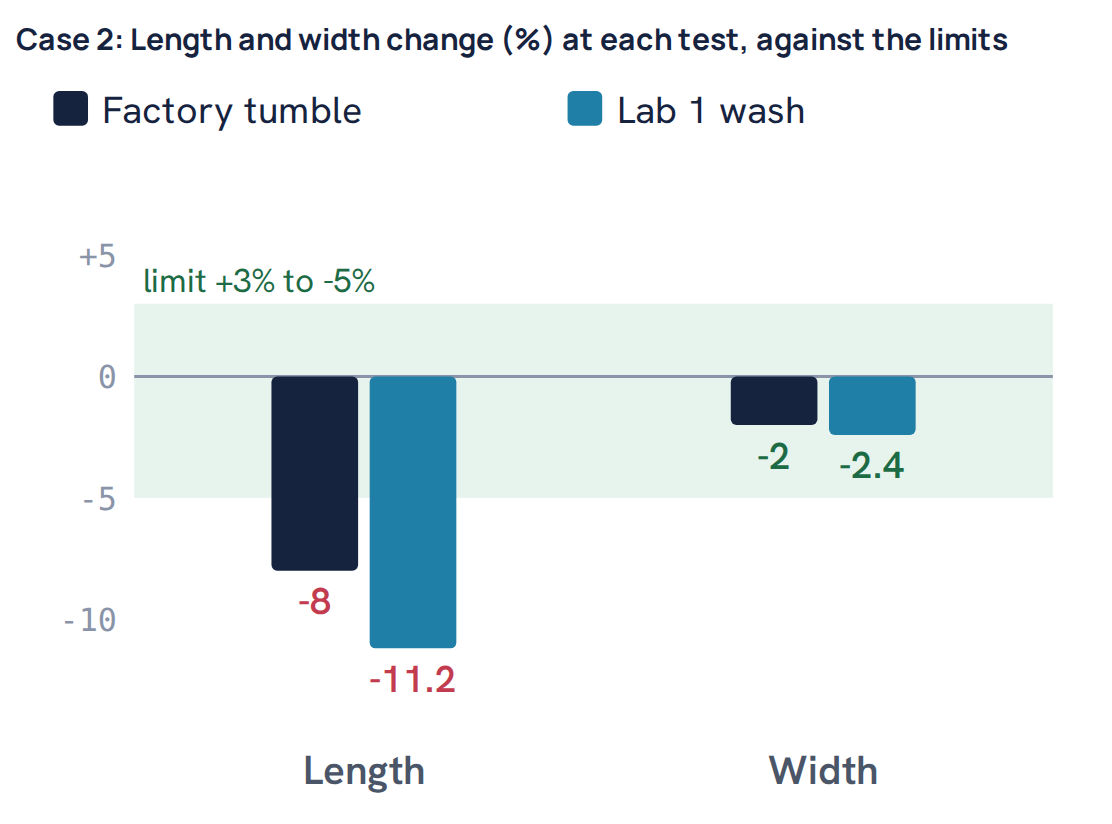
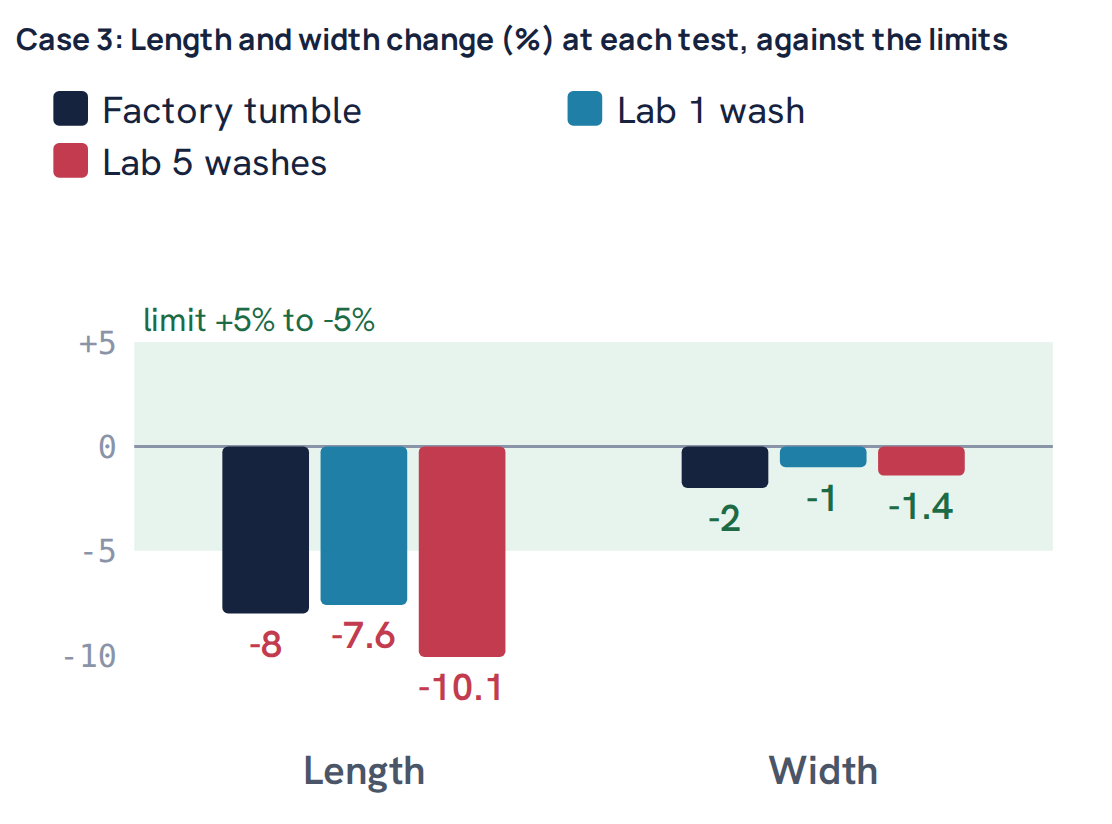
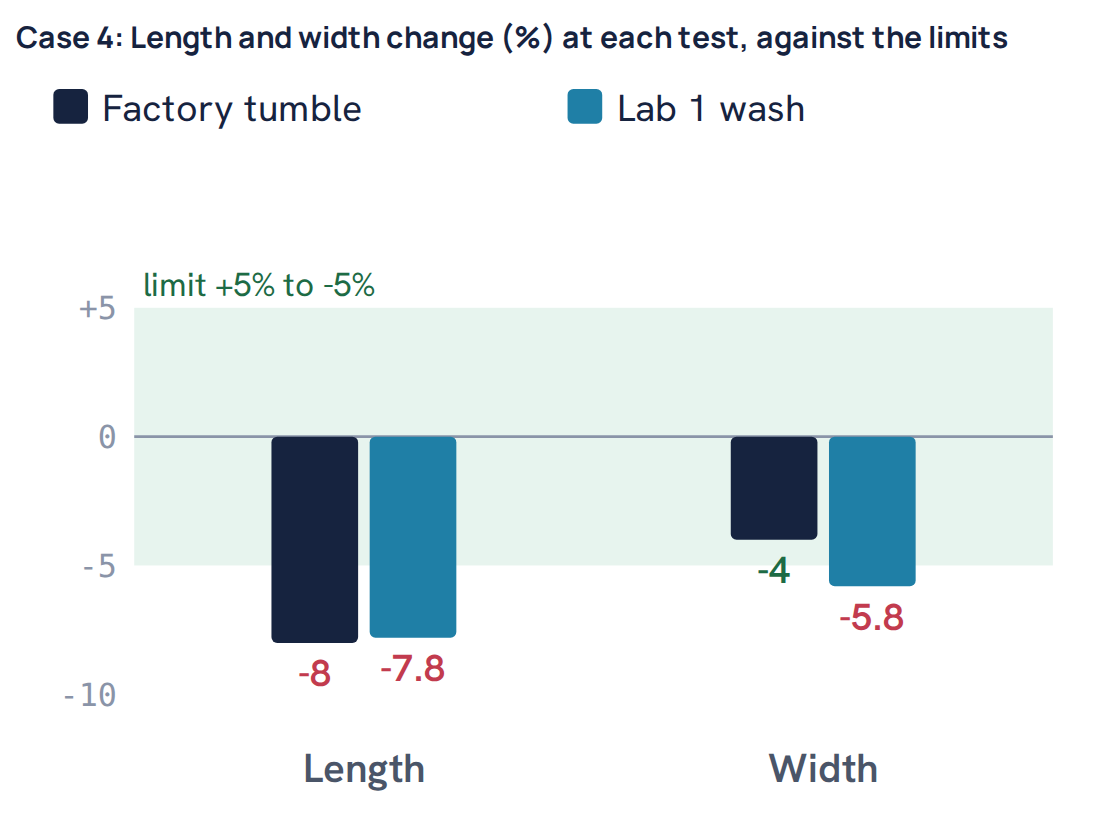
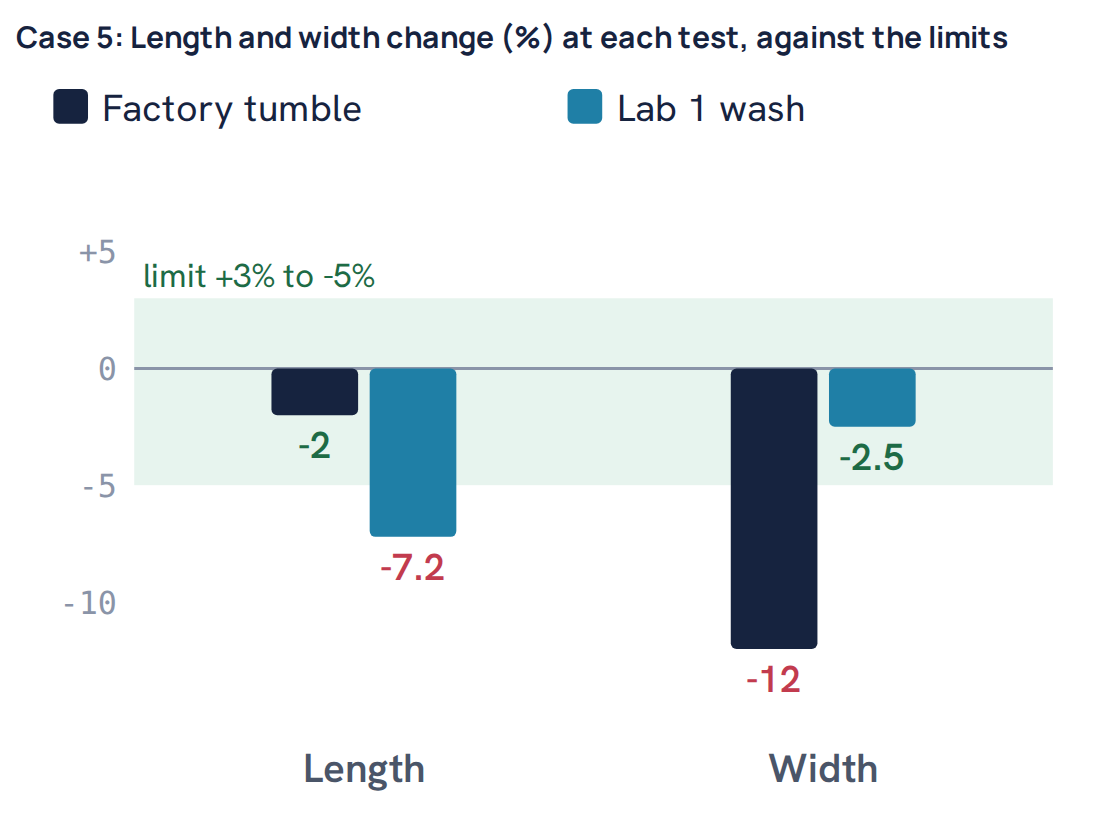
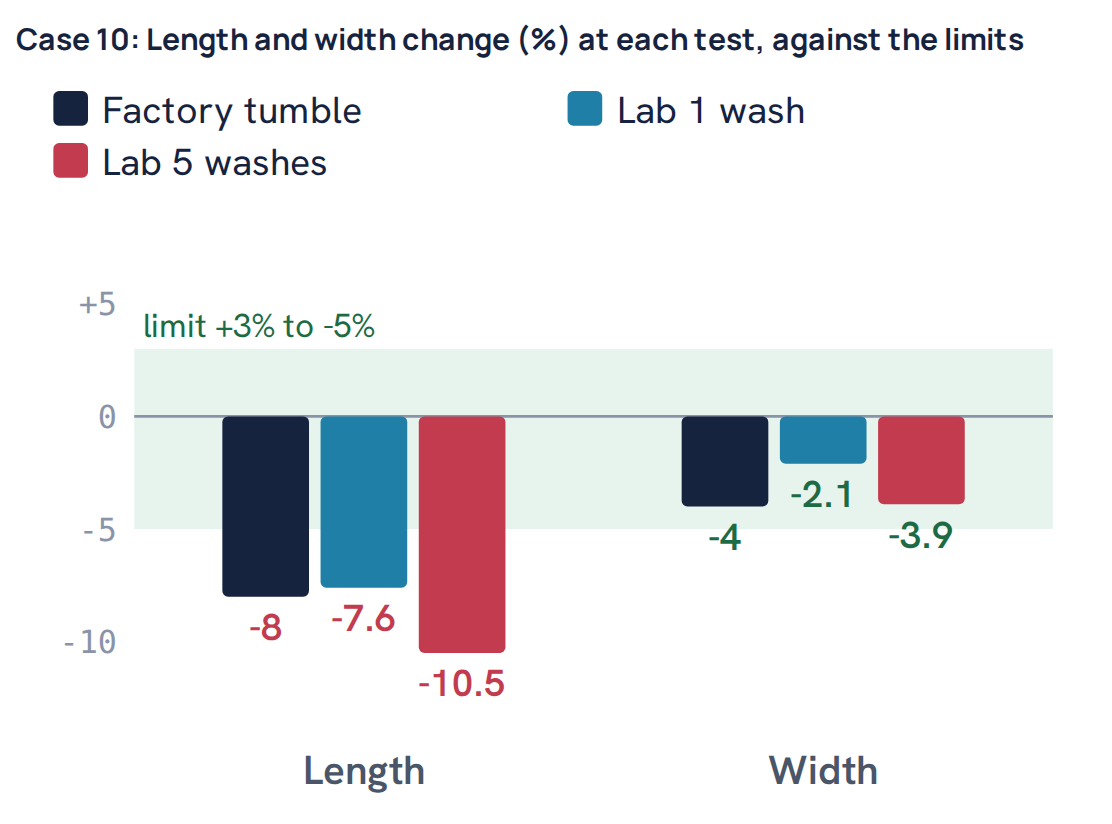
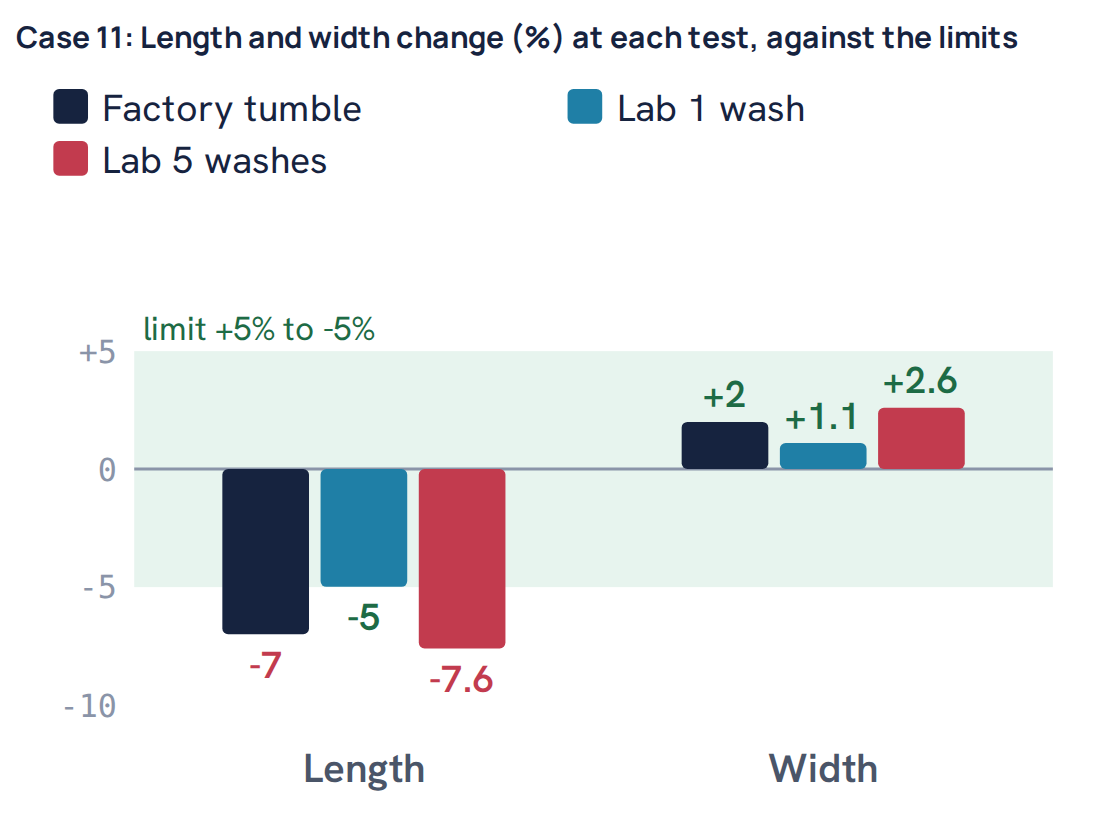
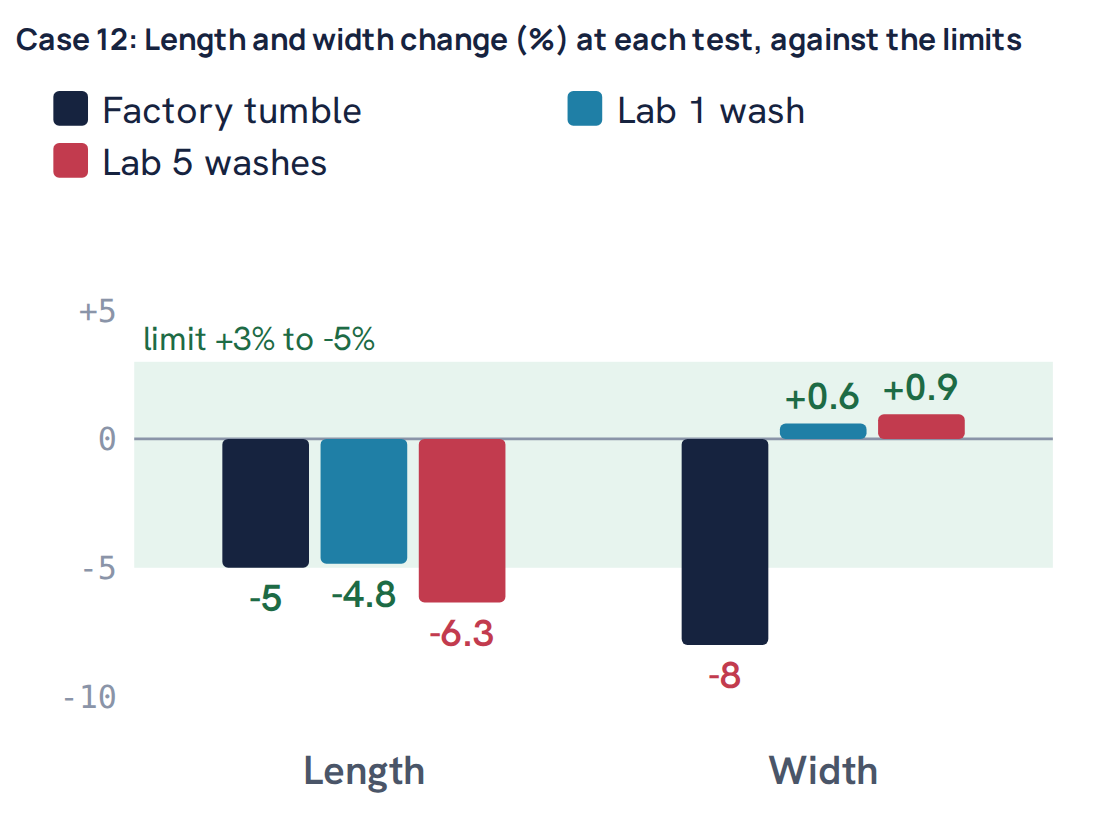
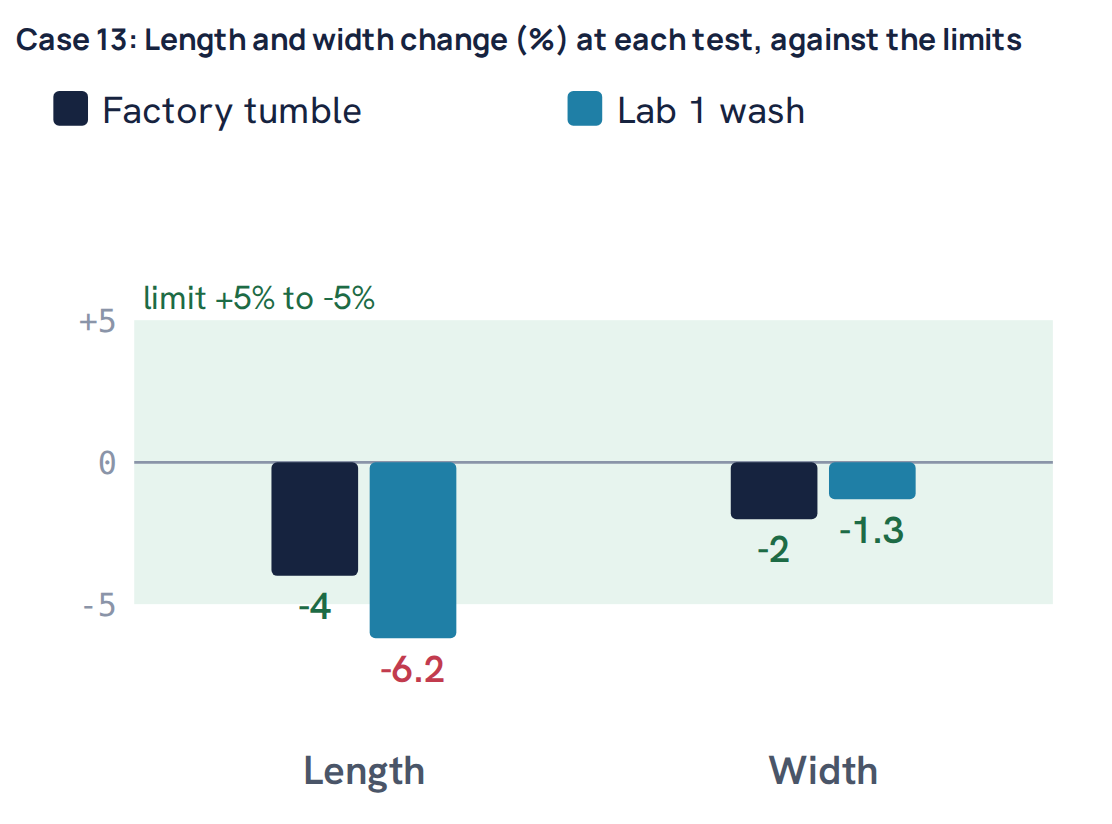
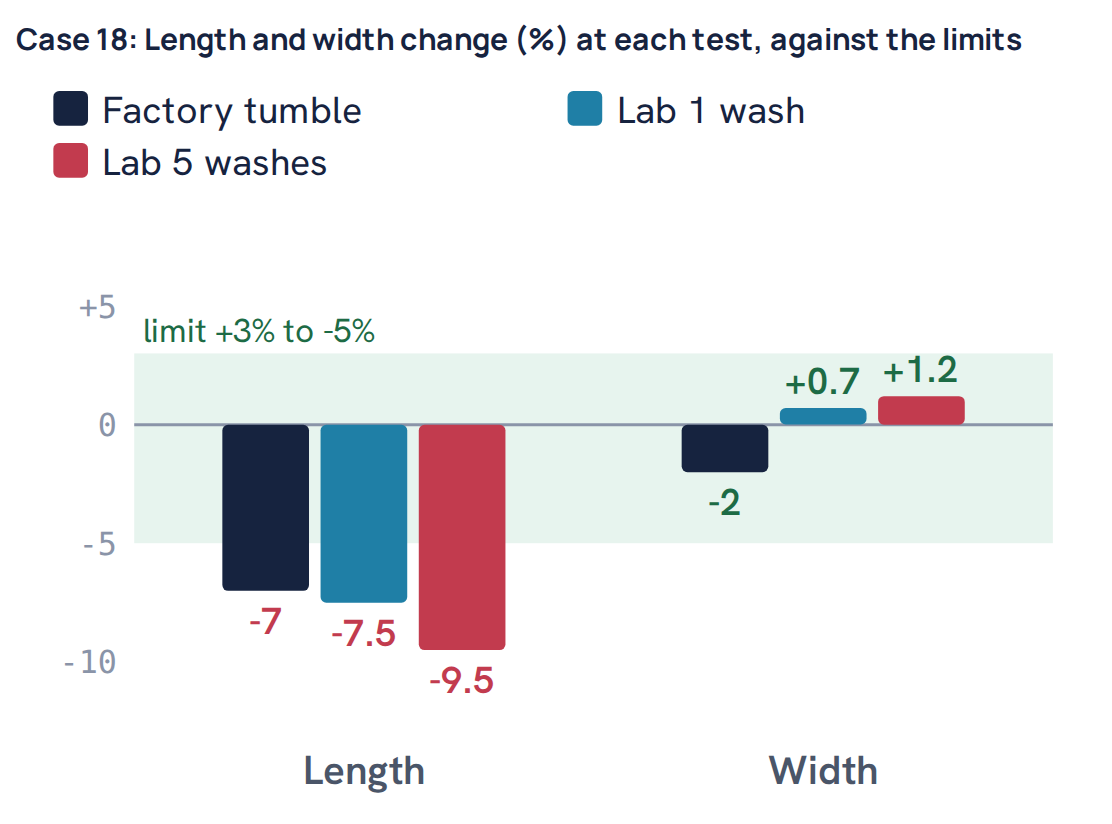
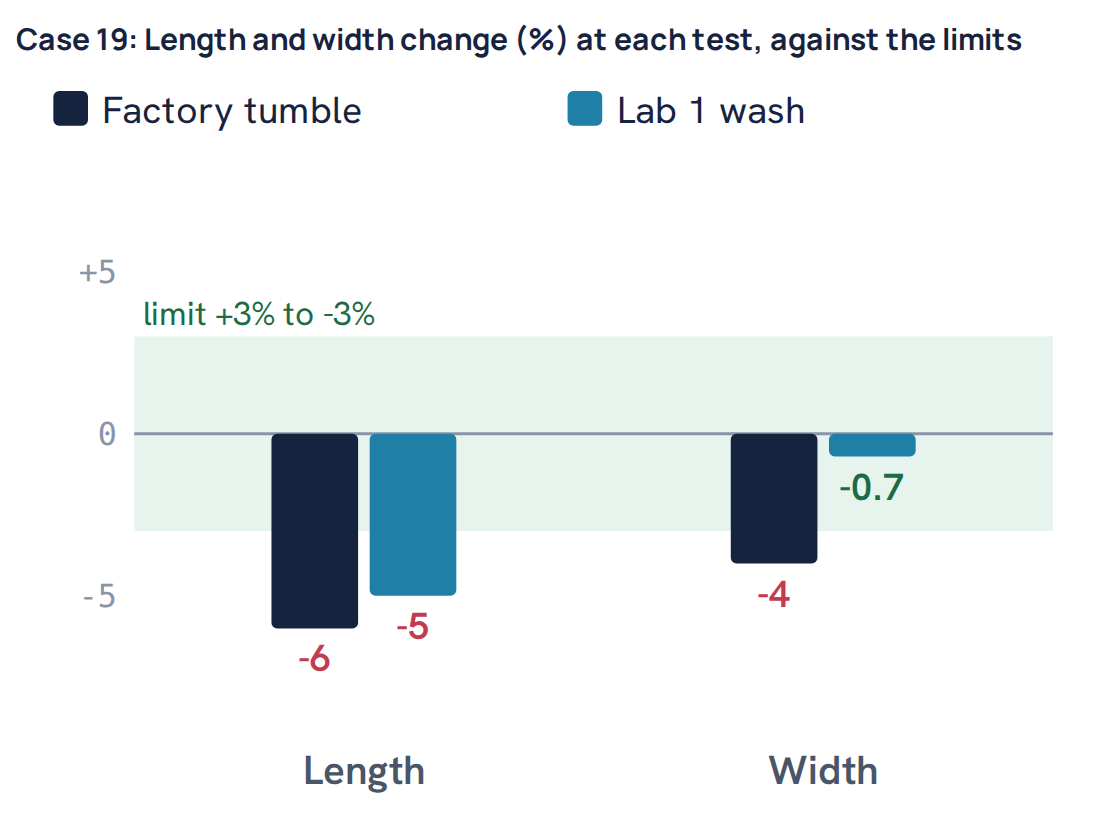
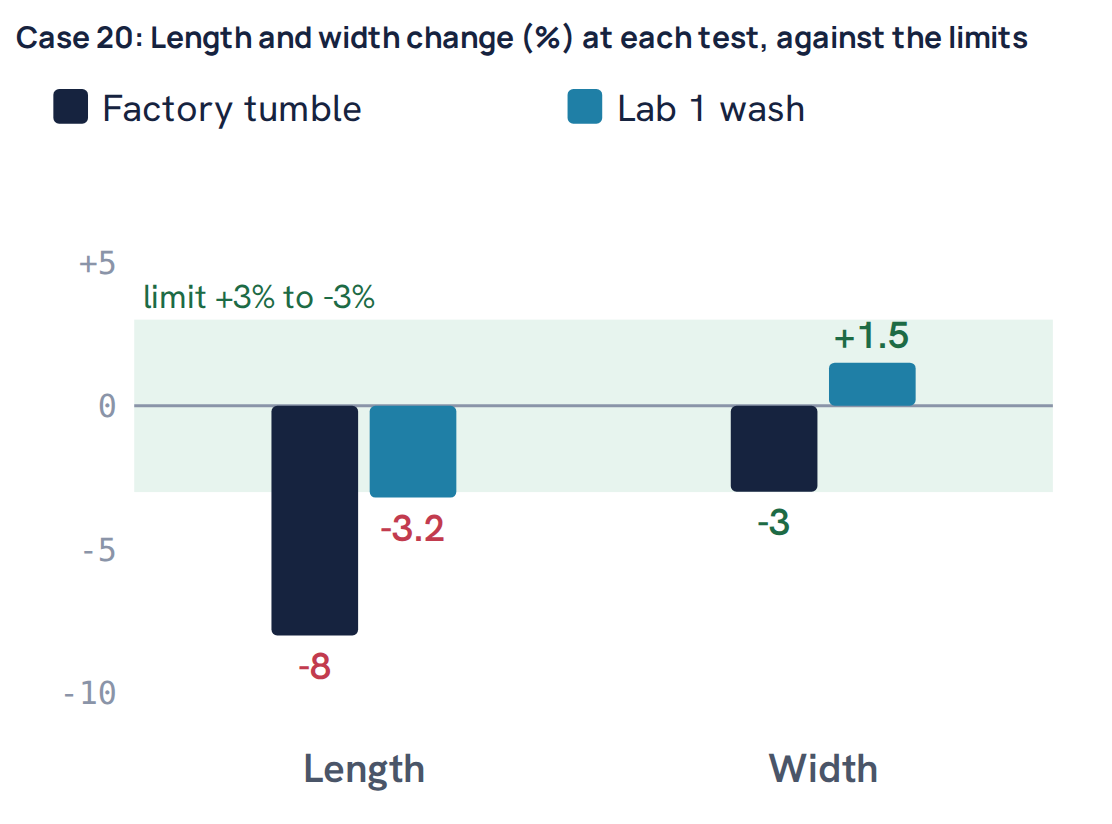
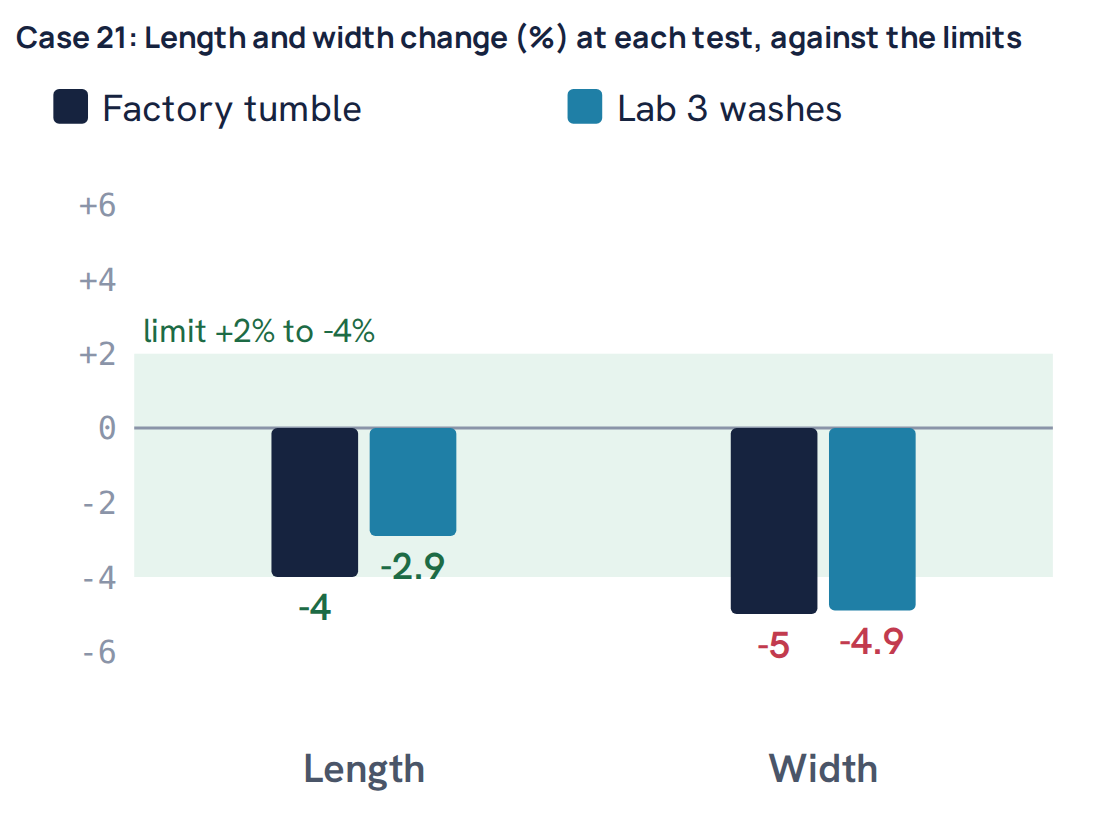
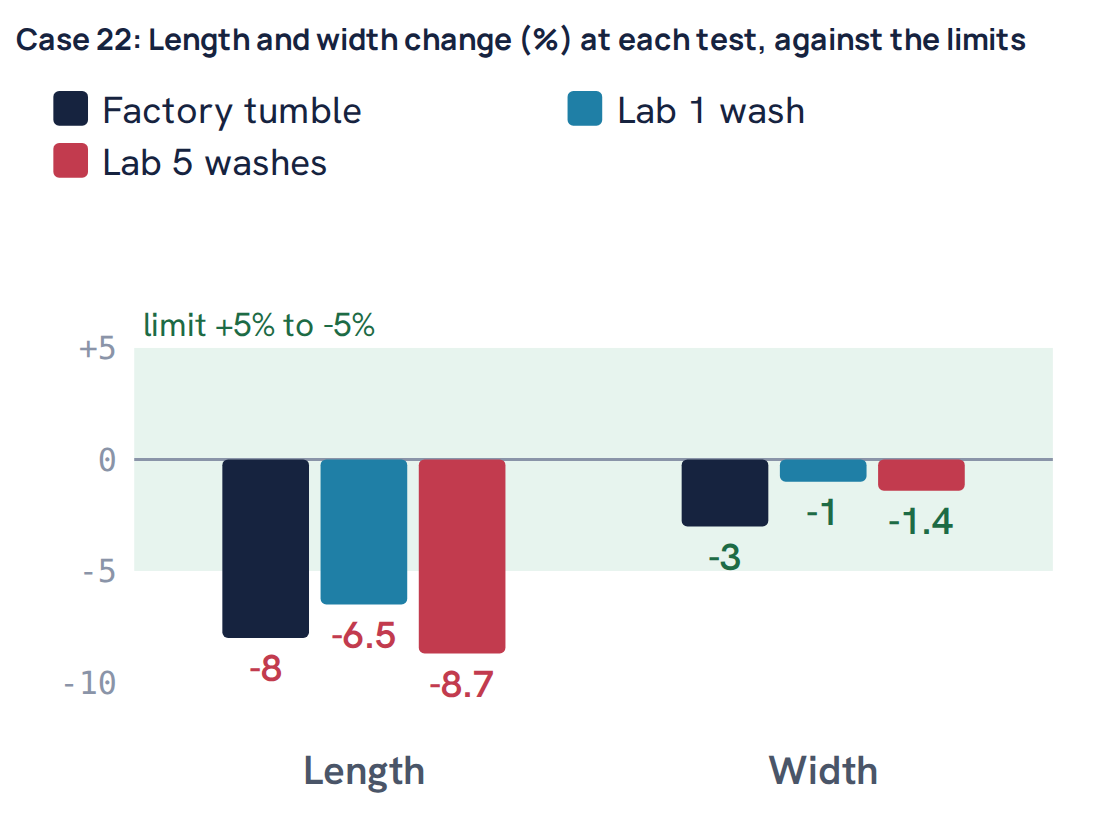
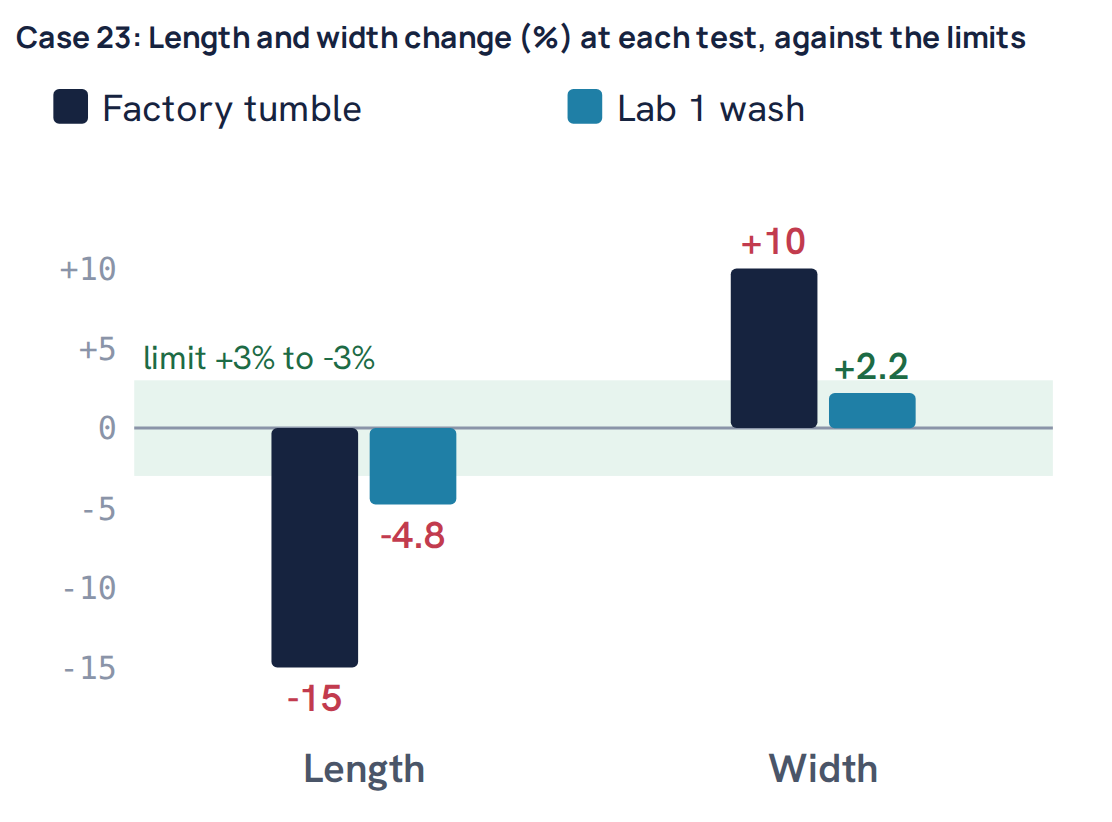
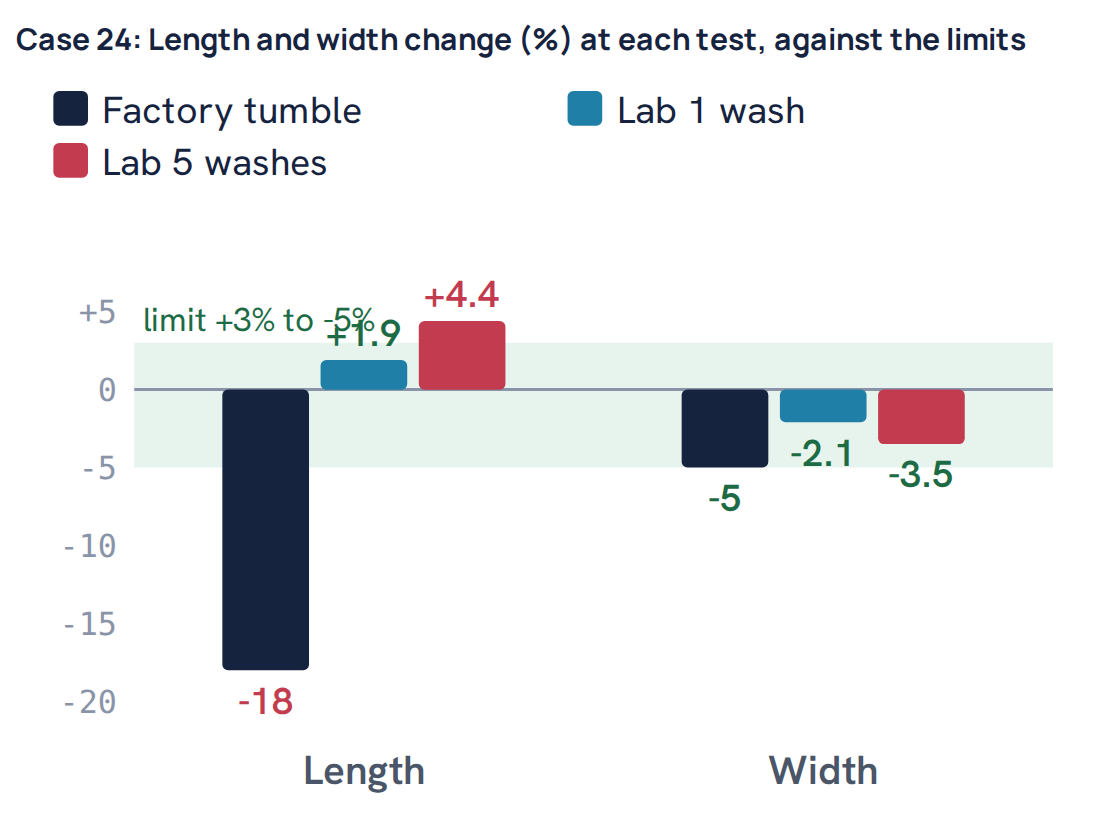
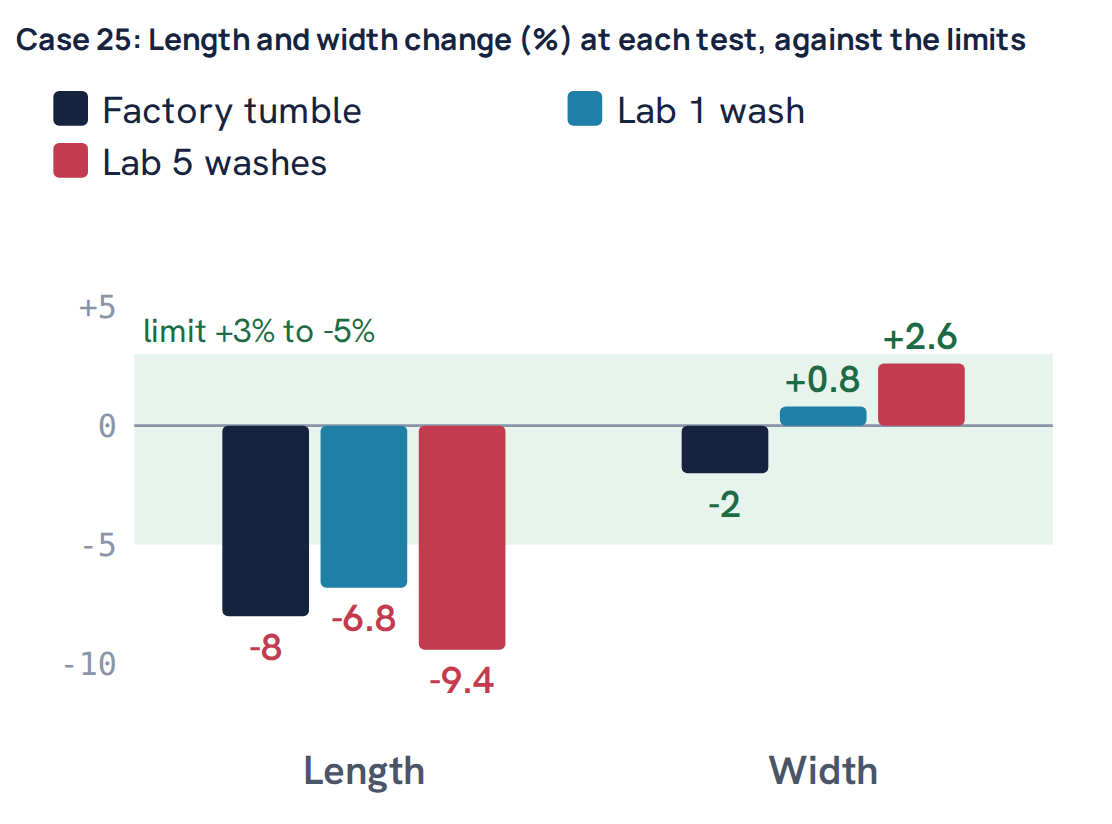
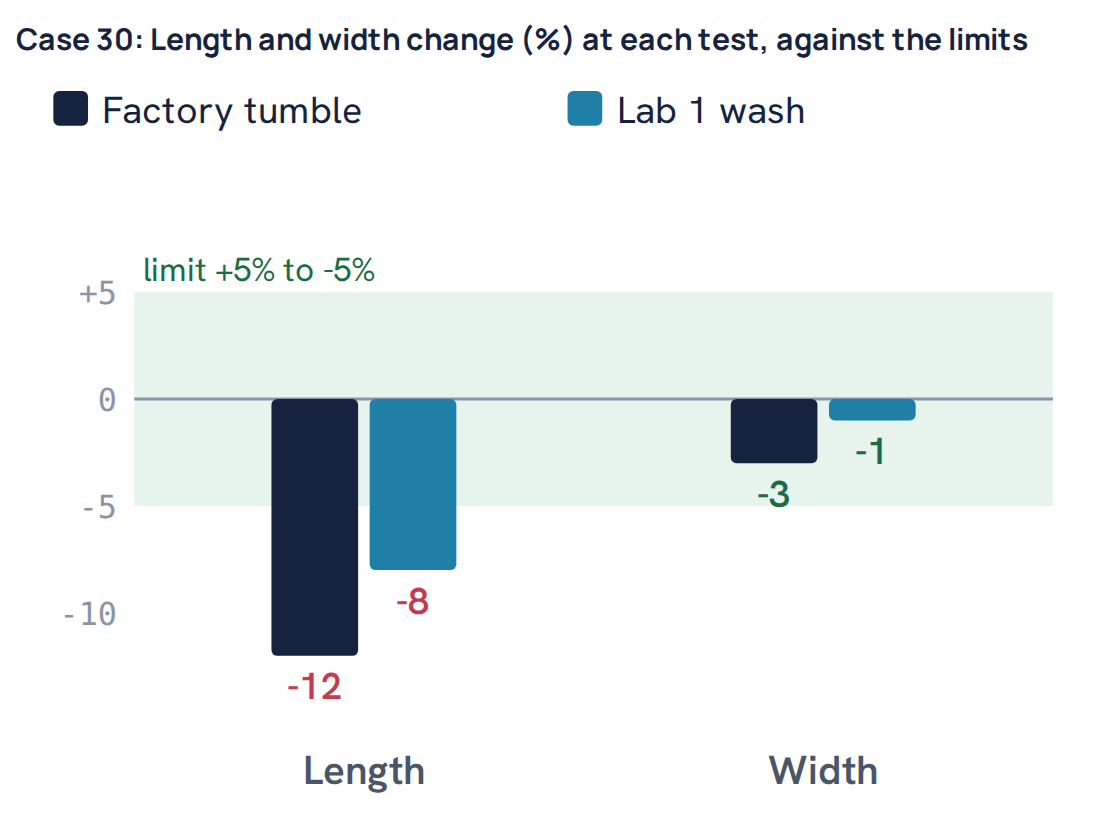
Each case shows the fabric as it was knitted, the route it took through dyeing and finishing, and the shrinkage at each test: the factory tumble test, then the lab after one wash and, where tested, after five washes (or three for AATCC 135). In the chart, the green band is the buyer’s limit; a red value is out of limit.
Single jersey: 8 cases
Single jersey is dyed as a tube turned inside out unless it is heat set or singed; then it is slit, processed open width and back sewn before dyeing.
Case 1: Twill jersey, 190 GSM, length shrinkage
- Yarn: 30/1 combed + 30/1 combed
- Stitch length: 20
- Machine: 34″ × 24G
- Required: 180 cm, 190 GSM
- Finished: 177 cm, 175 GSM
Lab test: ISO 6330 / ISO 5077; Normal program, machine wash 40°C, line dry, 1 wash
Route: Greige → Slitting → Singeing → Back sewing → Dyeing → Stenter → Compacting
Results
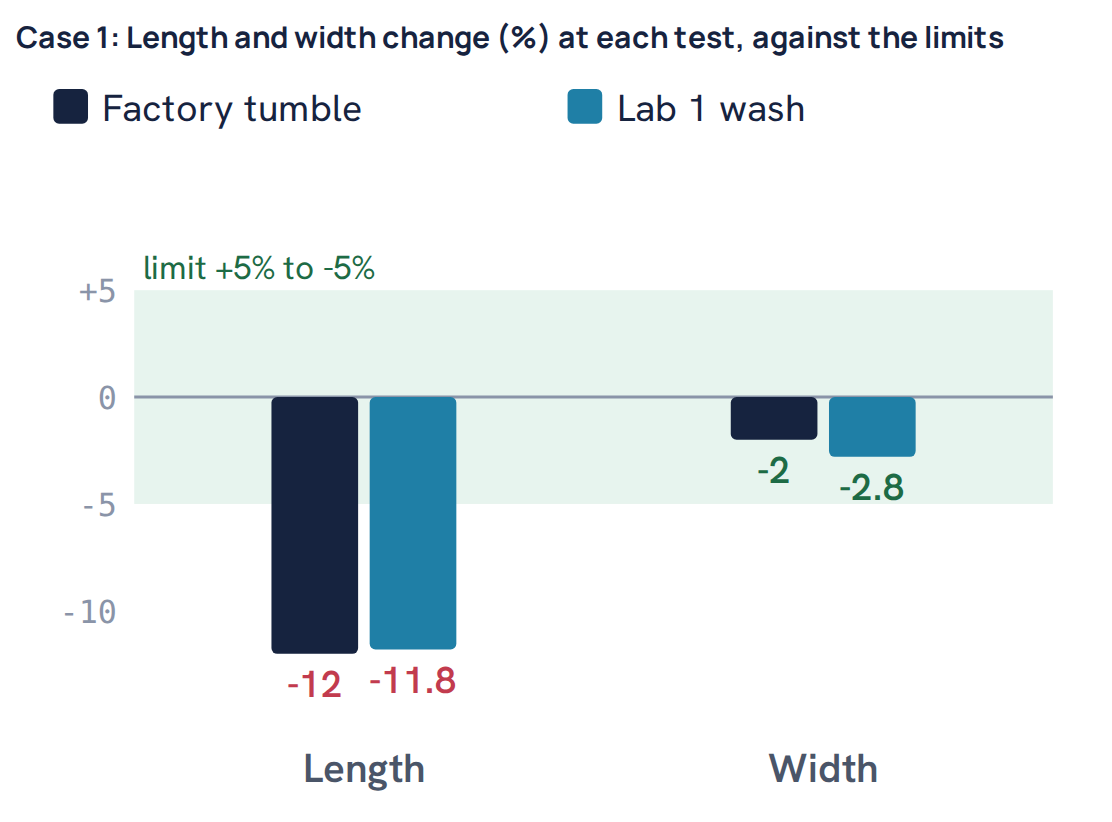
- Factory tumble: length -12%, width -2%
- Lab 1 wash: length -11.8%, width -2.8%
- Limit: -5% to +5%
- Spirality (tumble): 2%
Other tests that failed in the same lab report: GSM.
Cause and remedy
Cause: The factory tumble test already showed -12% in length. The batch left finishing with length tension still in it; the warning sign was on our own sheet before delivery.
Remedy: When the factory tumble shows more than 5% length shrinkage, run a wash and line-dry test the way the lab does before delivery, and reprocess on the stenter with more overfeed and re-compact if it is still out.
Remedy: Give the stenter more overfeed and raise compaction on the compactor, so the length taken out in dyeing is put back before delivery.
Case 2: Yarn-dyed single jersey, 150 GSM, length shrinkage
- Yarn: 34/1 cotton mélange + 34/1 cotton
- Stitch length: 30.2
- Machine: 36″ × 20G
- Required: 180 cm, 150 GSM
- Finished: 172 cm, 150 GSM
Lab test: ISO 6330 / ISO 5077; Normal cycle 40°C machine wash, tumble dry, 1 wash
Route: Greige → Slitting → Singeing → Back sewing → Dyeing → Stenter → Compacting
Results
- Factory tumble: length -8%, width -2%
- Lab 1 wash: length -11.2%, width -2.4%
- Limit: -5% to +3%
- Spirality (tumble): 3%
Other tests that failed in the same lab report: Spirality, GSM.
Cause and remedy
Cause: The factory tumble test already showed -8% in length. The batch left finishing with length tension still in it; the warning sign was on our own sheet before delivery.
Remedy: When the factory tumble shows more than 5% length shrinkage, run a wash and line-dry test the way the lab does before delivery, and reprocess on the stenter with more overfeed and re-compact if it is still out.
Remedy: Give the stenter more overfeed and raise compaction on the compactor, so the length taken out in dyeing is put back before delivery.
Case 3: Single jersey, 240 GSM, length shrinkage
- Yarn: 12/1 mélange 88% cotton + 12% viscose
- Stitch length: 44.5
- Machine: 34″ × 16G
- Required: 187 cm, 240 GSM
- Finished: 188 cm, 228 GSM
Lab test: Buyer in-house method; Machine wash 40°C, line dry, 1 wash
Route: Greige → Dyeing → Stenter → Compacting
Results
- Factory tumble: length -8%, width -2%
- Lab 1 wash: length -7.6%, width -1%
- Lab 5 washes: length -10.1%, width -1.4%
- Limit: -5% to +5%
- Spirality (tumble): 3%
Other tests that failed in the same lab report: none.
Cause and remedy
Cause: The factory tumble test already showed -8% in length. The batch left finishing with length tension still in it; the warning sign was on our own sheet before delivery.
Remedy: When the factory tumble shows more than 5% length shrinkage, run a wash and line-dry test the way the lab does before delivery, and reprocess on the stenter with more overfeed and re-compact if it is still out.
Remedy: Give the stenter more overfeed and raise compaction on the compactor, so the length taken out in dyeing is put back before delivery.
Case 4: Yarn-dyed twill jersey, 190 GSM, length shrinkage and width shrinkage
- Yarn: 30/1 cotton yarn-dyed + 30/1 cotton yarn-dyed
- Stitch length: 20
- Machine: 34″ × 24G
- Required: 180 cm, 190 GSM
- Finished: 185 cm, 180 GSM
Lab test: ISO 6330 / ISO 5077; Normal program, machine wash 40°C, line dry, 1 wash
Route: Greige → Slitting → Singeing → Back sewing → Dyeing → Stenter → Compacting
Results
- Factory tumble: length -8%, width -4%
- Lab 1 wash: length -7.8%, width -5.8%
- Limit: -5% to +5%
- Spirality (tumble): 3%
Other tests that failed in the same lab report: GSM.
Cause and remedy
Cause: The factory tumble test already showed -8% in length. The batch left finishing with length tension still in it; the warning sign was on our own sheet before delivery.
Cause: It was finished 5 cm wider than required (185 against 180). The extra width was pulled out on the stenter and came back in the wash: width shrinkage -5.8%.
Remedy: When the factory tumble shows more than 5% length shrinkage, run a wash and line-dry test the way the lab does before delivery, and reprocess on the stenter with more overfeed and re-compact if it is still out.
Remedy: Give the stenter more overfeed and raise compaction on the compactor, so the length taken out in dyeing is put back before delivery.
Remedy: Finish at the required width, not wider. If the greige cannot reach the width relaxed, change the knitting (machine diameter or stitch length), not the stenter setting.
Case 5: Single jersey, 180 GSM, length shrinkage
- Yarn: 24/1 cotton mélange
- Stitch length: 28
- Machine: 28″ × 24G
- Required: 150 cm, 180 GSM
- Finished: 152 cm, 165 GSM
Lab test: ISO 6330 / ISO 5077; Normal cycle 40°C machine wash, tumble dry, 1 wash
Route: Greige → Dyeing → Stenter → Compacting
Results
- Factory tumble: length -2%, width -12%
- Lab 1 wash: length -7.2%, width -2.5%
- Limit: -5% to +3%
- Spirality (tumble): 2%
Other tests that failed in the same lab report: none.
Cause and remedy
Cause: The fabric was stretched in length during wet processing and finishing, and the stenter and compactor did not put that length back. In the lab it shrank -7.2% in length.
Remedy: Give the stenter more overfeed and raise compaction on the compactor, so the length taken out in dyeing is put back before delivery.
Remedy: Check length shrinkage on a factory wash and line dry, the same way the lab tests it, not only on the quick tumble test.
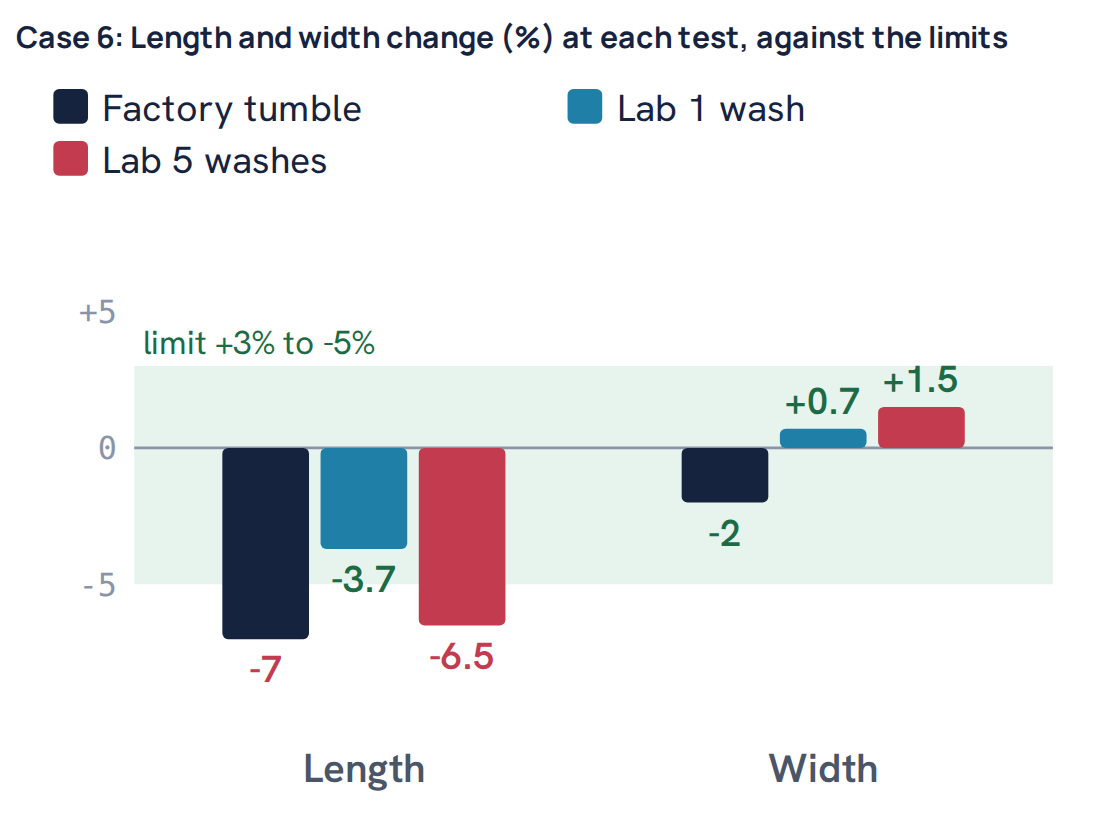
Case 6: Lycra single jersey, 180 GSM, length shrinkage
- Yarn: 34/1 organic cotton + 30D Lycra
- Stitch length: 29
- Machine: 30″ × 28G
- Required: 180 cm, 180 GSM
- Finished: 180 cm, 168 GSM
Lab test: ISO 6330 / ISO 5077; Normal cycle 40°C, tumble dry, 1 wash
Route: Greige → Slitting → Heat setting → Singeing → Back sewing → Dyeing → Stenter → Compacting
Results
- Factory tumble: length -7%, width -2%
- Lab 1 wash: length -3.7%, width +0.7%
- Lab 5 washes: length -6.5%, width +1.5%
- Limit: -5% to +3%
- Spirality (tumble): 2%
Other tests that failed in the same lab report: Bursting strength, GSM.
Cause and remedy
Cause: The factory tumble test already showed -7% in length. The batch left finishing with length tension still in it; the warning sign was on our own sheet before delivery.
Cause: It was heat set, so the elastane was fixed; the shrinkage came from length tension added after heat setting, in dyeing and on the stenter.
Cause: It passed after one wash (-3.7%) and failed after 5 washes (-6.5%). The shrinkage kept going wash after wash: the fabric was not fully relaxed when it was finished.
Remedy: When the factory tumble shows more than 5% length shrinkage, run a wash and line-dry test the way the lab does before delivery, and reprocess on the stenter with more overfeed and re-compact if it is still out.
Remedy: Run the dyeing with lower reel speed and nozzle pressure, and give the stenter maximum overfeed so the length tension is released before compacting.
Remedy: Give the stenter more overfeed and raise compaction on the compactor, so the length taken out in dyeing is put back before delivery.
Case 7: Yarn-dyed heavy jersey, 240 GSM, length shrinkage
- Yarn: 16/1 combed yarn-dyed
- Stitch length: 32.5
- Machine: 36″ × 20G
- Required: 175 cm, 240 GSM
- Finished: 170 cm, 226 GSM
Lab test: AATCC 135; Normal cycle, 41±3°C, tumble dry low, 3 washes
Route: Greige → Slitting → Singeing → Back sewing → Dyeing → Stenter → Compacting
Results
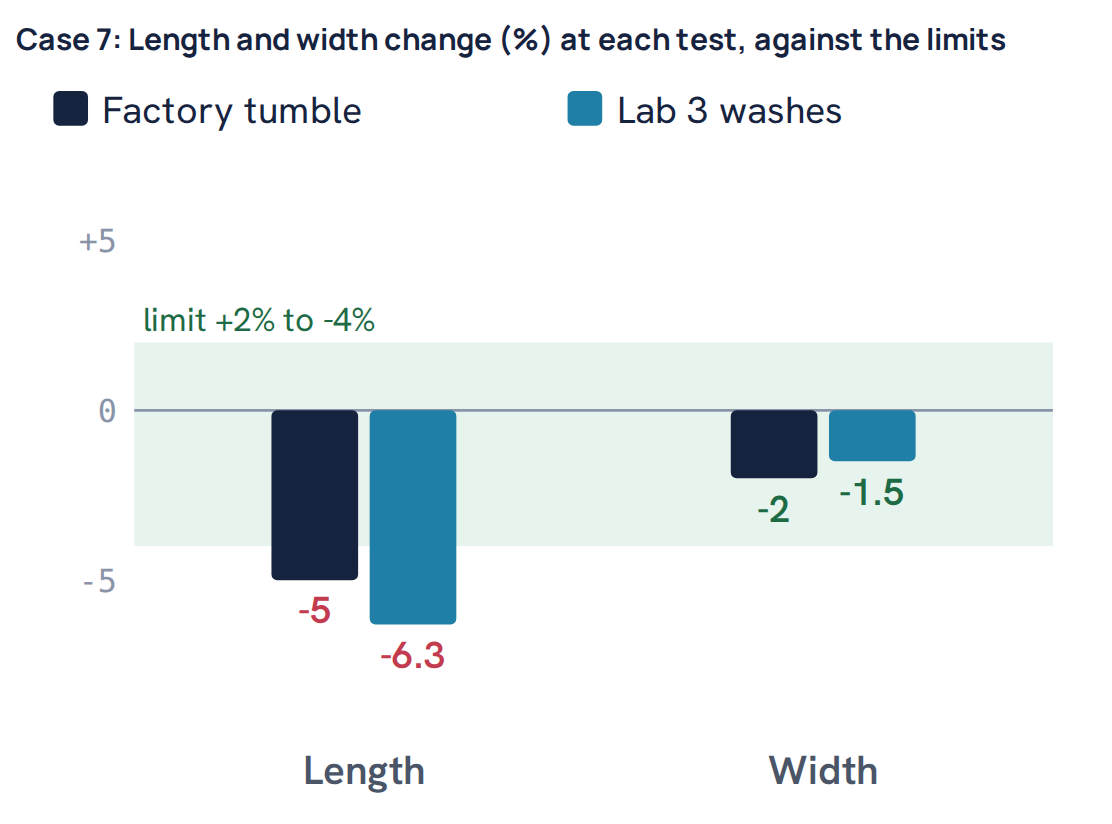
- Factory tumble: length -5%, width -2%
- Lab 3 washes: length -6.3%, width -1.5%
- Limit: -4% to +2%
- Spirality (tumble): 3%
Other tests that failed in the same lab report: none.
Cause and remedy
Cause: The factory tumble test already showed -5% in length. The batch left finishing with length tension still in it; the warning sign was on our own sheet before delivery.
Remedy: When the factory tumble shows more than 5% length shrinkage, run a wash and line-dry test the way the lab does before delivery, and reprocess on the stenter with more overfeed and re-compact if it is still out.
Remedy: Give the stenter more overfeed and raise compaction on the compactor, so the length taken out in dyeing is put back before delivery.
Case 8: Yarn-dyed single jersey, 280 GSM, width shrinkage
- Yarn: 26/2 ply cotton yarn-dyed
- Stitch length: 37
- Machine: 34″ × 16G
- Required: 155 cm, 280 GSM
- Finished: 170 cm, 258 GSM
Lab test: ISO 6330 / ISO 5077; Normal program 4N, 40°C, line dry, 1 wash
Route: Greige → Slitting → Singeing → Back sewing → Dyeing → Stenter → Compacting
Results
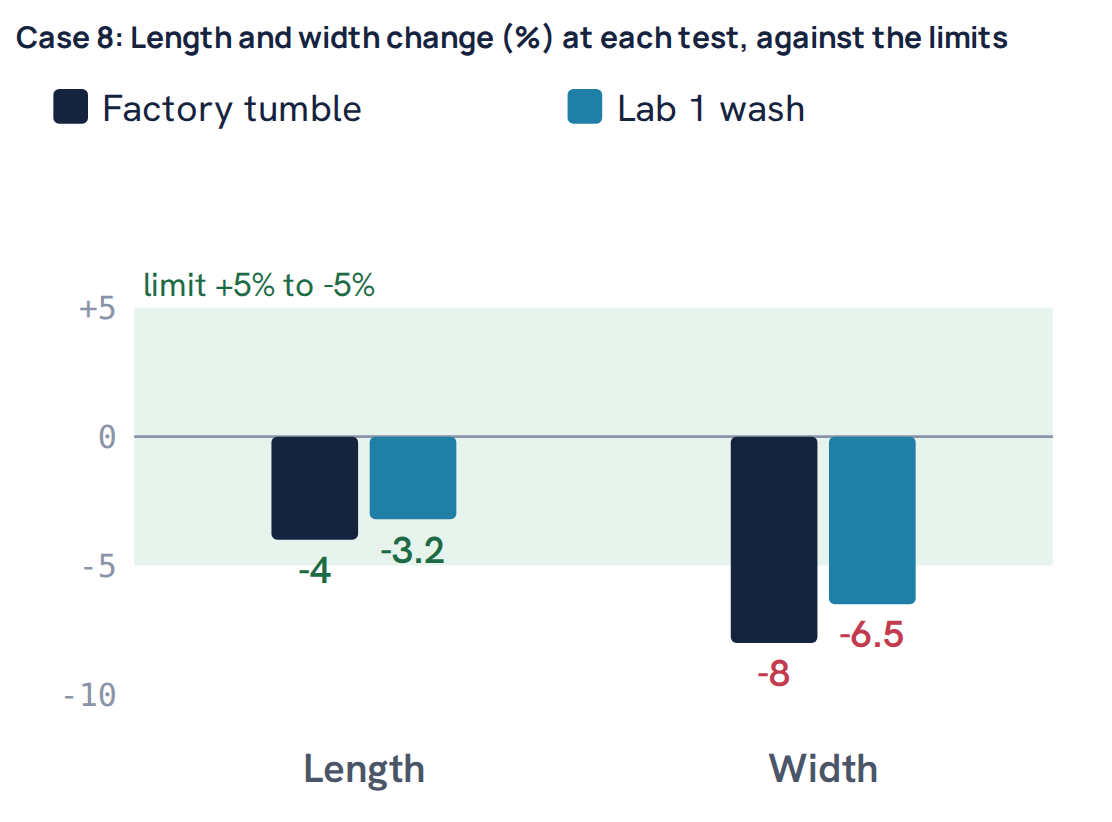
- Factory tumble: length -4%, width -8%
- Lab 1 wash: length -3.2%, width -6.5%
- Limit: -5% to +5%
- Spirality (tumble): 2%
Other tests that failed in the same lab report: Rubbing fastness, Light fastness, GSM.
Cause and remedy
Cause: It was finished 15 cm wider than required (170 against 155). The extra width was pulled out on the stenter and came back in the wash: width shrinkage -6.5%.
Remedy: Finish at the required width, not wider. If the greige cannot reach the width relaxed, change the knitting (machine diameter or stitch length), not the stenter setting.
Rib: 9 cases
Rib is a stable double knit. It is heat set only when heavy, tight, Lycra body rib or a design rib that needs its width fixed.
Case 9: Yarn-dyed 2×1 lycra rib, 215 GSM, length shrinkage
- Yarn: 34/1 organic cotton yarn-dyed + 30D Lycra
- Stitch length: 28
- Machine: 36″ × 18G
- Required: 115 cm, 215 GSM
- Finished: 112 cm, 202 GSM
Lab test: ISO 6330 / ISO 5077; Normal cycle, 40°C, line dry, one wash
Route: Greige → Dyeing → Stenter → Compacting
Results
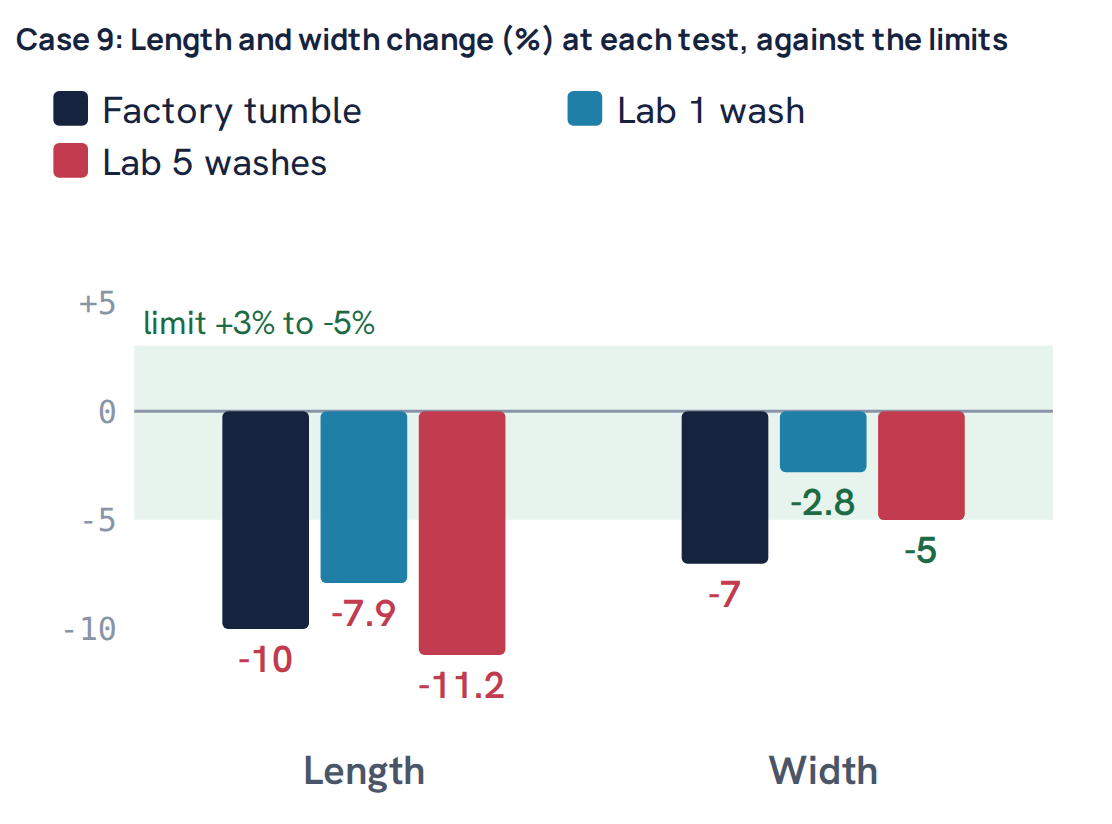
- Factory tumble: length -10%, width -7%
- Lab 1 wash: length -7.9%, width -2.8%
- Lab 5 washes: length -11.2%, width -5%
- Limit: -5% to +3%
- Spirality (tumble): 2%
Other tests that failed in the same lab report: Bursting strength.
Cause and remedy
Cause: The factory tumble test already showed -10% in length. The batch left finishing with length tension still in it; the warning sign was on our own sheet before delivery.
Cause: It carries Lycra but was not heat set. Without heat setting, the elastane keeps pulling the fabric back in length after every wash.
Remedy: When the factory tumble shows more than 5% length shrinkage, run a wash and line-dry test the way the lab does before delivery, and reprocess on the stenter with more overfeed and re-compact if it is still out.
Remedy: Heat set every Lycra body fabric before dyeing, at the required width, so the dimensions are fixed before wet processing.
Remedy: Give the stenter more overfeed and raise compaction on the compactor, so the length taken out in dyeing is put back before delivery.
Case 10: Lycra pointelle rib, 240 GSM, length shrinkage
- Yarn: 30/1 organic cotton + 30D Lycra
- Stitch length: 3.1
- Machine: 34″ × 18G
- Required: 170 cm, 240 GSM
- Finished: 165 cm, 210 GSM
Lab test: ISO 6330 / ISO 5077; Normal cycle 40°C machine wash, line dry, 1 wash
Route: Greige → Slitting → Heat setting → Back sewing → Dyeing → Stenter → Compacting
Results
- Factory tumble: length -8%, width -4%
- Lab 1 wash: length -7.6%, width -2.1%
- Lab 5 washes: length -10.5%, width -3.9%
- Limit: -5% to +3%
- Spirality (tumble): 2%
Other tests that failed in the same lab report: GSM.
Cause and remedy
Cause: The factory tumble test already showed -8% in length. The batch left finishing with length tension still in it; the warning sign was on our own sheet before delivery.
Cause: It was heat set, so the elastane was fixed; the shrinkage came from length tension added after heat setting, in dyeing and on the stenter.
Remedy: When the factory tumble shows more than 5% length shrinkage, run a wash and line-dry test the way the lab does before delivery, and reprocess on the stenter with more overfeed and re-compact if it is still out.
Remedy: Run the dyeing with lower reel speed and nozzle pressure, and give the stenter maximum overfeed so the length tension is released before compacting.
Remedy: Give the stenter more overfeed and raise compaction on the compactor, so the length taken out in dyeing is put back before delivery.
Case 11: Slub design rib, 230 GSM, length shrinkage
- Yarn: 22/1 cotton slub
- Stitch length: 23+27
- Machine: 36″ × 20G
- Required: 155 cm, 230 GSM
- Finished: 160 cm, 240 GSM
Lab test: Buyer in-house method; Very mild cycle, machine wash 40°C, line dry, 1 wash
Route: Greige → Dyeing → Stenter → Compacting
Results
- Factory tumble: length -7%, width +2%
- Lab 1 wash: length -5%, width +1.1%
- Lab 5 washes: length -7.6%, width +2.6%
- Limit: -5% to +5%
- Spirality (tumble): 3%
Other tests that failed in the same lab report: Spirality, GSM.
Cause and remedy
Cause: The factory tumble test already showed -7% in length. The batch left finishing with length tension still in it; the warning sign was on our own sheet before delivery.
Cause: This is a texture structure: it was opened out in finishing and closed back up in washing.
Cause: It passed after one wash (-5%) and failed after 5 washes (-7.6%). The shrinkage kept going wash after wash: the fabric was not fully relaxed when it was finished.
Remedy: When the factory tumble shows more than 5% length shrinkage, run a wash and line-dry test the way the lab does before delivery, and reprocess on the stenter with more overfeed and re-compact if it is still out.
Remedy: Dry the texture relaxed (no length tension) and finish it slightly under the target width, so it is already in its relaxed state when it reaches the lab.
Remedy: Give the stenter more overfeed and raise compaction on the compactor, so the length taken out in dyeing is put back before delivery.
Case 12: 2×1 lycra rib, 200 GSM, length shrinkage
- Yarn: 40/1 organic cotton + 30D Lycra
- Stitch length: 27
- Machine: 42″ × 18G
- Required: 120 cm, 200 GSM
- Finished: 130 cm, 185 GSM
Lab test: Buyer in-house method; Normal cycle, 40°C, line dry, one wash, garment; tested on the garment
Route: Greige → Slitting → Heat setting → Singeing → Back sewing → Dyeing → Stenter → Compacting
Results
- Factory tumble: length -5%, width -8%
- Lab 1 wash: length -4.8%, width +0.6%
- Lab 5 washes: length -6.3%, width +0.9%
- Limit: -5% to +3%
- Spirality (tumble): 2%
Other tests that failed in the same lab report: Bursting strength.
Cause and remedy
Cause: The fabric was stretched in length during wet processing and finishing, and the stenter and compactor did not put that length back. In the lab it shrank -6.3% in length.
Cause: It was heat set, so the elastane was fixed; the shrinkage came from length tension added after heat setting, in dyeing and on the stenter.
Cause: It passed after one wash (-4.8%) and failed after 5 washes (-6.3%). The shrinkage kept going wash after wash: the fabric was not fully relaxed when it was finished.
Remedy: Run the dyeing with lower reel speed and nozzle pressure, and give the stenter maximum overfeed so the length tension is released before compacting.
Remedy: Give the stenter more overfeed and raise compaction on the compactor, so the length taken out in dyeing is put back before delivery.
Remedy: Check length shrinkage on a factory wash and line dry, the same way the lab tests it, not only on the quick tumble test.
Case 13: Flatback rib, 260 GSM, length shrinkage
- Yarn: 26/1 combed
- Stitch length: 28.5+23.0
- Machine: 34″ × 18G
- Required: 150 cm, 260 GSM
- Finished: 147 cm, 232 GSM
Lab test: ISO 6330 / ISO 5077; Normal program, 40°C, line dry, reference detergent, one wash
Route: Greige → Slitting → Singeing → Back sewing → Dyeing → Stenter → Compacting
Results
- Factory tumble: length -4%, width -2%
- Lab 1 wash: length -6.2%, width -1.3%
- Limit: -5% to +5%
- Spirality (tumble): 2%
Other tests that failed in the same lab report: Spirality.
Cause and remedy
Cause: The fabric was stretched in length during wet processing and finishing, and the stenter and compactor did not put that length back. In the lab it shrank -6.2% in length.
Cause: This is a texture structure: it was opened out in finishing and closed back up in washing.
Remedy: Dry the texture relaxed (no length tension) and finish it slightly under the target width, so it is already in its relaxed state when it reaches the lab.
Remedy: Give the stenter more overfeed and raise compaction on the compactor, so the length taken out in dyeing is put back before delivery.
Remedy: Check length shrinkage on a factory wash and line dry, the same way the lab tests it, not only on the quick tumble test.
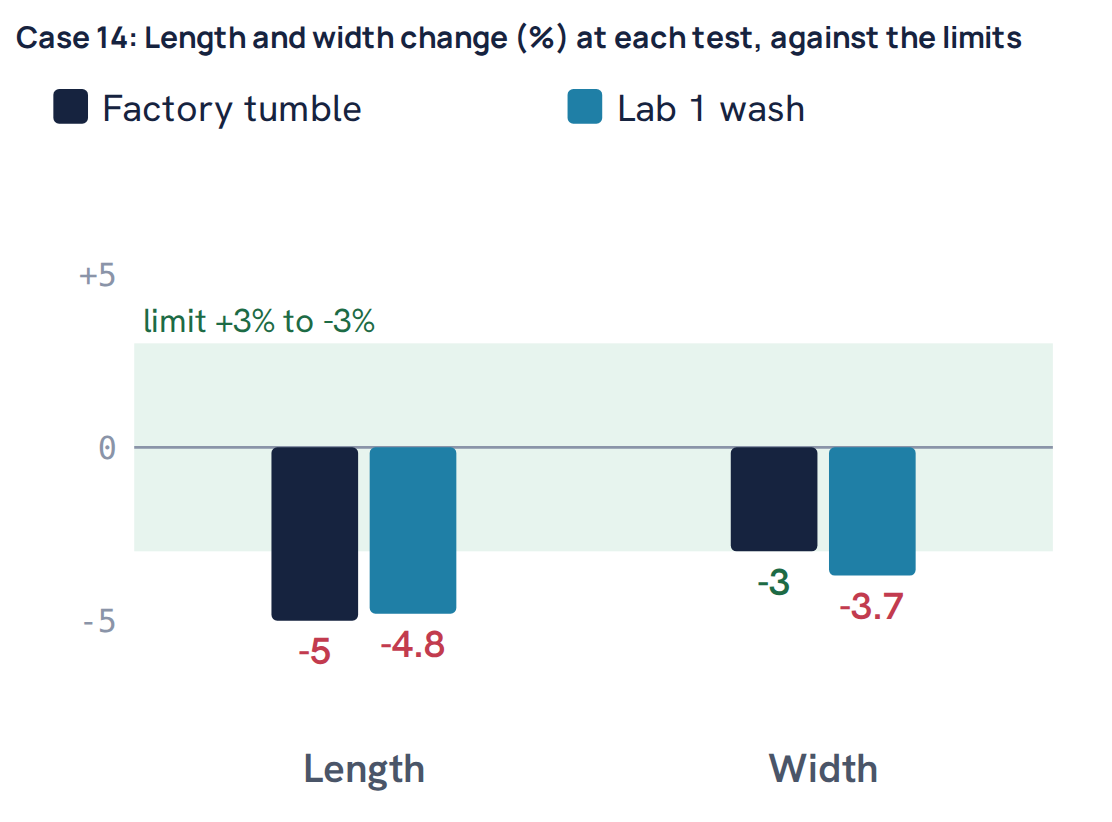
Case 14: 1×1 lycra rib, 250 GSM, length shrinkage and width shrinkage
- Yarn: 34/1 cotton viscose 60/40 + 30D Lycra
- Stitch length: 27
- Machine: 32″ × 18G
- Required: 140 cm, 250 GSM
- Finished: 142 cm, 250 GSM
Lab test: ISO 6330 / ISO 5077; Mild program, 30°C, line dry, reference detergent, one wash
Route: Greige → Dyeing → Stenter → Compacting
Results
- Factory tumble: length -5%, width -3%
- Lab 1 wash: length -4.8%, width -3.7%
- Limit: -3% to +3%
- Spirality (tumble): 2%
Other tests that failed in the same lab report: GSM.
Cause and remedy
Cause: The factory tumble test already showed -5% in length. The batch left finishing with length tension still in it; the warning sign was on our own sheet before delivery.
Cause: It carries Lycra but was not heat set. Without heat setting, the elastane keeps pulling the fabric back in length after every wash.
Cause: It was finished 2 cm wider than required (142 against 140). The extra width was pulled out on the stenter and came back in the wash: width shrinkage -3.7%.
Remedy: When the factory tumble shows more than 5% length shrinkage, run a wash and line-dry test the way the lab does before delivery, and reprocess on the stenter with more overfeed and re-compact if it is still out.
Remedy: Heat set every Lycra body fabric before dyeing, at the required width, so the dimensions are fixed before wet processing.
Remedy: Give the stenter more overfeed and raise compaction on the compactor, so the length taken out in dyeing is put back before delivery.
Remedy: Finish at the required width, not wider. If the greige cannot reach the width relaxed, change the knitting (machine diameter or stitch length), not the stenter setting.
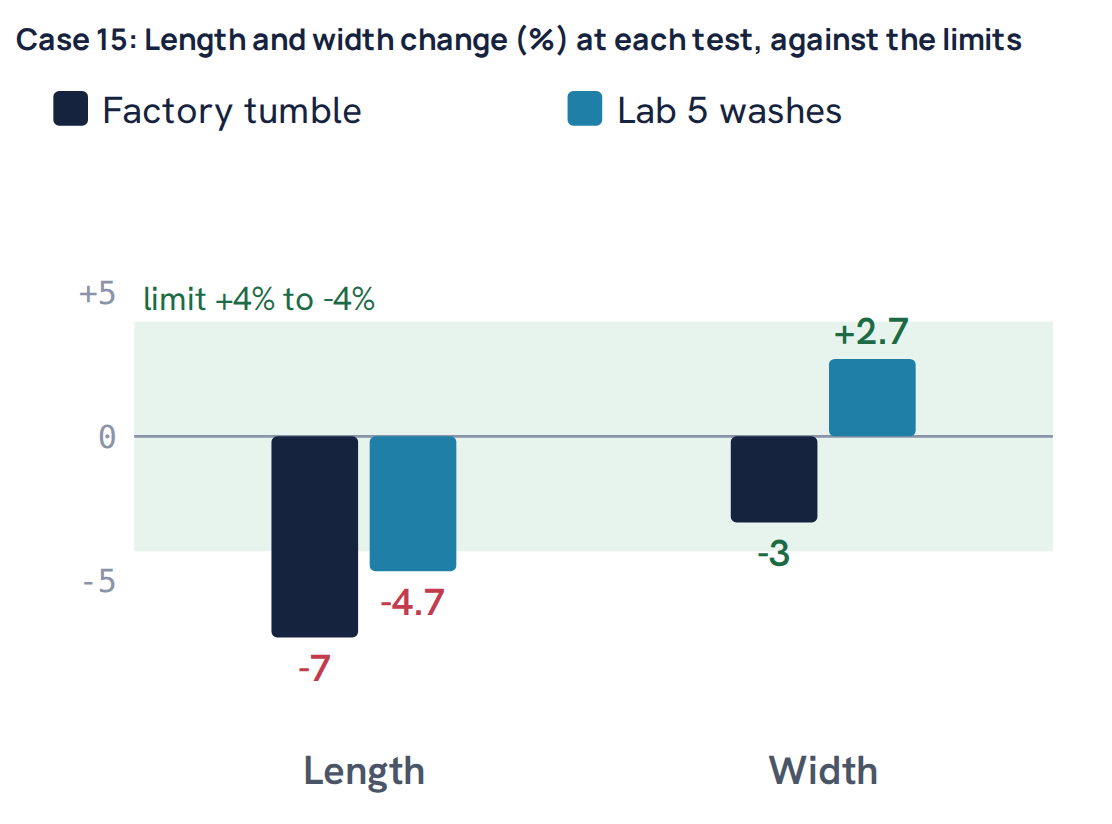
Case 15: Design rib, 320 GSM, length shrinkage
- Yarn: 30/1 combed + 24/2 ply combed
- Stitch length: 34.5+32.5+22.5
- Machine: 38″ × 18G
- Required: 190 cm, 320 GSM
- Finished: 183 cm, — GSM
Lab test: ISO 6330 / ISO 5077; Normal program 40°C, line dry, reference detergent, 5 washes
Route: Greige → Dyeing → Stenter → Compacting
Results
- Factory tumble: length -7%, width -3%
- Lab 5 washes: length -4.7%, width +2.7%
- Limit: -4% to +4%
- Spirality (tumble): 2%
Other tests that failed in the same lab report: Rubbing fastness.
Cause and remedy
Cause: The factory tumble test already showed -7% in length. The batch left finishing with length tension still in it; the warning sign was on our own sheet before delivery.
Cause: This is a texture structure: it was opened out in finishing and closed back up in washing.
Remedy: When the factory tumble shows more than 5% length shrinkage, run a wash and line-dry test the way the lab does before delivery, and reprocess on the stenter with more overfeed and re-compact if it is still out.
Remedy: Dry the texture relaxed (no length tension) and finish it slightly under the target width, so it is already in its relaxed state when it reaches the lab.
Remedy: Give the stenter more overfeed and raise compaction on the compactor, so the length taken out in dyeing is put back before delivery.
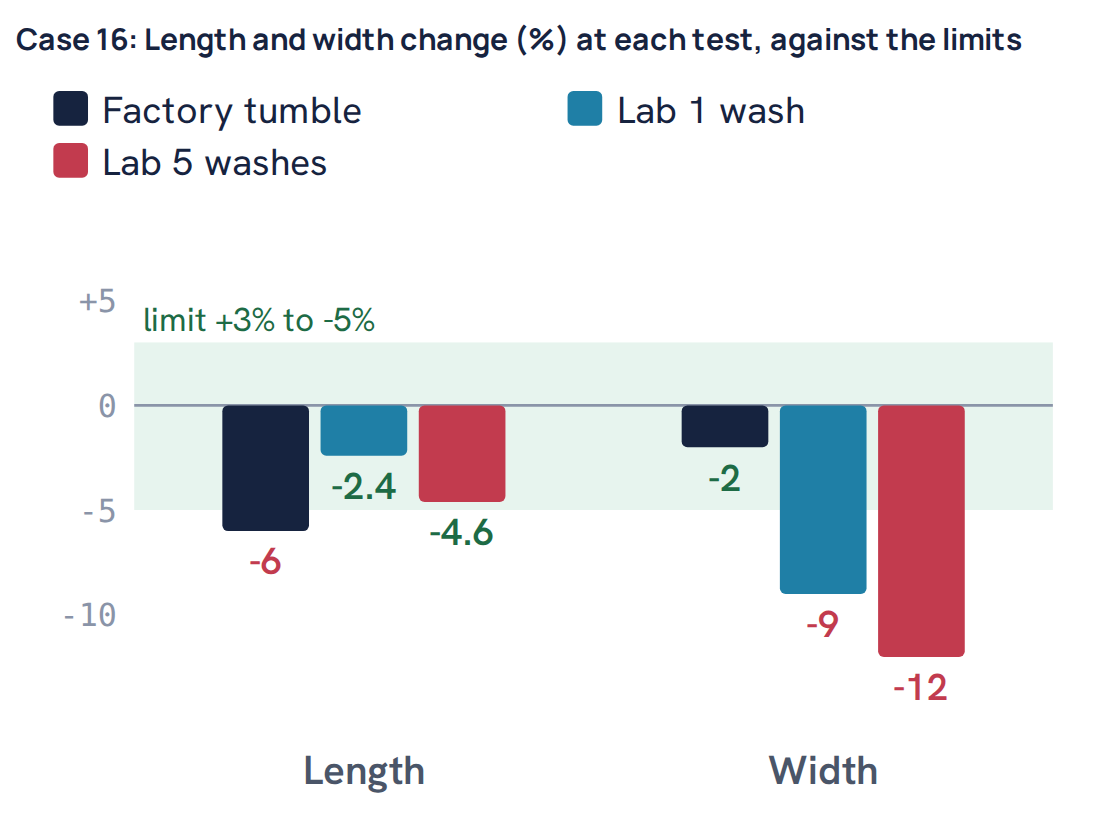
Case 16: Drop needle lycra design rib, 210 GSM, width shrinkage
- Yarn: 34/1 organic cotton + 30D Lycra
- Stitch length: 2.8
- Machine: 38″ × 18G
- Required: 200 cm, 210 GSM
- Finished: 132 cm, 200 GSM
Lab test: ISO 6330 / ISO 5077; Very mild cycle, 30°C, line dry, one wash
Route: Greige → Slitting → Heat setting → Back sewing → Dyeing → Stenter → Compacting
Results
- Factory tumble: length -6%, width -2%
- Lab 1 wash: length -2.4%, width -9%
- Lab 5 washes: length -4.6%, width -12%
- Limit: -5% to +3%
- Spirality (tumble): 2%
Other tests that failed in the same lab report: none.
Cause and remedy
Cause: The width shrank -12% in the lab: the structure closed in after washing.
Remedy: Set the stenter width close to the relaxed width of the fabric and check width after a factory wash before delivery.
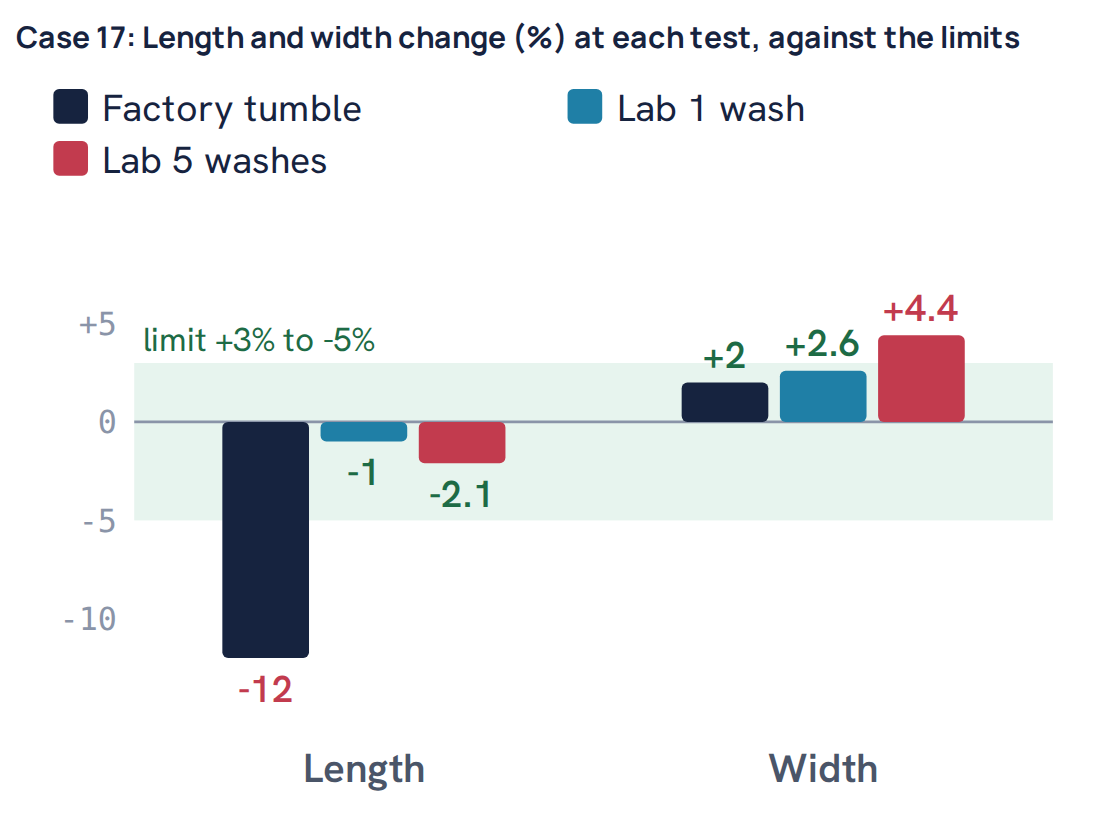
Case 17: Design rib, 200 GSM, width growth
- Yarn: 34/1 organic cotton
- Stitch length: 44.5+28.5+30.5
- Machine: 36″ × 18G
- Required: 170 cm, 200 GSM
- Finished: 160 cm, 175 GSM
Lab test: ISO 6330 / ISO 5077; Normal cycle 40°C machine wash, line dry, 1 wash
Route: Greige → Slitting → Singeing → Back sewing → Dyeing → Stenter → Compacting
Results
- Factory tumble: length -12%, width +2%
- Lab 1 wash: length -1%, width +2.6%
- Lab 5 washes: length -2.1%, width +4.4%
- Limit: -5% to +3%
- Spirality (tumble): 2%
Other tests that failed in the same lab report: none.
Cause and remedy
Cause: It was finished 10 cm narrower than required (160 against 170). Fabric held narrow spreads back out in the wash: width growth +4.4%.
Remedy: Finish at the full required width so the fabric does not grow back out in washing.
Interlock: 4 cases
Interlock is a stable double knit; Lycra interlock is always heat set to fix the stretch and width.
Case 18: Double tuck lycra bonded interlock, 240 GSM, length shrinkage
- Yarn: 40/1 cotton modal 50/50 + 40D Lycra
- Stitch length: 26
- Machine: 38″ × 24G
- Required: 180 cm, 240 GSM
- Finished: 182 cm, 242 GSM
Lab test: ISO 6330 / ISO 5077; Normal cycle, 40°C, line dry, one wash
Route: Greige → Slitting → Heat setting → Back sewing → Dyeing → Stenter → Compacting
Results
- Factory tumble: length -7%, width -2%
- Lab 1 wash: length -7.5%, width +0.7%
- Lab 5 washes: length -9.5%, width +1.2%
- Limit: -5% to +3%
- Spirality (tumble): 3%
Other tests that failed in the same lab report: GSM.
Cause and remedy
Cause: The factory tumble test already showed -7% in length. The batch left finishing with length tension still in it; the warning sign was on our own sheet before delivery.
Cause: It was heat set, so the elastane was fixed; the shrinkage came from length tension added after heat setting, in dyeing and on the stenter.
Remedy: When the factory tumble shows more than 5% length shrinkage, run a wash and line-dry test the way the lab does before delivery, and reprocess on the stenter with more overfeed and re-compact if it is still out.
Remedy: Run the dyeing with lower reel speed and nozzle pressure, and give the stenter maximum overfeed so the length tension is released before compacting.
Remedy: Give the stenter more overfeed and raise compaction on the compactor, so the length taken out in dyeing is put back before delivery.
Case 19: Lycra interlock, 280 GSM, length shrinkage
- Yarn: 40/1 cotton + 20D Lycra dyeable
- Stitch length: 29.5
- Machine: 38″ × 24G
- Required: 190 cm, 280 GSM
- Finished: 169 cm, 265 GSM
Lab test: ISO 6330 / ISO 5077; Mild program, machine wash 30°C, line dry, 1 wash
Route: Greige → Slitting → Heat setting → Back sewing → Dyeing → Stenter → Compacting
Results
- Factory tumble: length -6%, width -4%
- Lab 1 wash: length -5%, width -0.7%
- Limit: -3% to +3%
- Spirality (tumble): 2%
Other tests that failed in the same lab report: Rubbing fastness, Water fastness, Perspiration fastness.
Cause and remedy
Cause: The factory tumble test already showed -6% in length. The batch left finishing with length tension still in it; the warning sign was on our own sheet before delivery.
Cause: It was heat set, so the elastane was fixed; the shrinkage came from length tension added after heat setting, in dyeing and on the stenter.
Remedy: When the factory tumble shows more than 5% length shrinkage, run a wash and line-dry test the way the lab does before delivery, and reprocess on the stenter with more overfeed and re-compact if it is still out.
Remedy: Run the dyeing with lower reel speed and nozzle pressure, and give the stenter maximum overfeed so the length tension is released before compacting.
Remedy: Give the stenter more overfeed and raise compaction on the compactor, so the length taken out in dyeing is put back before delivery.
Case 20: Lycra interlock, 280 GSM, length shrinkage
- Yarn: 40/1 cotton + 20D Lycra dyeable
- Stitch length: 29.5
- Machine: 38″ × 24G
- Required: 190 cm, 280 GSM
- Finished: 166 cm, 260 GSM
Lab test: ISO 6330 / ISO 5077; Mild program, machine wash 30°C, line dry, 1 wash
Route: Greige → Slitting → Heat setting → Back sewing → Dyeing → Stenter → Compacting
Results
- Factory tumble: length -8%, width -3%
- Lab 1 wash: length -3.2%, width +1.5%
- Limit: -3% to +3%
- Spirality (tumble): 3%
Other tests that failed in the same lab report: GSM.
Cause and remedy
Cause: The factory tumble test already showed -8% in length. The batch left finishing with length tension still in it; the warning sign was on our own sheet before delivery.
Cause: It was heat set, so the elastane was fixed; the shrinkage came from length tension added after heat setting, in dyeing and on the stenter.
Remedy: When the factory tumble shows more than 5% length shrinkage, run a wash and line-dry test the way the lab does before delivery, and reprocess on the stenter with more overfeed and re-compact if it is still out.
Remedy: Run the dyeing with lower reel speed and nozzle pressure, and give the stenter maximum overfeed so the length tension is released before compacting.
Remedy: Give the stenter more overfeed and raise compaction on the compactor, so the length taken out in dyeing is put back before delivery.
Case 21: Yarn-dyed design interlock, 180 GSM, width shrinkage
- Yarn: 40/1 CVC 60/40 + 50D polyester yarn-dyed
- Stitch length: 25.5+22.0
- Machine: 36″ × 28G
- Required: 180 cm, 180 GSM
- Finished: 185 cm, 180 GSM
Lab test: AATCC 135; Normal cycle 41±3°C, tumble dry low, 3 washes
Route: Greige → Dyeing → Stenter → Compacting
Results
- Factory tumble: length -4%, width -5%
- Lab 3 washes: length -2.9%, width -4.9%
- Limit: -4% to +2%
- Spirality (tumble): 2%
Other tests that failed in the same lab report: Fibre analysis.
Cause and remedy
Cause: It was finished 5 cm wider than required (185 against 180). The extra width was pulled out on the stenter and came back in the wash: width shrinkage -4.9%.
Remedy: Finish at the required width, not wider. If the greige cannot reach the width relaxed, change the knitting (machine diameter or stitch length), not the stenter setting.
Terry: 3 cases
Terry is dyed loop side inside. Heavy terry (350 GSM and up) is heat set before dyeing.
Case 22: Diagonal terry, 410 GSM, length shrinkage
- Yarn: 20/1 combed + 8/1 carded
- Stitch length: 47.5+44+22
- Machine: 30″ × 20G
- Required: 180 cm, 410 GSM
- Finished: 177 cm, 404 GSM
Lab test: Buyer in-house method; Normal cycle 40°C machine wash, line dry, 1 wash
Route: Greige → Slitting → Heat setting → Back sewing → Dyeing → Stenter → Compacting
Results
- Factory tumble: length -8%, width -3%
- Lab 1 wash: length -6.5%, width -1%
- Lab 5 washes: length -8.7%, width -1.4%
- Limit: -5% to +5%
- Spirality (tumble): 3%
Other tests that failed in the same lab report: none.
Cause and remedy
Cause: The factory tumble test already showed -8% in length. The batch left finishing with length tension still in it; the warning sign was on our own sheet before delivery.
Remedy: When the factory tumble shows more than 5% length shrinkage, run a wash and line-dry test the way the lab does before delivery, and reprocess on the stenter with more overfeed and re-compact if it is still out.
Remedy: Give the stenter more overfeed and raise compaction on the compactor, so the length taken out in dyeing is put back before delivery.
Case 23: Yarn-dyed design terry, 210 GSM, length shrinkage
- Yarn: 32/1 cotton yarn-dyed + 22/1 cotton yarn-dyed
- Stitch length: 31.5+18.5
- Machine: 30″ × 24G
- Required: 170 cm, 210 GSM
- Finished: 170 cm, 185 GSM
Lab test: ISO 6330 / ISO 5077; Mild program 30°C, tumble dry, reference detergent, 1 wash
Route: Greige → Slitting → Singeing → Back sewing → Dyeing → Stenter → Compacting
Results
- Factory tumble: length -15%, width +10%
- Lab 1 wash: length -4.8%, width +2.2%
- Limit: -3% to +3%
- Spirality (tumble): 3%
Other tests that failed in the same lab report: GSM.
Cause and remedy
Cause: The factory tumble test already showed -15% in length. The batch left finishing with length tension still in it; the warning sign was on our own sheet before delivery.
Cause: Terry of this weight was dyed without heat setting, so the loop yarn and the ground were free to relax and close up in washing.
Remedy: When the factory tumble shows more than 5% length shrinkage, run a wash and line-dry test the way the lab does before delivery, and reprocess on the stenter with more overfeed and re-compact if it is still out.
Remedy: For terry that fails length, use relax drying after the stenter and higher compaction; heat set it when the weight is 350 GSM or more.
Remedy: Give the stenter more overfeed and raise compaction on the compactor, so the length taken out in dyeing is put back before delivery.
Case 24: Design terry, 270 GSM, length growth
- Yarn: 26/1 cotton + 20/1 cotton
- Stitch length: 4.25+1.75
- Machine: 34″ × 16G
- Required: 160 cm, 270 GSM
- Finished: 162 cm, 274 GSM
Lab test: ISO 6330 / ISO 5077; Normal cycle, machine wash 40°C, line dry, 1 wash
Route: Greige → Dyeing → Stenter → Compacting
Results
- Factory tumble: length -18%, width -5%
- Lab 1 wash: length +1.9%, width -2.1%
- Lab 5 washes: length +4.4%, width -3.5%
- Limit: -5% to +3%
- Spirality (tumble): 3%
Other tests that failed in the same lab report: GSM.
Cause and remedy
Cause: Here the fabric grew in length, up to +4.4%. It had been over-compacted in length; washing released the compaction and the loops opened out again.
Remedy: Reduce compaction and overfeed for this structure: finish to the target length shrinkage, not beyond it.
Waffle: 2 cases
Waffle is a loose texture knit: no enzyme, singed when a clean face is needed, and its GSM must be checked after washing.
Case 25: Lycra slub design waffle, 230 GSM, length shrinkage
- Yarn: 28/1 cotton slub + 30/1 cotton + 30D Lycra
- Stitch length: 2.90+1.55
- Machine: 40″ × 18G
- Required: 170 cm, 230 GSM
- Finished: 160 cm, 220 GSM
Lab test: ISO 6330 / ISO 5077; Normal cycle 40°C, line dry, 1 wash
Route: Greige → Dyeing → Stenter → Compacting
Results
- Factory tumble: length -8%, width -2%
- Lab 1 wash: length -6.8%, width +0.8%
- Lab 5 washes: length -9.4%, width +2.6%
- Limit: -5% to +3%
- Spirality (tumble): 2%
Other tests that failed in the same lab report: none.
Cause and remedy
Cause: The factory tumble test already showed -8% in length. The batch left finishing with length tension still in it; the warning sign was on our own sheet before delivery.
Cause: It carries Lycra but was not heat set. Without heat setting, the elastane keeps pulling the fabric back in length after every wash.
Remedy: When the factory tumble shows more than 5% length shrinkage, run a wash and line-dry test the way the lab does before delivery, and reprocess on the stenter with more overfeed and re-compact if it is still out.
Remedy: Heat set every Lycra body fabric before dyeing, at the required width, so the dimensions are fixed before wet processing.
Remedy: Give the stenter more overfeed and raise compaction on the compactor, so the length taken out in dyeing is put back before delivery.
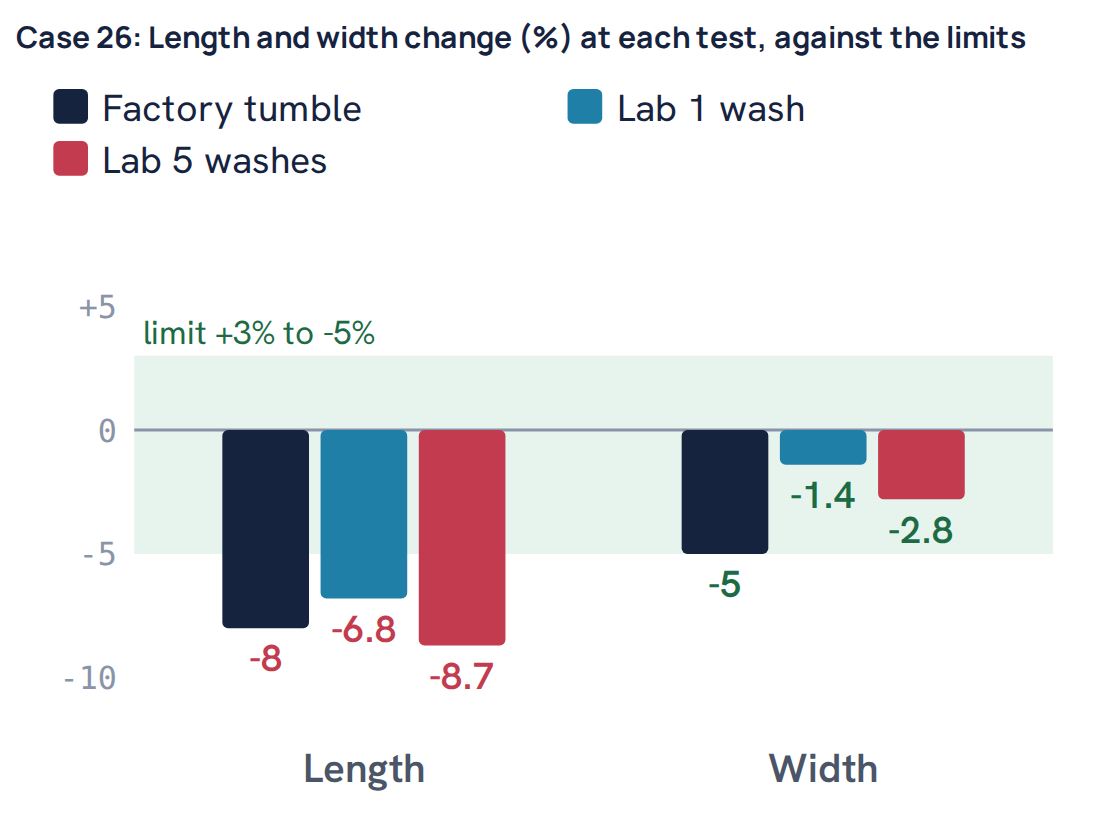
Case 26: Waffle, 210 GSM, length shrinkage
- Yarn: 30/1 organic cotton
- Stitch length: 40+20
- Machine: 34″ × 18G
- Required: 125 cm, 210 GSM
- Finished: 140 cm, 200 GSM
Lab test: ISO 6330 / ISO 5077; Mild cycle 30°C machine wash, line dry, 1 wash
Route: Greige → Dyeing → Stenter → Compacting
Results
- Factory tumble: length -8%, width -5%
- Lab 1 wash: length -6.8%, width -1.4%
- Lab 5 washes: length -8.7%, width -2.8%
- Limit: -5% to +3%
- Spirality (tumble): 2%
Other tests that failed in the same lab report: none.
Cause and remedy
Cause: The factory tumble test already showed -8% in length. The batch left finishing with length tension still in it; the warning sign was on our own sheet before delivery.
Cause: This is a texture structure: it was opened out in finishing and closed back up in washing.
Remedy: When the factory tumble shows more than 5% length shrinkage, run a wash and line-dry test the way the lab does before delivery, and reprocess on the stenter with more overfeed and re-compact if it is still out.
Remedy: Dry the texture relaxed (no length tension) and finish it slightly under the target width, so it is already in its relaxed state when it reaches the lab.
Remedy: Give the stenter more overfeed and raise compaction on the compactor, so the length taken out in dyeing is put back before delivery.
Fleece: 4 cases
Fleece is dyed loop side inside; fleece of 350 GSM and up is heat set before dyeing.
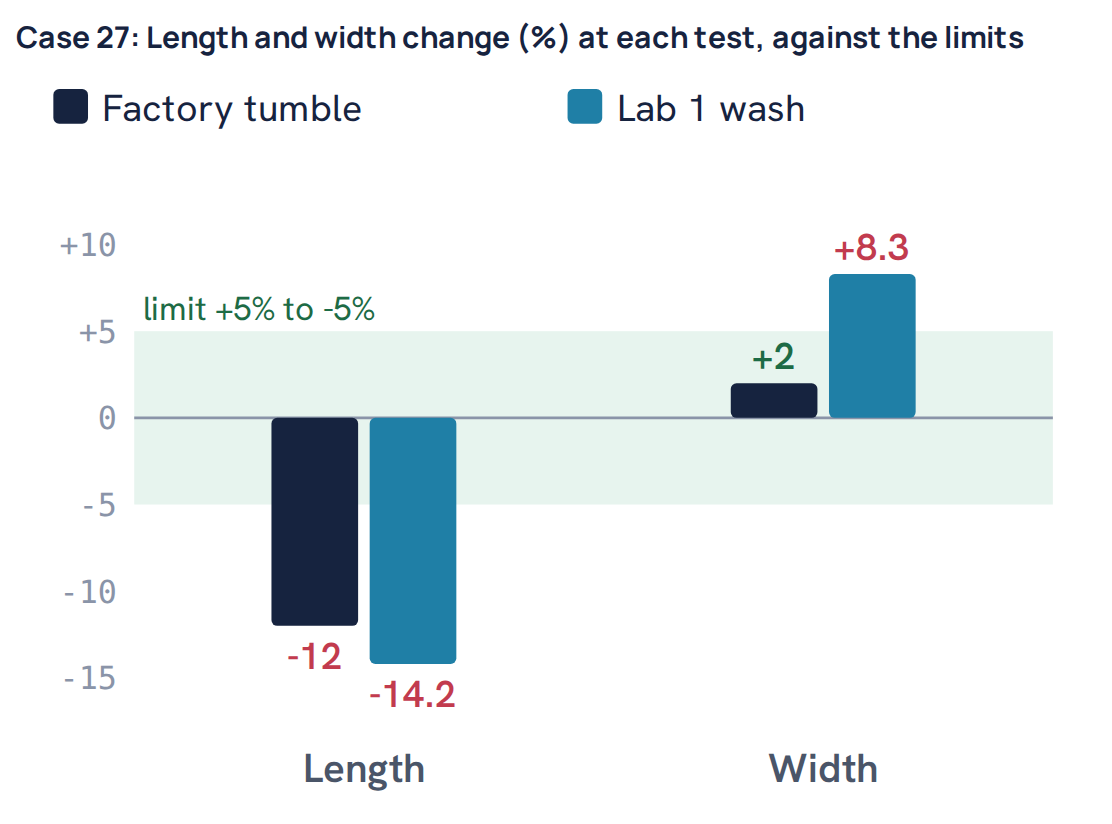
Case 27: Fleece, 375 GSM, length shrinkage and width growth
- Yarn: 34/1 cotton + 30/1 cotton + 8/1 carded
- Stitch length: 41.5+36+17
- Machine: 30″ × 20G
- Required: 175 cm, 375 GSM
- Finished: 155 cm, 340 GSM
Lab test: ISO 6330 / ISO 5077; Normal program 4N, 40°C, line dry, 1 wash
Route: Greige → Dyeing → Stenter → Compacting
Results
- Factory tumble: length -12%, width +2%
- Lab 1 wash: length -14.2%, width +8.3%
- Limit: -5% to +5%
- Spirality (tumble): 2%
Other tests that failed in the same lab report: GSM.
Cause and remedy
Cause: The factory tumble test already showed -12% in length. The batch left finishing with length tension still in it; the warning sign was on our own sheet before delivery.
Cause: Fleece of this weight was dyed without heat setting, so the loop yarn and the ground were free to relax and close up in washing.
Cause: It was finished 20 cm narrower than required (155 against 175). Fabric held narrow spreads back out in the wash: width growth +8.3%.
Remedy: When the factory tumble shows more than 5% length shrinkage, run a wash and line-dry test the way the lab does before delivery, and reprocess on the stenter with more overfeed and re-compact if it is still out.
Remedy: For fleece that fails length, use relax drying after the stenter and higher compaction; heat set it when the weight is 350 GSM or more.
Remedy: Give the stenter more overfeed and raise compaction on the compactor, so the length taken out in dyeing is put back before delivery.
Remedy: Finish at the full required width so the fabric does not grow back out in washing.
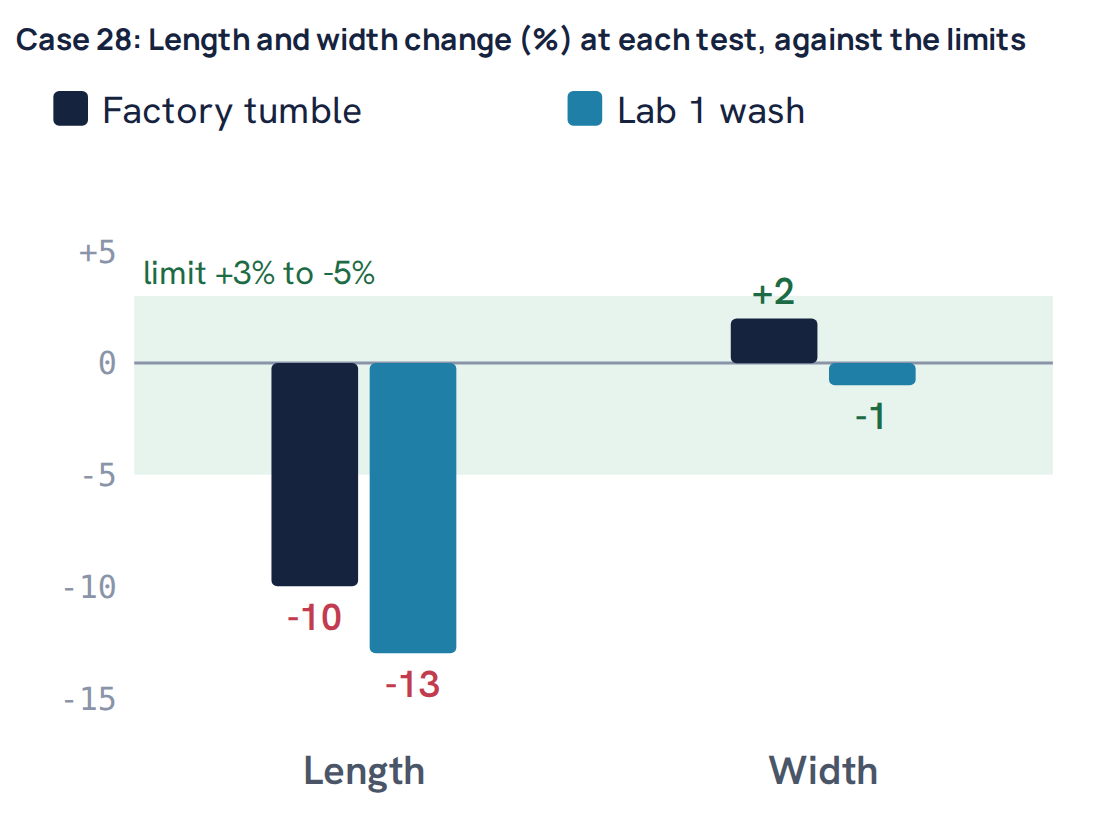
Case 28: Fleece, 255 GSM, length shrinkage
- Yarn: 34/1 CVC 60/40 + 12/1 CVC 60/40
- Stitch length: 46+37+16
- Machine: 30″ × 20G
- Required: 175 cm, 255 GSM
- Finished: 162 cm, 280 GSM
Lab test: ISO 6330 / ISO 5077; Normal cycle 40°C machine wash, tumble dry, 1 wash
Route: Greige → Dyeing → Stenter → Compacting
Results
- Factory tumble: length -10%, width +2%
- Lab 1 wash: length -13%, width -1%
- Limit: -5% to +3%
- Spirality (tumble): 2%
Other tests that failed in the same lab report: none.
Cause and remedy
Cause: The factory tumble test already showed -10% in length. The batch left finishing with length tension still in it; the warning sign was on our own sheet before delivery.
Cause: Fleece of this weight was dyed without heat setting, so the loop yarn and the ground were free to relax and close up in washing.
Remedy: When the factory tumble shows more than 5% length shrinkage, run a wash and line-dry test the way the lab does before delivery, and reprocess on the stenter with more overfeed and re-compact if it is still out.
Remedy: For fleece that fails length, use relax drying after the stenter and higher compaction; heat set it when the weight is 350 GSM or more.
Remedy: Give the stenter more overfeed and raise compaction on the compactor, so the length taken out in dyeing is put back before delivery.
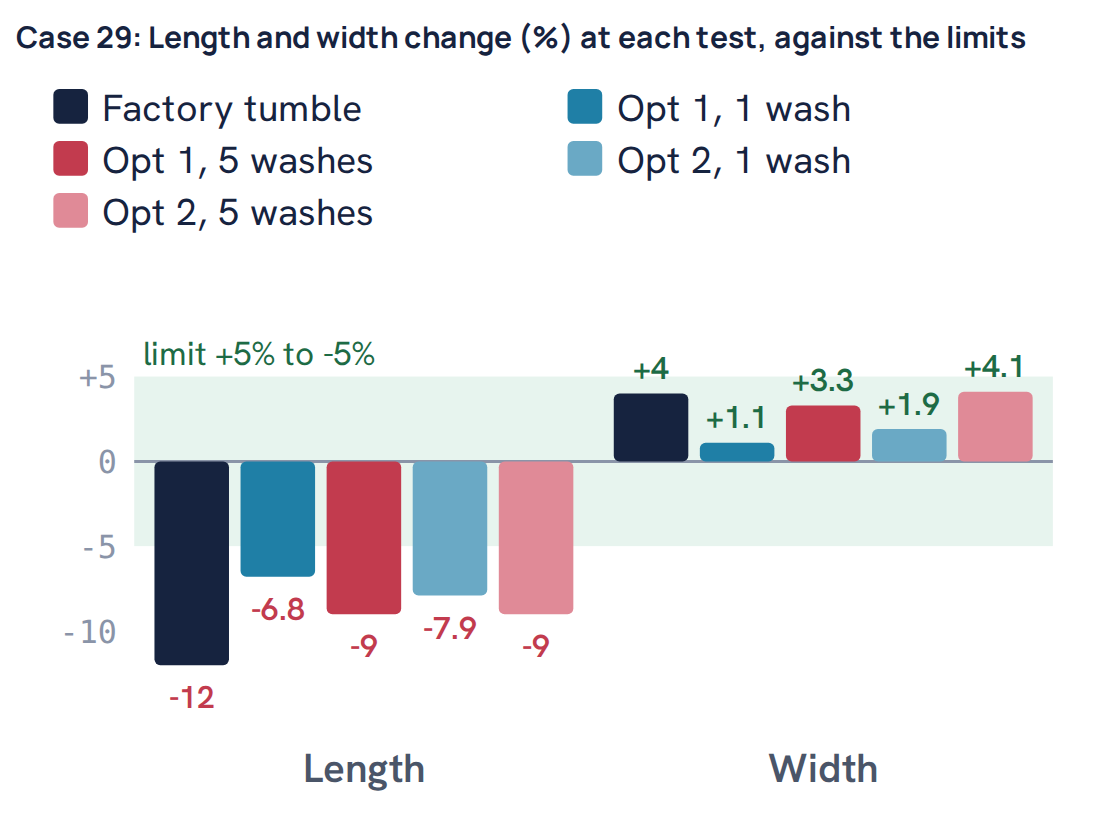
Case 29: Fleece, 330 GSM, length shrinkage
- Yarn: 30/1 combed + 26/1 CVC 60/40 + 8/1 carded
- Stitch length: 47.5+39.5+20
- Machine: 36″ × 14G
- Required: 170 cm, 330 GSM
- Finished: 154 cm, 320 GSM
Lab test: Buyer in-house method; Normal cycle 30°C machine wash, line dry, 1 wash
Route: Greige → Dyeing → Stenter → Compacting
Results
- Factory tumble: length -12%, width +4%
- Option 1, 1 wash: length -6.8%, width +1.1%
- Option 1, 5 washes: length -9%, width +3.3%
- Option 2, 1 wash: length -7.9%, width +1.9%
- Option 2, 5 washes: length -9%, width +4.1%
- Limit: -5% to +5%
- Spirality (tumble): 3%
Other tests that failed in the same lab report: Pilling.
Cause and remedy
Cause: The factory tumble test already showed -12% in length. The batch left finishing with length tension still in it; the warning sign was on our own sheet before delivery.
Cause: Fleece of this weight was dyed without heat setting, so the loop yarn and the ground were free to relax and close up in washing.
Remedy: When the factory tumble shows more than 5% length shrinkage, run a wash and line-dry test the way the lab does before delivery, and reprocess on the stenter with more overfeed and re-compact if it is still out.
Remedy: For fleece that fails length, use relax drying after the stenter and higher compaction; heat set it when the weight is 350 GSM or more.
Remedy: Give the stenter more overfeed and raise compaction on the compactor, so the length taken out in dyeing is put back before delivery.
This batch was finished in two options and both were tested; both failed.
Case 30: (diagonal) fleece, 320 GSM, length shrinkage
- Yarn: 34/1 combed + 26/1 combed
- Stitch length: 46.5+38.5+20
- Machine: 30″ × 16G
- Required: 160 cm, 320 GSM
- Finished: 153 cm, 310 GSM
Lab test: ISO 6330 / ISO 5077; Normal program 40°C, line dry, reference detergent, 1 wash
Route: Greige → Dyeing → Stenter → Compacting
Results
- Factory tumble: length -12%, width -3%
- Lab 1 wash: length -8%, width -1%
- Limit: -5% to +5%
- Spirality (tumble): 2%
Other tests that failed in the same lab report: Rubbing fastness, Water fastness.
Cause and remedy
Cause: The factory tumble test already showed -12% in length. The batch left finishing with length tension still in it; the warning sign was on our own sheet before delivery.
Cause: Fleece of this weight was dyed without heat setting, so the loop yarn and the ground were free to relax and close up in washing.
Remedy: When the factory tumble shows more than 5% length shrinkage, run a wash and line-dry test the way the lab does before delivery, and reprocess on the stenter with more overfeed and re-compact if it is still out.
Remedy: For fleece that fails length, use relax drying after the stenter and higher compaction; heat set it when the weight is 350 GSM or more.
Remedy: Give the stenter more overfeed and raise compaction on the compactor, so the length taken out in dyeing is put back before delivery.
From the floor: what I learned from these 30 cases
- Heat setting is not only for crease marks; it is mainly for dimensional stability.
- We decide it on six points: the fibre (polyester and nylon are heat set), elastane or Lycra in the fabric, the GSM, the construction (a tight knit is heat set whatever the GSM), the width and stability the buyer needs, and design fabrics, which are heat set to fix the design at the width where it shows.
- Fabric with polyester must be finished at 100–110°C on the stenter and compactor, not at the 140–150°C used for cotton.
- Let the fabric relax 12 to 24 hours before cutting.
Questions
What is the shrinkage tolerance for knit fabric?
Most buyers allow ±5%, or up to 5% shrinkage and 3% growth, after washing to ISO 6330. Some set ±3% for fine or Lycra fabrics.
Why does knit fabric shrink more in length than in width?
Because it is pulled in length all through dyeing and finishing. That stretch is released in the first wash unless overfeed and compaction have already taken it out.
Does heat setting stop shrinkage?
It fixes the elastane and the width, and lowers the risk, but length tension added after heat setting still has to be released on the stenter and compactor.
Why did the fabric pass after one wash but fail after five?
It was not fully relaxed when finished, so it kept shrinking wash after wash. Relaxed drying and more compaction fix this.
Related: shrinkage and GSM after wash calculator · knit GSM from stitch length.

Textile engineer with 14+ years in dyeing and fabric development. He writes every guide on Dyeing Solution from real production work. Full profile